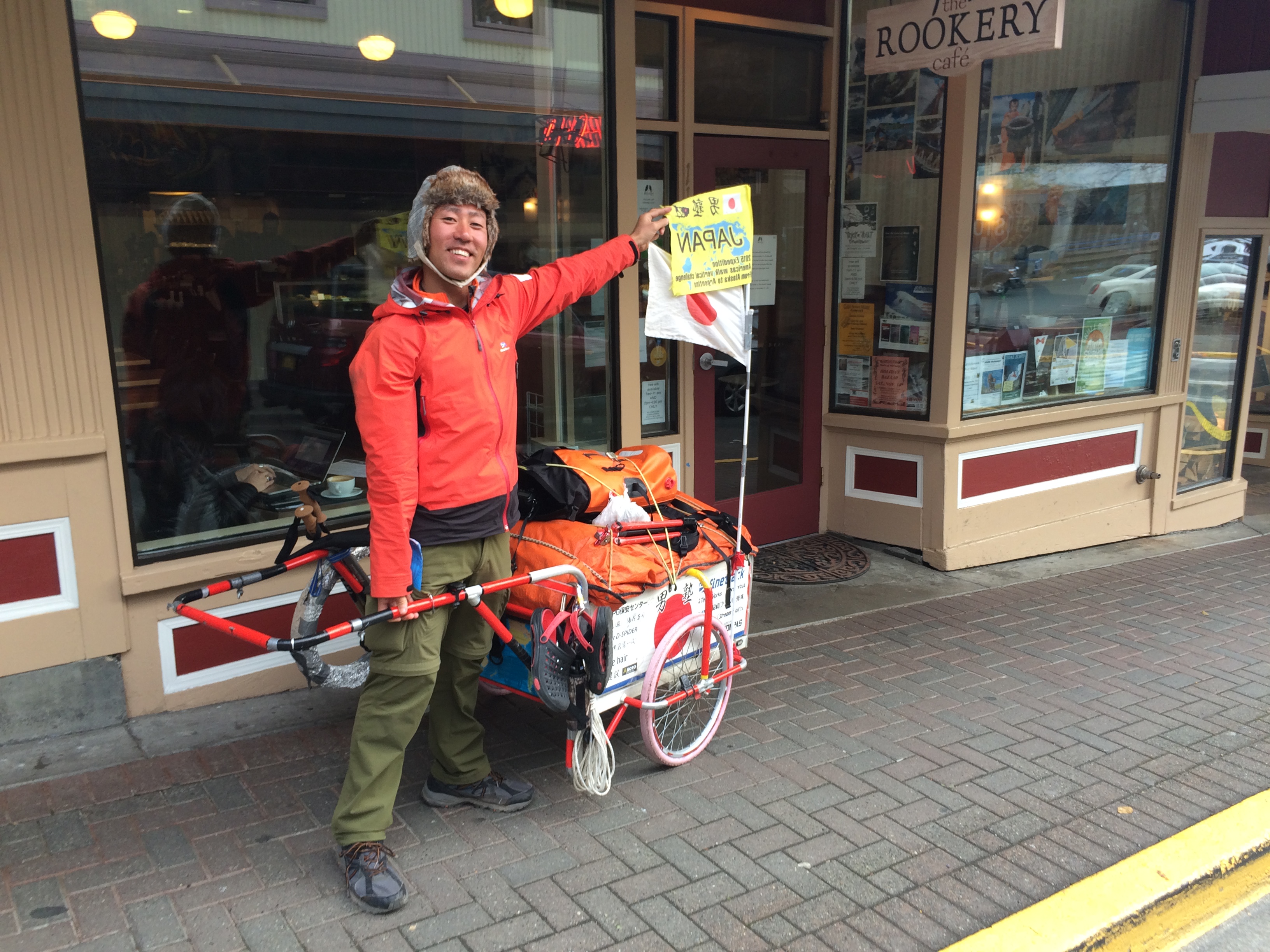
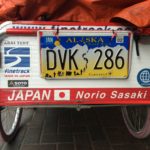
A man who is walking around the world is in Juneau through the weekend. Norio Sasaki is from Kyoto, Japan, and has been on the road for a while. I caught up with Sasaki at the Rookery Café.
Sasaki is visitng Juneau before heading to Argentina. (Photo by Scott Burton/KTOO)
“I went to Australia, New Zealand, Taiwan and Korea three years ago,” Sasaki said.
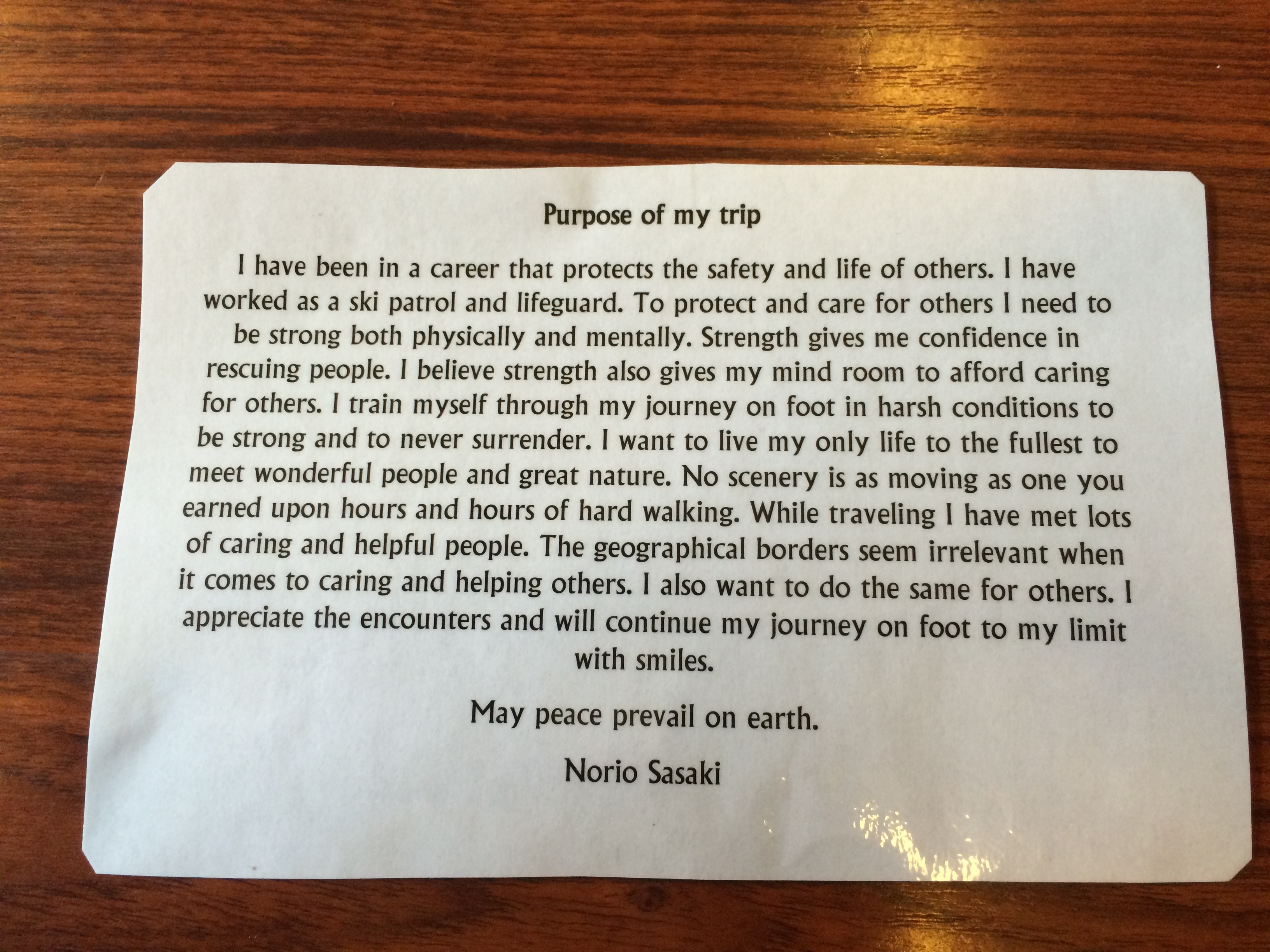
Sasaki said his English is not great, so he readily passes out a card that explains his trip. Roughly summarized, the laminated card says that he’s worked as a lifeguard and ski patroller and needs to be strong to continue helping others.
When asked why Sasaki is walking around the world he handed us this. (Photo by Scott Burton/KTOO)
Norio Sasaki spare tires, bear spray and mountain equipment. (Photo by Scott Burton/KTOO)
Sasaki says he’s been on the road for about 3 years. (Photo by Scott Burton/KTOO)
Worn tires show Sasaki’s 30 miles-per-day in the summer, and 24 in the winter. (Photo by Scott Burton/KTOO)
Walking around the world is a good way to see nature and meet people, and along the way he’s pulling a 175-pound rickshaw.
“This is my cart — all aluminum. So very light and I can carry inside an airplane. This is (my) spare tire and bear spray and mountain equipment. This is (my) speedometer. I walked 50 km in the summer season; winter season 40 km every day,” Sasaki said.
That translates to about 30 miles in summer, and 25 in winter.
“I walk through (the) pass, very hard. And downhill, very hard because my cart (has) no brake, only foot brake — (it’s) very hard,” he said laughing.
From here, Sasaki’s route includes Wrangell, Prince Rupert, Prince George, Jasper, Banff, Calgary, Yellowstone and eventually Argentina. He thinks he’ll be on the road for another three years. You can follow him on Facebook — just search for Sasaki Norio.
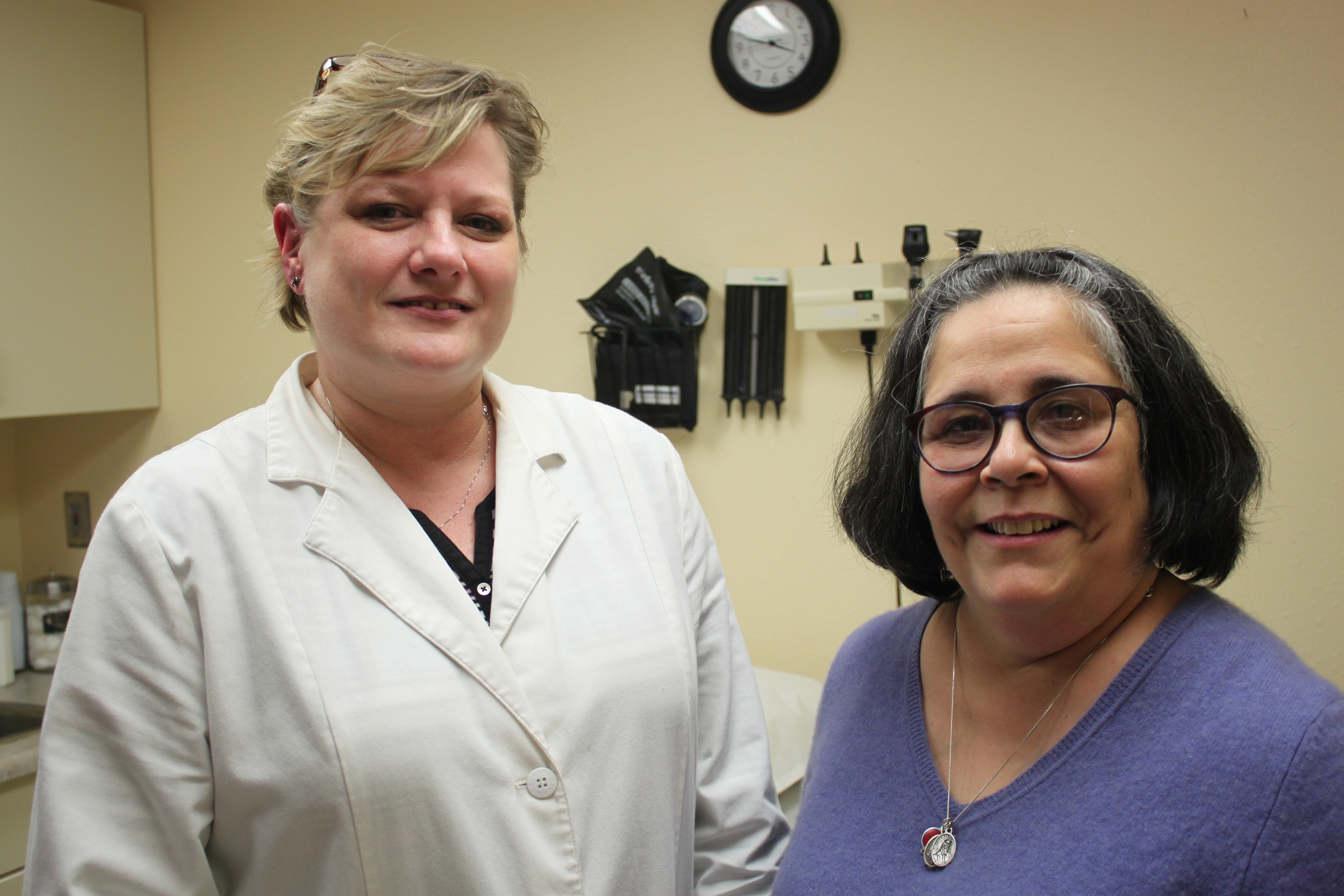
Nurse Practitioner Cynthia Mattoni (left) is the new medical provider at Front Street Community Health Center. Paula Rohrbacher is a medical assistant and works at the front desk. The health center also has a full-time case manager. (Photo by Lisa Phu/KTOO)
Front Street Community Health Center in Juneau has a new permanent nurse practitioner after a year of temporary medical providers.
Cynthia Mattoni was a temporary nurse practitioner at the Front Street Community Health Center before she decided to apply for the permanent position. She’s been on the job since Oct. 1 and is very busy.
“It’s reorganizing the clinic. It’s a lot of paperwork and a lot of education and developing those relationships with the patients, the community, the community providers, the pharmacy so they know who I am and that I’m permanent,” Mattoni said.
Mattoni is seeing up to 16 patients a day, but her schedule can vary.
“Some days are full, some days aren’t full. Some days we’re available for the walk-in who wants an appointment,” Mattoni said.
Mattoni provides general primary care. She’s certified in family practice and concussion care. She does annual checkups, childrens’ physicals and well-woman exams.
Front Street Clinic has traditionally served the homeless population. Last year, it expanded to include all low-income patients who have trouble accessing health care. There’s a sliding scale fee schedule, and a case manager can help patients sign up for Medicaid.
Serving the homeless population is still a primary focus and Mattoni finds the work gratifying.
“They’re kind of like the forgotten part of society and I treat everybody like they’re my family. It doesn’t matter who you are. We’re all human. We all have the same needs and that respect goes a long way,” Mattoni said.
Mattoni moved to Juneau from Cleveland where she used to work in the emergency room. She encountered people who were homeless there, but she says working at Front Street is very different.
“This is family practice. This is not only managing their conditions, but it’s managing chronic conditions for a long period of time. In the emergency room, you would just see them for one episodic visit. Here, I’m actually following them and following the progression of their medical care,” Mattoni said.
Mattoni is the health center’s only provider. As Front Street was transitioning from being under SEARCH to becoming its own nonprofit, it discontinued behavioral health and dental services because of budget constraints.
But the nonprofit recently received a federal grant of $220,000 and will soon recruit for a behavioral health specialist and another case manager. Dental services are still not in the near future.
Board president Dr. Carl Heine said the clinic has been outsourcing management services to Wrangell-based Alaska Island Community Services. The board is exploring the idea of completely turning the clinic over to the health care organization.
“Our main concern is that the clinic continues to exist and operate and continues to meet its mission of serving the homeless and the underserved with quality medical care. We’re not necessarily, as a board, concerned that we are the ones running it,” Heine said.
Heine said the new funding and its main federal grant of $385,000 are both renewable and will hopefully keep the clinic sustainable.
The long-term plan is to locate the Front Street Community Health Center inside the Housing First facility to be built in Lemon Creek.
Front Street Community Health Center is hosting an open house for First Friday, Nov. 6. Check out art in the lobby, get some refreshments and meet the new nurse practitioner. The clinic is located at 225 Front St., Suite 202. It’s also holding a fundraiser through the end of the year to match a $50,000 donation from Northern Light United Church.
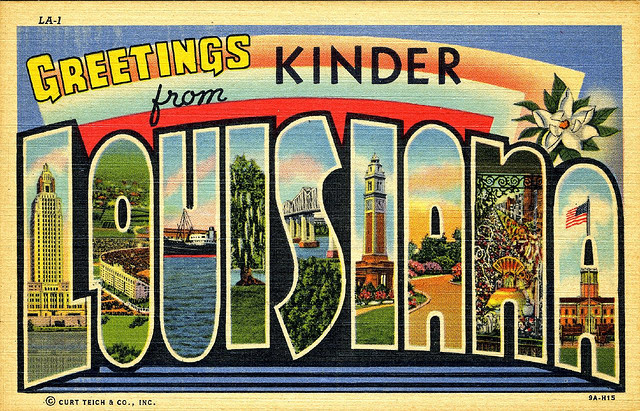
Last weekend, some 40 Alaskans journeyed down to Louisiana for the Blackpot music and food festival. The two-day festival is in its tenth year and takes place in and around the city of Lafayette in the south central part of the state. The weekend included a cook off, 25 bands, camping, jamming and lots of dancing.
Many of the Alaskans are musicians, music appreciators and friends who know each other through the Alaska music scene, and their trip has become a tradition.
Hear their voices and music from the Pine Leaf Boys here:
“I love how the Cajun culture marries love of food, love of dancing, love of community, and it reminds me of home.” –Kate Consenstein, Anchorage
“The energy is just so positive. I feel like if you come here it’s like getting a cultural hug.” –WeeBee Aschenbrenner, Cantwell, Alaska
“We got Cajun music. We got blues. We got rock and roll. We got zydeco.” -Paul “Bird” Edwards, Eunice, Louisiana
“One of the things we have a lot of at our festival is food—from everything and anything deep fried, to some of the great Cajun dishes like gumbo and jambalaya and étouffées.” –Derek Landry, Lafayette, Louisiana
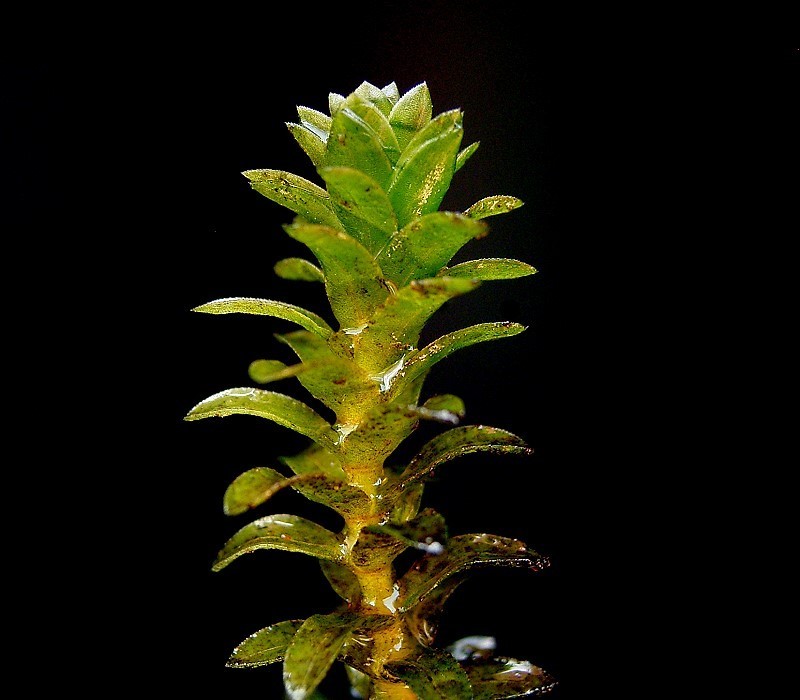
Elodea canadensis. (Creative Commons photo by Frank Vincentz)
One wee fragment of it can flourish into a swath of green growing strands that entangles float planes and boat engines. Across the state, it has been found in 18 freshwater lakes and rivers. Many people decorate their fish aquariums with it.
It’s called Elodea.
Last week, the aquatic plant was a topic of discussion at the Alaska Invasive Species Workshop in Juneau. Researchers have traced the beginning of the invasive plant’s transmission around Alaska to people dumping out their aquariums into nearby lakes. An aggressive hitchhiker, Elodea will cling to float planes and spread further.
Tom Heutte, an aerial survey coordinator with theU.S. Fish & Wildlife Service, described one encounter in Cordova.
“We were flying along and one of our aerial surveyors looked out the window and sees a bunch of weeds stuck to the rudder of the float plane,” he said.
Elodea outcompetes native plants by blocking sunlight and degrades salmon habitat. The plant has been found from Fairbanks to Cordova, but not in Southeast. Heutte hopes that the region has avoided invasion.
He surveyed the float plane pond at Juneau’s airport for Elodea and found none. Heutte said that saltwater is a likely Elodea killer, one reason Southeast may have avoided the plant invasion. He also believes that lack of a road system, and difficulty of access to remote lakes, may have kept Elodea from spreading here. Over the next two years Heutte plans to survey lakes throughout the region in order to find out for certain.
It all begins with one plant fragment, he said.
Experts discovered a weapon against Elodea called fluridone. The herbicide disrupts Elodea’s capability to photosynthesize. It prohibits the plant’s ability to produce its own food, killing by starvation, yet harms few native plants. In some parts of Alaska scientists have completely eradicated Elodea with fluridone, said John Morton, supervisory fish and wildlife biologist at the Kenai National Wildlife Refuge.
Elodea is just one front in a battle against invasives.
“We are only at the beginning of the invasion curve for novel species,” Morton said.
For those who love to make things and tinker, finding the right tools and work space can be difficult and expensive.
In recent years, many people have been turning to community workshops known as “makerspaces.” Members of these organizations have access to a shared workspace and tools for their own personal projects — anything from artwork to prototyping new products.
Now, the fledgling Juneau Makerspace is bringing this movement to the capital city.
About a year ago, founder Sam Bornstein started the nonprofit as a place for like-minded creators to “come and build their dreams.” Although he currently works in finance, his passion for engineering inspired him to start the organization in his spare time.
“Anyone who wants to create or make or design anything is our goal,” he said. “We want to be able to get the widest net possible and be available for any type of project that you have that you want to work on.”
He and some volunteers are still clearing out the group’s new facility in Lemon Creek. When they moved in over the summer, it was filled wall to wall with ceramic molds from the previous occupants.
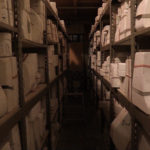
Shelves of ceramic molds still remain at the Juneau Makerspace. When they moved into the space, it was nearly full of these molds. (Photo by David Purdy/KTOO)
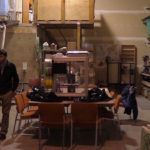
Juneau Makerspace’s new facility. They are in the process of clearing it out and acquiring tools. (Photo by David Purdy/KTOO)
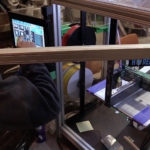
The new 3D printer sits on a table in the new Juneau Makerspace (Photo by David Purdy/KTOO)
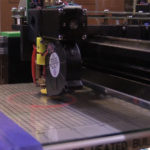
It’s mostly cleared now, with room for some tables and the latest addition — a donated 3D printer. Inside a big glass and metal box, the moving print nozzle lays down melted plastic in a precise pattern. As the plastic cools, more layers are added to form small objects based on a digital model.
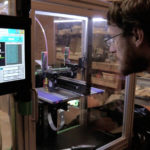
The printer requires precise calibration. Bornstein is still getting familiar with all the different controls and adjustments.
“It sat in someone’s garage until yesterday. And they brought it over here and gave it to us and said ‘Good luck,’” he said.
Once it’s adjusted, the print head moves back and forth, laying down layers of plastic. The outline of the base emerges in a couple of minutes, but Bornstein estimates it will take 7 to 12 hours for the printer to build up the finished vase, layer by layer.
Sam Bornstein makes adjustments to a print job on Juneau Makerspace’s 3D printer. (Photo by David Purdy/KTOO)
The print head of the 3D printer at Juneau Makerspace begins to lay down the base for a plastic object it is printing (Photo by David Purdy/KTOO)
Sam Bornstein prepares the 3D printer at Juneau Makerspace (Photo by David Purdy/KTOO)
Bornstein plans to eventually teach others in Juneau to use the printer for their own projects. Juneau Makerspace is planning a Kickstarter campaign to pay for more tools and equipment, and Bornstein hopes that people with many different skills will gather to share their knowledge and experience.
“I’m hoping we can build a community of makers here,” he said. “We’ve got artists and teachers and designers all coming together and I’m hoping that we can all learn from each other.”
Soon, they’ll announce membership plans for those interested in gaining access to the space and its resources. Updates and more information are available on Facebook.