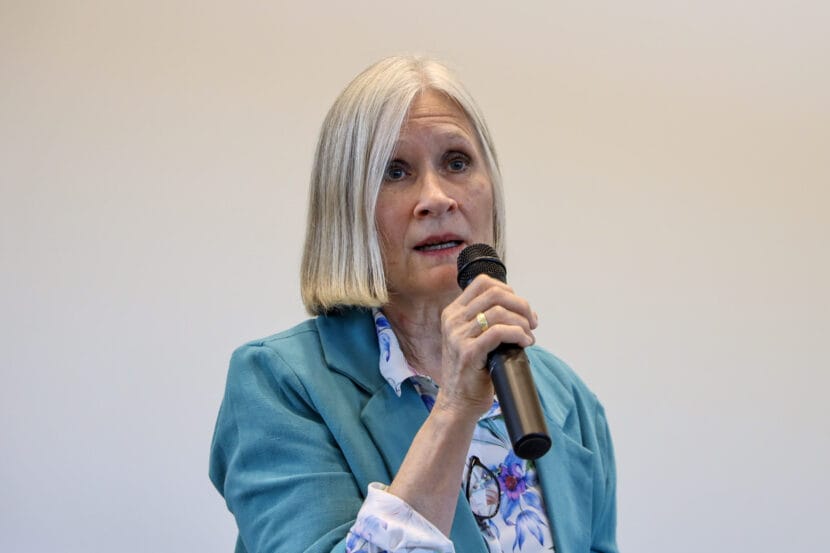
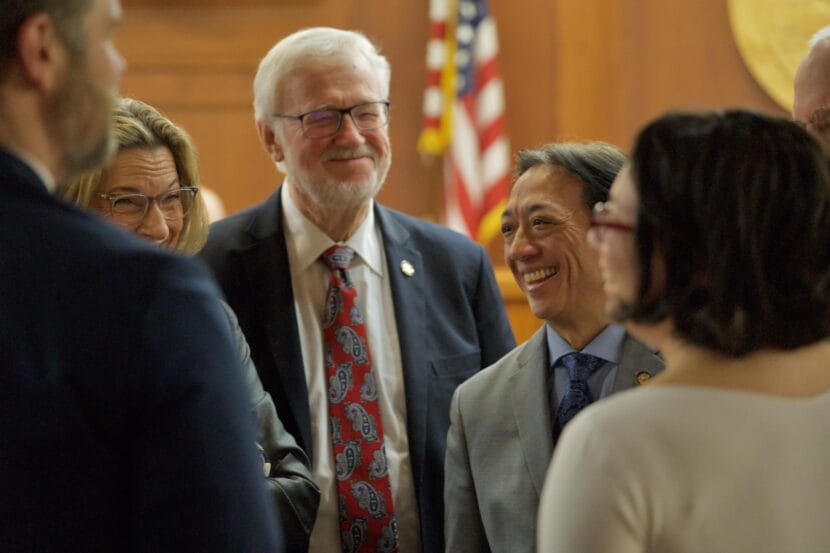
Rep. Andi Story, D-Juneau, speaks during a town hall event in the Mendenhall Valley on Wednesday, June 26, 2024. (Photo by Clarise Larson/KTOO)
A proposal that would create and fund tribally-run public schools inched closer to reality on Thursday. The House Tribal Affairs Committee moved House Bill 59 over to the Education Committee.
If the Alaska Legislature passes it, five tribes would get close to $17.5 million for the first year to run pilot programs for tribally-compacted schools across the state. Despite the short amount of time left in this year’s legislative session and a nearly $2 billion deficit in the budget, bill authors and supporters are hopeful the program will happen eventually.
Mischa Jackson is a tribal education liaison for the Central Council of the Tlingit and Haida Indian Tribes of Alaska. She said she hopes public support during the legislative process highlights the importance of kickstarting the program sooner.
“I am really hopeful. I think I’m just so passionate about education,” Jackson said. “I truly believe anything is possible, especially as an educator, we can seem to do anything on a whim’s notice and get it done and do it really well.”
Jackson said Tlingit and Haida will move forward with plans for its own education campus even if the Legislature doesn’t approve tribal compacting this year.
The House Tribal Affairs Committee updated the bill with an amendment to shorten the timeframe of the project from Rep. Rebecca Schwanke, R-Glennallen, and sent it to the House Education Committee for consideration.
Rep. Andi Story, a Juneau Democrat, is on both committees and laid out next steps.
“We’d like to bring in some of the school districts from the area where the tribal schools will be, and just talk about issues, about how it will affect districts and if anything should be done,” she said.
Joel Isaak is a consultant for tribal compacting with the Alaska Department of Education and Early Development. He said the state and tribes will continue working on the program even if the bill doesn’t pass this year.
“We’re hoping the Legislature will keep this moving forward, and we’re also willing to keep working at this to make it be the bill that it needs to be – which we feel very strongly, that this bill takes us there, and that the Legislature can keep supporting this effort,” he said.
Washington is the only state that has tribally-compacted public schools. The New Mexico Legislature also passed a bill to create education compacts that was vetoed by its governor last month.
House Bill 59 is expected to be heard by the House Education Committee next Wednesday.
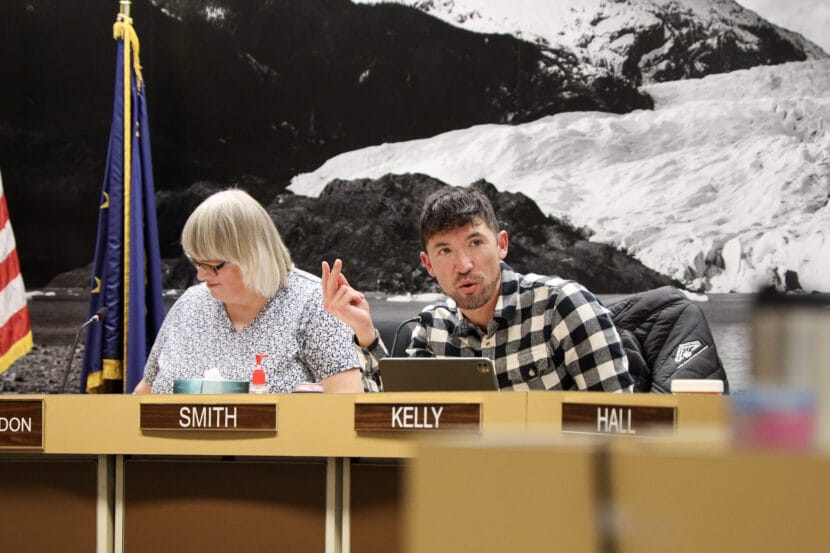
Deputy Mayor Greg Smith speaks during a Juneau Assembly finance committee meeting on Wednesday, April 30, 2025. (Photo by Clarise Larson/KTOO)
The Juneau Assembly moved forward with a plan on Wednesday that would add up to $10 million to the city’s debt if approved by voters in this fall’s election. It would fund critical repairs and upgrades to Juneau’s schools after years of deferred maintenance.
The Assembly decided to prioritize funding repairs to schools over the city’s water and sewer systems, which are also in need of some TLC. That means utility rate hikes are likely on the way.
Superintendent Frank Hauser spoke about the need for school repairs and upgrades at a meeting last month.
“The impact that facilities, well-functioning facilities — not only having roofs that are not leaking, but also HVAC systems that are consistent and sustained at a comfortable level — the importance of that is for the learning environment of our students,” he said.
The repairs would include partially reroofing Juneau-Douglas High School: Yadaa.at Kalé and Sítʼ Eetí Shaanáx̱ Glacier Valley Elementary School, upgrading heating and ventilation systems and adding new security and safety measures district-wide.
The decision last night wasn’t final. The Assembly still needs to take public comment before deciding whether the bond measure will go to voters. During the same meeting, the Assembly shot down a different bond package that would have asked voters to fund repairs to the city’s water and sewer systems, as much of its infrastructure reaches the end of its lifespan.
Assembly member Maureen Hall said she worried that putting two bond questions on the ballot would overwhelm voters. It also comes after last fall’s election, when Juneau voters approved a different $10 million wastewater bond to replace infrastructure at the Juneau Douglas Wastewater Treatment Plant.
“I think there’s going to be an awful lot on the ballot this fall, and so I am a little hesitant to charge forward,” she said.
Instead, members voted to push forward with a plan that would increase residential water and sewer rates by 5% annually over the next five years, and pair it with a bond package or other payment options later down the line.
City Manager Katie Koester said she believes the proposed 5% increases are the “least painful option” for residents that still addresses the need to pay for repairs.
“I worked with the utility and we really, like, sharpened our pencils and scoured budgets to try to come to you with the recommendation that we feel like has the lowest impact on our ratepayers and the lowest current year pain on our budget,” she said.
But the proposed increases would only begin to offset hundreds of millions of dollars in maintenance or replacement needs. In December, Juneau’s Water Utilities Division originally proposed increasing residents’ rates by more than 60% over the next five years to address those urgent repairs.
Assembly member Alicia Hughes-Skandijs said she thinks the 5% increases are too low given the significance of the problem.
“I don’t want us to be a body that kicks problems forward to future Assemblies and only continues to put us in a worse situation financially, at a time where our equipment is super old,” she said.
But, Assembly member Ella Adkison said the proposed increase won’t go unnoticed.
“We talk about affordability in Juneau, utility rates are one of the biggest factors in affordability, because it affects everyone, including some of our lowest-income families,” she said. “It can really hit them hard.”
The Assembly will still need to take public comment at a future meeting before passing any rate hikes. If approved, those would go into effect in July.
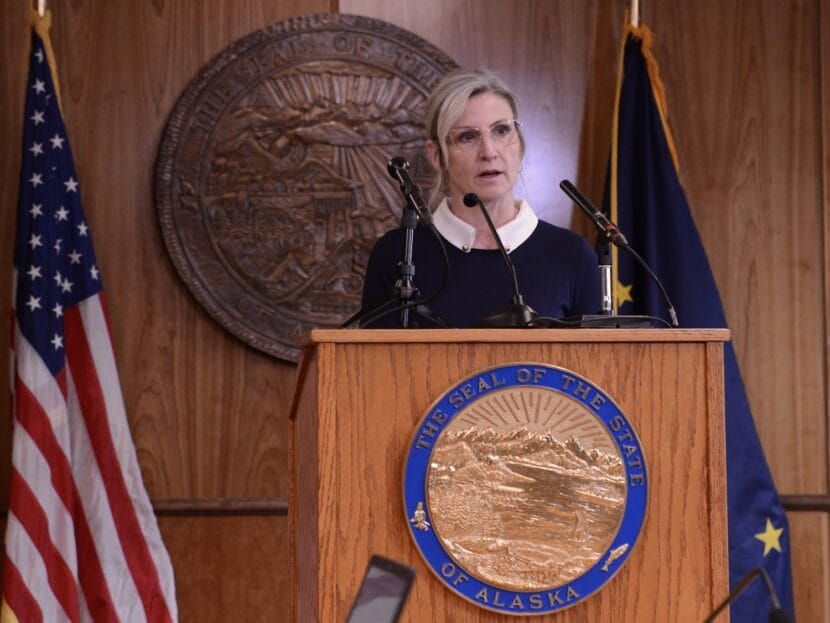
Deena Bishop, commissioner of the Alaska Department of Education and Early Development, speaks to reporters during a news conference Thursday, April 17, 2025. (Photo by James Brooks/Alaska Beacon)
Alaska Education Commissioner Deena Bishop sent a letter to superintendents statewide urging them to lobby legislators for the governor’s education policy items – or risk Dunleavy again vetoing an increase to school funding.
On Wednesday, some superintendents from districts across the state shared reactions to the commissioner’s veto threat, calling it “surprising,” “concerning” and “disappointing,” and called for state support for Alaska schools.
“We are at a make-or-break point,” said Roy Getchell, superintendent of the Haines School District in a phone interview, referring to many districts facing steep deficits, program cuts and school closures. “It’s not a game. It’s a reality. It’s something that all sides have worked hard and spent a lot of time on. It’s a nonpartisan issue.”
Bishop’s letter sent on Monday, as first reported by the Anchorage Daily News, came ahead of an Alaska Legislature vote on House Bill 57, which would permanently increase the base student allocation, core of the state’s per-student funding formula, by $183 million per year. The bill also added policy changes that many lawmakers saw as a compromise with Dunleavy after he vetoed a larger education boost on Apr 17 citing a lack of policy changes. On Wednesday, the Senate voted 17-3 and the House voted 31-8 in favor of the bill, sending it to Dunleavy.
In the letter, Bishop listed Dunleavy’s policy priorities she said superintendents should speak for, including grants for districts showing student reading improvements, open enrollment for students across districts, and increased funding for homeschool programs.
“If these critical reforms are not included, we risk repeating the challenges of previous years when the education bill — and its funding components — were vetoed. We also face the possibility that the funding element of the bill could be reduced or vetoed, as it was for FY24,” Bishop said, referring to Dunleavy cutting $87 million, half of on-time funding, approved by the Legislature in 2023.
“Please prioritize reaching out to your House and Senate members as soon as possible,” she wrote. “A personal call or email stressing the importance of these reforms and their direct impact on your district will be highly effective.”
Madeline Aguillard, superintendent of the Kuspuk School District in the middle Kuskokwim River region, expressed her concern in an email on Wednesday.
“For a sitting commissioner to send a politically charged message that appears to threaten a gubernatorial veto, particularly one directed at local education leaders working tirelessly on behalf of their communities, was surprising and concerning to receive,” she said.
She said Dunleavy’s policies are focused on urban and Railbelt districts, while rural districts like Kuspuk are in desperate need of a basic funding increase. “In Kuspuk, there are no charter or private schools—and there is no community interest in creating them. Our families want safe, fully staffed brick-and-mortar public schools. They deserve that,” she said.
“Kuspuk families experience some of the highest poverty rates in the state. Our buildings are crumbling, our curriculum is over a decade old, and we are struggling to retain staff due to uncompetitive wages. Yet we continue to be an afterthought in these policy discussions,” she said. “Where do districts like ours fit into the state’s long-term vision for education?”
Aguillard emphasized that while districts support the current legislation and funding increase, the proposal is still insufficient for schools grappling with almost a decade of flat funding, rising costs, inflation and deferred maintenance accumulating at schools.
“This feels like the futures of our students are being used as bargaining chips in a game that overlooks the vast and varied realities of education across Alaska,” she said.
Shannon Harvilla, superintendent of the Bristol Bay Borough School District, also urged bipartisan support for the education funding bill.
“While I was surprised by Commissioner Bishop’s letter—particularly its tone and timing—I remain focused on what matters most: stability and opportunity for Alaska’s students,” Harvilla said in an email. “I’ve witnessed firsthand how a decade without meaningful BSA increases has strained our ability to recruit staff, balance budgets, and meet the needs of students. A bipartisan solution has been passed, and I believe now is the time for support—not political pressure.”
Harvilla also noted the advocacy efforts of the Alaska Superintendents’ Association, which “actively engaged in good-faith dialogue with both the Governor’s Office and the Legislature throughout this session,” he said. “Their goal, which I support, has been to advocate for a responsible compromise that reflects the realities we face at the local level.”
Getchell, with the Haines Borough School District, expressed frustration with the ongoing political debate, and state leaders leaving schools without financial certainty almost at the end of the school year. “I don’t know on May 1 what my budget is going to be,” he said. “This isn’t about emails, it’s not about superintendents or governors or commissioners. It’s about 5 year olds and their futures. And I think they deserve better than this.”
Dunleavy’s office declined to comment on the letter or effort to pressure lawmakers.
After legislators passed the funding bill, several members of the multipartisan House majority caucus expressed their concern at the letter.
Rep. Rebecca Himschoot, I-Sitka, told reporters after the Legislature’s vote on Wednesday that she had a call from one superintendent that spoke in support of Dunleavy’s policy items, but declined to say who.
House Speaker Bryce Edgmon, I-Dillingham, also commented on Bishop’s message.
“I don’t think her letter had any material effect,” he said. “I don’t remember, at least as a legislator, ever seeing an agency head or a department official attempting to get outside entities, such as school districts in this case, to actively work to persuade the Legislature to take the position. I don’t remember that happening.”
He added: “It surprised me to see that.”
The education funding measure, House Bill 57, is expected to be transmitted to Dunleavy on Thursday. He has until May 17 to sign the bill, veto it or allow it to become law without his signature.
If Dunleavy again vetoes the legislation, this time legislators said they may have the 40 votes to override it.
It’s less clear whether the Alaska Legislature could override the threat in Bishop’s letter. If Dunleavy were to veto money needed to fully fund the new BSA, overriding that veto would require 45 votes, just three votes fewer than the combined number of House members and senators who voted for HB 57.
In addition, lawmakers would have to call themselves into a special session or wait until the Legislature reconvenes in January. A special session wouldn’t be an easy ask, Edgmon said.
This story was republished with permission from Alaska Beacon.
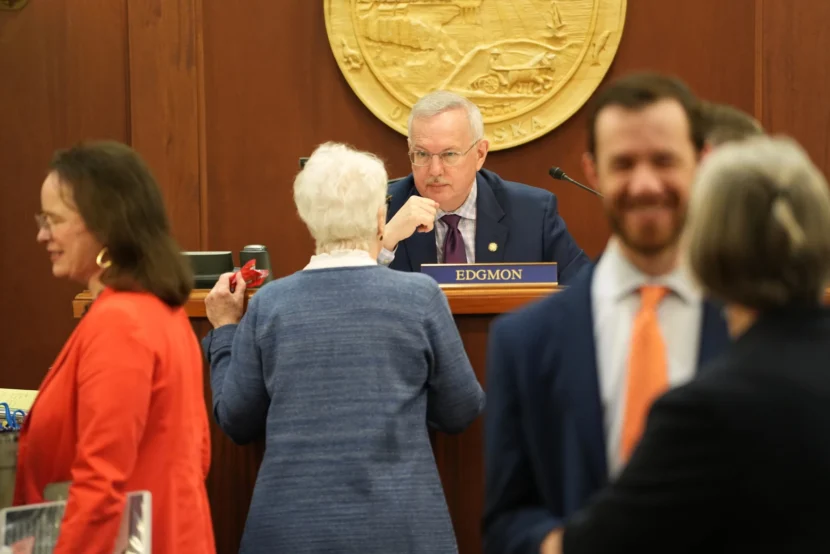
House Speaker Bryce Edgmon, I-Dillingham, confers with House Rules Committee Chair Louise Stutes, R-Kodiak, on the House floor on April 30, 2025. (Eric Stone/Alaska Public Media)
Alaska’s public schools may get a long-sought increase in state funding this year. A bill that would boost state education funding and make changes to state education policy passed the state House and Senate Wednesday and will soon head to Gov. Mike Dunleavy’s desk.
House Bill 57 would provide a $700 increase to basic per-student state education funding, the base student allocation, a longtime priority for the bipartisan coalitions who control the House and Senate.
Billed as a compromise, the package would also limit student cellphone use during school hours, make a number of changes to the laws governing charter schools, and — if lawmakers pass an otherwise unrelated tax bill — create a new incentive program that would provide school districts with $450 for each young student who reads at grade level or demonstrates improvement.
Any leftover revenue brought in by the tax bill, which would expand corporate income taxes to include non-Alaska companies who do business in the state over the internet, would be put toward career and technical education.
“This bill supports all public schools: brick-and-mortar, charter, homeschool, correspondence and residential,” said minority Sen. Mike Cronk, R-Tok.
Senators voting against the bill said they were worried the tax bill may not pass into law. Though Senate Minority Leader Mike Shower, R-Wasilla, said he would advocate for the tax expansion, he said the uncertainty led him to oppose the bill.
“I want to know that I’m voting for something that is going to do what I think it’s going to do, and I can’t guarantee that as I stand here today,” Shower said.
Wednesday’s vote started with a redo: senators approved a very similar bill on Monday, but discovered what Senate President Gary Stevens, R-Kodiak, called a “drafting error” before the House could vote on the measure. Senators deleted the errant amendment and approved a very similar replacement to it before approving the bill 17-3 Wednesday afternoon. Shortly afterward, the House passed the bill 31-8.
The votes in the House and Senate crossed caucus lines, with 3 minority Republican senators and 10 Republican House members joining all members of the bipartisan coalitions who control both chambers.
It’s unclear whether Gov. Mike Dunleavy will sign or veto the bill. Dunleavy’s education commissioner, Deena Bishop, emailed superintendents on Monday and asked them to urge their legislators to modify the bill to align with Dunleavy’s priorities. Though lawmakers added several policy initiatives proposed by Dunleavy to the bill that passed, they declined to add additional funding for correspondence schools or implement a statewide open enrollment policy.
“If these critical reforms are not included, we risk repeating the challenges of previous years when the education bill — and its funding components — were vetoed,” Bishop wrote.
Bishop also raised the possibility that Dunleavy could use his line-item veto power to delete funding from the state budget that would allow for the $700 funding increase. Dunleavy used a veto to reduce one-time funding lawmakers approved for schools in 2023, but he has not vetoed the long-term funding specified by the base student allocation.
Dunleavy’s office declined to say whether the governor will sign the bill. His communications director, Jeff Turner, instead pointed to a nearly week-old social media post discussing a prior version of the bill that called for lawmakers to make “a few key edits.” Lawmakers have since amended the bill to address some, but not all, of his priorities.
“The governor’s last statement on the bill … still stands,” Turner wrote.
Lawmakers may not need Dunleavy’s consent for the bill to become law. It takes a two-thirds majority to override a veto, a total of 40 votes across the House and Senate. If all 48 legislators who voted for the bill support an override, they would have enough votes, even at a higher three-quarters threshold that would be necessary if Dunleavy vetoes funding for the bill.
“I am confident that we’re going to get this bill past the finish line,” Sen. Löki Tobin, D-Anchorage, said in an interview after the vote.
Several minority lawmakers, including some conservative Republicans, said they would vote to override a veto from the governor if it became necessary, including Sens. Robert Yundt, R-Wasilla, Mike Cronk, R-Tok, and James Kaufman, R-Anchorage, and Reps. Justin Ruffridge, R-Soldotna, and Sarah Vance, R-Homer.
Vance said she planned to ask Dunleavy not to veto the bill, saying she thought the reforms included in House Bill 57 would benefit the state’s struggling schools. But she said she would support an override if it came to that.
“I don’t want to, but I’m willing if necessary,” Vance said.
Some other lawmakers who voted for the bill, including House Minority Leader Mia Costello, R-Anchorage, declined to say whether they’d vote to override the governor.
“We don’t know what’s going to happen,” she said. “I mean, this is the process, and I would rather not comment on that at this time.”
Once the bill is transmitted to his office, the state Constitution provides him 15 days, excluding Sundays, to sign or veto it. Otherwise, it becomes law automatically.
House Speaker Bryce Edgmon, I-Dillingham, said he expected the bill to go to the governor in short order. He said he was confident the bill would become law one way or another.
“We are going to get something through this year, and we will override the governor if he chooses, at this time to, on a second occasion, veto the bill,” Edgmon said. “I would hope … that the governor respectfully takes heed of the broad support behind the measure that just passed both bodies, and if he doesn’t, there will be a veto override vote.”
But a veto could scramble the dynamics. Last year, after lawmakers approved Senate Bill 140, a similar education funding and policy package, on a 56-3 vote, they fell one vote short of overriding Gov. Mike Dunleavy’s veto.
“I really hope we learned our lesson from that,” said Ruffridge, who voted to override last year’s veto. “It’s good for us to make sure that we don’t vote yes on this if you don’t plan on voting yes again.”
Senators smile ahead of a final vote on House Bill 57 on Monday, April 28, 2025. (Eric Stone/Alaska Public Media)
The Alaska Senate passed a second attempt at an education funding bill on Monday, setting up an up-or-down vote in the House that could send the bill to Gov. Mike Dunleavy.
House Bill 57 would boost the basic input into the state’s public school funding formula, the base student allocation, by $700. It comes less than a week after lawmakers failed to override Dunleavy’s veto of a $1,000 boost to basic funding. The bill passed 19-1 with five members of the all-Republican minority caucus crossing over in support. Sen. Robb Myers, R-Fairbanks, was the only no vote.
School administrators, parents, businesspeople and community leaders have pleaded with lawmakers to boost education funding for years, and there’s broad agreement that the state’s public schools are underfunded. But lawmakers have failed to come to terms with each other and the governor on a long-term increase, instead offering one-time cash infusions the last two years.
“While the bill before you isn’t the final answer to adequately funding our schools, it will get the much-needed financial resources our schools desperately need to retain high quality educators, reduce class sizes, keep beloved extracurricular activities and support our struggling students,” Senate Education Committee Chair Löki Tobin, D-Anchorage, said.
It’s an attempt at compromise. Dunleavy has called for any school funding boosts to be tied to policy items that he says would boost student performance. Those include changes to state law aimed at boosting charter schools and correspondence homeschool, along with grants supporting literacy in elementary schools.
Tobin, who negotiated in closed-door meetings with the governor’s staff on a prior attempt to find common ground on an education funding bill, said the final bill did not represent a deal with the governor.
“I am working with my colleagues here in the Senate and also in the House to ensure that we have a veto-proof majority supporting this legislation,” Tobin said in an interview after the vote. “I’ve been working my ass off, so I’m hopeful.”
The bill that arrived in the Senate Monday morning would, in addition to boosting overall school funding, provide a 10% boost in student transportation funding, require school districts to regulate student cellphone use and simplify the process of creating a new charter school or renewing its contract. It would also set up a task force to study education funding.
After the bill advanced out of committee last week, Dunleavy said he would sign the bill if lawmakers made “a few key edits.” Those included additional provisions aimed at boosting charter schools, an additional funding boost for correspondence homeschool, and an incentive program aimed at improving reading scores for young students.
Senators modified the bill in some important ways during debate on the floor, adding some but not all of the policies Dunleavy requested.
“We believe we’ve struck the most reasonable compromise we’re going to find this year,” Senate Minority Leader Mike Shower, R-Wasilla, said.
One amendment, which passed with unanimous support, added a literacy incentive program proposed by Dunleavy to the bill. The program would pay school districts $450 for each student in kindergarten through sixth grade who reads at grade level or demonstrates improvement.
But, as the state faces a dire budget picture, senators tied the literacy program to passage of a Senate-approved bill that would boost state revenue. Senate Bill 113 would require companies who do business in the state via the internet to pay Alaska state income taxes. Senators have described the tax bill as a “unicorn” and said it would not increase taxes on Alaskans or companies based within the state. Revenues from the tax change would be allocated to the literacy program, with any money in excess of the cost of the reading program going towards career and technical education.
“I’m just trying to find a way to get what I believe is the most important part of all this to the finish line,” said Sen. Robert Yundt, R-Wasilla and a member of the all-Republican minority caucus who sponsored the amendment alongside Democratic colleagues.
Some other Senate-approved changes to the bill relate to charter schools. If a school district decides to terminate a charter school contract, the bill would require them to show cause and give the charter school a chance to address the issue. It would also speed the timeline for the state school board to act on charter schools’ appeal of local board decisions.
Another amendment to the bill would require school districts to set nonbinding target class sizes, with maximum targets set in state law: 23 for elementary schools and 30 for middle and high schools at 30. Districts would be tasked with tracking actual average class sizes and reporting them to the state. Tobin said the amendment, which passed unanimously, would help lawmakers “figure out the best way to support our local school districts and get them the resources they need.”
The newly amended bill would also ban student cellphone use during school hours, including lunch, unless a school board sets out a policy allowing it.
Sen. Shelley Hughes, R-Palmer, said the cellphone policy, in addition to the reading-focused incentive grants, “would be a game-changer.”
The Senate also approved an amendment that would require lawmakers to study, but not necessarily implement, an open enrollment system that would allow families living in one school district to enroll their children in another.
Senators rejected a number of other changes to the bill, including proposals to reduce the number of years that the state tracks student outcomes, require districts to report the results of staff exit interviews and add an incentive to the state school funding formula that the sponsor said would “encourage” correspondence students to take standardized tests.
Dunleavy’s proposal to increase correspondence homeschool funding did not come up for a vote. Hughes said lawmakers were looking to keep the overall cost of the bill manageable given the state’s budget constraints, and that the benefits of a homeschool funding boost would not necessarily flow to students.
“It was not going to change, for instance, the allotment that a parent would get per child,” Hughes said. “It would have provided more for the district.”
Senate approval of the bill sets the stage for a fast-track vote in the House.
Because an earlier version of the bill already passed the House, though at that time it included only a requirement to regulate student cellphone use, Senate passage sets up a yes-or-no concurrence vote in the House. If the House votes to accept the Senate’s changes, it would be sent to the governor’s desk.
A spokesperson for Dunleavy declined say whether the governor supported the new bill ahead of the final House vote. But Hughes, a close ally of the governor, said she had been in touch with Dunleavy, asking him to accept the compromise.
“I can almost guarantee you that the governor is not a happy camper right now,” Hughes said. “But I will tell you, I had a conversation with him over the weekend, and I talked about pride and ego and really implored him to look at the big picture”
Several Republican senators — Sens. Mike Cronk, R-Tok, Robert Yundt, R-Wasilla, and James Kaufman, R-Anchorage — said they would support an override if Dunleavy ultimately vetoes the bill. Several said they were glad to support a compromise.
“We’re not a Republican in Idaho, and we’re not a Democrat in California,” Yundt said. “This is a state where everybody has to give.”
Hughes and Shower said their support for an override would depend on whether the tax bill that would fund the reading program passes.
Though the House initially planned to vote on the final bill Monday, lawmakers sent the bill back to the Senate for a re-vote after discovering an error in the bill’s language. A final vote is expected Wednesday.
Correction: An earlier version of this story said the vote came less than a week after the governor’s veto. It comes less than a week after a failed override vote.
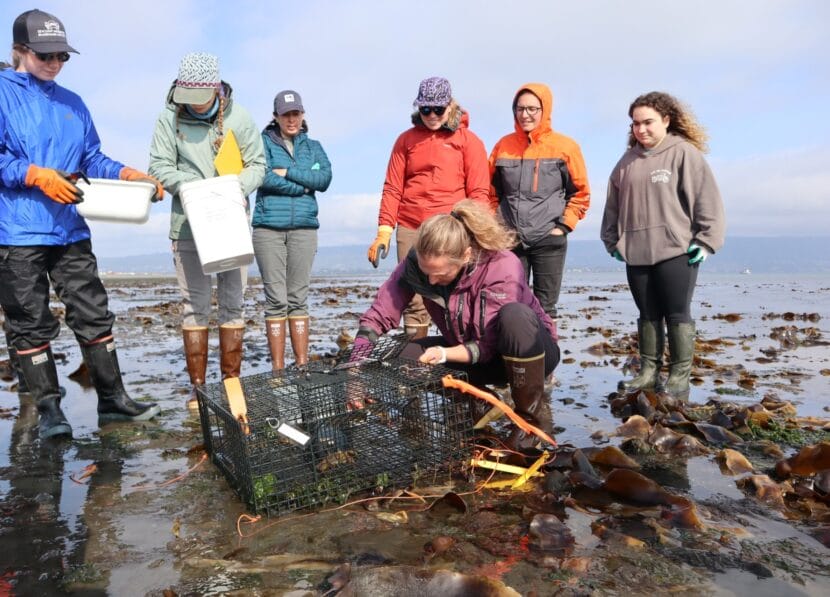
Students, staff and partners with Kachemak Bay National Estuarine Research Reserve check a crab trap at a community workshop. (Photo courtesy of reserve staff)
Alaska could lose several research institutions and a pipeline into science for budding researchers in the state if the Trump administration’s proposed cuts to the National Oceanic and Atmospheric Administration’s budget become a reality.
“Even the possibility of the disruption is affecting the students and the researchers,” said Joshua Hostler, a Ph.D. student at the University of Alaska Fairbanks. His research group met this week to discuss if they’d apply for a new federal funding opportunity. Because of the uncertainty, they probably won’t.
“Even if they do approve the funding, are they going to take it away later?” Hostler said.
He said that groups across the university system have been easing up on submitting research proposals for the same reason.
The Trump administration proposed to slash the National Oceanic and Atmospheric Administration’s budget by about 27% and eliminate climate research in a memo leaked this month. The draft cuts would terminate funding for several research institutes that rely on the agency to finance their work in Alaska. Among those on the chopping block are the Cooperative Institute for Climate, Ocean, and Ecosystem Studies (CICOES), the Alaska Ocean Observing System, Alaska Sea Grant, the Alaska Center for Climate Assessment and Policy and the Kachemak Bay National Estuarine Research Reserve.
The institutions share projects, faculty and student researchers with the University of Alaska so the state can understand and adapt to climate change while training the next generation of in-state experts.
Hostler is currently developing a seasonal lightning forecast system to help wildfire managers in Alaska plan for the upcoming fire season. Lighting strikes most in Interior Alaska, and that’s where the biggest wildfires in the state happen. Hostler is using machine learning models to predict the intensity of lightning a season in advance, so fire managers know where to put their resources.
But he’s funded by a NOAA grant from the Oceanic and Atmospheric Research office that would be eliminated under the draft cuts, and he applied for the grant with help from CICOES, which would also be cut. The funds cover Hostler’s wages of $29 per hour.
“Without that funding, I just wouldn’t be able to pay my rent,” he said. “I’d have to stop doing the research that I’m doing now and I’d have to go get a job somewhere.”
Hajo Eicken heads the International Arctic Research Center at UAF. He said these NOAA-funded institutes have helped create a pipeline for students to develop research in Alaska and then have opportunities to continue working here after graduating.
“These students, in particular, the Ph.D. students, they’re at the cutting edge of the field,” he said. “They help us respond much more effectively to various opportunities and challenges that we’re facing in Alaska.”
CeCe Borries-Strigle, a Ph.D. student at UAF who is set to finish her degree this summer, was planning to stay at the university for another year as a post-doctoral researcher to finish her work improving fire weather forecasts in the state. But, like Hostler, that project would be funded through a NOAA office and a research institute that may soon cease to exist.
Borries-Strigle is based in Kenai and was there in 2019 when the Swan Lake Fire jumped Sterling Highway and smoke choked the region for several months. She said she wants to stay in Alaska working on wildland fire research, but might have to change those plans due to funding uncertainty.
“I think there’s going to be a huge generation of scientists that miss out on more early career training because the funding is not there,” she said. “Those jobs aren’t there.”
At Kachemak Bay National Estuarine Research Reserve in Homer, 10 college students participate in community-driven research projects each year. Katherine Schake manages the reserve and said that past students have gone on to manage invasive European green crab with the Metlakatla Indian Community, track fish stocks at the Alaska Department of Fish and Game and been hired on to continue freshwater research at the reserve.
The reserve receives more than $800,000 per year from NOAA, and a 30% match from the University of Alaska Anchorage. That covers facilities and half of the staff’s salaries, Schake said. Without the base NOAA funds, she said that the staff would likely drop from 10 to four, and they wouldn’t be able to continue mentoring students.
One key service that students help with in Alaska is collecting data at sea. Seth Danielson leads an oceanography lab at UAF. His team tracks ocean conditions such as the temperature, nutrient content and salinity off the coast of Alaska over long time periods. That data, which shows how the seas are changing, feeds into how fisheries are managed.
“So NOAA develops the ecosystem status report for the North Pacific Fisheries Management Council every fall, and the council uses the assessments of ocean conditions as they set harvest levels for next year’s catch limits,” Danielson said. “So not all that data is collected only by NOAA — some of it’s collected by university researchers like us.”
More than 60% of Danielson’s funding comes from NOAA through the Alaska Ocean Observing System, one of the institutes that would be closed under the proposal. If that happens, he says he would probably have to lay off four of his five staff members.
He’d lose more than staff. Last August, his team moored half a million dollars worth of equipment to the bottom of the ocean. To get the data it’s been collecting all year, they need funding to sail out there and retrieve it.
“So not only is the data at risk and the students who are relying on that data for their graduate research, but the equipment itself is at risk — the batteries don’t last forever,” he said.
If the batteries die before Danielson can secure funding for the expedition, all of the data would be lost.
In Juneau, Curry Cunningham runs a fisheries lab through UAF. He estimates that NOAA pays for at least 30% of his research and staff, and said that the bleak funding outlook means he’s planning to scale back the number of graduate students and research projects he’ll take on in the future.
Right now, Cunningham oversees six graduate students and four post-graduate researchers. Three of them are working on NOAA-funded projects.
“A lot of the job opportunities that may have been available in the recent past are unlikely to be available for some of our students as they exit our program,” he said.
The proposed cuts come as UAF has set a goal to become one of the top-tier research institutions in the nation, called R1 status. To qualify, the university needs to award an average of 70 doctorates per year. Laura Conner is vice chancellor for research at UAF. She said that roughly a quarter of the university’s operating budget comes from the federal government, and graduate researchers rely on federal dollars.
“It’s likely that large decreases in federal support could impact R1,” Conner said.
But, she said it’s hard to predict how it will play out and UAF is still hopeful it can achieve the status.
Even so, she said that a deep cut to NOAA funding, “will have a chilling effect on research across the nation, more generally.”
Staff at NOAA’s Juneau offices and the White House declined to comment, and final funding decisions have not yet been made.
Clarification: This story has been updated to reflect that former students are assisting the Metlakatla Indian Community with invasive species response.
Close
Update notification options
Subscribe to notifications
Subscribe
Get notifications about news related to the topics you care about. You can unsubscribe anytime.