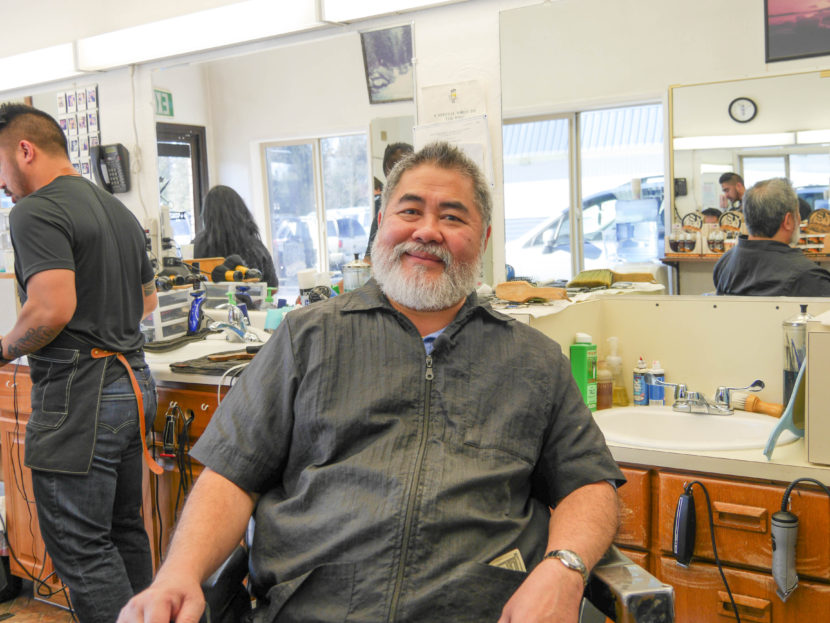
Gerry Carrillo Sr. sits in his barber’s chair at at his barbershop. He’s owned Gerry’s Barbershop for nearly 30 years. (Photo by Lakeidra Chavis/KTOO)
Gerry’s Barbershop has been around for nearly three decades in Juneau.
Owner Gerry Carrillo Sr., who emigrated from the Philippines in the mid-1970s when he was 16, started the shop after he was laid off from a state job in the 1980s. Now, he runs the shop with his daughter, Eva, and his son, Gerry Jr.
They say that after awhile even the clients become family.
Gerry’s Barbershop occupies a little nook next to a pizzeria in Juneau’s Mendenhall Valley suburb.
On a recent afternoon, the inside of the shop is loud — the music is up, conversations are going and the clippers are buzzing.
Here, it’s walk-ins only. A traditional cut, like a fade, is $18.
Eva is the oldest child. Covered in tattoos with long, black hair dominated by lime-green streaks, she’s full of laughter.
She has always loved doing hair and has worked alongside her dad for almost 10 years.
The trends with cuts come and go, she says.
“I did a lot of regular haircuts, and then the fauxhawk came back,” she says. “And now I still do a lot of mohawks, I think it’s ’cause I look like this so they always come to me, but a lot of people have been getting, like, old-fashioned haircuts like the traditional comb-backs and the pompadours.”
Lots of kids have bookended their school careers with haircuts at the shop, from their first day of class to graduation.
Kyle White is one of them.
Eva Carrillo cuts Kyle White’s hair at Gerry’s Barbershop. Kyle has been going to the shop since he was a kid. (Photo by Lakeidra Chavis/KTOO)
As he sits in Eva’s chair, White recalls visiting the shop as a kid: Gerry Sr. would tuck a Tootsie Roll behind his ear. If the young Kyle sat still for the cut, then he got the candy.
When White got older, he wanted a different hair style.
“I remember one time, I was like, ‘Hey Gerry, I think I’m going to do something different,’ and he was like, ‘No, you’re going to get the Kyle cut,'” he says. “And so I was like, ‘OK.’”
Eva lets out a loud laugh.
“Typical,” she says with a smile.
“‘No, no, no, you don’t want that.’ Like that?,” she asks, imitating her dad’s voice.
“Yeah, exactly,” White says, “‘You’ll get the Kyle cut.’ And then I just now started to get the fauxhawk.”
Combing his hair up to cut the ends, Eva tells White the style looks good on him.
White has checked out other shops in town, but always comes back to Gerry’s.
“Sometimes when they’re closed, I go somewhere, and they always don’t get it right,” he says. “But you come here for so long, they know what I want.”
Gerry Jr.’s chair is in the middle of the shop.
“I like to say that I beautify people,” he says.
Gerry Carrillo Jr. cuts David Mende’s hair. Gerry is the newest family member to work at Gerry’s Barbershop. (Photo by Lakeidra Chavis/KTOO)
His friends used to joke that he’d end up working for his dad — he didn’t believe them. Now, Gerry Jr. is in his third year working with his dad.
“I consider this like a family barbershop: grandpa will come and get a haircut, dad, grandson, sometimes great-grandson,” he said. “It’s hard. I guess working in a barbershop I feel like I don’t know how much time has passed by until someone comes in and I can see their hair.”
Gerry Sr. says haircuts will always be in demand.“(At the time) the economy was low, and I figured (that) hair is growing, it’s always got a job for me to do,” he said.
Cutting hair is a tradition in his family, he says.
“We got the blood of the barber,” he says. “My uncle was here first, long, long time ago, 1908 and he started a barbering business and he was very well-known in this town. … And I decided to go to school as a barber and (as) it happened I had a good touch.”
The Carrillos say they become a part of their customers’ family, even if in a small way.
The trio has given people their first haircuts, and sometimes their last.
A couple of years ago, a customer asked Eva to cut his hair before cancer took it away.
“He came back a year later, looking better than he did when I cut his hair off, he had so much hair, I was like, ‘Is that you?”… He’s doing really well,” she said.
Over the span of two hours, an old high school friend stops by, as well as a long-time customer who owns a pet grooming service in town and a new regular.
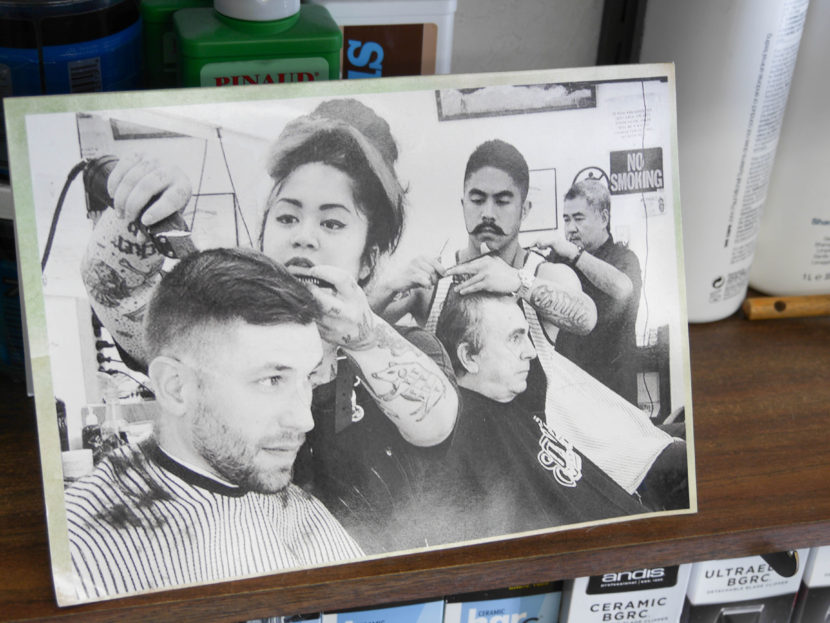
A photo of the Carrillo family sits on a shelf inside Gerry’s Barbershop. From left to right: Eva, Gerry Jr., and Gerry Sr. (Photo by Lakeidra Chavis/KTOO)
The barbers cut hair to celebrate the good moments and honor the bad.
Near Gerry Sr.’s chair toward the back of the shop, a black-and-white photo sits on a small bookshelf that stores supplies. In it, daughter, son and father are cutting hair. Gerry Jr. is sporting a handlebar mustache and has a large tattoo on his forearm. Written in cursive, it’s the family name, “Carrillos.”
But the trio make it clear that in their shop, family can be anybody — not just the people cutting your hair.
There are rating systems for hospitals, nursing homes and doctors. So why is it so hard to compare providers of child care?
Part of the reason is that there are no nationally agreed-upon standards for what determines the quality of child care. The standards that do exist are formulated in each state, and they vary widely.
For example, some states require that child care workers have a teaching certificate. Others require certain college courses. Some have strict ratios of how many caregivers are required per child.
But all of these criteria are important in assessing the quality of a child care facility, says Susan Hibbard, director of Build Initiative, which works with states developing early childhood programs.
What’s needed, she says, is a tool that makes it easier for parents to evaluate and compare the child care options in their communities.
“So you know that if you see 3 stars out of 3 stars, your child is going to have teachers who are nurturing, have experience, understand child development and know how to work with children and help them thrive,” she says.
About 20 states are “on their way,” Hibbard says, having received federal funding in 2011 to build a system to define, measure and improve quality. Some states are working to create online tools based on standards suggested by the federal Department of Health and Human Services. These standards are the basis for a rating system HHS calls the Quality Rating and Improvement System.
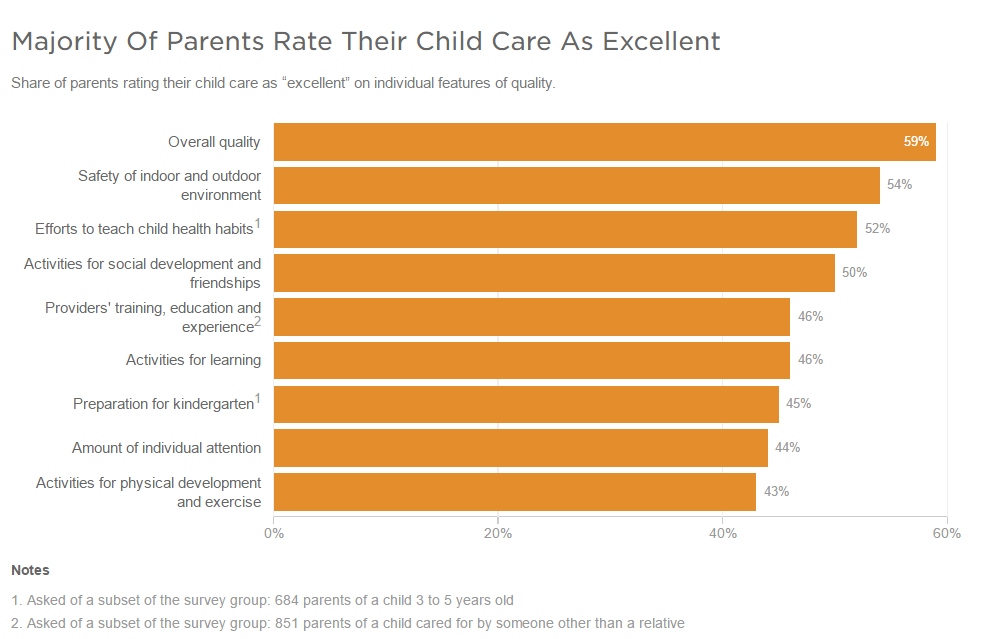
A recent poll by NPR found that among parents whose child gets care from someone other than a relative, 71 percent cite quality as one of the top two or three reasons for choosing one child care provider or program over another. Our polling partners are the Robert Wood Johnson Foundation and the Harvard T.H. Chan School of Public Health.
Source: NPR/Robert Wood Johnson Foundation/Harvard T.H. Chan School of Public Health poll of 1,120 parents or guardians of a child 5 years old or younger not yet in kindergarten who receives regularly scheduled care at least once a week from someone other than a parent. The poll was conducted June 8 through Aug. 7, 2016. Margin of error: +/- 3.4 percentage points. Credit: Katie Park/NPR
The quality factors most frequently volunteered by parents included trustworthy providers (20 percent), activities for learning (13 percent), educated/well-trained providers (12 percent) and activities for building friendships (7 percent). Parents cited more than a dozen other quality factors as important to them.
A more comprehensive rating system might have helped Kinsee Morlan avoid problems with a child care provider, even though she did do her best to find out basic information.
When Morlan got pregnant with her first child, Harper, she and her husband started looking for day care. They explored lots of options, including large day care centers near their San Diego home. But the large centers, with lines of cribs and lines of rocking chairs, just weren’t for them. “I just couldn’t wrap my brain around that,” Morlan says.
Eventually they decided on a small home setting, which seemed perfect. It had a little preschool room in the back of the house, which was “like this magical little room with glass windows everywhere, really bright and in a garden,” Morlan says, adding it was just the kind of place it seems kids “would love to be.”
Morlan made sure the day care center was licensed by the state of California, and she even checked to make sure there were no serious infractions on file.
Harper was less than a year old when she enrolled him.
Everything seemed to be going well until one day the caretaker mentioned Harper had been kicking and screaming while in a car seat.
Morlan and her husband didn’t think much about it until they got home that night, changed his diaper and saw deep red abrasions on his leg.
“As a first-time mom, I freaked out,” Morlan says. She took Harper to urgent care, where doctors “gave us a grave look” and said it looked like Harper was in some sort of car seat or child holding device for “way too long.”
She says she and her husband lost faith in the day care system after that and decided to care for Harper within the family. Morlan took off work one day a week. So did her husband. Morlan’s mother-in-law filled in the other three days.
The parents made this commitment: They would not send Harper to preschool until he could communicate clearly and tell them what happened at school.
Today, Harper is 3 and is enrolled in preschool. Morlan makes sure that she asks him how his day went every day.
While this case is extreme, it’s an example of the difficulty parents face when trying to figure out if a day care program is good, just OK or bad.
Copyright 2016 NPR. To see more, visit http://www.npr.org/.
Parents struggle with the costs and choices with child care. Chelsea Beck/NPR
Life is pretty busy for Mike Buchmann, a high school art teacher and football coach, and his wife Shannon, who works as an assistant controller at a small private college near their home in Mishawaka, Ind.
Everyone is out the door by 7:45 each morning: Mike shuttles their two older kids to before-school care, while Shannon drops off their 14-month-old at a church-based child care center before they head off to their full-time jobs.
After their mortgage — which is about 20 percent of their combined take-home pay — child care is the family’s biggest expense. In fact, the cost of their youngest child’s day care alone — $660 a month — is more than half the family’s monthly mortgage payment.
At the end of the month — after making payments for utilities, their car and Mike’s school loan — the family has “zero for savings and zero left over,” he says.
“All of a sudden, my wife is looking around, saying here’s the bottom line: There’s more red ink than there is black, we gotta do something about it.”
That’s why, several times a month — after he works a full day, coaches football after school, helps feed and bathe the kids before tucking them into bed — Mike heads out and spends a few more hours driving for Uber.
“It’s a little hectic and the hours are insane. But you can sleep when you’re dead,” the 43-year-old says. “That’s how you feel when you’re a parent anyway, you’re tired all the time anyway, you may as well make some money.”
The Buchmann family isn’t alone. Across the country, parents are hustling to find ways to balance the high cost of child care with their budgets.
And no wonder: The average cost of day care in the U.S. — $9,589 per year — edges out the average cost of in-state college tuition at $9,410, according to a recent report from New America, a think tank in Washington, D.C., in collaboration with Care.com, an online resource that connects families and caregivers.
To put that in perspective another way: In four states — Kentucky, Montana, Oregon and Wisconsin — average child care costs exceed median rent. In 11 states — Idaho, Illinois, Iowa, Kansas, Massachusetts, Michigan, Minnesota, Ohio, South Dakota, Vermont, Washington — and the District of Columbia, the average cost of full-time day care is more than 90 percent of median rent.
That means for many families, a significant chunk of household spending goes toward child care; in states such as Mississippi and West Virginia, child care costs account for 40 to 45 percent of total household income.
Compare that to the Department of Health and Human Services’ benchmark for affordable care: 10 percent of family income.
But these numbers capture only a fraction of the challenge and stress facing families with young children in need of care.
Ask just about any parent — regardless of where in the U.S. they live, socioeconomic status or race — and they’re likely to have strong opinions and a story to tell of juggling priorities, cutting costs and employing creative strategies to get the best child care they can afford. A few of the NPR poll respondents share their stories.
A Wisconsin family embraces frugality
Child care is the single biggest monthly expense for Danielle Westhoff Smith and her husband Cameron: They spend more than $2,000 — or 34 percent of their monthly take-home pay — on child care for their 3-year-old and 4-month-old. By comparison, rent for their three-bedroom home in Madison amounts to a quarter of their income. Wisconsin is among the states where average child care costs are more than median rent.
Danielle, 33, is a postdoctoral fellow researching Ebola at the University of Wisconsin; her husband, a former engineer who is now an attorney for the state government. To make ends meet, the family lives frugally. They don’t have cable, shopped around for a no-contract cell phone plan that costs $50 a month and bought “semi-smart” phones out of pocket. They eat out only once or twice a month. They have one car and use public transportation. They’re trying to save $1,000 a month toward a down payment on a house and retirement, but miscellaneous expenses crop up all too frequently and there’s not much left over.
“We don’t have enough in the budget to save anything for their college,” Danielle says. “I’m basically paying for it right now.”
And it’s no exaggeration: In Wisconsin, the annual cost for infant care at a center is $11,579, compared to $8,781 for in-state college tuition, according to a 2015 report from Childcare Aware of America. The Smiths pay $27,000 a year for their two children, with infant care accounting for a larger proportion of the total. On average, infant care at a center costs 12 percent more nationwide than for older children.
Managing these costs is a huge concern and affects more than just decisions about money.
“We have quite a few friends who had their children shortly after our first and now are thinking about second children, and it’s all about cost of day care and the timing,” she says. “All of our friends are in that same situation.”
Danielle and Cameron would like to have three kids — “it’s kind of our number,” she says — but they are putting it off purely for financial reasons.
They’ll wait until either their son starts elementary school or Danielle is at a point in her career that she can take a year off work to stay home with the kids. They did the calculations and a third child is the tipping point at which day care will cost more than she earns. She’s put a lot of thought into when it would be best, professionally, for her to take a break — and how the timing will affect her future job prospects.
She never imagined that life in her 30s would require so much financial vigilance.
“When you go to college and plan your career … you don’t expect to be in a position where you have to nickel and dime everything,” she says. “It just kind of hit us. We’re right at that age where we’re starting our jobs, starting our families.”
She feels fortunate that they’re able to make ends meet. Still, she can’t help but worry.
“When you talk about finances and planning for the future, I know it’s not enough, and so it makes me nervous,” she says.
“But what options do you have? Not have children?” she continues. “That’s something that’s really important to us.”
An Ohio family makes a plan and sticks to it
Michelle and Stephen Chester, of Cincinnati, are feeling similar anxieties.
“We’re nearing 40, and it’s like, OK, we thought we’d have these kinds of problems and such in our 20s, and here we are, almost 40, and we’re still having these issues,” says Michelle, who is 37.
Child care costs have squeezed the family particularly hard for the last 14 months, after the birth of twin daughters.
Michelle and Stephen spend $2,000 a month on full-time care for their daughters and a half-day of care for their 6-year-old son.
Even with a significant multi-child discount, it’s equal to their mortgage.
“Every day, you wake up and go, ‘Thank God I still have a job,’ because if one of us for some reason loses our job, we’re sunk,” says Michelle, who is a client specialist at an investment firm.
Michelle and Stephen, a computer programmer, went through their budget item by item and cut out excess spending. They’re delaying bigger-ticket purchases. They use a lot of coupons and eat out less. Michelle knows all of the restaurants that have kids-eat-free nights.
With the help of YouTube and advice from relatives, the husband and wife have also taken on various home repair projects themselves: replacing leaking faucets and toilets, weatherproofing all their windows.
Even though they’ve made a lot of cuts, Michelle says there is still plenty of day-to-day juggling.
“It’s a challenge, and really, the tax credit that the government gives us … it’s the same as it was in the 1980s,” she says. “And there’s no way we’re paying the same for child care for now that we were paying back in the 1980s.”
Michelle is referring to Flexible Spending Accounts for dependent care, which allow employees to set aside pre-tax money from their monthly paychecks for child care for children younger than 13. Those contributions are limited to $5,000 annually — and have been since 1986. Compare that to average weekly child care costs, which have risen nearly 70 percent from 1985 to 2011, the most recent data available from the Census Bureau.
“When you think about it, $5,000 a year, we spend in the first quarter,” she says.
And so far, congressional efforts to increase the limit — and to index dependent care to inflation — have gone nowhere.
Michelle and Stephen also discussed the possibility of one parent staying home. They sat down and ran the numbers when they found out they were having twins.
“If it were just day care, I would stay home,” she says. “But because I also cover groceries, my car and a little bit of the utilities, I can’t afford to. It wouldn’t make sense for us.”
There’s regret in Michelle’s voice when she discusses how little she and her husband are saving. The silver lining is that whatever little they do save, she says, goes into savings accounts they set up for the children.
“That’s just money I don’t want to touch,” she says. “I want to be able to say, OK, this is your money. Kind of like my parents did for me, and my father-in-law and mother-in-law did for my husband, to give them a jumpstart later in life.”
Many Americans hope to be able to give their children what their parents gave them; but the stark economic reality is that, in many cases, it simply won’t be possible.
In the meantime, the Chesters have identified points where there costs will go down: when there are no more diapers ($100 less a month), when the twins move into the toddler room at their day care center ($80 less). Each change, as Michelle puts it, “gives us just a little bit more breathing room, and maybe a chance to start adding back to our savings.”
Her advice for other parents who are struggling with child care costs?
“Make a plan and stick to it. Stick to it as much as you can. There’s always going to be something that pops up, but if you’ve got a plan in place, you know how the numbers will fall,” she says. “And it is a comfort at night when you can go to bed and say, OK, at least I know I can afford my house, my kids in a safe place, the utilities and groceries. Everything else? Not that important.”
A North Carolina family talks money every month
A lot of families rely on grandparents for child care. For lower-income families, relatives are often the only option. But even for higher-earning families, relatives are a key backup to keeping often-fragile child care arrangements from unraveling.
That’s the case for Brian Hickey of Raleigh, N.C. Even when his children were in full-time center-based care, he says, there were still sick days.
“Thank God my parents were in the area,” he says.
But his parents have lives of their own, and Hickey is wary of taking them for granted.
“Old people used to tell me, don’t wear out your welcome,” the 35-year-old says with a laugh.
Bottom line is that there’s no getting around the financial burden of child care.
“It’s an astronomical cost,” says Hickey, whose children are now 12, 8 and 5.
Managing child care costs is “arguably the most stressful part of my life,” the 35-year-old geotechnical engineer says.
Full-time care for the two younger children cost Hickey and his wife about a quarter of their net monthly income — just $125 more per month than their mortgage payment. The Hickeys are another family who pay well over 10 percent of their income for child care — above the U.S. government standard for affordable care.
On paper, Hickey says, his family’s household earnings — his wife works in retail management — should be enough. But with student loans and child support for his oldest child, Hickey says the reality was that paying for child care was a struggle.
He could have found a cheaper option — but did not want to compromise on quality.
“I didn’t want my kid to be somewhere … for 8 hours and not learn anything, not do anything, with no expectations of growth or development,” he says.
And if finding that balance was difficult for the two-parent, middle-class Hickey family, it’s all the more daunting for lower-earning families or single parents.
Hickey says frank conversations about finances and a constant re-evaluation of financial priorities are key ways he and his wife try to keep stress at bay.
“Every month, that’s a conversation in this house. Every month, we sit down,” he says. “You have to make your choices. Where are we at, and what can we do to keep moving forward? For us, if you do it frequently, you make better choices. Don’t wait until there’s a problem.”
Despite the complaints about the cost burden, Hickey echoes other parents when he zeroes in on what truly matters: trustworthy, dependable child care.
“At the end of the day, I can lose my house, my job, my car, you can replace those,” he says. “You can’t replace your kids.”
Copyright 2016 NPR. To see more, visit http://www.npr.org/.
A doctor who treats infertility in New York City says he has helped a couple have the first baby purposefully created with DNA from three different adults.
John Zhang of the New Hope Fertility Center in Manhattan traveled to Mexico earlier this year to perform a procedure for a couple from Jordan that enabled them to have the baby in May, according to a clinic spokesman.
Zhang performed the procedure in the hopes of helping the couple, who the clinic declined to identify, have a healthy baby. The couple had lost their first two children to Leigh syndrome, an inherited neurological disorder.
The idea of creating babies this way to help prospective parents who come from families plagued by genetic disorders has long been controversial. In February, a 12-member panel assembled by the National Academies of Sciences, Engineering and Medicine outlined a plan for how scientists could ethically pursue the research.
The Food and Drug Administration had requested the report after two other groups of U.S. scientists asked for permission to try. Despite the report, the FDA said Congress had prohibited the agency from allowing the procedure. In response to the latest development, the FDA reiterated that position in an email to NPR.
That prohibition had prompted Zhang to travel to Mexico, according to the clinic.
The baby’s birth prompted both praise and criticism. Some infertility experts welcomed the development as a potentially important step for women carrying genetic disorders.
Zhang plans to present the details of the case at the society’s meeting next month in Salt Lake City.
Some scientists said the move was irresponsible because not enough research had been done to know whether it was safe.
“This is a troubling development on a number of levels,” wrote Paul Knoepfler, a cell biologist at the University of California, Davis, in an email to NPR. “It could have gone wrong in any number of ways and still could.”
Even one scientist hoping to perform this procedure in the United States is worried about details he has seen in Zhang’s presentation.
“While exciting, there appears to be problems with the study,” wrote Dieter Egli of Columbia University Medical Center in an email. Egli said he sees possible abnormalities in the embryos Zhang created.
Others fear the move could open the door to the creation of so-called designer babies, in which parents try to pick and chose the traits of their children.
“This is entrepreneurial reproductive technology at its most unethical and irresponsible,” wrote David King, who heads the genetic watchdog group Human Genetics Alert in London, in an email. “When are the world’s governments going to stop rogue scientists crossing crucial ethical lines?”
The birth of the child was first reported Tuesday by the British magazine New Scientist. A clinic spokesman who asked not to be named told NPR that most of the details in the article were accurate except statements that the baby was born in Mexico and there was no oversight of the procedure there.
Leigh syndrome is known as a mitochondrial disorder because it is caused by defects in a type of DNA known as mitochondrial DNA. Mitochondria are structures in cells that provide the cells with energy.
To help women who carry defects in mitochondrial DNA, scientists have developed techniques to replace the defective mitochondrial DNA with healthy DNA.
The technique Zhang used involved removing all the DNA from the nucleus of eggs donated by women with healthy mitochondrial DNA. The DNA in the nucleus of eggs carries most of the genetic information needed to create a person, including the information most people consider important, such as determining an individual’s physical appearance.
Zhang then removed all the nuclear DNA from the eggs of the woman trying to have a healthy baby and placed that DNA into the donor egg, leaving the defective mitochondrial DNA behind. Those eggs, which then presumably had only healthy DNA, were then fertilized with sperm from the husband of the woman trying to have a baby.
Zhang created five embryos this way. Only one developed normally, according to his report. It was transferred into the woman’s womb and resulted in the birth of a boy, who appears healthy, according to the clinic.
Because mitochondrial DNA is only passed from women to their female offspring, the boy is incapable of transferring the transplanted DNA to any future children, sidestepping many of the ethical concerns.
Copyright 2016 NPR. To see more, visit http://www.npr.org/.
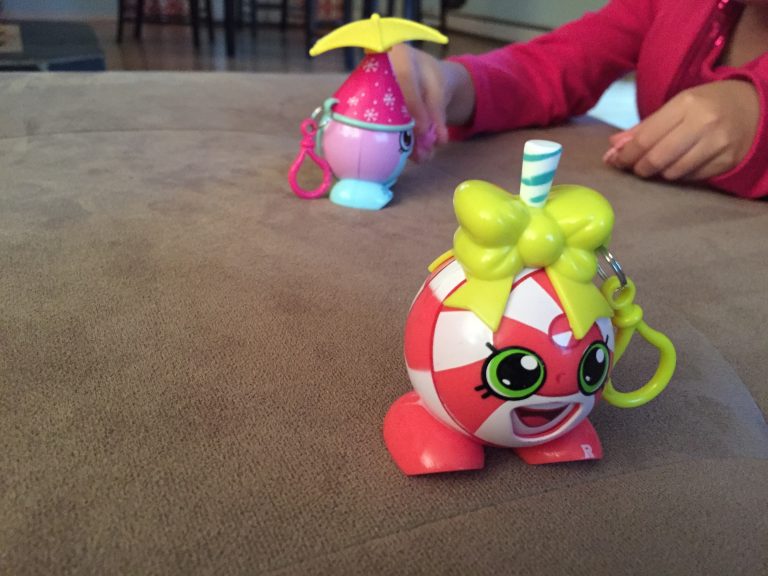
Rusty plays with her Shopkins toys. (Photo by Anne Hillman/Alaska Public Media)
The American Academy of Pediatrics says most kids have a stable sense of gender identity by the time they are 4 years old. Rusty is one of them.
Rusty may have been born a boy, but she knows she is definitely a girl.
The 4-year-old is really focused.
“This is Shopkin,” she says, pulling out tiny, cartoonish plastic models of food and household items that are plastered with giant eyes and goofy smiles. “Shopkin. Shopkin poster, Shopkin oven… .”
She excitedly runs into her room and pulls open a drawer filled with them, extracting one of her newest.
“It’s a bone, and her name is Bone-a,” she says, explaining the small piece of yellow plastic shaped like a dog bone.
Even the pink walls of her bedroom are plastered with Shopkins stickers, though she has Princess stickers up, too. She doesn’t only like Shopkins.
Rusty’s older sister, Lola, 7, says this is a new look for Rusty’s room.
“It’s a pinkalicious! I’ll tell you what it used to be like. His bed used to be like a pirate bed. The curtains used to be blue. And this used to be like a town carpet.”
Rusty says she didn’t like the old room – it didn’t fit who she was. “I didn’t feel comfortable in my bed. That’s how it happened.”
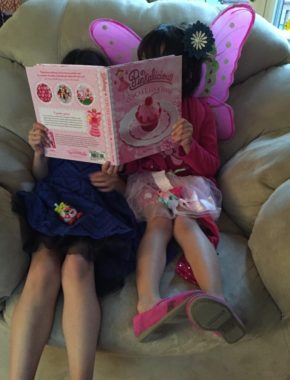
Rusty and Lola read a cupcake cookbook together. (Photo by Anne Hillman/Alaska Public Media.)
Rusty didn’t feel comfortable in boy’s clothes, either.
She started stealing things out of Lola’s closet.
Lola says she was not happy about that because they were her dresses.
As soon as their parents started letting Rusty shop in the girls’ department, and Rusty left Lola’s clothes alone, Lola didn’t care.
“As long as he’s happy, I’ll be happy,” she says as she rifles through his clothes, pointing out which ones used to be her dresses.
That’s Jennifer’s theory, too. She’s the kids’ mom. Jennifer says the first time Rusty told her she was a girl was about a year ago.
“He corrects us if we call him a boy. If I say, ‘You’re my big boy,’ he’s like, ‘Ah, I’m a girl. Thanks.’”
At first Rusty just wanted to play with girls’ toys and dress up for fun. Rusty picked a princess cake and Hello Kitty decorations for her third birthday.
Jennifer says they didn’t think anything of it.
Then Rusty started fighting about clothes in the morning – she only wanted to wear dresses and was stealing from Lola. Eventually Jennifer bought Rusty girl clothing, and the fights stopped. Rusty declared that she is a girl. Jennifer says she and her husband are just going with what seems to be working.
“I don’t know that there should be a handbook, but there should at least be something easier to navigate through all this,” she says, laughing.
Jennifer says she’s learning as she goes. Last week, the day before the interview, Rusty’s pediatrician asked if Rusty preferred “he” or “she”. Rusty picked “she.” Jennifer is still trying to remember to change pronouns. She says it makes her realize she has so many more questions about what to do next.
“Do I have to tell people? Do I have to announce it to people? Do I want to hear what people have to say about that? I just want to be in my bubble. Like I’m not sure what to do with that. I told some of my close friends and they’re just like, ‘OK!’ but then it’s like do I tell the school? Do I tell the daycare? What do you do? I don’t know.”
When she first started posting photos of Rusty dressed as a girl on her Facebook page, she got mixed reactions. She pulls up an image on her phone, Rusty smiling with boyish short hair, a pink t-shirt, and pants plastered with pictures of puppies.
“I put this one on Facebook and I got a lot of feedback like why am I letting him do that and dadada.”
Despite that, Jennifer says she feels like her family is mostly in a safe, protected space. Only one close relative has rejected Rusty for identifying as a girl. But Jennifer worries that it won’t always be this easy. That’s why we’re only using their first names—she knows it’s important to talk about this because other people are experiencing it too, but she wants to protect her children. She thinks Rusty might have the same fears.
“Just before I told you that you could ask him whatever you want, I said, ‘Can Anne ask you about being a girl?’ And he was like, ‘No.’ And I said ‘why?’ And he said, ‘If I tell her, will she leave?’”
Rusty never explained why she said that.
Jennifer wonders what’s next for her child. What will Rusty’s school say when she starts kindergarten? Which bathroom will she use? But ultimately it comes down to just one thing:
“As long as he’s happy – she’s happy. Rusty’s happy. That’s all that matters. And to me Rusty appears to be very happy.”
Rusty runs past her mom, dressed entirely in pink with a tutu and sparkly wings, radiating confidence, and grabs the microphone to continue our first conversation.
“So I have a Shopkins stuffy, and it’s beautiful.”
A 17-year-old boy was killed in an accidental shooting outside a home in the Mountain Wood Circle neighborhood Saturday morning.
The boy was one of four males preparing for a duck hunt according to a Juneau Police Department press release.
He was reportedly standing outside of a truck when he tried to pull his shotgun out of the back seat by its barrel. The shotgun went off and the boy was hit in his torso.
The rest of the hunting party was standing outside of the truck during the shooting. Police said they tried to give the victim first aid before 1st responders arrived.
An ambulance took the victim to Bartlett Regional Hospital where he was pronounced dead.
The victim was a student at Thunder Mountain High School. Police said Juneau School District will provide grief counseling to people who knew the victim and those hurt by his death.
JPD spokeswoman Erann Kalwara said accidental shootings are rare in Juneau. She wasn’t certain how many occur but said there are no more than two per year.
Close
Update notification options
Subscribe to notifications
Subscribe
Get notifications about news related to the topics you care about. You can unsubscribe anytime.



9(MDEwMjQ0ODM1MDEzNDk4MTEzNjU3NTRhYg004))

9(MDEwMjQ0ODM1MDEzNDk4MTEzNjU3NTRhYg004))
9(MDEwMjQ0ODM1MDEzNDk4MTEzNjU3NTRhYg004))