The third day of the Christopher Strawn homicide trial on Wednesday featured the seating of the jury, opening statements, and the first piece of evidence presented at trial, a harrowing account of a terrified woman hiding in her trailer from a man she believed had just shot her friend.
Christopher Strawn is standing trial in Juneau Superior Court on charges related to the October 2015 shooting death of 30-year-old Brandon Cook at the Kodzoff Acres trailer park.
On Wednesday, prosecuting and defense attorneys agreed to the five-woman, nine-man jury that will hear the case through an expected two weeks of trial. Two jurors to be randomly selected toward the end of the trial will be excused as alternates.
After the jury was sworn in, attorneys for the prosecution and defense outlined their cases in opening statements.
Assistant District Attorney Amy Paige admitted that the alleged murder weapon is still missing, but other evidence found at the scene and in Strawn’s own trailer point to him as the only suspect in the case.
“We may never find the shotgun that ended Mr. Cook’s life,” Paige said. “But we know who did. That person is Christopher Strawn, and at the end of this trial the state will ask that you find him guilty of that murder in the first degree.“
Defense attorney Eve Soutiere showed pictures of Strawn’s own trailer at lot 35 in the nearby Glacier View trailer park.
“The police immediately zeroed on Mr. Strawn as their only suspect, to the exclusion of all other suspects,“ Soutiere said.
The proximity of Strawn’s own trailer to the scene in Kodzoff Acres may be important as prosecutors later present testimony about the search for the suspect and the murder weapon.
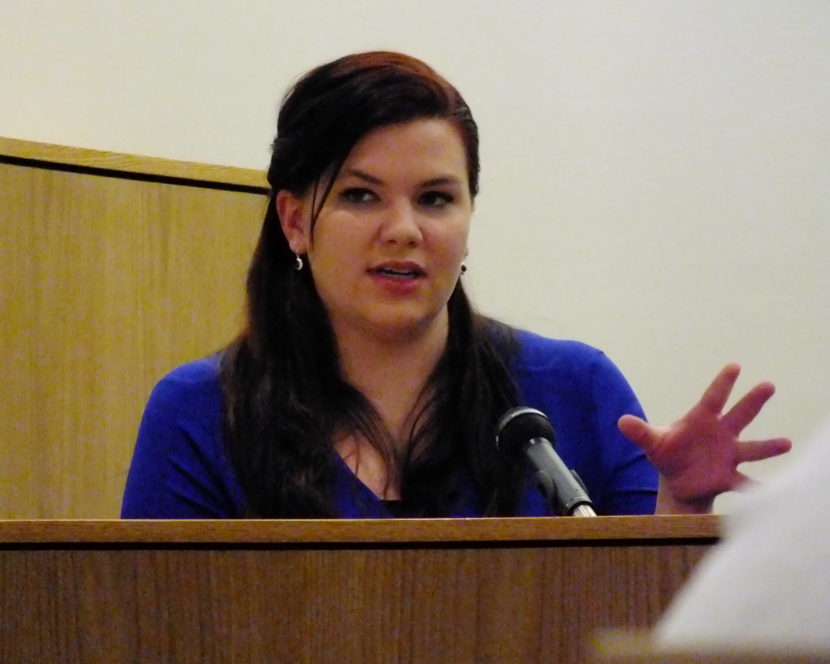
Juneau Police and Capital City Fire/Rescue dispatcher Erika Johnson was the first witness to take the stand Wednesday. She remembered how she was one of two dispatchers working the graveyard shift on Oct. 20, 2015, when she answered a 911 call from Tiffany Albertson at her trailer at C-16 Kodzoff Acres number 1. Albertson, Cook and Strawn had all been working on remodeling the trailer that Albertson had just purchased when Cook was shot in the back of the head.
At the very start of the 911 call, a hysterical Albertson told Johnson that she was hiding in an open closet in the back of the trailer because she feared the shooter would come after her. Johnson calmed Albertson as officers converged on the scene.
Johnson: Do you hear him in the house at all, Tiffany?
Albertson: I can’t tell.
Johnson: OK. I just want you to stay quiet. I have multiple officers that are tracking him down, OK?
Albertson: Are they here?
Johnson: They are. They’re going to track him down, OK?
Albertson: Hurry, hurry, please!
Johnson: They’re there, Tiffany, OK? I just need you to try your best to hide in the house and stay quiet. Leave the phone open. Don’t hang up so that I can update my officers, OK?
For nearly 22 minutes, Johnson continued to calm Albertson, asked whether there was a way to protect herself, and coaxed pieces of information out of her that would be useful to officers.
Not on the 911 tape was Johnson simultaneously communicating with officers trying to determine whether the suspect was still present and how to safely enter the trailer.
“Please, please! I’m so scared!” Albertson whispered. “I know you’re scared, Tiffany,” Johnson said. “I’m here with you, OK?“
Under cross-examination by Soutiere, Johnson conceded that Albertson was not able to immediately name the suspect or describe what he was wearing. But later, under continued questioning by Paige, Johnson explained why that wasn’t unusual.
Paige: Is it fair to say that she was quite hysterical on the phone with you?
Johnson: Correct.
Paige: You’ve had a lot of experience as a dispatcher now. Was it difficult for you as a dispatcher in your experience to get information from her that you could then convey to the officers because of her emotional state?
Johnson: You typically have to calm down. They call it the hysteria threshold. You have to break through that barrier first before you can get the information that you need.
Paige: Did you ever break through that barrier with her?
Johnson: I started to get some information. But I had to ask her things multiple times to get it.
Cook’s family, who had traveled from out of state for the trial, became upset as they watched the opening statements and heard the 911 call from the back of the courtroom.