Local Government

Is this empty gravel lot about to become downtown Juneau’s newest tourist attraction?

Snow covers the Archipelago Lot on South Franklin Street on Friday, Feb. 20, 2026. (Photo by Clarise Larson/KTOO)

A large gravel lot in the heart of downtown Juneau’s tourism corridor has sat empty for years. But that might soon change. 

On Tuesday, the city’s planning commission will consider whether to approve a conditional use permit for the construction of a two-story retail and entertainment building called “Alaska Fly & Dive.”

According to the permit application, the project will bring tourists coming off cruise ships into an immersive theater experience of Alaska’s natural wonders, like local glaciers and underwater adventures. The development would include three large interactive theaters/rides, a retail store and some office space. 

The project, estimated to cost at least $60 million with hopes of opening in 2027, would turn into a civic and educational venue in the tourism off-season. 

This is a drawing of the proposed Alaska Fly & Dive building in downtown Juneau. (City and Borough of Juneau)

“I know it’s private property. They should be allowed to develop as they do, but I just don’t know that it will benefit Juneau, as I know it, or the Juneau that is here after the tourists leave,” former Juneau Assembly member Loren Jones said in an interview.  

Back in 2019, the Juneau Assembly negotiated a land swap with property owner Archipelago Properties LLC, a subsidiary of Morris Communications based in Georgia and the former owner of the Juneau Empire newspaper. The negotiation was so that the city could develop bus staging and additional pedestrian space along the seawalk. Plans for Morris Communications to develop something on their property have been discussed for at least close to a decade. 

Jones voted against the land trade deal. He was skeptical about how any development there would benefit the community as a whole. 

At the time of the deal, a representative for the property said they wanted to develop the lot into retail shops and restaurants starting in 2020. That never happened. 

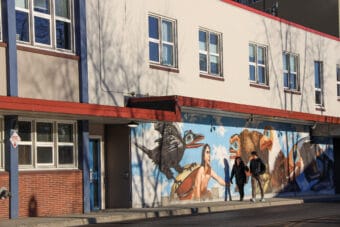
Instead, the nearly 1-acre property adjacent to the downtown library and parking garage — along South Franklin Street and under the watchful eyes of the Elizabeth Peratrovich mural — has remained largely empty. That’s despite the property’s extreme proximity to where 1.7 million cruise ship tourists walk off ships and into downtown Juneau each summer.

Jones said he’s not totally against the current “Alaska Fly & Dive” project — but needs more convincing that it will actually benefit Juneau.

“I don’t see anything in there that tells me that somebody in the middle of winter is going to leave their home in the valley and go,” he said. “I can’t imagine any of us going down in the middle of winter to take a simulated boat ride or a simulated submarine ride.”

Still, the new project has received letters of support from the Juneau Economic Development Council, Travel Juneau, the Downtown Business Association and the Society of St. Vincent de Paul. According to its application with the city, the development is in collaboration with Melvern Entertainment, a company that develops theater attractions for Disney, Universal Studios and Six Flags.

The proposed theaters include a 60-person 4D theater, a 72-person flying theater, and three 20-person ocean simulator theaters. The flying theater and ocean simulator theater would also be rides, taking guests via immersive films to see local glaciers and landscapes, and on underwater adventures.

This is a concept design of the Alaska Fly & Dive’s flying theater. (City and Borough of Juneau)

Liz Perry with Travel Juneau said in an interview that she’s excited to see the empty lot turn into something new. 

“This would be a terrific year-round addition to our offerings for both visitors and residents — it will create something that hasn’t been in that lot,” she said. 

And before you ask – no, they’re not planning to build any housing there. At least not in this application. Alix Pierce is Juneau’s Visitor Industry Director. In an interview, she said she thinks the project could help with managing the number of tourists that come into town each day in the summer. 

“I think having something downtown on the waterfront that’s indoors and helps manage congestion by pulling people into an activity, is a positive thing,” she said. 

The applicant for the permit is Reuben Willis, a local insurance Agent for State Farm. He declined an interview with KTOO to speak about the project before the meeting on Tuesday. In the application, it states that he signed a sales agreement for the lot, which is in a “due diligence period.” Morris Communications has also not responded to multiple requests for comment. 

The Juneau planning commission will decide whether to approve a conditional use permit for the project’s construction, along with two other variance requests related to the project, on Tuesday at 6 p.m. at City Hall. 

Residents can weigh in on Juneau’s multimillion-dollar budget hole at upcoming workshops

Cars drive past City Hall in downtown Juneau on Thursday, Jan. 22, 2026. (Photo by Clarise Larson/KTOO)

Juneau residents will have a chance to weigh in on what they’d like the city to prioritize during its upcoming budget process as it faces a multimillion-dollar budget hole. 

The city will host the first of three public workshops on the topic on Wednesday at 5:30 p.m. at the Filipino Community Hall downtown. The workshop is filled up – the city capped participation at 25 people – but people can join a waitlist. 

During last fall’s municipal election, Juneau voters approved municipal tax cuts that will lower the city’s revenue by an estimated $10 to 12 million. At the upcoming workshops, city officials will break down what services are at stake. Residents will have a chance to share their thoughts and work through different scenarios to balance the budget. Those could include cuts to city services or increases in local sales taxes.

The upcoming workshops come after a city survey that asked residents to pick what city programs and services are most important to fund and to pick what services to reduce funding for. The list includes programs like libraries and museums, trails and parks, and homelessness services. 

The survey also asked what residents want the Assembly to prioritize, like whether to keep taxes low, continue to support local businesses year-round, or fund affordable housing projects. The survey closed earlier this week and the results have yet to be shared with the public. 

City officials say the survey and the public workshops will help inform the Assembly in the coming months as it decides how to move forward with the budget. 

Two other workshops are slated in the coming weeks at the Mendenhall Valley Library on Feb.  24 and Douglas Library on March 3. Both are also full, but people can join a waitlist for potential future workshops. The Assembly will also host a listening session for the public to weigh in on the process on April 15.

Juneau Assembly OKs more than $2M toward affordable housing projects

Tlingit Haida Regional Housing Authority workers construct a house in the Pederson Hill subdivision on Tuesday, Feb. 10, 2026 (Photo by Clarise Larson/KTOO)

The Juneau Assembly approved more than $2 million in city funding to support four proposed affordable housing projects on Monday.

The money comes from the city’s Affordable Housing Fund. The fund was created five years ago to help combat the city’s housing shortage. It offers grants or loans to projects that aim to build more low- and middle-income housing.

The projects approved Monday are expected to create more than 40 housing units, including both single-family homes and apartment complexes located throughout the borough.

Dave D’Amato is a developer attempting to renovate the shuttered Bergmann Hotel in downtown Juneau into an apartment complex. In an interview on Tuesday, he said it hasn’t been easy.

“There’s quite a few elements that are outside the city’s control that are conspiring to make building very challenging and very costly,” he said. 

Last night, he got some help with those costs. The Assembly approved a $900,000 loan for his project that would turn the historic 46-room hotel into an 18-unit apartment complex. The loan is close to one-third of the total projected cost of $3.1 million. 

D’Amato said he hopes to have the units ready for renters within two years. He’s been working on redeveloping the building since 2017.

The former Bergmann Hotel in downtown Juneau on Jan. 11, 2024. (Clarise Larson/KTOO)

“I was really pleased that the Assembly decided to preserve the Bergmann and to simultaneously add 18 housing units to its affordable housing profile moving forward,” he said. 

The Assembly also approved two grants to Tlingit Haida Regional Housing Authority. One grant is for $800,000 to help fund the construction of 16 single-family homes in the Pederson Hill subdivision, some of which are currently being built. The other grant is for $250,000 to help pay for building five single-family homes on North Douglas.

Southeast Endeavors, LLC was approved for a $200,000 loan to construct a fourplex on Lee Street in Auke Bay. The Assembly did not vote on a fifth project that was up for a $150,000 grant to the Society of St. Vincent de Paul because of a clerical error. That vote was pushed to a later meeting.

At the meeting, the Assembly also approved zoning changes at two locations in Lemon Creek to allow for more housing developments in the future.

Juneau Assembly to vote on $2.3M worth of affordable housing funding

The former Bergmann Hotel in downtown Juneau on Jan. 11, 2024. (Photo by Clarise Larson/KTOO)

The Juneau Assembly will vote Monday night on whether to approve $2.3 million worth of city funding to support five proposed affordable housing projects. 

The money comes from the city’s Affordable Housing Fund. The city created the fund five years ago to address its housing shortage — specifically, the lack of low- and middle-income rentals. Since then, the city has awarded nearly $13 million in grants or loans from the fund. This round, $2.5 million is available.

The city uses criteria like proximity to public transportation and long-term affordability to decide which projects get funding and how much. The projects proposed this year would help create more than 40 units of housing, comprising both single-family homes and apartment complexes, all across the borough.

The city uses a formula based on Juneau’s income data to determine eligibility for affordable housing programs. People qualify as “low-income” if their household or individual income is at or below 80% of the Area Median Income. In Juneau in 2025, 80% AMI for a single person is $72,080 and $102,960 for a four-person household.

City and Borough of Juneau Rental Limits for 2025. (HUD User Datasets)

The Tlingit Haida Regional Housing Authority is up for two grants. One is for $800,000 to help fund the construction of 16 single-family homes in the Pederson Hill subdivision. The other grant is for $250,000 to help pay for building five single-family homes on North Douglas.

Another applicant, Dave D’Amato with Brave Enterprises, LLC, is up for a $900,000 loan to help fund the renovation of the shuttered Bergmann Hotel in downtown Juneau. The project would turn the historic 46-room hotel into an 18-unit apartment complex.

Shawn Kantola with Southeast Endeavors, LLC, is asking for a $200,000 loan to construct a fourplex on Lee Street in Auke Bay. And the Society of St. Vincent de Paul requested a $150,00 grant to help pay for long-term maintenance of its Teal Street facilities. 

Juneau residents have the chance to testify on ordinances on Monday’s agenda – as well as on non-agenda items – in person or online before the Assembly votes. People who want to testify online must notify the city clerk by 4 p.m. before the meeting. The meeting begins at 6 p.m. at City Hall. 

Juneau Assembly considers school and wastewater bonds, temporary tax for next election

People walk past City Hall in downtown Juneau on Thursday, Jan. 22, 2026. (Photo by Clarise Larson/KTOO)

The Juneau Assembly has some big financial decisions to make in the coming months. That’s because the city faces a multimillion-dollar budget hole that could result in cutting some city services in order to stay afloat. 

Along with figuring out how to balance the city’s budget, the Juneau Assembly will need to decide in the coming months whether a temporary tax and two bond debt proposals will appear on October’s municipal ballot. 

“I think at the end of the day why we put things on ballots are to give voters the choice. If they don’t want to fund these things then they won’t. We don’t lose anything because of that,” said Christine Woll, an Assembly member and finance committee chair. 

At a finance committee meeting Wednesday night, the Assembly discussed whether to ask voters to renew a 3% temporary sales tax currently in place, along with putting two bond packages on the ballot to fund critical repairs and upgrades to Juneau schools and the city’s water and sewer systems, which proponents say are sorely needed.

Juneau currently charges 5% in local sales taxes. That’s made up of both permanent and temporary taxes. 

Of that 5%, 3% is a temporary tax, which Juneau has had in place for decades. Voters approved extending it for five years in 2021. It expires in mid-2027. The money collected from that 3% tax currently goes toward numerous city services, like police and fire, street maintenance and snow removal, and general government operations. 

City Finance Director Angie Flick said the money is fairly flexible. 

“Really your roads, drainage, retaining walls, sidewalks, stairs, and we’ve been doing some utility work in that realm as well,” she said. 

At the meeting on Wednesday, some Assembly members were hesitant about whether to put the questions on the ballot. That’s because tax questions dominated last fall’s election and because the city is in a time of budget uncertainty. 

When it comes to bonds, Juneau voters approved adding nearly $23 million to the city’s debt in 2024 for public health and safety improvements. But last year, the Assembly narrowly voted against putting school and water and sewer systems bonds on the 2025 ballot because of how crowded the ballot was already. 

Assembly member Paul Kelly said he is still undecided on whether he wants to put them both on this year’s ballot, but he’s interested in approving at least one. 

“I’m interested, for sure, in the general obligation bond for schools,” he said Wednesday. 

Despite the initial discussion, the temporary tax and bond packages still need to go through a few committees before the Assembly votes on whether to put them on the ballot. This year’s municipal election is on Oct. 6.

Juneau Assembly asks View Drive residents to help pay for their own buyout after years of outburst flooding

The Mendenhall River surrounds homes on View Drive in the Mendenhall Valley on Tuesday, July 22, 2026. (Photo by Clarise Larson/KTOO)

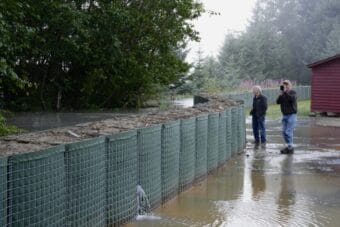
The City & Borough of Juneau tip-toed toward a federal buyout program for homeowners on View Drive this week, a street that’s been hit the hardest by annual glacial outburst flooding. The city’s asking those residents if they’ll help pay for it.

Eighteen homes line the forested cul-de-sac on View Drive, which extends into the Mendenhall River like a peninsula. They’re located beyond the temporary levee the city built last year, which protected hundreds of homes during the record flood in August. 

The buyout program, through the Natural Resources Conservation Service, or NRCS, would cost roughly $25 million if every household participates. The federal government has offered to cover three-quarters of the cost. The local portion could be around $6 million. 

City Manager Katie Koester spoke about it at a Juneau Assembly finance committee meeting on Jan. 7.

“The project would be a buyout of up to 18 homes on View Drive, and those homes would need to be demoed and turned into parkland in perpetuity,” she said. 

The city sent an informal ballot and letter to View Drive residents on Wednesday, asking if they’d be willing to give up hundreds of thousands of dollars from their home payout to shoulder that local portion. But it’s still unclear how this would work. In exchanges with KTOO, staff from the federal agency and the city explained it differently. 

Tracy Robillard, a spokesperson for NRCS Alaska, said in an email that state governments typically sponsor the 25% cost-share — including in New Jersey and Connecticut, and upcoming projects in New Mexico and South Carolina — where state environmental protection agencies have programs to purchase floodplains. In other cases, city governments have paid the local portion, Robillard said. 

Brett Nelson, Alaska’s watershed program manager at NRCS, said at the committee meeting there is another option.

“The more likely route would be some sort of third party coming up with the 25% local cost share,” he said. 

That third party could be a nonprofit. City staff spoke with the Southeast Alaska Land Trust back in July, but leaders there said they can’t commit millions of dollars in such a short time frame. 

NRCS hopes to offer the buyout before the next flood, expected this summer, Nelson said.

The U.S. Army Corps of Engineers is working on an engineered solution that would protect the whole Valley, but it’s still years away. In the meantime, homes on View Drive are expected to flood again and again. Some residents have said that leaving feels like their only option. 

“That’s an individual decision for those property owners, whether or not to, you know, take their chances and wait for an enduring solution,” Koester said at the meeting. 

If the buyout program moves forward, homes would be appraised at their 2024 value, prior to the flood that year. 

The city is asking residents to submit their informal ballots by Feb. 16, and plans to discuss the results at a Juneau Assembly committee meeting on Feb. 23. 

Site notifications
Update notification options
Subscribe to notifications