Housing

Juneau Assembly OKs more than $2M toward affordable housing projects

Tlingit Haida Regional Housing Authority workers construct a house in the Pederson Hill subdivision on Tuesday, Feb. 10, 2026 (Photo by Clarise Larson/KTOO)

The Juneau Assembly approved more than $2 million in city funding to support four proposed affordable housing projects on Monday.

The money comes from the city’s Affordable Housing Fund. The fund was created five years ago to help combat the city’s housing shortage. It offers grants or loans to projects that aim to build more low- and middle-income housing.

The projects approved Monday are expected to create more than 40 housing units, including both single-family homes and apartment complexes located throughout the borough.

Dave D’Amato is a developer attempting to renovate the shuttered Bergmann Hotel in downtown Juneau into an apartment complex. In an interview on Tuesday, he said it hasn’t been easy.

“There’s quite a few elements that are outside the city’s control that are conspiring to make building very challenging and very costly,” he said. 

Last night, he got some help with those costs. The Assembly approved a $900,000 loan for his project that would turn the historic 46-room hotel into an 18-unit apartment complex. The loan is close to one-third of the total projected cost of $3.1 million. 

D’Amato said he hopes to have the units ready for renters within two years. He’s been working on redeveloping the building since 2017.

The former Bergmann Hotel in downtown Juneau on Jan. 11, 2024. (Clarise Larson/KTOO)

“I was really pleased that the Assembly decided to preserve the Bergmann and to simultaneously add 18 housing units to its affordable housing profile moving forward,” he said. 

The Assembly also approved two grants to Tlingit Haida Regional Housing Authority. One grant is for $800,000 to help fund the construction of 16 single-family homes in the Pederson Hill subdivision, some of which are currently being built. The other grant is for $250,000 to help pay for building five single-family homes on North Douglas.

Southeast Endeavors, LLC was approved for a $200,000 loan to construct a fourplex on Lee Street in Auke Bay. The Assembly did not vote on a fifth project that was up for a $150,000 grant to the Society of St. Vincent de Paul because of a clerical error. That vote was pushed to a later meeting.

At the meeting, the Assembly also approved zoning changes at two locations in Lemon Creek to allow for more housing developments in the future.

Juneau Assembly to vote on $2.3M worth of affordable housing funding

The former Bergmann Hotel in downtown Juneau on Jan. 11, 2024. (Photo by Clarise Larson/KTOO)

The Juneau Assembly will vote Monday night on whether to approve $2.3 million worth of city funding to support five proposed affordable housing projects. 

The money comes from the city’s Affordable Housing Fund. The city created the fund five years ago to address its housing shortage — specifically, the lack of low- and middle-income rentals. Since then, the city has awarded nearly $13 million in grants or loans from the fund. This round, $2.5 million is available.

The city uses criteria like proximity to public transportation and long-term affordability to decide which projects get funding and how much. The projects proposed this year would help create more than 40 units of housing, comprising both single-family homes and apartment complexes, all across the borough.

The city uses a formula based on Juneau’s income data to determine eligibility for affordable housing programs. People qualify as “low-income” if their household or individual income is at or below 80% of the Area Median Income. In Juneau in 2025, 80% AMI for a single person is $72,080 and $102,960 for a four-person household.

City and Borough of Juneau Rental Limits for 2025. (HUD User Datasets)

The Tlingit Haida Regional Housing Authority is up for two grants. One is for $800,000 to help fund the construction of 16 single-family homes in the Pederson Hill subdivision. The other grant is for $250,000 to help pay for building five single-family homes on North Douglas.

Another applicant, Dave D’Amato with Brave Enterprises, LLC, is up for a $900,000 loan to help fund the renovation of the shuttered Bergmann Hotel in downtown Juneau. The project would turn the historic 46-room hotel into an 18-unit apartment complex.

Shawn Kantola with Southeast Endeavors, LLC, is asking for a $200,000 loan to construct a fourplex on Lee Street in Auke Bay. And the Society of St. Vincent de Paul requested a $150,00 grant to help pay for long-term maintenance of its Teal Street facilities. 

Juneau residents have the chance to testify on ordinances on Monday’s agenda – as well as on non-agenda items – in person or online before the Assembly votes. People who want to testify online must notify the city clerk by 4 p.m. before the meeting. The meeting begins at 6 p.m. at City Hall. 

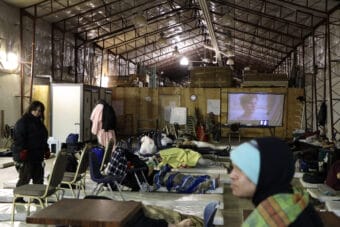
Why Juneau’s warming shelter moved multiple times during the avalanche advisory

Juneau’s emergency warming shelter on Thursday, Jan. 25, 2024. (Clarise Larson/KTOO)

Avalanche risk rose over the weekend as more snow and then rain pounded Juneau. Meanwhile, staff at the city’s emergency warming shelter for unhoused residents relocated operations three times in two days.

When the city issued evacuation advisories for high risk areas of town on Friday, it said the shelter along Thane Road was too close to historic avalanche paths to stay put, said St. Vincent de Paul Director Jennifer Skinner. 

The warehouse the city and the nonprofit use for the shelter is right below the red zone on the city’s avalanche risk map

“It was intense to realize that we were going to have to relocate our operations to, at that point, an undisclosed location,” she said. “And we were on standby.”

The shelter serves an average of 45 people who don’t have another place to sleep each night.

Shelter staff packed up everything they could — including a refrigerator — in an hour and a half. Skinner said she was preparing for an avalanche to prevent them from accessing the building ever again. 

First, the city told them to move to the Marie Drake building between the high school and Harborview Elementary School.

“And we completely 100% reset there, and as we were finishing, we’re hearing the roof, and we’re hearing all these cracks and creaks and such,” Skinner said. “And so we contacted our city officials again and said, ‘Hey, is this safe?’ And he said, ‘You know what? Get out. Let’s err on the side of caution.’”

So warming shelter staff evacuated that building, too. They had to make a safety plan with the fire department to go back in and get all the equipment they’d moved in.

The city and Red Cross of Alaska has made Centennial Hall available for residents in avalanche slide zones. 

But city Emergency Programs Manager Ryan O’Shaughnessy said the city wanted to avoid housing the two groups together, citing concerns over potential drug use and hygiene. 

So the city identified Sít’ Eetí Shaanáx — Glacier Valley Elementary as the only available building for the warming shelter. The school had closed for part of the school week so crews could shovel snow off the roof. 

With the help of a moving company, Skinner said they were able to set up at the school. They finished setting up an hour before the shelter opened at 9 p.m.   

“So that was a huge success for us — we didn’t skip a beat,” she said. “Our patrons were not impacted at all by having to reset.”

The warming shelter operated out of the school for just one night, and 44 people came to stay. 

Then, on Saturday, city officials determined the Thane warehouse to be safe enough for Skinner and her staff to move back in. 

Some Juneau residents raised concerns on social media about temporarily housing the unhoused population in an elementary school. 

City Manager Katie Koester spoke to some of those concerns at Monday’s Juneau Assembly meeting.

“We had a thorough inspection, a thorough cleaning of the facility,” she said. “But really for life safety of those residents, we had to make that decision, and we had to make that decision quickly.”

But Skinner said she mostly saw support from Juneau residents during the crisis. 

“I can’t express my gratitude to community members and community businesses that are so willing to step in and step up when we have a hard time,” she said. “And help us problem solve and just be like ‘we got you.’”

The emergency warming shelter is once again operating out of its usual location in Thane, with transportation to and from the Glory Hall, which provides meals and other day services. 

Avalanche risk remains high, and the city’s evacuation advisory is still in place for residents living in the Behrends slide path. 

Residents at a mobile home park in Juneau go weeks without adequate water pressure

The sun sets on Friday, January 17, 2019 at the Thunder Mountain Mobile Park in Juneau, Alaska. Residents are currently under a boil water notice after several days of low-pressure. (Photo by Rashah McChesney/KTOO)
The sun sets on Friday, January 17, 2020 at the Thunder Mountain Mobile Park in Juneau, Alaska. (Photo by Rashah McChesney/KTOO)

Dozens of Thunder Mountain Mobile Park residents weren’t able to use their showers or do laundry over the holidays and during recent snowstorms. 

Wright Services, the company that owns the park, said it won’t be able to repair the main water line until temperatures warm. And warm weather isn’t in the forecast any time soon. 

Tammy Jablonski said it’s making it hard to live her life. 

“I had, like, just a trickle come out,” she said. “Not enough to flush the toilet, not enough to, obviously, to take a shower or wash dishes or do anything else. Laundry, nothing.”

Jablonski has lived at the mobile park for more than 10 years. In 2020, the park lost water pressure during a cold spell, but it was resolved after a few days. This time, she said her water has been nothing but a trickle since Dec. 20. 

Wright Services General Manager David Crocker said some of the pipes that connect the main city water line to individual mobile homes are frozen. 

“Once it happens up at the top, where the connection is that the residents are responsible for, it can freeze them down into the main line and cause issues with people, other people in the park, other than just that one unit,” he said. “So we’ve been working diligently to try to identify where those issues are and take care of them.”

But, Crocker said, they can’t reach the main line with construction equipment because the ground is frozen. Instead, they are trying to trace the blockage by investigating each report. 

According to survey results Crocker shared, out of 89 residences, 60 initially had issues with low water pressure, and as of Monday, people in 11 residences reported the pressure had improved. 

When the pressure issues started, the company provided each resident with cases of water, two day passes to Juneau’s pools for showers, and portable toilets in the park.

But Jablonski said that the cases of water are long gone, the local pools have been closed sporadically, and the porta-potties immediately froze and are unusable.

She said she called Wright Services before the New Year to ask if there would be a rent reduction. Instead, she was charged the full amount, plus a rent increase that the company informed residents of before the water issues started.

“I never got a phone call back, and I have an auto payment for the park on my bank account, and it came out big as you please,” Jablonski said. “And it went up.” 

She said she hasn’t been hearing much from the company as this problem persists. When asked about rent reduction, Crocker told KTOO the company is focused on repairing the issue and declined to answer the question.  

The Alaska Landlords and Tenants Act says tenants can seek damages via lawsuits if services that should be provided in their leases aren’t. 

Jablonski said she and other residents just want running water again. 

“We are asking for help. We’re not trying to be demanding. We’re not being ugly,” she said. “We’re asking for basic services.”

In the meantime, the lack of water has taken a toll, Jablonski said. Especially on top of the historic amounts of snow. 

“I love a good snowstorm. But this one has handed my tail to me. The amount of money I’ve had to spend to get dug out, to help dig out myself, to get my roof cleaned off, to not be able to come in and take a hot shower and cook a good hot meal with hot water,” she said. “It’s like are you kidding me?” 

With another snowstorm descending, she worries that a fix won’t come any time soon. 

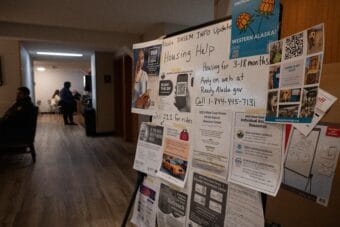
Western Alaska evacuees in Anchorage slowly moving to temporary housing

People stand outside a hotel with cars are parked in front
Evacuees of ex-typhoon Halong in Anchorage are moving out of hotels where they have been sheltering for months, and into temporary housing around the city. (Matt Faubion/Alaska Public Media)

Western Alaska residents who evacuated to Anchorage after the remnants of Typhoon Halong battered their villages are now moving out of city hotels and into temporary housing.

They’re looking forward to having more privacy, being able to cook for themselves and having more space, said Jeremy Zidek, public information officer for the Alaska Division of Homeland Security and Emergency Management.

“Hotel rooms are small,” Zidek said. “They’re meant to be someplace that you stay temporarily. These folks have been living there for quite some time.”

The state moved evacuees into hotel rooms around Anchorage in early November, after some had stayed in mass shelters for several weeks following the storm.

Ex-Typhoon Halong slammed into Western Alaska in October with wind, rain and flooding that devastated some communities, including Kipnuk and Kwigillingok, where homes floated off their foundations. One woman in Kwigillingok was found dead in the aftermath, and more than 1,000 people were displaced.

More than 500 people who evacuated to Anchorage are still in hotel rooms. But, as of the end of the year, the state had moved more than 150 people into temporary housing.

There are financial and logistical hurdles that slow down the process, Zidek said.

“With a diverse group of people with different capabilities, we have to really do that case by case and do that case work,” he said. “So it’s a complicated process, and to do that with 600 people is taking some time.”

Each move requires background and credit checks, and the homes need to be furnished, which Zidek said has been a challenge: They’re routinely buying out stores around the city. The state is also working to keep extended families close to each other. The cold weather this winter makes moving more difficult as well, Zidek said.

Another hurdle is the tight housing market in Anchorage. But housing is tight across the state, and Zidek said Anchorage actually has more availability than the rest of Alaska.

The state of Alaska has a cost-sharing agreement with the Federal Emergency Management Agency to fund the hotel stays, with FEMA paying 75% of the cost and the state covering the rest. Once people move into temporary housing, Zidek said, that changes.

“Most people moving into temporary housing are taking advantage of that FEMA rental assistance,” he said. “And then as we move down the road, there will be other housing assistance funding that could be brought to bear for people. It’s based on a case-by-case basis.”

Some people have started working and are able to pay their own rent, Zidek said.

There are some people who won’t qualify for temporary housing because they don’t pass background checks or credit requirements, Zidek said. The state plans to find alternative housing for those people, he said.

The state will focus on rebuilding in Western Alaska in the spring, Zidek said, so that those who want to return home can do so as soon as possible.

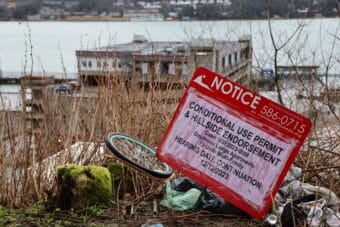
City plans to demolish Telephone Hill neighborhood before a lawsuit to save it goes to trial

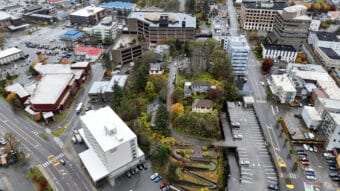
Snow covers the Telephone Hill neighborhood in downtown Juneau on Thursday, Dec. 18, 2025. (Photo by Clarise Larson/KTOO)

A civil lawsuit aimed at preserving a historic neighborhood in the capital city is set for trial next summer. Juneau’s city government, meanwhile, plans to demolish the neighborhood before then.

At a hearing on Wednesday, Superior Court Judge Amanda Browning set the trial date for August 2026. Three longtime tenants of the city-owned Telephone Hill neighborhood filed the lawsuit in October. It seeks to both stop the city’s demolition and reverse the evictions of renters. 

City Attorney Emily Wright said, as it stands legally, nothing is holding the city back from continuing with demolition. 

“There’s nothing stopping forward movement,” she said. “Right now, the timeline that the city manager’s office is working on is a March demo.”

After years of public debate, the Juneau Assembly approved demolishing the homes on the hill this spring to redevelop the area into newer, denser housing. The Assembly says the plan is necessary to address Juneau’s lack of housing. 

But, the tenants’ lawsuit claims that the city improperly evicted people on the hill, illegally phased the redevelopment and the project fails to comply with federal and state historic preservation acts. The city has repeatedly denied these claims.

Following Wednesday’s hearing, the tenants’ attorney, Fred Triem, said he intends to file a motion to prevent the demolition pending the outcome of the August trial. Judge Browning will decide whether to accept or deny it. 

“We want to save the old buildings — that’s the object of the suit,” he said. “We will move forward in the court system with our efforts to protect the buildings while we await the trial presently scheduled for August.”

At the hearing, Judge Browning also ruled on a couple of the eviction cases the city filed against remaining tenants who refused to vacate by the city’s Nov. 1 deadline. While Browning ruled in favor of the city’s right to evict two residences, she gave different eviction deadlines to the tenants because of their personal circumstances. A third eviction case is still pending. 

Site notifications
Update notification options
Subscribe to notifications