
Alaska Public Media

Alaska Public Media is one of our partner stations in Anchorage. KTOO collaborates with partners across the state to cover important news and to share stories with our audiences.
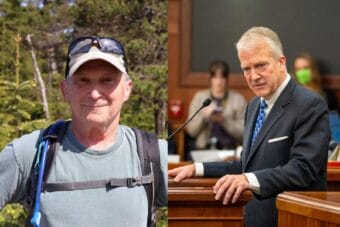
Alaska legislator’s chief of staff arrested on child sex crime charges

A man in a blue suit stands at left in a side-by-side with his alleged Snapchat avatar.
Craig Scott Valdez, left, next to a Snapschat avatar he allegedly used to contact children for the purpose of sexually exploiting them. (Memorandum in support of detention in U.S. vs. Craig Scott Valdez)

A state legislator’s former chief of staff faces charges of child sexual exploitation and child sex trafficking. Federal agents arrested Craig Scott Valdez, 36, early Friday in Juneau, according to court documents.

Valdez is an Anchorage resident listed as having served as Republican Wasilla state Sen. George Rauscher’s chief of staff since November. Valdez was terminated Friday hours after the charges were made public, according to a press secretary for the state Senate minority caucus, of which Rauscher is a member.

Valdez was also elected as chair of the Anchorage Young Republicans in January 2025 and became the group’s state committee chair last month, according to social media posts.

A grand jury on Tuesday indicted Valdez on charges of sex trafficking a minor, sexual exploitation of a minor – for both allegedly producing and receiving child sexual abuse material – and coercion and enticement of a minor. The alleged crimes occurred in October 2025, according to the indictment.

Court documents detail a specific instance in which Valdez allegedly lured a 15-year-old girl to his Anchorage home. But prosecutors also wrote that the FBI has identified at least 11 other potential victims, and federal authorities are asking the public for help as their investigation continues.

In a court filing supporting Valdez’s detention in jail, federal prosecutors laid out what they say happened in October:

Valdez had met the 15-year-old girl on Snapchat, picked her up at her home and drove her to his house, “for the purpose of sexually exploiting the child to celebrate his birthday,” the detention memorandum says.

The girl’s sibling alerted her mother, who used a family tracking application to track her daughter to Valdez’s home in south Anchorage. The mother called Anchorage police after arriving at Valdez’s home and waited outside, where she heard her daughter inside the house say something about wanting to leave.

“(The girl’s) mother then entered the residence, struck Valdez once in the face and recovered the child, who exhibited signs of extreme drug or alcohol intoxication and had difficulty walking and maintaining consciousness,” the memo says. “(Police) responded a short time later, at which point Valdez, puzzlingly, chose to flee from his own residence.”

While the girl had left her own phone at Valdez’s residence, the mother was able to copy messages from a separate linked device showing Valdez had used Snapchat to entice the girl to come to his home for sexual purposes.

The girl later told investigators that other children had introduced her to Valdez when she was 13 or 14 years old.

Law enforcement officials do not think the October incident was the first time Valdez exploited the girl, nor do they think she was his only victim.

Federal prosecutors wrote in a news release Friday that investigators are looking for more information, including other victims. They say he went by the usernames “NONAME20233132” or “DOCHANK” and ask that anyone with further information on Valdez call the FBI Anchorage Field Office at 907-276-4441 or deliver tips anonymously to tips.fbi.gov.

A request for comment Friday morning to Rauscher’s office was referred to the state Senate minority caucus’s press secretary, who said she did not have any information to release beyond what was publicly available in the court documents. The press secretary, Cassandra Day, texted later to say that Valdez had been fired.

The next hearing in the case is set for Monday.

Editor’s note: This story has been updated to reflect that Valdez was fired from his position as state Sen. George Rauscher’s chief of staff Friday afternoon.

Correction: An earlier version of this story misstated the group Valdez was elected chair of in 2025. He was elected chair of the Anchorage Young Republicans, not the Alaska Young Republicans.

Sullivan laces annual address to Legislature with partisan complaint

Sen. Dan Sullivan addresses the Alaska Legislature on Feb. 18, 2026.
Sen. Dan Sullivan addresses the Alaska Legislature on Feb. 18, 2026. (Eric Stone/Alaska Public Media)

U.S. Sen. Dan Sullivan, in his annual address to the Alaska Legislature, slammed national Democrats as bent on ruining Alaska.

“Now, I’m not being partisan here. These are just the facts,” he said at one point during his speech Wednesday. “And Alaskans should know who wants to help us and who wants to hurt us.”

As in past years, he blamed the Biden administration for trying to shut down Alaska. But under President Trump, he said, Alaska is in the midst of a comeback, with renewed emphasis on military expansion, resource development, Coast Guard icebreakers and a new rural health care fund.

“Our state will receive from this fund approximately $1.4 billion over the next five years to transform our health care system,” Sullivan said, to resounding applause in the state House chamber.

As he describes it, though, Democrats are still targeting Alaska. Sullivan referred to the U.S. Senate’s top Democrat, Chuck Schumer, at least nine times.

Sullivan spoke for about 50 minutes and took questions from half a dozen legislators and then from reporters at the Capitol.

He doesn’t often take challenging questions in large public forums, so his yearly address to the Legislature is closely watched, especially now that he’s running for reelection, aiming to serve his third six-year term.

Rep. Genevieve Mina, D-Anchorage, who chairs the health committee, challenged Sullivan on the $1.4 billion achievement. She said she’s discovered that Alaska isn’t allowed to use the health care fund to help self-employed people cope with rising premiums, on clinic expansions or to build housing for health care workers, among other priorities.

“You helped shape the Rural Health Transformation Program Funds. Why are these funds so difficult for us to use to address Alaska’s core issues?” she asked Sullivan. “And how will this finite fund help address the thousands of Alaskans who will lose their health insurance?”

She cited a new analysis finding that up to 12,000 Alaskans risk losing their Medicaid insurance coverage because of another provision in the same bill.

Sullivan said wasn’t aware of the report or of all the restrictions on how Alaska can spend its share of the health care fund.

“This is not going to be a panacea that solves everything,” he said, though he also said that the government might be able to remove some of the limits.

Sen. Forrest Dunbar, D-Anchorage, contrasted Sullivan’s negative take on Biden with his positive stance on Trump and asked how far his loyalty goes.

“You’ve said yes to Trump many times. I’m wondering if you’re willing to say no,” Dunbar said. “For example, if we saw a deployment of federal forces to Alaska, like we’ve seen it seen in Minnesota, or if the federal government demands we purge our voter rolls, will you say no to Trump?”

Sullivan seemed irritated at Dunbar.

“I think you were the guy who asked me last year about Medicaid,” Sullivan recounted, and he began his answer there.

“You know who cut Medicaid for Alaska? Chuck Schumer, right? That’s a fact,” Sullivan said. “So I wish that you and others could have gone to Schumer and said, ‘Hey, why are you cutting Medicaid for Alaska?'”

Schumer didn’t cut Medicaid funding for Alaska, but Sullivan had tried to get an increase in the Medicaid payment rate for the state. Opposition was bipartisan.

As for Dunbar’s current question, Sullivan said he goes after Trump administration officials when they deserve it, sometimes publicly.

“You want to put out a tweet smashing them on certain issues or criticizing them? Sometimes that works,” Sullivan responded. “But sometimes, if you want results, that’s not always the best way to get results.”

Rep. Ashley Carrick, D-Fairbanks, said the speech was “par for the course” for Sullivan. Still, she said, the tone was jarring in the House chamber.

“His hyper-partisanship really showed in the speech today, and it does present a sharp departure from Alaska’s bipartisan coalition governance and the spirit of Alaskans to not affiliate with parties as often as not,” she said.

She found it “surprising” that Sullivan suggested Alaska legislators lean on Schumer.

“We don’t really have that authority to, you know, make demands of those that are not our senators,” she said. “And the insinuation that it’s only Democrats in the United States Senate that are holding back progress is a mischaracterization of some of the biggest and most challenging problems that we have.”

It takes bipartisan solutions to solve the complex disputes facing the country, she said.

Sen. Lisa Murkowski is scheduled to address the Legislature late next month.

10 candidates report six-figure hauls from early fundraising in Alaska governor’s race

People walk by the Governor’s House, as it’s referred to in official documents, in downtown Juneau, Alaska on Friday, March 21, 2025. (Clarise Larson/KTOO)

The first round of fundraising reports in the 2026 governor’s race were released Tuesday, shedding some light on a crowded field.

Altogether, candidates raised more than $4.3 million by the beginning of February, according to the first batch of campaign finance reports in the race.

Anchorage podiatrist and Republican Matt Heilala accounts for more than a quarter of the total. Heilala contributed nearly $1.3 million to his own campaign, accounting for more than 94% of his fundraising. In an interview, Heilala said self-funding his campaign means he can turn down contributions from donors or groups that don’t jive with his values.

“I’m not in desperate need of big money from big, influential donors. There’s a quid pro quo, and that’s a major problem,” Heilala said. “Not to say I’m not going to take money from some big donors as we keep going, but I’m going to be able to be very, very selective.”

Heilala has also accumulated hundreds of smaller donors, raising more than $60,000 from just shy of 350 donors.

Former Attorney General Treg Taylor is another Republican candidate relying on self-funding to an extent. He’s the No. 2 fundraiser in the race so far, with roughly $880,000 in total contributions. About a third of that comes from Taylor himself.

Taylor leads in external fundraising by a significant margin. He’s raised more than $592,000 in outside funding from nearly 250 donors, including $100,000 from Anchorage anesthesiologist John Morris and several five-figure checks from business and medical professionals in Anchorage and the Matanuska-Susitna Borough.

Former state Revenue Commissioner Adam Crum is in third with roughly $350,000 in contributions, much of it from himself and family members. An uncle of Crum’s wife, Charles McGarrity of Florida, was the largest single contributor at $40,000, and Crum kicked in an additional $60,000. Another notable Crum contributor is state Education Commissioner Deena Bishop, who donated $5,000.

Crum said he’s expecting more money to come off the sidelines and head to candidates as the August primary draws closer.

“Knowing that there’s a handful of us that are kind of out in front on the money side, I think that fundraising is going to ramp up,” Crum said.

Tom Begich was the top Democratic fundraiser in this round of reports. The former Anchorage state senator has also taken in roughly $350,000 from a wide range of donors. He said fundraising ramped up in earnest when Mary Peltola announced she’d be running for U.S. Senate rather than for governor.

Begich is “not a wealthy person,” he said in an interview, and he said he’s proud of the fact that 92% of the funding for his campaign has come from Alaskans.

“Buying your way to the governorship is just not — I just don’t think that’s good for Alaska,” he said. “What I want to see is people reaching out to regular donors, getting people who are regular Alaskans engaged and involved in their campaign. And that’s certainly what I’m doing.”

Among Begich’s largest donors are Anchorage wealth manager Justin Weaver, donating $75,000, Anchorage attorney Robin Brena, who kicked in $50,000 and attorney Mark Choate of Juneau, who contributed $15,000. Chicago-based Jennifer Pritzker, a cousin of billionaire Democratic Illinois Gov. J.B. Pritzker, donated $10,000. Begich said he’d never met her but appreciated the support.

Another Democrat in the race, former state Rep. Jonathan Kreiss-Tomkins, didn’t join the race until after the reporting period had ended. But according to his campaign, he’s raised $750,000 in his first two weeks in the race. That’s more than twice as much as Begich, who has been in the race since August.

Including Kreiss-Tomkins, 10 candidates reported raising six-figure totals. Those include Republicans Shelley Hughes, Bernadette Wilson, Click Bishop and Dave Bronson, in addition to Democrat Matt Claman. Republican Lt. Gov. Nancy Dahlstrom, who won Trump’s endorsement in the 2024 House race, raised just over $17,000.

“It’s a little bit like being a venture capitalist,” said Scott Kendall, an attorney and occasional campaign operative. “When you’re a candidate, you’re selling a product — and if no one’s investing, that’s a bad sign.”

But with strong early fundraising, quite a few candidates have a real shot at winning, Kendall said.

“For probably the most important race in the state, we have a level of competition maybe we’ve never seen,” Kendall said. “Yeah, there were 48 candidates in the special election for Don Young’s seat. But really, there were only, like, four or five, six serious candidates. Here, there’s really 10 legit candidates, and it’s pretty exciting.”

The top four vote-getters in the nonpartisan blanket primary in August will advance to the general election in November.

Correction: An earlier version of this story misstated where Mark Choate lives. He lives in Juneau, not Anchorage.

ICE detains Soldotna kindergartner and family

A man stands at a podium with a group behind him.
Rev. Michael Burke of St. Mary’s Episcopal Church speaks at a news conference on Tuesday, Feb. 17, 2026. (Matt Faubion/Alaska Public Media)

Immigration enforcement agents swarmed a Soldotna home Tuesday morning and took a family of four, including a kindergartner, into custody.

Sonia Arriaga, from Jalisco, Mexico, has lived in Alaska since 2023. Her husband, Alexander Sanchez-Ramos, said agents arrived in about five vehicles and pulled her from her car when she returned from driving her middle child to school.

“I’m not talking about nicely, either. I’m talking about aggressively grabbing her and pulling her out. You know, she’s still in her pajamas, for crying out loud,” he said.

Sanchez-Ramos is an American citizen, born in Seward. He said masked agents placed him in handcuffs as he stood outside in temperatures hovering in the teens, wearing gym shorts and sandals. They questioned him about who else was at home. A relative brought the youngest child out.

“He was upset. He was crying, asking for his mom,” Sanchez-Ramos said.

Arriaga and her three sons, ages 5, 16 and 18, were eventually taken to Anchorage. The oldest son was put in jail, Sanchez-Ramos said, while the younger sons and their mom were detained in a hotel.

The story of their arrest reached a group of church leaders in Anchorage who told reporters the case raised grave moral concerns.

“How could anyone possibly claim to support family values when they are willing to stand by and be silent when a five year old is taken into detention?” said Rev. Michael Burke, senior pastor at St. Mary’s Episcopal Church.

He said the incident could traumatize a child for the rest of his life.

Burke said he isn’t disputing the lawful enforcement of immigration restrictions. But, he said, federal agencies are trampling the law and violating the pledge that stepped-up enforcement would target criminals and the “worst of the worst.”

“As faith tradition leaders, grounded in the Hebrew Scriptures, in the gospel of Jesus Christ, we say that there is something deeply wrong here,” he said from his church pulpit, with eight pastors representing different congregations behind him. “There is a moral crisis in America where we detain and arrest families and small children.”

Sanchez-Ramos said Arriaga was in the country legally and was seeking asylum based on threats of violence in Jalisco. She had legal authorization to work, he said. She missed a hearing date in January, he said, but their lawyer assured them all the paperwork had been filed to revive her claim.

They met at a Mexican restaurant where they both worked and married earlier this month, he said.

Immigration and Customs Enforcement has not yet responded to an emailed query about the case.

Anchorage’s Schumacher earns silver in cross-country team sprint

Two men holding silver medals
Ben Ogden (right) and Gus Schumacher (left) won silver medals on Feb. 18 at the 2026 Milano Cortina Winter Olympic games. (Nat Herz/Alaska Public Media)

Anchorage cross-country skier Gus Schumacher won a silver medal Wednesday at the 2026 Milano Cortina Winter Olympic games, after racing a near-perfect anchor leg in the team sprint event.

Paired with teammate Ben Ogden from Vermont, Schumacher challenged Norwegian superstar Johannes Klæbo on the last climb of the six-lap race and finished just ahead of Italy.

It’s Schumacher’s first Olympic medal, and he said he was dialed in nearly all the way to the finish line to claim it.

“I think I did a good job of not thinking too, like, results-wise until, you know, I could see Ben on the other side there and knew I had space,” he said. “I’m really proud of how I just sort of skied with abandon in a way, because when I’m skiing free I’m the best.”

Schumacher is 25 years old and grew up in Alaska and has dreamed about the Olympics for most of his life.

He became the first American to win a gold medal in an individual race at the Junior World Ski Championships in 2020. Then in 2024, he became the youngest American to win a World Cup cross-country ski race. Schumacher was one of eight Alaska Nordic skiers competing in this year’s Olympics.

Schumacher raced against Ogden on the U.S. circuit starting at a young age. They’ve since become close friends and are rooming together in Italy, where Ogden also won a silver in the individual sprint race.

Schumacher said that history made it particularly special to stand on the podium alongside Ogden. There’s a whole community that makes a result like an Olympic medal possible, he said.

“Amazing to cross that line and celebrate with Ben, and then just like everyone who’s helped us along the way. Like, my parents are here, and the whole wax staff, and the staff in general, and coaches and everything,” Schumacher said. “It means a lot to all of us.”

Schumacher and his coach Erik Flora say they’re delighted to get home and share the medal with teammates, friends and other Alaskans.

Meda DeWitt, traditional healer, announces run for governor

Meda DeWitt is running for governor as an independent.
Meda DeWitt is running for governor as an independent. (DeWitt campaign)

A 17th candidate has announced she’s running for governor.

Meda DeWitt, 45, is a traditional healer, drawing on her Tlingit heritage. She teaches at the University of Alaska.

She’s running as a nonpartisan.

“I care about our future,” she said. “I care about the way that we steward our lands and want to see a state that has a thriving ecosystem and healthy communities that can live in perpetuity.”

In 2021, DeWitt chaired a campaign to recall Gov. Mike Dunleavy. The petition gathered more than 60,000 signatures but fell short of the number needed for a recall election.

Her campaign website lists a wide array of priorities, from cost of living to health care to the state economy.

DeWitt lives in Anchorage and has family roots in Wrangell and Yakutat, as well as relatives around the state.

The Aug. 18 primary will feature a long list of gubernatorial candidates, most running with the Republican label. In the primary, voters can choose just one. The top four candidates, of any party, will advance to the November ballot. General election voters will have the option of ranking up to four candidates.

Site notifications
Update notification options
Subscribe to notifications