Western

With Western Alaska salmon runs weak, managers set limits on the pollock fleet’s chum bycatch

Audience listens to testimony Feb. 9, 2026, at the North Pacific Fishery Management Council meeting in Anchorage. Subsistence fishers from the Yukon and Kuskokwim river basins were among those attenting the meeting and giving public testimony about bycatch of chum salmon in the Bering Sea pollock fishery. Also attending the meeting were people involved in the pollock industry. Public testimony on the issue to the full council stretched over four days. (Photo by Yereth Rosen/Alaska Beacon)

Federal fishery managers have approved the first-ever mandatory caps on at-sea interception of chum salmon, a fish species critical to Indigenous communities along Alaska’s river systems.

The North Pacific Fishery Management Council on Wednesday voted in favor of new limits for the pollock fleet to reduce the amount of chum salmon accidentally caught in trawl nets, a phenomenon known as bycatch.

North Pacific Fishery Management Council member Nate Pamplin, Diana Evans, the council’s executive director, and council chair Angel Drobnica listen to testimony on Feb. 7, 2026, at the February meeting in Anchorage. (Photo by Yereth Rosen/Alaska Beacon)

The compromise, approved at the end of a 10-day council meeting, addresses a yearslong conflict that pitted the in-river salmon fishermen and their Indigenous cultures against the economically important harvesters of Alaska pollock, the top-volume U.S. commercial seafood.

Achieving effective safeguards for Western Alaska chum salmon while balancing needs of all parties amid environmental factors that are out of managers’ control was difficult, Angel Drobnica, the council’s chair, said just before the vote was taken.

“This is the most challenging issue I’ve worked on during my time in this process,” she said, referring to her three years on the full council and six years on the group’s advisory panel. “I believe this motion is durable and enforceable and reflective of input from both sides and has maintained a clear focus on Western Alaska salmon.”

Salmon bycatch is a hot-button issue in Alaska fisheries. Total amounts of chum salmon accidentally caught in the trawl nets used by the pollock fleet can number in the hundreds of thousands — though the vast majority of the chum salmon intercepted in the Bering Sea in this manner is not of Alaska origin, according to council data.

While bycatch limits have been in place for several years for Chinook salmon, this is the first time managers have imposed limits for chum salmon. Both Pacific salmon species are important to the Yukon and Kuskokwim river system communities, and both have collapsed in recent years, at times prompting complete fishing closures all the way into Canada’s Yukon Territory.

A list of people signed up to testify at the February meeting of the North Pacific Fishery Management Council is taped to a William A. Egan Civic and Convention Center room door on Feb. 9, 2026, The room, down the hall from the rooms where the council was convened, was reserved and used for the duration of the meeting by tribal oroganizations, including the Kuskokwim River Inter-Tribal Fish Commission and the Tanana Chiefs Conference. (Photo by Yereth Rosen/Alaska Beacon)

The measure imposing chum bycatch limits, years in the making, included several elements:

  • It sets an annual bycatch cap of 45,000 Western Alaska chum salmon.
  • It apportions the cap among the different pollock-fishing sectors: at-sea processors, catcher ships that deliver to onshore plants, catcher vessels that deliver to “motherships,” which are vessels that collects harvests; and Community Development Quota organizations, which represent rural and Indigenous communities have invested in the fisheries and are assigned shares of annual groundfish harvests.
  • It applies the cap to corridors in the Bering Sea that are known to be used by migrating Western Alaska chum salmon and to the summer months when bycatch of Western Alaska chum is concentrated, then when Alaskans are most affected. The use of corridors is intended to address the fact that the vast majority of chum salmon netted as bycatch in the Bering Sea are fish from Asian hatcheries rather than fish that swim though and spawn in Alaska rivers.
  • The approved measure contains triggers that would enforce area-specific pollock trawling shutdowns if bycatch levels are reached.
  • The approved measure mandates the use of bycatch-reduction technology and practices that are currently voluntary in the industry. Those include employment of salmon-excluding devices that allow salmon to swim free of nets holding pollock and enhanced communication and record-keeping to broaden knowledge among the fleet, tribal organiziation and members and the general public about potential bycatch hotspots and how to avoid them.
Signs seen Feb. 7, 2026, at a room in the William A. Egan Civic and Convention Center used by tribal organizations attending the North Pacific Fishery Management Council meeting. (Photo by Yereth Rosen/Alaska Beacon)

The measure is set to go into effect in 2028.

Managers approved it by an 8-3 vote. One of the dissenters, Seattle-based Jamie Goen, executive director of Alaska Bering Sea Crabbers, said the cap was too high.

“This motion is a license to kill 45,000 Western Alaska chum when we have information showing that every salmon that comes back to Western Alaska rivers counts,” she said Wednesday just before the vote was taken. “Every female salmon holds the potential to release thousands of eggs that can grow exponentially to feed in-river communities and keep their cultures alive.”

The reduction in pollock harvesting that would result from a lower cap would be “negligible,” compared to the losses suffered by river communities, she said.

Goen’s comments mirrored a slogan imprinted on wristbands, buttons and other items distributed by tribal groups attending the meeting: “Every Salmon Counts.”

Council member Jon Kurland, who is also director of the National Oceanic and Atmospheric Administration’s Alaska fisheries service, said that while the salmon crash has had “devastating effects” in Western Alaska with details that are “heartbreaking,” the socioeconomic benefits of the pollock harvests also need to be considered.

Wristbands and buttons bearing the slogan “EVERY SALMON COUNTS” are displayed on a table on Feb. 9, 2026. The wristbands and buttons were being distributed by tribal organizations attenting the North Pacific Fishery Management Council meeting in Anchorage. The slogan references the argument that every salmon that avoids bycatch and is able to swim to river spawning grounds is important to the population and to the people who depend on salmon runs. (Photo by Yereth Rosen/Alaska Beacon)

Those include “the family businesses that operate catcher boats, the seafood processing capacity in many remote areas that really needs a steady flow of pollock to process other species for smaller-scale fisheries and the ways that the community development quotas improve people’s lives in 65 Bering Sea communities,” he said.

After the vote, tribal representatives attending the meeting had mixed reactions to the council’s action. In some ways, it was a positive movement, they said.

“It’s a start,” said Charlie Wright, secretary and treasurer of the Tanana Chiefs Conference.

“The pressure is on,” said Eva Burk of Nenana, a tribal representative on the council’s advisory panel.

But Wright, from the Yukon River village of Rampart, and Burk said they were disappointed that the numerical cap was not lower and that the geographic area to which it will apply was not broader.

An organization representing the pollock industry said the council’s action was fair, decision was fair, even though it puts some more burden on pollock harvesters.

“The Council’s decision reflects the seriousness of the challenges facing Western Alaska chum salmon and the complexity of managing a dynamic fishery,” said a statement released by the Alaska Pollock Fishery Alliance. “The pollock industry respects the Council process and remains committed to working within this new framework while continuing to invest in science-based, real-time avoidance tools that have already delivered meaningful reductions in Western Alaska chum bycatch.”

Alaska pollock, shown here from a harvest, make up the nation’s top-volume single-species commercial seafood catch. Each December, the North Pacific Fishery Management Council sets the next year’s harvest levels for pollock and other groundfish. Those decisions are based on scientific analysis that could be compromised this year by the federal government shutdown. (Photo provided by the National Oceanic and Atmospheric Administration)

Wednesday’s vote came after four days of often impassioned public testimony sessions that started on Saturday and ran through Tuesday afternoon. An estimated 170 people attending the meeting addressed the council during those days. They included subsistence fishers and leaders of tribal originations along the Yukon and Kuskokwim basins, small-scale pollock harvesters, representatives of fishing companies, Indigenous organizations with investments in the pollock fishery and others.

One of the tribal leaders testifying was Brian Ridley, chief executive of the Tanana Chiefs Conference, an organization of Interior Alaska Athabascan tribal government. TCC and other tribal groups have been seeking the strictest limits possible, he told the council.

For Yukon River communities, salmon fishing closures over the past years have resulted in “food insecurity, starvation, diabetes, cancer and cultural loss,” he said in testimony Saturday.

“Let me be clear: We’re not asking to shut down the pollock fishery. We’re asking for the first real step in sharing the burden of conservation, the same step Yukon fishers began taking decades ago. Our communities have carried the burden alone for more than 20 years. Today, we’re asking the pollock fleet to finally share the burden,” Ridley said.

There were more personal accounts, like one delivered Saturday by Julia Dorris of Kalskag, a village on the middle section of the Kuskokwim River.

“My dad had a dog team. Because of less chum and the restrictions, he no longer had his team. And had to get rid of all the dogs. It was heartbreaking to see a strong person quietly fading,” Dorris said.

The pollock trawl fleet had its defenders as well.

Those included Frank Kelty, a former mayor of Unalaska, and Victor Tutiakoff Sr., the Aleutian Island city’s current mayor. Tutiakoff mentioned that he himself is a subsistence fisher, so he understands subsistence needs. Kelty mentioned the Community Development Quota groups that, under a program established in 1992, comprise villages in different Western Alaska regions that have banded together to invest in Bering Sea and Aleutian Islands fisheries.

“The pollock fishery, as we all know, is the economic engine of Unalaska and other fishery-dependent communities in the Bering Sea region, including the six CDQ groups. A closed or reduced pollock season is devastating,” Kelty told the council.

Unalaska is “a one-horse town” completely dependent on commercial fishing, with the local government highly dependent on fishing-related taxes, he said. “If you have reduced or closed seasons, you see impacts throughout the community. The population reduces, employment at the plants goes away, the school population drops, clinic — it’s just a bad situation,” Kelty said.

Defenders of the pollock industry included Native organizations. One was the Qawalangin Tribe of Unalaska, which presented a recently passed resolution warning that hard caps on chum bycatch could cause “significant economic risk for Tribal members and for fishery-dependent communities.”

Although they sometimes disagreed about the role of bycatch, speakers on both sides of the debate agreed that the problems facing Western Alaska chum salmon, as well as the faltering runs of Chinook salmon, are myriad.

Climate change, with effects in both the ocean and in freshwater systems, is a major factor, speakers said. For example, Jacob Ivanoff of Unalakleet, representing the Nome Eskimo Community tribal government, described the masses of fish found dead of heat stroke in rivers in 2019, along with water temperatures that ranged up to 85 degrees during that year’s marine heatwave.

The growing presence of Asian hatchery chum salmon in the Bering Sea is a complicating factor. The flood of new fish, aside from competing with Alaska fish for food and potentially crowding Alaska fish out of the habitat, are dominant in the bycatch numbers.

In past years, genetic testing shows that only about a fifth of the chum salmon netted as bycatch by the Bering Sea pollock fleet has been from Western Alaska, council members said. Most of the rest is from Asian hatcheries, including hatcheries in Russia, though a small portion has also been composed of chum salmon from the state’s more southern Gulf of Alaska waters or from the Pacific Northwest region even farther south.

The total chum salmon bycatch in the pollock fishery in 2025 was about 151,000 fish, according to a report presented to the council early in the meeting. Most of that was hatchery fish. The percentage of bycatch that was fish from Western Alaska rivers was low, but it fluctuates from year to year and even from week to week during harvest seasons, according to genetics information presented by the Bristol Bay Science and Research Institute.

Bycatch concerns go beyond salmon. The term refers to any accidental netting, hooking, entaglement or crushing of an untargeted species. Several types of fish, birds and marine mammals are killed or injured through bycatch in different fisheries. NOAA keeps track of annual bycatch totals.

Eva Burk, Jessica and Rory Black, Ariella Bradley, Fatima Lord-Minano and Charlie Wright cut salmon during an August 2025 cultural camp held in Nenana. The youth and adults in the camp were able to harvest and process a few chum salmon in 2025, for the first time in several years. Burk, who is from Nenana, is a tribal representative on the North Pacific Fishery Management Council’s advisory panel. Wright is secretary and treasurer of the Tanana Chiefs Council. Both have argued for tighter restrictions on at-sea interception of Western Alaska chum salmon. (Photo provided by Eva Burk)

One phone call at a time, Kipnuk residents vote on whether to rebuild or relocate

A few dozen people gathered in Anchorage on Jan. 31, 2026, while several dozen more joined virtually, to discuss whether to rebuild or relocate Kipnuk.
A few dozen people gathered in Anchorage on Jan. 31, 2026, while several dozen more joined virtually, to discuss whether to rebuild or relocate Kipnuk. (James Oh/Alaska Public Media)

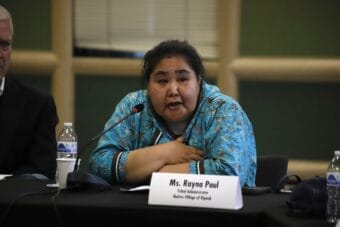
Rayna Paul sat in an Anchorage office on Monday, scrolling through a spreadsheet filled with hundreds of names and phone numbers of Kipnuk tribal members.

“We are just on As,” she said with a chuckle.

Paul is Kipnuk’s environmental director who is in charge of the village’s voting process. Over the next several days, she and her team plan to call every single adult tribal member – that’s about 900 people – and ask them a pressing question: Do they want to rebuild the village in its current location or move to higher ground?

“It’s very important for us to find out what the tribal members from Kipnuk want to do, so we can continue trying to move forward in applying for funding,” she said. “We’re always on a timeline.”

Rayna Paul and her team started reaching out to Kipnuk residents on Feb. 9, 2026, to collect their votes on whether they want to relocate or rebuild. (Alena Naiden/KNBA)

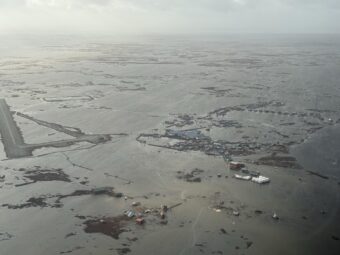
Kipnuk sits about 4 miles inland from the Bering Sea, in the Yukon-Kuskokwim Delta. Last fall’s disastrous winds and flooding destroyed homes and infrastructure there and contaminated land and water. Today, most residents remain evacuated in Bethel or Anchorage, including Paul. She said she wants the future Kipnuk to be safe.

“We love our community. We miss our community,” Paul said. “We’re doing it for our future generations to come, because they might not know what to do when this happens again. I think we’re just going to be hit with many, many storm events.”

The first community meeting about whether to relocate happened about a week ago. The decision to start voting followed swiftly.

Sheryl Musgrove, who directs the climate justice program under the Alaska Institute for Justice, is assisting the village in the process. She said residents need to act quickly to make the most of both the short construction season and the available funding for disaster recovery.

“It seems fast, but we’re four months out from the disaster,” Musgrove said. “The tribe just needs to know which direction they’re going, so that they can put their efforts into following the path forward that they determine is the best path for them.”

The relocation process can be costly, but Musgrove pointed out that so is repairing and rebuilding homes and infrastructure.

The fall storm also destroyed much of Kwigillingok and residents have already voted to relocate. Musgrove said that while the relocation of another village in the region, Newtok, took decades, she hopes that Kipnuk and Kwigillingok can be examples of how to move through this process faster.

“They don’t have decades. They need to do it immediately,” Musgrove said. “My hope is, they can show other communities that are going to be faced with this in the future, that you can rebuild someplace else – if that’s what they decide – on a short timeline as the disaster recovery process.”

Kipnuk leadership is looking at two sites for relocation, both between the village and Chefornak. (Photo from the Native Village of Kipnuk)

Right now, Kipnuk leadership is looking at two sites for relocation. They are both between the village and Chefornak, in the area of a historical settlement called Cheeching. Both spots are located on higher ground, one close to the ocean and the second one further inland. The village would have to work with either the Chefarnrmute Corporation or U.S. Fish and Wildlife Service to obtain ownership of the sites.

During the voting process, Paul said she and her team of four will also ask residents if they want to suggest any other sites for relocation.

They still have a lot of phone calls to make. While Kipnuk was home to about 700 people, Paul said the Native Village of Kipnuk has closer to 1,240 tribal members, and about 900 of them are ages 18 or older. She said they hope to reach all the adults within a week.

“It’s hard, but it’s doable,” Paul said.

Paul said she’s unsure how long the process will actually take and when the results will be announced. She said that if Kipnuk residents don’t receive a call by Friday, they should reach out to her and provide their phone number.

Kipnuk confronts hard choice on relocation after last year’s devastating storm

people at a meeting
Rayna Paul (left) and other Kipnuk residents listen as elder David Carl speaks about relocating the village to higher ground. Several dozen people attended the meeting on Jan. 31, 2026, with some participating in person in Anchorage and others calling in by phone. (James Oh/Alaska Public Media)

Kipnuk resident Rayna Paul fought back tears as she talked about how the remnants of Typhoon Halong ravaged her village — and why relocating is so important for the next generation.

“We want them to have a livable life too,” she said, and then continued in Yup’ik, “Safe-alriamek cucuklirarkaugukut relocate-ararkaukumta,” which means, “We have to pick land that is safe if we are to re-locate.”

Paul joined more than 50 Kipnuk residents at a meeting on Saturday to begin discussing the future of their village after last fall’s powerful storm destroyed homes, contaminated water and forced nearly everyone to leave. Now the residents face a critical decision: rebuild in the same spot or move to higher ground?

Kipnuk Village Council President Daniel Paul said the community is divided.

“I had many calls from our tribal members, half of them wanna stay, half wanna go,” he said. “Relocation decision will be upon my tribal members, their votes and their voice inputs.”

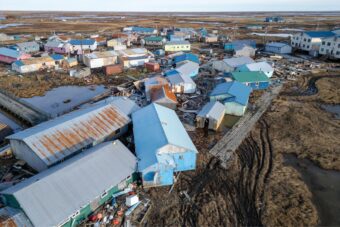
Kipnuk is about four miles inland from the Bering Sea coast and was once home to about 700 people. Most remain evacuated in Anchorage or Bethel, except for a group of roughly 100 residents who are back in the village working to rebuild. There’s a lot to do. The storm demolished about 150 homes, damaged boardwalks, disturbed gravesites and left lands and water contaminated with spilled oil and other hazardous materials.

Storm-damaged Kipnuk, as seen from the air on Oct. 19, 2025. (Eric Stone/Alaska Public Media)

On Saturday, the community began discussing its future.

Sheryl Musgrove, who directs the climate justice program under the Alaska Institute for Justice, told residents that it’s up to them to decide whether to relocate.

“It’s a decision of the community alone,” she said. “No one can force you to move, but then again, others can’t force people to stay there either.”

Residents spoke predominantly in Yup’ik, asking what relocation could look like. Some asked about how to choose a new site and secure land ownership.

“Who is dealing with the land?” Larry Kalistook asked. “Is anyone dealing with the land?”

Kipnuk resident Larry Kalistook asks village and state officials questions about possible relocation during the meeting on Jan. 31, 2026. (James Oh/Alaska Public Media)

Others pondered what it would take to set up critical infrastructure in a new place. Village Council Vice President Chris Alexie said figuring out a school, an airport and a health clinic would be a start.

“Those are the most important things, and water and sewer systems also,” Alexie said. “It’s not going to be easy but we’re going to deal with this.”

Alexie said that working through the relocation process could take years.

For Newtok, it took decades and well over $100 million. In Kwigillingok, the other village hit hardest by the storm, residents have already voted to move. But it’s unclear when it will happen and how much it will cost.

If Kipnuk decides to relocate, one potential option is going to Cheeching, a historical settlement on higher ground between Kipnuk and Chefornak. It’s now owned by Chefornak’s Chefarnmute Corporation.

The corporation’s vice president, Larry Kairauiuak, said Chefornak itself relocated back in the 1950s — and he thinks that’s why it didn’t suffer more damage in the storms.

“If the elders at that time had not decided to move to our current location, we would have been in the same situation as Kipnuk with the typhoon,” he said. “We’re grateful for our leaders at that moment to move to higher ground.”

A few dozen people gathered in Anchorage on Jan. 31, 2026, while several dozen more joined virtually, to discuss whether to rebuild or relocate Kipnuk. (James Oh/Alaska Public Media)

Kairauiuak said his village is open to a conversation about helping Kipnuk, and the corporation will hold a meeting with shareholders on March 7.

“We have a lot of families from not just Kipnuk but in Kwig, Tuntutuliak, Kong, Nightmute,” he said. “Our community is receptive to hear what they have to say.”

Kairauiuak said residents from many villages in the region have family ties to Cheeching, so that’s why it’s important for Chefornak residents to have a chance to weigh in on the future of that land.

Kipnuk elder David Carl said he remembers growing up Cheeching — his family called it “rock mountain.” It’s about 10 miles from Kipnuk and he supports moving there because he said the ground is more stable.

“They will make a wise decision if they relocate to the site right there,” he said. “Being an elder, we’re not thinking about ourselves, who we are now, we just want to fight for our upcoming generations.”

Kipnuk Council President Daniel Paul (center) prays at the meeting in Anchorage on Jan. 31, 2026, alongside other village, state and federal officials. (James Oh/Alaska Public Media)

But for Daniel Paul, Kipnuk is home and he hopes to live there again one day.

“For me, I’m gonna stick with Kipnuk, regardless of how the situation is,” he said. “I was raised there, and I’ll stay there.”

Paul said discussions will continue and residents have a lot of factors to weigh. But Kipnuk leaders also feel a sense of urgency. He said the village expects only one substantial influx of federal funding. To make the best use of it, he said, they need to decide soon whether they want to stay or move.

Editor’s note: KYUK’s Julia Jimmie provided Yup’ik translations for this story.

Trump administration denies full disaster funding for Western Alaska storms, state files appeal

Eric Phillip, the boardwalk foreman for Kongiganak, Alaska, surveys infrastructure damage caused by Typhoon Halong, Oct. 18, 2025. (Alaska National Guard photo by Staff Sgt. Joseph Moon)

The Trump administration has denied Alaska’s request for full reimbursement for disaster relief efforts immediately following last October’s devastating Western Alaska storms, despite the Dunleavy administration’s claim that the federal disaster declaration meant the state would be fully reimbursed.

Gov. Mike Dunleavy arrives in Bethel after visiting the storm-damaged villages of Kipnuk and Kwigillingok on Oct. 17, 2025. (Photo by Eric Stone/Alaska Public Media)

That leaves the state on the hook for millions of dollars for disaster recovery, however the full amount is still unknown.

The state’s request for federal support for 100% of disaster relief efforts in the first 90 days after the storms hit was denied on Dec. 20, according to a spokesperson for the Alaska Division of Homeland Security and Emergency Management on Thursday.

The state appealed the denial on Jan. 15, and asked for a 90% federal cost reimbursement, but has not yet gotten a response from the Federal Emergency Management Agency.

“We have not heard back from FEMA on approval or denial and there is no timeframe requirement,” said Jeremy Zidek, public information officer for the division, by email.

A spokesperson for Dunleavy’s office did not respond to a list of questions, but confirmed the appeal on Friday. “An appeal has been filed and the administration will await the federal government’s decision,” said Jeff Turner, Dunleavy’s communications director.

In the meantime, the federal government is reimbursing Alaska’s disaster recovery efforts at roughly 75%, leaving the state to cover 25% of its costs, with some exceptions for certain relief programs, Zidek said.

Following the West Coast storm disaster in October, Dunleavy quickly declared a state disaster emergency. On Oct. 22, his office announced that the Trump administration approved the state’s request for a federal disaster declaration, and the state’s full costs would be covered immediately following the storms.

“President Trump was deeply concerned with the wellbeing of Alaskans who lost their homes and livelihoods to this historic storm,” Dunleavy said in a statement along with the announcement. “I want to thank him and his administration for approving the disaster declaration because now Alaskan families have local, state and federal support for rebuilding their lives in the months ahead.”

“The federal disaster declaration authorizes a 100 percent federal cost share for all categories of relief assistance for the next 90 days,” the statement said.

Dunleavy’s office did not respond to questions about his previous statement or whether his office had communication from the Trump administration about why the request was denied.

Alaska’s Republican U.S. congressional delegation applauded the federal disaster declaration and Trump’s support for the Western Alaska disaster response last year. All three members said through spokespeople Friday that they support the state’s appeal.

U.S. Sen. Lisa Murkowski has been actively engaged with FEMA and state officials throughout the disaster relief efforts, said her communications director, Joe Plesha, in a statement on Friday. “Alaska’s vast geography and many rural communities make disaster response more challenging and recovery efforts significantly more costly,” he said. “She supports the state’s appeal and will work to secure the maximum amount of federal support available to Alaskans who have suffered so much from this devastating storm.”

A spokesperson for U.S. Sen. Dan Sullivan, Amanda Coyne, said the senator has advocated for the 100% federal cost share, as well as organized a delegation of FEMA and other Trump administration officials to visit Western Alaska.

“Given the severity of the storm and its devastating impacts on communities in Western Alaska, Senator Sullivan believes an increased federal cost share is warranted,” Coyne said. “He will continue strongly advocating with FEMA and other senior officials in the Trump Administration for an increased federal cost share as the state’s appeal goes through the process.”

A spokesperson for Alaska’s lone U.S. Representative, Nick Begich III, said on Friday that he supports the appeal and will continue to advocate for those impacted by Typhoon Halong at the Congressional level. “Our office is in communication with the Administration to ensure recovery efforts in Western Alaska remain a priority,” spokesperson Silver Prout wrote.

Western Alaska storm recovery is ongoing

The Western Alaska storms and particularly ex-Typhoon Halong brought record-breaking winds and flooding — damaging thousands of structures, roads, boardwalks, airports and other critical infrastructure. It prompted the state’s largest mass evacuation of residents from their homes to other villages, Bethel and Anchorage.

Evacuees of Kipnuk and Kwigillingok wait to board an evacuation flight from Bethel to Anchorage on Oct. 15, 2025 (Photo by Corinne Smith/Alaska Beacon)

While some Western Alaska residents are continuing to rebuild through the winter, other residents who evacuated to Anchorage are living in temporary housing. As of Thursday, the Alaska Division of Homeland Security and Emergency Management reports that 471 residents are still sheltering in hotels in Anchorage.

The state is administering public assistance programs, which reimburse costs of repairing public infrastructure and utilities, as well as provide individual disaster assistance, in partnership with other agencies, including FEMA.

FEMA has awarded $31.2 million in individual assistance to date, Zidek said.

More than 2,000 residents have been awarded state individual assistance, and 1,794 households have registered for federal assistance from FEMA.

Those applications for state and federal assistance are still open until Feb. 20.

State disaster relief funding under debate

The state’s disaster relief funding is a point of ongoing debate among lawmakers and the governor, as they kick off discussion of Dunleavy’s proposed $7.75 million budget and its $1.5 billion deficit.

Last year, legislators approved $23.3 million in state disaster relief funds, but Dunleavy vetoed $10.3 million of that sum last summer, leaving $13 million in the budget. In November, following the federal government shutdown, Dunleavy announced a state disaster to help provide food aid, transferring $10 million to the state’s disaster relief funding from the Department of Environmental Conservation’s Village Safe Water and Wastewater Infrastructure program.

This year, the governor has requested an additional $40 million in the state’s supplemental budget, which is a routine ask for additional money to pay the state’s bills for the previous year.

Sen. Bert Stedman, R-Sitka, a co-chair of the Senate Finance Committee, didn’t mince words about the governor’s back and forth with disaster spending. “Ill-advised and foolish,” he said. “It makes no sense what he did to me, frankly, and it’s embarrassing for him, his veto.”

But Stedman said he hopes the state’s federal appeal is approved, and expects legislators to pass the governor’s request for the additional $40 million. “Obviously, 100% is better than 90 and 90 is better than 75,” Stedman said of the federal cost share. “So that’s pretty much a given there. But we will fund the disaster request as the governor puts it on the table, through next week’s amendments.”

Sen. Jesse Kiehl, D-Juneau, also a member of the Senate Finance Committee, commended the governor for his record on disaster response, and echoed hope for the appeal to move forward. “There’s no question in my mind that this is exactly what the federal disaster relief programs exist for. So I think the governor’s request was the right thing, and if it came back at less than full funding from the feds, that’s the wrong call,” Kiehl said.

Kiehl described the state’s fiscal picture, with rising costs and ongoing debates on how to raise more revenues, as “bleak.” “So there isn’t cash just sitting around for disaster assistance,” he said. “We have to step up for western Alaska financially. That’s going to stink, but we have to do it, as far as I’m concerned.”

A typical cost share between the federal government and a state for disaster relief efforts is a 75% federal and 25% state cost split.

“We have dozens of federal declared disasters we are currently working on that have the 75/25 cost share structure,” said Zidek, with agency. “Large disasters are occasionally given a modified cost share structure adjustment, but it is not guaranteed. When we have a large disaster, we ask for modification to reduce the amount of state funding needed because as managers of state funds it is the responsible thing to do.”

Western Alaska evacuees in Anchorage slowly moving to temporary housing

People stand outside a hotel with cars are parked in front
Evacuees of ex-typhoon Halong in Anchorage are moving out of hotels where they have been sheltering for months, and into temporary housing around the city. (Matt Faubion/Alaska Public Media)

Western Alaska residents who evacuated to Anchorage after the remnants of Typhoon Halong battered their villages are now moving out of city hotels and into temporary housing.

They’re looking forward to having more privacy, being able to cook for themselves and having more space, said Jeremy Zidek, public information officer for the Alaska Division of Homeland Security and Emergency Management.

“Hotel rooms are small,” Zidek said. “They’re meant to be someplace that you stay temporarily. These folks have been living there for quite some time.”

The state moved evacuees into hotel rooms around Anchorage in early November, after some had stayed in mass shelters for several weeks following the storm.

Ex-Typhoon Halong slammed into Western Alaska in October with wind, rain and flooding that devastated some communities, including Kipnuk and Kwigillingok, where homes floated off their foundations. One woman in Kwigillingok was found dead in the aftermath, and more than 1,000 people were displaced.

More than 500 people who evacuated to Anchorage are still in hotel rooms. But, as of the end of the year, the state had moved more than 150 people into temporary housing.

There are financial and logistical hurdles that slow down the process, Zidek said.

“With a diverse group of people with different capabilities, we have to really do that case by case and do that case work,” he said. “So it’s a complicated process, and to do that with 600 people is taking some time.”

Each move requires background and credit checks, and the homes need to be furnished, which Zidek said has been a challenge: They’re routinely buying out stores around the city. The state is also working to keep extended families close to each other. The cold weather this winter makes moving more difficult as well, Zidek said.

Another hurdle is the tight housing market in Anchorage. But housing is tight across the state, and Zidek said Anchorage actually has more availability than the rest of Alaska.

The state of Alaska has a cost-sharing agreement with the Federal Emergency Management Agency to fund the hotel stays, with FEMA paying 75% of the cost and the state covering the rest. Once people move into temporary housing, Zidek said, that changes.

“Most people moving into temporary housing are taking advantage of that FEMA rental assistance,” he said. “And then as we move down the road, there will be other housing assistance funding that could be brought to bear for people. It’s based on a case-by-case basis.”

Some people have started working and are able to pay their own rent, Zidek said.

There are some people who won’t qualify for temporary housing because they don’t pass background checks or credit requirements, Zidek said. The state plans to find alternative housing for those people, he said.

The state will focus on rebuilding in Western Alaska in the spring, Zidek said, so that those who want to return home can do so as soon as possible.

Halong-impacted individuals may be eligible for unemployment assistance

Boats washed up into the trees by the remnants of Typhoon Halong are seen across the Kanektok River from the community of Quinhagak on Oct. 16, 2025.
Boats washed up into the trees by the remnants of Typhoon Halong are seen across the Kanektok River from the community of Quinhagak on Oct. 16, 2025. (Bryan Jones Jr. on behalf of Qanirtuuq Incorporated and Nalaquq, LLC)

Individuals who have been impacted by Typhoon Halong may be eligible for unemployment benefits.

On Dec. 26, the Alaska Department of Labor announced that anyone who lived or was employed at the time of the disaster in the Lower Kuskokwim Regional Education Attendance Area (REAA), the Lower Yukon REAA, or the Northwest Arctic Borough areas may be eligible for Disaster Unemployment Assistance.

That’s a special kind of unemployment benefit that supports people whose ability to work was impacted by a disaster.

To qualify, the typhoon must have impacted your ability to return to the place where you worked, or you must have sustained an typhoon-related injury that impacted your ability to work. People who suddenly became a major support to their household following a death related to the typhoon may also be eligible. If you were scheduled to begin work in an area impacted by the typhoon, you may also qualify.

The assistance payments would be between $153 and $370 per week for up to 27 weeks. The deadline to apply is Feb. 20, 2026.

People who want to apply will be asked for their social security numbers, as well as dates they worked and contact information for employers. Self-employed people or those who were previously unemployed may also be eligible, and they will be asked to provide a record of their wages.

For more information and to see if you might qualify, call 907-465-4691. Free interpreter services are available.

Site notifications
Update notification options
Subscribe to notifications