KYUK is our partner station in Bethel. KTOO collaborates with partners across the state to cover important news and to share stories with our audiences.

Alaska Sen. Lyman Hoffman (D-Bethel), the state’s longest-serving legislator, sits in the Legislative Information Office in Bethel on Jan. 29, 2026. (Evan Erickson/KYUK)
Sitting in the Legislative Information Office in Bethel, full of hardbound volumes and photos of the state’s political history, Sen. Lyman Hoffman said he’s ready to close the book on his own four-decade career in politics.
“I think it’s, it’s time … the next closest person behind me is 14 years behind me,” Hoffman said.
Hoffman has spent most of his time in the Senate, representing Southwest Alaska. He said he thinks he’s made a difference in the lives of rural Alaskans.
“I funded weatherization, set up a weatherization program where close to 60% of the funds, about $700 million, went into weatherizing people’s homes. People have come up to me and said, as a result of the weatherization program, their heating bill went down by hundreds of dollars a month,” Hoffman said.
Hoffman also cited his creation of a billion-dollar endowment to protect rural electricity subsidies under the state’s Power Cost Equalization program. He does admit that the cost of living in rural Alaska remains staggeringly high.
Hoffman said that his priority in his final session is finding ways to fund the budget. He said that Gov. Mike Dunleavy’s idea of a sales tax is not one of them.
“I haven’t heard anybody that really likes that idea in the legislature,” Hoffman said.
Hoffman said that the proposal to add a 4% sales tax during the tourist season and a 2% sales tax during the other half of the year would run up against local taxing schemes adapted to rural needs.
“He wants no exceptions, no loopholes, no food, heating, fuel. Everything is going to be taxed. And I would say that that would put rural areas at a larger disadvantage because we already pay the highest cost for heat,” Hoffman said.
In Bethel, there have already been long-standing challenges collecting the 6% local sales taxes the city levies. Hoffman said that the governor’s proposal would mean the state would collect taxes on behalf of cities like Bethel, removing that burden. But he said this potential upside is far outweighed by the downsides.
Dunleay’s fiscal plan also proposes a constitutional amendment that would require half of the state’s yearly draw from the Permanent Fund to go toward paying higher dividends. Critics say that would make balancing the budget nearly impossible.
Hoffman said the state might be in a better position today if lawmakers hadn’t stripped down a 2018 bill that used Permanent Fund earnings to cover state operating costs for the first time. Hoffman said he supported a provision to set the dividend at a lower, more sustainable rate. But that idea was rejected.
“If we had passed that bill with that provision in it, the dividend would be $1,500 and continue to grow out in the future. Now, we’re fighting tooth and nail to try to get at least $1,000 in the dividend and fund government,” Hoffman said.
Hoffman said that he has encouraged Dillingham Independent Rep. Bryce Edgmon to run for his Senate seat in November. Edgmon is also the current Speaker of the House. Hoffman said it makes sense because of Edgmon’s record of rural and urban support, and the fact that he’s already represented Kuskokwim River communities within his district.
Hoffman said that he’s concerned that there will be less rural representation on the powerful Senate Finance Committee he co-chairs when he leaves. But he’s optimistic that the bipartisan Bush Caucus he has played a key role in can continue to wield power across the aisle, and that rural issues will continue to get attention statewide.
“The influence of people off the rail belt over the last three decades has been tremendous,” Hoffman said.
Hoffman said that it is critical that legislators form a better working relationship with the governor in 2026. When it comes to ways the state can support ongoing relief efforts following damage from Typhoon Halong, he said Dunleavy has given him an open ear. But Hoffman said specific ideas should come from affected communities.
“The decisions on what needs to be done has to be decided by the local people, and we have to see how we can implement them,” Hoffman said.
Soon, Hoffman will be stepping away from politics. On top of having more time to spend with his wife, Lillian, who he says has been his greatest source of support, Hoffman plans to take time for hunting and fishing around Bethel.
“I’m going to jump on my snowmachine and ride away into the sunset,” Hoffman said.
The 2026 regular legislative session is scheduled to wrap up by May 20.
The Alaska Airlines airport terminal in Bethel. (Katie Basile/KYUK)
On Jan. 4, Bethel resident Shane Iverson said that he was shocked when he stepped up to the Alaska Airlines counter at the Anchorage airport to check in for his flight home.
“I had two kids. We each had three items to check in, so nine items. I was sitting there with a ton of boxes and luggage when they told me they were gonna have to charge me for most of it,” Iverson said.
It was a surprising bill that Iverson and some other Alaska Airlines passengers have faced while checking baggage that used to fly for free within the state. The company said that it is working to reverse an issue with its Club 49 program that has affected the baggage benefit.
That benefit is a longtime Alaska Airlines policy of allowing three free checked bags per person on flights within the state. Iverson said that maxing out on luggage is something a lot of Bethel residents do.
“That’s kind of part of the equation of your trip. If you can afford to fly in, at least you’re gonna get a little savings on your supplies that you can bring back, and the variety of things you can find,” Iverson said.
In October 2025, Alaska Airlines announced that it would be limiting the perk to Alaska residents enrolled in its Club 49 loyalty program.
For Iverson, the change seemed inconsequential. He’s a resident, and he’s been a member of the free loyalty program since it launched in 2011. But when he checked in on his phone the night before flying, the app showed that he would be charged hundreds of dollars in baggage fees.
“I was like, it’s probably just a computer snafu, pretty understandable. I’ll just go early because probably other people are going to be dealing with this too,” Iverson said.
Initially, Iverson said that he was told that he would need to re-enroll in Club 49, and that it would take a week or more to process. But after some back and forth, he said that a ticket agent agreed to waive the fees. But he said he’s still not sure what happened.
In an emailed statement on Jan. 5, Alaska Airlines spokesperson Tim Thompson confirmed that some, but not all, Club 49 members have been incorrectly charged bag fees since a new baggage policy went into effect on Jan. 3. Current Club 49 members do not need to re-enroll in the program.
Thompson said that the problem may be resolved as early as Jan. 7. Meanwhile, customers can get bag fees waived at ticket counters by showing they have Club 49 status in the mobile app, or by showing proof of Alaska residency. Club 49 members who were incorrectly charged bag fees should contact customer service for assistance.
Iverson said that he was disappointed to find that other Bethel residents affected by the error also had little idea of what to make of it.
“Who’s ever in charge of communicating really needs to do a better job. Because, you know, in rural Alaska we follow this closely. (It) really affects our lives,” Iverson said.
Meanwhile, Alaska Airlines’ new baggage policy means non-Club 49 members without other special statuses are on the hook for new fees. According to reporting by KNOM, non-members without an Atmos Rewards credit card or elite status now need to pay at least $230 to check three bags within Alaska.
On top of the three free bags, Club 49 membership offers two free checked bags for flights to and from Alaska.
Confirm enrollment in Club 49 online by opening your profile dropdown menu, clicking Account Overview, and navigating to Membership Card. On the mobile app, click the Account tab and scroll down to Atmos Rewards and member card.
Editor’s note: Shane Iverson is KYUK’s former general manager.
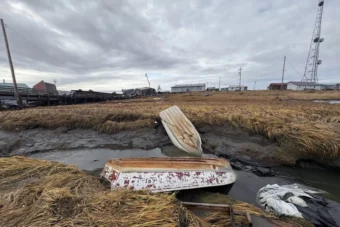
Boats washed up into the trees by the remnants of Typhoon Halong are seen across the Kanektok River from the community of Quinhagak on Oct. 16, 2025. (Bryan Jones Jr. on behalf of Qanirtuuq Incorporated and Nalaquq, LLC)
Individuals who have been impacted by Typhoon Halong may be eligible for unemployment benefits.
On Dec. 26, the Alaska Department of Labor announced that anyone who lived or was employed at the time of the disaster in the Lower Kuskokwim Regional Education Attendance Area (REAA), the Lower Yukon REAA, or the Northwest Arctic Borough areas may be eligible for Disaster Unemployment Assistance.
That’s a special kind of unemployment benefit that supports people whose ability to work was impacted by a disaster.
To qualify, the typhoon must have impacted your ability to return to the place where you worked, or you must have sustained an typhoon-related injury that impacted your ability to work. People who suddenly became a major support to their household following a death related to the typhoon may also be eligible. If you were scheduled to begin work in an area impacted by the typhoon, you may also qualify.
The assistance payments would be between $153 and $370 per week for up to 27 weeks. The deadline to apply is Feb. 20, 2026.
People who want to apply will be asked for their social security numbers, as well as dates they worked and contact information for employers. Self-employed people or those who were previously unemployed may also be eligible, and they will be asked to provide a record of their wages.
For more information and to see if you might qualify, call 907-465-4691. Free interpreter services are available.
“Aanaq? Am I Your Sunset?” by Lani Hulse was written to support Typhoon Halong-impacted families in partnership with the Western Alaska Disaster Relief Fund. (Lani Hulse)
When writer Lani Hulse heard the news about Typhoon Halong, she was across the country in Hawaii, where she lives.
“I just, I couldn’t help with each video that I watched online — people posting about the disaster, and afterwards — I just could not just sit there,” Hulse recalled. “I was like, there’s something I can do.”
Hulse was in the middle of writing a novel, part of a journey to reconnect with her Yup’ik culture. The author, who spent periods of her upbringing in Bethel, has family roots in the Yukon Delta village of Kotlik, which suffered damage from the October storm. Her father was also a principal across schools in the region, including Kipnuk.
“I was like, wait, I could do something creative and connect with a nonprofit, and get something rolling, have something physical that’s positive and connects to my culture as well,” Hulse said.
Hulse began coordinating with the Alaska Community Foundation to host a fundraising sale of the children’s book she was inspired to write. It’s called “Aanaq? Am I Your Sunset?” and 50% of each sale goes directly to the Western Alaska Disaster Relief Fund to support families impacted by Typhoon Halong. The other 50%, Hulse said, will cover the cost of production and taxes involved.
The storybook was inspired by a moment Hulse experienced with her son, Ashton. At the end of a stressful day, Hulse said that the two went for a drive.
“During the drive, the most captivating sunset caught my attention and I paused. And I was like, ‘Oh my gosh.’ I was like, ‘Ashton, look at that sunset. It’s so beautiful,’ ” Hulse remembered. “And my son was quiet for a second, and he asked, ‘Am I your sunset?’ I lost my breath for a moment.”
Hulse said that the book came from this seed of connection and meaning between parent and child. The story follows the layout of a poem, an adult responding to a child asking the same question in a backdrop of Yup’ik culture.
“And then each page, it’s almost like a poem goes over like, ‘Yes, you are my sun. You are my moon.’ And there’s lots of culturally significant imagery in there as well, like eating salmonberries, tundra tea, as well as, like, fishing and Northern Lights,” Hulse said.
Hulse said that she hopes the book will find buyers among those looking to support relief efforts, but she also hopes copies find their ways into the hands of those affected by the typhoon.
The book features a journal section where families can record shared memories together.
“I can’t imagine what these families are going through right now, and I wanted to bring something positive to their life,” Hulse said. “The main part of this story is what matters most is family moments with your family, these sweet moments throughout your day.”
Susan Sookram takes advantage of the empty hot tub at the Yukon-Kuskokwim Fitness Center on Nov. 26, 2025. (MaryCait Dolan/KYUK)
Susan Sookram sat in the hot tub of the Yukon-Kuskokwim (Y-K) Fitness Center. She brought her book to settle into — an anthology containing the first three Hitchhiker’s Guide to the Galaxy books — with the whole tub to herself.
But up until recently, this post-workout ritual was put on pause.
“I think I did come a little bit less without that motivating thought of taking a relaxing dip afterwards,” Sookram said.
Since July, the hot tub in Bethel’s fitness center had been out of commission. There was an issue with its pump. And, like with any beloved relative – people have been calling, sending Facebook messages, and stopping by in person for months to ask if it was getting better.
Bethel Parks and Recreation Department staff said that they even got a request from a community member to publicly share the tracking information on the missing part so that everyone could keep tabs on it. Then, after four months, it was finally fixed.
“It was sort of to very quiet fanfare, and I felt like it deserved more of a community-wide announcement and/or celebration,” Sookram said.
A sign at the Yukon-Kuskokwim Fitness Center declares the hot tub open after it’s new pump was installed. November 17, 2025 in Bethel, AK. (Samantha Watson/KYUK)
David Chakuchin, the facilities manager at the fitness center, said that he didn’t know the hot tub outage would be that big of a deal.
“It was kind of surprising how people would be, like, getting upset,” Chakuchin said. “Like, chill. It’s just a hot tub.”
In the months since the hot tub has been down, the rumors have flown around town about what had gone wrong. KYUK Multimedia Department’s MaryCait Dolan asked Chakuchin about some of them during our interview.
“Wasn’t it also, like, once the part came in, there had to be someone to, like, crawl into the inner workings of the hot tub too?” Dolan asked. “I don’t know where I heard that.”
Chakuchin smiled.
“No, no one had to crawl,” Chakuchin said, laughing.
In actuality, what happened is a classic tale in rural Alaska. The broken part first had to be identified and its nearly $10,000 price tag paid for. Then it had to be shipped to Bethel from the lower 48, which takes much longer than normal shipping times. And then there were bigger problems to solve.
“Typhoon Halong hit, and then that, like, just delayed it another, like, two or three weeks, maybe,” Chakuchin said.
This is the first time in the pool’s 11 year history that it has needed major maintenance.
“In the future, I don’t think it’s going to be that hard because we kind of learned a lot of lessons,” Chakuchin said.
Chakuchin said that it was surprising to hear how much people cared about the hot tub.
Mac Nowicki is a hot tub regular and admitted that he fell into the party of pushier hot tub inquirers.
“I did for, I don’t know, like two months, [a] pilgrimage asking,” Nowicki said. “They displayed little piece of paper which says ‘it’s on the way’. Then they display another piece of paper which says ‘we should fix it,’ and then — finally.”
Now on the other side, Nowicki said that it’s been nice to have the space for his muscles and spine to relax. He likes to come at least twice a week.
Now that it’s back open, the hot tub and greater fitness center have been busy. After Typhoon Halong displaced many residents of coastal communities to Bethel, the fitness center is offering its showers and facilities, including the hot tub, to evacuees.
Chakuchin said that there are a lot of people using the facilities. Bethel is the only community in the Y-K Delta to have a pool and hot tub. Bethel Life Savers also sponsors free snacks and drinks for impacted families.
“There’s a lot, a lot of families come in, and it’s, it’s nice, nice to see it’s more busy for us, but it is nice that they do have a place to come in,” Chakuchin said.
On Friday and Monday nights, community members gather in the hot tub before starting a pickup game of water polo.
“If we’re one or two people shy of two teams, we have recruited people that never played before from just chilling in the hot tub,” Scott said.
That’s water polo regular Sundi Scott. Scott said that the moments before jumping in the pool to play are particularly important.
“It gives us time to socialize before we get really competitive with each other,” Scott said.
Scott said that during the hot tub’s outage, participation numbers suffered. But now there have been enough people for two teams and time to laugh and relax against the jets.
For water polo regular and KYUK’s outgoing news director Sage Smiley, it’s her last night in town before moving away.
“I wanted to spend my last night with the community,” Smiley said. “And the way you do that on a Friday night in Bethel, at least for me, is by playing water polo and sitting in the hot tub.”
The fitness center’s Equitable Access Program offers assistance to make memberships accessible for all families interested. For more information, visit the Y-K Fitness Center’s website.
Pickup water polo is held on Monday and Friday evenings, beginning in the hot tub at 7:00 p.m. before playing between 7:15 p.m. and 7:30 p.m.
The first week of school in Aniak, Alaska. Alaska’s education department has transferred ownership of 54 buildings to rural public school districts since 2003, including Aniak’s elementary school. (Gabby Hiestand Salgado/KYUK)
For more than a decade, the Kuspuk School District asked Alaska’s education department for the money to fix a rotting elementary school. The school, in the small and predominantly Indigenous community of Aniak in western Alaska, was in deep need of repairs. The nearby Kuskokwim River had flooded the 88-year-old building several times. The walls were moldy. Sewage was leaking into a space below the school’s kitchen.
In 2018, the department finally approved the school district’s $18.6 million funding request to build a new elementary school wing onto Aniak’s middle and high school building, which was owned by the state.
But on Page 4 of the funding contract for the project, Alaska’s education department included a catch.
“The State would only build the new school if the local school board agreed to own it when completed,” former superintendent James Anderson said in an email to KYUK Public Media, NPR and ProPublica.
In the end, Anderson agreed. He worried that if he didn’t, it would jeopardize kids’ health and safety. But he said he also worried about the financial and legal implications of the agreement for the school district, where nearly 30% of families live in poverty. If the state owned the building, it would be responsible for repairs and liability. Anderson worried that if the district took ownership of the school, it might be on the hook.
According to a review of deeds and project funding agreements, Alaska’s education department has transferred ownership of 54 buildings to rural public school districts since 2003. That’s nearly four times as many compared with the two decades prior. That same year, a new clause appeared in the funding agreements that districts sign with the state: In return for the money to make repairs to run-down schools or to build new ones, school districts would have to agree to own the buildings.
Alaska education department spokesperson Bryan Zadalis said in an email that the department didn’t have documentation about why the contract language changed. He wrote that “the main clauses of the project agreement are boilerplate language” and were last reviewed by Alaska’s Department of Law in 2019.
Seven current or former superintendents representing rural school districts with student populations that are predominantly Alaska Native said it’s unclear whether a change of ownership also changes a school district’s responsibility to maintain its facilities. The districts can’t use tax revenue to pay for education because the communities they serve are unincorporated. As a result, the state is required by law to pay for construction and maintenance in many rural school districts, but it often takes years to secure that money. Because the funds are hard to come by, superintendents have also said they feel pressure to sign the contracts.
“We’re all sort of trying to find the best, most optimal use of very lean resources,” said Hannibal Anderson, superintendent of the Lower Kuskokwim School District, Alaska’s largest rural district, covering an area nearly the size of West Virginia. “There’s very little room for negotiation.”
Last summer, after nearly two decades, two more Kuspuk district schools, upriver from Aniak, received funding from the state to remedy severe structural problems and serious health and safety risks that the district has reported to the state’s education department for years. In both cases, the money wasn’t enough to fix everything, but superintendent Madeline Aguillard said it was better than nothing, so she signed contracts that also required the district to own those schools.
“What choice did I have?” she asked.
Madeline Aguillard, superintendent of the Kuspuk School District, is negotiating with the state over ownership of school buildings. (Gabby Hiestand Salgado/KYUK)
Over the last year, KYUK, NPR and ProPublica have documented a health and safety crisis inside many rural school buildings across Alaska. Water lines and sewer systems are backing up. Roofs are leaking and foundations are crumbling. Until this summer, at least one school was in danger of collapse. The state has largely ignored hundreds of requests from rural school districts to fix deteriorating buildings. Some of the worst conditions exist at state-owned schools.
Losing Sleep Over Liability
Unlike most other U.S. states, where schools are owned locally, Alaska’s education department owns nearly half of the 128 rural schools open in the state today. In most cases, school districts own the remainder.
In an interview, education department staff said shifting ownership from the state to districts cuts red tape and gives districts more local control over how the building is maintained and used.
“We’re very much a hands-off landlord, as it were,” said Lori Weed, the education department’s school finance manager. “So the hope was that districts would take title to sites so that they could have the control, because we’ve been so hands off.”
A damaged ceiling in Aniak’s high school in August. (Gabby Hiestand Salgado/KYUK)
There are several overlapping Alaska laws governing school ownership. Collectively, they allow school districts to take over supervision of school construction or maintenance projects and to initiate a transfer of ownership. None of those laws require schools to accept ownership; one says a school board “may” take that action.
However, in some cases, the education department’s contracts say that school boards “shall” take over ownership in order to receive funding.
Howard Trickey, an attorney who has spent most of his career representing public schools in Alaska, said the state could be misinterpreting the law. “‘May’ means you don’t have to do something,” he said. “So to interpret that statute to say it’s mandatory is overreaching.”
The contract for Aniak’s elementary school project says the district “agrees to comply” with several conditions and “shall request title interest of the new facility.” According to the education department, districts are permitted to request the removal of this provision, and it doesn’t require the transfer in order for a district to receive project funding.
Aguillard said she’s still trying to negotiate with the state. Records show Alaska’s education department still owns the facilities used for education in Aniak.
Trickey also believes that such ownership changes could create huge risks for rural school districts in Alaska.
“Suppose a facility was in such disrepair and had such life safety issues as inadequate electrical system, and the school catches on fire and burns down and children are injured,” Trickey said. “If the state owned it, the state would be liable for those injuries.”
A staff member with the education department said there hasn’t been a recent case where someone got hurt. “I would argue that if something happens, it’s going to become a legal battle,” said Heather Heineken, the department’s director of finance and support services, who previously was finance director for a district in Alaska’s Interior.
Aniak students play outside on the playground. (Gabby Hiestand Salgado/KYUK)
Rod Morrison, superintendent of the Southeast Island School District, said he loses sleep over liability in his schools, which suffer from leaking roofs, black mold and, at one school, a nonfunctional fire suppression system. The state transferred ownership of that school, in Thorne Bay, to the district in 1998.
In August, Morrison asked the state to allow him to use $300,000 left over from a state-funded project at another school in his district to address the fire suppression system. In September, Michael Butikofer, facilities manager for Alaska’s education department, denied the request, saying it may not be legal. He encouraged Morrison to submit a new application for the funds to fix the suppression system instead.
“When they denied the transfer of the funds or refused to fix my fire suppression system, then I requested the state to take liability of that facility,” Morrison said. “Then of course they said no, they’re not going to take liability for that.”
In a response letter, Butikofer told Morrison that the “ultimate responsibility for day-to-day safety and facility operations lies with the district.”
The district has made 17 funding requests to the state since 2009 for the money to replace the system. During a Senate Finance Committee hearing in Juneau this spring, Morrison presented lawmakers with a giant light bulb, blackened by a short in the electrical wiring in the school’s gymnasium ceiling. Morrison said it’s not a matter of if, but when, a fire might consume the building.
Rod Morrison, superintendent of the Southeast Island School District, said he loses sleep over liability in his schools, including fire hazards (left), leaking roofs (center) and structural damage (right). (Rod Morrison)
Decades of Contamination
Alaska inherited dozens of schools from the U.S. Bureau of Indian Affairs (BIA) in the three decades after it gained statehood in 1959. During those decades, state officials complained about being burdened with schools that were already in bad shape.
Those schools also came with other liability risks. Some buildings stand on land previously used by the military, where highly toxic and volatile chemicals have been found. And leaking fuel tanks have contaminated the property at dozens of rural schools, according to the Alaska Department of Environmental Conservation.
That was the case with a BIA school in the Bering Sea community of Toksook Bay, which the state acquired in 1990. There, a corroded pipe leaked 5,000 gallons of fuel into the crawl space of a maintenance building associated with the elementary school. The city of Toksook Bay sued both the school district and the state, arguing that the leak contaminated the city’s water system, damaged land and caused illness. The state Legislature approved over a million dollars in settlement funds for the city.
In response, the Legislature passed a law in 1997 that limited the state and rural school districts’ liability for chemical spills on their land. However, the law does not absolve the state or districts from paying for cleanups, which can cost millions.
Bill O’Connell, who manages contaminated site cleanup for the state Department of Environmental Conservation, said paying for cleanups is harder in rural districts. In municipal school districts, local taxes can help cover the cost. But rural districts rely on the state for nearly all of their funding.
“The money that the school districts get is just to educate the students,” O’Connell said. “There’s no consideration of contaminated site cleanup. It’s really just kind of an unmet need.”
Students eat lunch during the first week of school at Aniak. (Gabby Hiestand Salgado/KYUK)Students in math class during their first week of school in Aniak. The superintendent says the state required the school district to take ownership of the new elementary school. (Gabby Hiestand Salgado/KYUK)
He pointed to an old building in Aniak that served the U.S. Air Force during the Cold War as particularly concerning. He said the legacy of highly toxic contaminants started before the building was used for education. The state-owned building, once used by the school district for vocational training, has been demolished, but its foundation stands about 200 yards from the school where kids still take classes everyday. O’Connell said cleanup at the site was officially completed this year, but there are still contaminants below the surface and it is unlikely any new construction will ever be allowed there.
In 1997, the same year the liability law passed in Alaska, a group of parents sued the state over conditions inside rural public schools where their kids spent their days. When the case was settled in 2011, the judge’s consent decree called on the state to pay for five new schools. At the time, the state owned four of those buildings. The state paid to build the schools but required each of the districts to accept a transfer of ownership.
Ken Truitt, an attorney who represented the education department in 2003, when the ownership requirement appeared in construction and maintenance funding agreements, said he does not recall being consulted on the contracts or the addition of that language.
Tim Mearig, a former facilities maintenance director for the education department, said that in the early 2000s, leadership believed “it was of no benefit to the state to hold title, and it was a significant benefit to districts to manage their own property.”
Mearig said a change of ownership was eventually “baked in” to project agreements.
Some ownership and liability questions come down to what the state’s constitution requires. Alaska’s education commissioner, Deena Bishop, said the constitution is intended to give local communities maximum control and that the department is following the law. But Trickey, the longtime attorney for Alaska school districts, said the transfers “don’t relieve the state of that ongoing, continuing constitutional duty.”
“The constitution says the state has a duty to establish and maintain a system of public schools open to the children of the state,” he said. “And that just fundamentally and basically starts with adequate schools.”
Students run toward the finish line in a cross-country race in Aniak this August. (Gabby Hiestand Salgado/KYUK)
This story is a collaboration from NPR’s Station Investigations Team, which supports local investigative journalism, member station KYUK, and ProPublica’s Local Reporting Network.
Emily Schwing reported this story while participating in the University of Southern California Annenberg Center for Health Journalism’s National Fellowship. She also received support from the Center’s Fund for Reporting on Child Well-being and its Dennis A. Hunt Fund for Health Journalism.
Close
Update notification options
Subscribe to notifications
Subscribe
Get notifications about news related to the topics you care about. You can unsubscribe anytime.