Interior

A University of Alaska Fairbanks student is out on bail after tearing up and eating another student’s AI-generated art

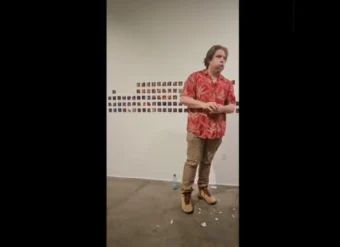
Some pictures remained on the wall after Granger ate around 57 of the 160 images on display on Jan. 13.
Some pictures remained on the wall after Granger ate around 57 of the 160 images on display on Jan. 13. (Lizzy Hahn)

A University of Alaska Fairbanks student is out on bail after ripping almost 60 images off the walls of a university art gallery and eating some of them earlier this month.

The incident has since gone viral — prompting countless social media posts and even reaching national outlets. Lizzy Hahn, an undergraduate journalism student at UAF, broke the story in The Sun Star, the school’s student-run newspaper.

She said the incident is shaping culture and policy around AI on campus.

This interview has been lightly edited for length and clarity.

Lizzy Hahn: A student was tearing Polaroids off of an exhibit in the UAF Art Gallery and putting them in his mouth, chewing them, swallowing some bits, but spitting some bits out. This was a protest against the use of AI art, since this exhibit was made in collaboration between the artist, Nick Dwyer, and AI — like, he used ChatGPT to help him make it.

Shelby Herbert: Whoa. Tell me what happened to the protester.

LH: His name is Graham Granger. He was arrested by the UAF police and charged with criminal mischief in the fifth degree, and he was taken to the Fairbanks Correctional Center, where he was for about six or seven hours, I believe. So, he’s out on bail.

SH: That was quite a splashy headline, and that story has really sprouted wings. I’ve had folks texting me from the East Coast about it. How does it feel to see your work get so much exposure?

LH: It’s really insane to me. I am a young journalist here at UAF. I’m a senior graduating soon, so like this is my first story to go — some people have said that it’s going viral. It has definitely been picked up by multiple, multiple, multiple news sources. Art News for one, Brut America for another.

SH: I think I just saw it in the New York Post?

LH: Yeah. Just so many media sources that have taken the information and my images and spread them to their corners of the world.

SH: Tell me about where you were when you found out this was going down.

LH: That’s actually kind of a funny story. I’m in a pottery class, and it’s in the fine arts building. And as I was walking in, I noticed that there was a police car outside of the building. So, I walk into class, and then my editor, Colin, starts texting our whole staff’s Slack. And he’s like, “Hey, is anyone in the arts building? There’s a student protesting in the gallery.”

So I asked my pottery teacher, like, “Hey, do you know anything about this?” And she’s like, “Yeah, I do.” So we walk into the gallery together, and all we see is just these torn up, chewed up bits of Polaroids. The artist was there, Nick Dwyer, and he was like, “Yeah, someone came and he started chewing up my work.”

SH: And how does the artist feel about all of this?

LH: He was upset, and rightfully so. This was his MFA exhibit. It’s hard to see your art destroyed like this. He had put a lot of time and effort into this. He wanted to press charges, and he had begun to press charges. But then the next day, things had kind of cooled down, he had talked to some of the art professors, and had realized that pressing charges maybe wouldn’t be the best idea.

Pieces of chewed up artwork lie on the floor in the University of Alaska Fairbanks art exhibit on Jan. 13. (Lizzy Hahn)

SH: Lizzy, you’re a journalism student and a student-reporter, but you also have a foot in the art world — you’re an art minor. Can you tell me about how AI content and tools are being received on campus, especially in the humanities?

LH: Yeah, so every teacher has an AI policy. This has been a fairly new development to the syllabi that we are getting. It’s gone from teachers saying, “You’re not allowed to use AI, don’t use AI.” But in the past year, there’s been kind of a shift towards like, yes, you can use AI, but cite it.

Then also, in the art community, we’re starting to see a little more use of AI, and that has really been because of Nick. Like, Nick is really spearheading the use of AI. Art and AI is kind of an interesting mashup because you don’t really think of them going together, but Nick has really used AI in his pottery and now in this AI art exhibit.

I don’t know that many students personally, besides Nick, who are using AI art, but I think that in the future, it totally could change and the use of AI could become more common.

SH: You’re working on part two of the story. Can you give us a little tease about what comes next?

LH: Yeah, I’m kind of looking into what is happening here at UAF, because since this protest has occurred, there has been a lot of uprise. Our student government here on campus has actually proposed a resolution to ban AI art in the department. But at the same time, the art department is creating a statement about their AI policies. So, unsure where that will go, but bright futures ahead!

First screen adaptation of ‘Two Old Women’ told in severely endangered Athabascan language

A still from the screen adaptation of Velma Wallis' 1993 novel, "Two Old Women."
A still from the screen adaptation of Velma Wallis’ 1993 novel, “Two Old Women.” (Deenaadàį’ Productions)

Fairbanks-based Alaska Native filmmakers from Deenaadàį’ Productions are bringing an award-winning 1993 book to the screen for the first time.

“Two Old Women” is an adaptation of Velma Wallis’ novel of the same name – and in the new film, the story is told entirely in Gwich’in. It premiered in Hawai’i last month, with homecoming showings scheduled in Alaska in December.

Wallis’s 1993 book is based on an Athabascan legend and takes place in a time before colonization. The story follows a pair of elderly women, Ch’idzigyaak and Sa’, who are left behind by their tribe, which faces starvation amid a harsh winter and shortage of food. The main characters then battle against the elements, relying on their ancestral knowledge and each other to survive in Alaska’s wilderness.

Filmmaker Princess Johnson remembers when she first read the book as a teenager, and she said adapting it for the screen is something she’s been wanting to do for more than 20 years.

“I felt that, when I initially read it, I could see it. You know? I could visualize it,” she said. “And, at that time, I was still very early in my filmmaking career and my filmmaking journey.”

In the years since then, Johnson has worked as a creative producer on the PBS Kids series “Molly of Denali” and produced six episodes of the latest season of HBO’s “True Detective.” Now, she’s added to her resume writing, directing and producing the 14-minute short for “Two Old Women,” a proof-of-concept for what she hopes to develop into a feature film.

In the screen adaptation, Ch’idzigyaak and Sa’ speak to each other in Gwich’in. In fact, the film is entirely in the Athabascan language, which is considered severely endangered.

Johnson said she got some pushback early on from production companies and others who thought the language piece would be a hard sell, but she said that part was non-negotiable.

“There’s just such a richness and a nuance. I think we would actually lose a lot if it was in English. It wouldn’t be as believable or, like, pull us into that authenticity of a pre-contact piece,” she said.

Gwich’in has about 300 speakers in Alaska, according to the Alaska Native Language Center, and 205 in Canada, per the country’s most recent census data, from 2021.

Taa’aii Peter, a producer on the project who also helped with the translation, is an advocate of Indigenous knowledges, languages and rights. He said experiencing Gwich’in on the big screen can be a source of pride, a way to uplift the language and even an educational tool.

“Art is such a powerful medium of communication. It’s inspirational, can be life changing and transformational for people,” said Peter, who also has a background in film production and previously served as the vice chancellor of rural, community and Native education at the University of Alaska Fairbanks.

Peter said the end product is just one part of what can give art that power. Behind the end product are the people – and the process – and he said the filmmakers brought together Gwich’in speakers and culture bearers so that, together, they could figure out how to best tell “Two Old Women” in a language that carried the story for thousands of years.

He said that decision “just makes complete sense.”

“And then it’s also this form of helping to make this contribution to advancing the important focus on language and language work that’s happening within our community and within a lot of other Indigenous communities,” Peter said.

The short film was shot in three days at Borealis Basecamp, north of Fairbanks, and at Gather, which is a social space downtown. But it’s been in the making for about five years. The filmmakers say, during that time, they used the project to build community in other ways, too, like running hide-tanning workshops where people could learn traditional practices while making clothing that appears in the film.

Like Peter, Johnson said the workshops, contributions and other inputs are just as important as what winds up on the screen.

“To me, like, in its best form, filmmaking can be a form of healing. It can be a form of medicine,” she said.

The film stars Margaret Henry John and Brenda K. Newman as Sa’ and Ch’idzigyaak, with Chief Galen Gilbert of Vashraii K’oo, Alaska, appearing as Chief Dajalti’. The 14-minute short will be screened in Fairbanks as part of an event at Morris Thompson Cultural and Visitors Center on Dec. 5, which starts at 5 p.m. It’ll also be shown at the Anchorage International Film Festival on Dec. 13 at 3 p.m.

Fairbanks mother speaks on her 2-month detainment by ICE

Atcharee Buntow with Dmonhi, her two-year-old son, after her release from ICE custody on Oct. 2, 2025.
Atcharee Buntow with Dmonhi, her two-year-old son, after her release from ICE custody on Oct. 2, 2025. (Atcharee Buntow)

On a sunny afternoon in early August, Atcharee Buntow was running an errand for her mom’s Thai restaurant, topping off their supply of oyster sauce. But when an unmarked vehicle pulled her over on her way home, it became one of the worst days of her life.

A U.S. Immigrations and Customs Enforcement agent approached her car, and Buntow started taking a video of the encounter on her phone while frantically trying to text her family.

Buntow says she didn’t know what was happening until after the agent put her in handcuffs.

“They did not identify themselves until they had me in custody,” she said in an interview after her release.

Buntow said she was told that she was being detained for overstaying her visa and then taken to a holding facility in Tacoma, Washington. She said she was locked in a dorm with about 60 other women, where it was hard to sleep and meals didn’t come on time.

“Some nights, we didn’t get our dinner till 10:30 p.m., or 11,” she said. “The latest night I ever got dinner was at 2:30 a.m., so I just starved that night.”

She was released on bail about two months later, on Oct. 2.

Buntow, who turns 43 this week, was born in Thailand but has lived in the United States since she was 11. She said she wasn’t aware that there had been any issue with her immigration status, especially after she got married to her first husband, an American citizen.

She’s now married to a different American citizen and is the mother of six American children — four adults and two younger kids. She said the separation was hardest for them.

“My 12-year-old, he was in and out of the hospital for asthma attacks,” Buntow said. “Now that I’m back, he is fine.”

She also has a two-year-old son who relatives say would cry every night she was gone. 

Buntow stayed in touch with family with a tablet she shared with dozens of other women in the detention center. She said those brief calls were one of her only sources of comfort behind bars.

“I was depressed,” Buntow said. “You know, what are they going to do for Thanksgiving? I cook every year. Mac and cheese, sweet potato pie and the green bean casserole. The kids love that.”

Buntow said she feels like her arrest was pretty random. But she’s been convicted of a few nonviolent misdemeanors in Fairbanks over the last couple decades, as well as a felony for fraudulently applying for the Alaska Permanent Fund dividend, according to court records.

She pleaded guilty to falsely claiming U.S. citizenship on her PFD application in 2014. Buntow said that was a mistake she made while she was filling out the PFD paperwork for her children. Now, she’s trying to get the conviction vacated so she can stay in Alaska with her family.

Over the last couple months, Buntow’s friends and neighbors, Fairbanks officials, and state legislators advocated for her release. Fairbanksans held a protest in her honor, and her family was able to crowdfund over $20,000 for her bail.

Buntow said the fundraiser remains active to help cover her legal fees while she tries to secure a green card.

Fairbanksans protested federal Immigration and Customs Enforcement activity throughout the city and rallied to support detained Thai resident Atcharee Buntow on Aug. 23, 2025. (Shelby Herbert/KUAC)

Margaret Stock, an Anchorage-based attorney who is recognized for her expertise in immigration law, said she’s seen many people in Alaska face similar situations this year. And that while the Trump administration insists ICE agents are only picking up the worst of the worst, she sees a lot of collateral damage.

“What I’m seeing are a lot of people being picked up who don’t have a criminal record,” Stock said. “Or it’s something really minor, like they had an encounter with the police, but no charges were filed. In some cases, they’re picking up U.S. citizens.”

Stock said she’s even working with an Alaska military veteran to fight deportation proceedings. She said the majority of people she sees ICE detaining are eligible for a green card, and that she believes ICE is putting pressure on them to leave the country by putting them in detention centers.

But those proceedings can take years. And Stock said legal resources are stretched thin, especially in Alaska.

“It’s pretty hard to find help,” she said. “I mean, there are a few private lawyers, but we’re strapped thin. Right now, the immigration judges have more than 4,000 cases per judge. Getting a hearing with the judge can take a really long time, and you have to comply with a lot of technical rules, so it’s really difficult if you don’t have an attorney.”

That’s the route Buntow is trying to take. Buntow said she’s cautiously hopeful she won’t be deported to Thailand, which doesn’t feel like home anymore.

“I don’t know anything over there,” she said. “I’ve been living here all my life. Where would I live? Where would I go? What will I do without my kids, my husband? I’m happy that I’m back, I’m just scared of what’s going to happen next.”

Her husband, an American citizen who has never left the country before, is preparing to start his life over with her abroad if their worst fears come to pass.

Buntow remains grateful for the time she has with her family and the chance to celebrate her birthday and the holidays together. But her thoughts remain with the other mothers she befriended in the Tacoma detention center.

Buntow is still in touch with a fellow detainee named Paula, an immigrant from the Philippines who was born in Cambodia.

“I just heard Paula got sent to Louisiana, which is worse than Tacoma,” Buntow said. “She has eight children. She’s been in there for 18 months, and her immigration case is over. She was trying to appeal it, and they denied her appeal. I really feel very bad for her. Like, I cried when she told me her story.”

ICE did not respond to interview requests before press time.

29 homes have been lost in Denali Borough fires, officials say

Smoke-covered hills near Chena Ridge in Fairbanks on July 8, 2025.
Smoke-covered hills near Chena Ridge in Fairbanks on July 8, 2025. (Shelby Herbert/KUAC)

Twenty-nine homes, along with 34 other structures, have been lost in the fires near Healy since they began last month, borough officials said Tuesday. Officials say that no structures have burned in the Fairbanks North Star Borough.

So far this week, scattered rain and cooler weather have been helping firefighters protect homes and infrastructure from the Interior wildfires. Over 200 fires are burning across the state, but firefighters are concentrating their efforts on the roughly two dozen that are threatening residential areas.

Meanwhile, smoke from the fires is a growing health concern. Air quality levels in Fairbanks dropped into the “unhealthy” range early this week. The city is shrouded in a pale haze that smells like a campfire, and borough officials are urging people to stay inside as much as possible.

Alaska Division of Forestry spokesperson Liv Stecker says she’s been asked a lot about whether recent rain will also help clear up the air. She says that unfortunately, that’s not the case.

“It kind of creates this blanket, this weight, the increased humidity that traps smoke in lower levels a little bit,” she said. “So you have kind of this smoky, humid condition around Fairbanks and beyond where the fires are impacting, which can definitely help slow fire behavior, but it decreases that air quality.”

Kaitlin Wilson is a spokesperson for the Fairbanks North Star Borough mayor’s office. She says the borough has opened its breathing room at the local public library, where residents can get a break from the smoke during regular business hours.

“As long as we’re having these unhealthy smoke levels, unhealthy air quality, we’re just urging residents to stay inside, limit prolonged exertion in the smoke,” she said.

Rain showers are expected to continue throughout the week, with a chance of thunderstorms. Fire activity is still slowing traffic on parts of the Parks and Elliott Highways, and drivers should expect delays.

HAARP researchers want you to know they’re just normal Alaskans doing ‘really cool science’

A man wearing a tall, pointed tinfoil hat stands in front of a field of giant antennas, holding an oversized picture frame that says hashtag UAFHAARP on it.
HAARP open house visitor Carl Triplehorn poses in front of the facility’s array of radio antennas. (Shelby Herbert/KUAC)

A gravel road runs along the edge of HAARP’s array – that matrix of giant radio antennas on the tundra that’s been blamed for everything from the 2010 Haiti earthquake to chronic fatigue syndrome. On June 14, Fairbanksan Carl Triplehorn stood by that road crafting a hat out of tinfoil. Then Jessica Matthews, HAARP’s director, handed him a big picture frame to pose with.

It’s fair to say that HAARP’s staff is in on the joke.

“Some of the best calls I get are from people that tell me, ‘I have a wedding that’s coming up. Can you guys help us out with the weather?’ Matthews said.

Scientists at the Gakona-based High-frequency Active Auroral Research Program — known everywhere as just HAARP — open their doors once a summer to show the public what they’re up to.

It wasn’t the facility’s first open house, but it was the first since the University of Alaska Fairbanks’s Geophysical Institute took complete possession of HAARP from the military this year — a process that started a decade ago.

The military built HAARP in the 90s to conduct atmospheric defense research. These days, scientists mostly use it to look into things like space weather, and how gravity acts on the ionosphere, the highest layer of Earth’s atmosphere.

Matthews said security around there used to be much tighter, which probably fed the intrigue.

“Back in the Air Force days, when you came up to that gate, you saw that scary, big red warning sign: ‘No Trespassing,'” she said.

HAARP’s shadowy reputation has been hard to shake

Speculation about what happens there runs pretty wild. Some believe the facility is trying to do everything from reversing Earth’s magnetic poles to trapping people’s souls.

And sometimes those ideas are endorsed by public figures. Like last year, when prominent far-right activist Laura Loomer accused HAARP of creating a blizzard to blow then-presidential candidate Donald Trump’s chances in the Iowa caucuses.

Matthews said the open houses pull the curtain back on what they’re really doing.

“Events like this give them an opportunity to actually ask some of those hard questions of the researchers and get an answer,” she said.

The people who work at HAARP are more than happy to talk about their research and day-to-day grind — when the mics are off. Most are wearing buttons that say, “No photos, please.” All of that is to safeguard against harassment and credible threats — which they do get from time to time.

“I take very seriously my obligation to protect our staff to the best of the ability that we can in every discussion that we have, in every meeting that we have,” Matthews said.

Taking off the tinfoil — and teaching the public about space physics

The idea behind the event isn’t just about clearing up dangerous misunderstandings. The scientists want to share what they’ve been learning about the upper atmosphere by beaming massive amounts of radio waves at it.

UAF physicist Craig Heinselman said the facility is like the “world’s best screwdriver” to poke at nearest space.

“Being able to steer the beam in various directions in very short time frames, transmitting at different frequencies,” he said. “The radio waves that are transmitted can also be polarized — kind of like polarized filters on your glasses — and they have different effects.”

HAARP’s array consists of 180 high frequency radio antennae spread over about 33 acres. (Shelby Herbert/KUAC)

He and his colleagues are looking into things that have practical applications, too. They’re studying how space weather interacts with the ionized layer of the atmosphere, which can sometimes disrupt GPS signals.

“We’re working on the basic research to get to there, but eventually we hope to get there and have better space weather prediction,” he said.

For Triplehorn — the guy with the tinfoil hat — that educational aspect was the biggest draw. And that’s true for most of the hundred or so guests, like UAF chemistry student Aggy Boldt.

“I think I’m just trying to explore my options, like what kind of career I could go into with chemistry,” she said. “I think it’s just cool to see what everyone else is doing and learn more about it.”

UAF chemistry student Aggy Boldt grabbed a bespoke frosted sugar cookie at the facility’s entrance on June 14, 2025. She said she was most excited about visiting the array. (Shelby Herbert/KUAC)

After a day packed with science talks, drone demonstrations, and walking tours that wound through the facility’s cavernous engine room and up to the array, Matthews, the director, said it was another successful outreach event.

“I’m thrilled that we had young kids that were asking for balloons and asking if they could steal two or three cookies for their siblings,” she said. “This is what I want to see.”

She says that she hopes each open house event makes the facility a little less frightening to the public.

“It’s just Alaskans that are helping to do some really cool science,” she said.

Wildfires prompt disaster declaration for Denali Borough

A man in a flight helmet looking through an aircraft window at a wildfire below.
The Bear Creek Fire north of Healy on June 25 (Erick Stahlin/AKCIMT)

Alaska Gov. Mike Dunleavy issued a disaster declaration on Thursday for the Denali Borough after the Bear Creek Fire destroyed homes and hampered transportation in the area.

Wildfires have been burning across the Interior since late last week. The Bear Creek Fire north of Healy has burned 26,000 acres, destroying some homes and forcing residents to evacuate.

The disaster declaration will support the borough’s response to the fire and open up state relief funds for displaced residents, according to the state Division of Homeland Security and Emergency Management.

Bear Creek Fire

Evacuations for the Bear Creek fire remained in place and unchanged on Friday, with a shelter located at Tri-Valley School in Healy. Denali Borough Mayor Chris Noel said the fire had forced at least 75 people to leave their homes.

Borough officials say they are still assessing the damage, but the fire destroyed at least 17 structures, six of them residential.

Noel also said that a damaged fiber optic line was causing cell service interruptions.

The fire also caused power outages in the area. At least 24 homes were still without power on Thursday, according to the Golden Valley Electric Association.

About 225 firefighters and support personnel were still working the Bear Creek and other nearby fires, said Rita Henderson, spokeswoman with the Alaska Incident Management Team, which includes federal, state, local and tribal entities.

Henderson said the firefighters had put in a dozer line to keep the fire from going further north. She said firefighters were also working to protect homes and roads near the Bear Creek Fire as well as several other fires north of Healy.

Henderson said helicopters were dropping buckets on hot spots along the Parks Highway, and pilot cars might continue escorting drivers through the area for another week or longer.

“The public should be ready for wait times along the Parks Highway going north and south, but they’re doing their best to keep that moving,” she said.

Fairbanks fires

Fires north of Fairbanks, totaling around 6,530 acres, have not been contained and continued to grow as of Friday.

No structures have been damaged in those fires so far, said Jessica Ferracane, the spokeswoman for the Southwest Area Incident Management Team.

Ferracane said the responders continued to focus on the Himalaya Road Fire, surveying the terrain from above and installing sprinklers around residences and other structures.

“This one is very close to homes,” she said.

A firefighter looks at Himalaya Road Fire on June 24.
A firefighter looks at Himalaya Road Fire on June 24. (Alaska Incident Management Team)

Fairbanks North Star Borough officials lowered evacuation levels around Himalaya Road and Aggie Creek on Thursday, allowing residents to return home.

Ferracane said firefighters would continue using heavy equipment along the Elliot Highway and other roads in the area.

“People should expect delays and possibly poor visibility due to smoke and also fire crews working alongside those roads,” she said.

Fire crews were also working on fires near Salcha, Tok and Delta Junction, as well as ones close to Rampart, Nelchina Glacier and Clear.

Drier weather and thunderstorms in the forecast 

The Interior started seeing warmer and dryer weather on Friday after a few days of cooler, wetter weather. The forecast showed warmer temperatures and light winds going forward, as well as potential for thunderstorms and lightning.

Fire managers warn that existing fires could grow and there could be new flareups.

“We’re coming back into sunny and warm days, and fires across the interior region are becoming more active,” said Sam Harrel, an information officer with the Alaska Division of Forestry and Fire Protection.

Site notifications
Update notification options
Subscribe to notifications