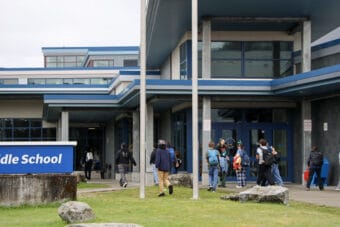
Kelley Harvey testifies during a Juneau School Board special meeting at Thunder Mountain Middle School on Feb. 19, 2026. (Photo by Jamie Diep/KTOO)
Listen here:
During Thursday’s meeting, the Juneau School Board discussed adding rather than cutting positions next school year. But unsettled union contracts continue to bring uncertainty to the budget process.
The board added new positions to next year’s proposed budget to support the school district’s homeschool program and nursing staff.
Board member Steve Whitney proposed adding a full-time health assistant to the budget. District leadership recommended adding another position to give the district’s lead nurse the flexibility to support all schools.
Whitney said adding a position is needed to support the district’s nine person nursing staff. District staff have reported an increase in the number of students with medical needs in recent years.
“From what I’ve seen, that’s a hole the district has, and I think it’s a liability, and I think we’re putting kids in danger,” Whitney said.
Board member Jenny Thomas also requested adding a counselor position for the district’s homeschool program, HomeBRIDGE. The program doesn’t currently have a counselor. It was requested by the program’s principal, Corey Weiss. Thomas said she wants to support the 210 students expected to be enrolled in that program next school year.
“They said their graduation rates were higher when they had a grad counselor, and we’ve seen them going back down because they lost that grant funding,” she said. “So I think it’s very important – for thinking about what is best for our students, and is going to help them achieve graduation – that we put a counselor in there.”
The $4.4 million deficit in the board’s proposed budget will grow larger with the two added positions – but the board decided earlier to fill the deficit with district savings.
The previous projected deficit was almost $1 million more. The budget now assumes 10% of employees will opt out of the district’s health insurance plan. As of earlier this month, more than 22% of them have waived the plan this school year.
But there are still some uncertainties. The district hasn’t reached new contract agreements with its teacher and support staff unions.
The current budget is based on the district’s most recent offer to Juneau Education Association, the teachers union – as well as on the district’s initial proposed contract for Juneau Education Support Staff.
Kelley Harvey, a teacher at Auke Bay Elementary School and co-chair of JEA’s negotiation support team, testified Thursday with that reminder.
“I would just ask that you remember that you have two units that have not settled a contract, that it’s just a one year contract that’s been offered to JEA, that we potentially would turn around and go into this again,” Harvey said. “And you’re just going to lose more teachers, and it’s the kids who suffer.”
It’s been more than a year since negotiations began with both unions. The district has an arbitration hearing scheduled with JEA on April 27 and 28, and JESS has been in mediation with the district.
During Thursday’s special meeting, there was no discussion of adding two positions that the Tlingit Culture, Language and Literacy program could stand to lose when grant funds end this year. There had been significant public comment in support of adding those positions in a previous budget forum.
The board will meet again about the budget on March 5. In the meantime, members will submit priorities on what else they want to add to the budget. The public can submit feedback on the budget by emailing the board at budgetinput@juneauschools.org or by completing Balancing Act, an interactive tool that lets the public build a budget and submit changes they want to see. That tool will close on March 1. The board plans to approve the budget by March 12.
Mt. Edgecumbe High School, the state’s sole public boarding school, is seen in Sitka on Oct. 6, 2025. (Corinne Smith/Alaska Beacon)
Lawmakers held a series of hearings with officials from Mt. Edgecumbe High School, the largest state-run boarding school in Alaska, following a tumultuous year of budget and staff cuts, administration changes and a wave of student disenrollments.
Sen. Bert Stedman, R-Sitka, opened his remarks at a Feb. 12 Senate Finance Committee hearing saying lawmakers need to air the school’s “dirty laundry” so they can help fix the school’s finances and make needed repairs.
“The goal here is to improve Mt. Edgecumbe High School, and we can’t do that without accurate information,” he said.
Stedman was among a delegation of legislators that made an impromptu visit to the school on Feb. 6, after the news of a mass student disenrollment after this winter break. Lawmakers reported they found leaking roofs, classrooms and buildings in disrepair, rodents, and outdated dormitories. They also met with students to hear about their concerns.
Buckets catch water from a leaky roof in the attic of a Mt. Edgecumbe High School girls dormitory, seen by legislators on a legislators’ visit on Feb. 6, 2026. (Courtesy of the Senate Finance Committee)
After the visit, Sen. Lyman Hoffman, D-Bethel, reported at a Senate news conference the conditions of the facilities were “deplorable.”
Hoffman, who also serves as the finance co–chair, did not mince words to school officials at the hearing. “I could say that if I were a parent, I wouldn’t let my child go to school there,” he said. “The condition of that school speaks for itself. ”
Mt. Edgecumbe High School is based in Sitka, which typically enrolls around 400 students, the majority of whom are Alaska Native from rural communities without local high schools. As of February, enrollment dropped to 311 students, officials said.
Superintendent David Langford, newly hired in July, told lawmakers that administrators were concerned that roughly 25% of students had disenrolled, but said they could not identify a common reason to explain why.
“So far, all the data of all the 100 students that have left this year, we can’t find any trends,” he said. “Like we didn’t have any majority of the students saying ‘it was the food’ or ‘it was the dorm,’ or was this or the other thing. But all those were issues that we’re working to rectify.”
Lawmakers put questions to Deena Bishop, commissioner of the Alaska Department of Education and Early Development, which administers the school, along with the governor-appointed Alaska State Board of Education.
Mt. Edgecumbe Superintendent David Langford (left) and Deena Bishop, commissioner of the Alaska Department of Education and Early Development, are seen on Feb. 11, 2026. They testified before several committees of lawmakers on the conditions at the boarding school, after over 100 students disenrolled to date this school year. (Corinne Smith/Alaska Beacon)
To explain recent events at the school, Bishop painted a picture for lawmakers of a “right-sizing” effort led by DEED after COVID pandemic relief funding ran out in 2024. She said Mt. Edgecumbe had a $1.6 million budget shortfall that forced a series of cost-cutting measures throughout 2025. The state sold off a parcel of land on the campus property for $900,000 to help fill that gap.
But Bishop said last year, the DEED and the administration cut four teachers, one administrator and two support staff positions. They also made cuts to student activities, travel and maintenance funding — plus a change in the superintendent and contractors running the student dorms and food service this year.
Mt. Edgecumbe High School student housing in Sitka on Oct. 6, 2025. (Corinne Smith/Alaska Beacon)
Langford testified that when he arrived in August, he wasn’t sure the school would open. But DEED and administrators made a series of emergency repairs and deep cleaned the kitchen facilities and dorms, replacing years-old mattresses, dorm furniture and upgrading the kitchen including all cookware.
Legislators asked how school facilities had been left to deteriorate so badly, who was responsible for advocating for the school repairs, and how officials planned to make improvements.
Hoffman said it was obvious from legislators’ visit that there is more work to do.
“It seems every time we go down the path, there are more and more and more issues that aren’t being addressed,” Hoffman said. “I’m glad we’re addressing the immediate needs, but there’s long term needs that need to be addressed that aren’t being addressed by the Department of Education.”
Bishop acknowledged that the effort is ongoing. “So in right-sizing the ship, it’s moving forward. I absolutely agree with you. Is Mount Edgecumbe where we want it to be? Absolutely not. I believe, with the leadership that is there and support for this school, that we can get there.”
Hoffman pointed out the school lost Americorps support staff after the Trump administration gutted the program last year. Mt. Edgecumbe lost three staff who served in major support roles for students for after-school activities and outings into town.
“The primary role of these people was to do nothing but be with students in the evening,” said Langford. He added that he tried to hire staff back this year, but it was too late. “So in terms of students going home, I would point to that as one of the biggest impacts that could have been prevented.”
In a state Board of Education meeting in December, parents, alumni and current and former staff from Mt. Edgecumbe testified that because of changes in the dorms, loss of staff and teachers and reduced activities, students’ quality of life suffered, and morale plummeted last fall. A local healthcare provider testified to members of the board that in the previous month, eight students were hospitalized for suicidal ideation — an unprecedented number, she said.
Ilana Kalke, a junior, was one of two Mt. Edgecumbe students that testified to lawmakers last week. She said there is a disconnect between the new contractor running the dorms, the NANA Corporation, and staff and students.
“It seems like they have trouble communicating, which impacts us, this leads to inconsistent application of rules,” Kalke said. “There’s been trouble communicating, getting rides, and just like less collaboration, which affects rec activities.”
Mt. Edgecumbe sophomore Kadyn Cross (left) and junior Ilana Kalke (right) testify before legislators on Feb. 11, 2026. (Corinne Smith/Alaska Beacon)
Kadyn Cross, a sophomore, testified in support of the school and told lawmakers that supporting the school supports students like him, who are coming from small villages like his community of Koyuk, on the coast of Norton Sound.
“MEHS is already producing future educators, leaders and contributors to Alaska’s communities. But we can’t do that without stable funding for staff, updated facilities, student activities, and real maintenance, especially maintenance, which is stretched thin right now,” he said. “I’m not here with data charts. I’m here as one student who moved from a small village to a school that changed my trajectory fast. And I’m one of hundreds. MEHS isn’t just a school, it’s a place that grows people who go back to their communities and strengthen them.”
Lawmakers slam Gov. Dunleavy for years of vetoing funds for repairs
Lawmakers criticized Gov. Mike Dunleavy for vetoing funding for Mt. Edgecumbe year after year — most recently last year vetoing $2.7 million for a new roof and windows on the girls’ dorm.
Since the start of Dunleavy’s term in 2019, the governor has vetoed funding allocated for Mt. Edgecumbe, including maintenance of the aquatic center and student services. He vetoed funds to replace the dorm windows for three years in a row. Over six years his vetoes totaled over $22.4 million, according to state data.
Storage containers and suitcases are stacked in a stairwell of the Mt. Edgecumbe girls dormitory as the attic is leaking, seen on a legislators’ visit on Feb. 6, 2026 (Courtesy of the Senate Finance Committee)
Sen. Löki Tobin, D-Anchorage and chair of the Senate Finance Committee, expressed her frustration at a Senate news conference last week, reading out a list of the vetoes. “We continue to advocate for school repairs and to address school infrastructure across the state,” she added. “And it seems that we do not have a governor who wishes to lead. It is incredibly frustrating.”
A spokesperson for the governor’s office responded to questions about lawmakers’ criticisms by email on Tuesday, noting the governor had approved $15.3 million for repairs and maintenance for Mt. Edgecumbe since 2019, including for bathroom and kitchen upgrades, asbestos and lead abatement and some funding toward replacing dorm roofs.
“The challenges Mt. Edgecumbe is currently addressing stem from years of low prioritization of needs. With the new leadership of Superintendent David Langford, under Commissioner Deena Bishop, emphasis has been placed on realigning the budget to remedy maintenance issues,” said Jeff Turner, Dunleavy’s director of communications.
Turner said that even with the governor’s vetoes, Mt. Edgecumbe maintenance and repairs are underway.
“Without the vetoed funding, Mt. Edgecumbe has reprioritized and has updated culinary equipment, furniture, and scheduled three buildings to be re-rooved this summer — with more to come. Budget management has now been placed at the forefront, allowing existing funding to begin remedying what was thought to be unattainable without further allocation,” he said. “This is a textbook example of results obtainable when accountability is highlighted.”
Legislative action for Mt. Edgecumbe repairs
On Wednesday, the Senate passed a new bill, Senate Bill 146, that would add Mt. Edgecumbe to the state’s school major maintenance list to be eligible for state grants for construction and maintenance projects. Currently Mt. Edgecumbe is maintained using funds through the Alaska Department of Transportation and Public Services, as a state-run facility.
The bill would also do away with the $70 million cap on the Regional Education Attendance Area school fund — for schools that rely solely on state funding as they’re located in rural areas without municipal funding — and allow those funds to be used for Mt. Edgecumbe projects, including teacher housing.
A similar bill was passed last year, but Dunleavy vetoed it. Senators said they are hopeful there will be more support this year, and the bill now advances to the House.
“I’m hoping that there’ll be broad support in the legislature like there was last year, and we’ll put it back on the governor’s desk, and hopefully the governor will reconsider,” Stedman said.
Sen. Bert Stedman, R-Sitka, is seen meeting with Mt. Edgecumbe students on a legislative visit on Feb. 6, 2026. (Courtesy of Senate Finance Committee)
Moving forward, Stedman said the Finance Committee is gathering information on critical repairs and maintenance needed, projects in progress and items to be added into next year’s budget, including funds immediately available to replace items like washing machines and mattresses.
“We’ll be monitoring it,” Stedman said Tuesday. “There’s a good percentage of the (Capitol) building here that got its attention, because it’s embarrassing for everybody.”
Lawmakers questioned Langford, the superintendent, last week on his role currently running two school districts this year — both the Mt. Edgecumbe high school and the Chatham School District, which serves approximately 175 students across rural schools in Angoon, Gustavus, Tenakee Springs and Klukwan.
Langford and Bishop testified that a former Wasilla Republican Senator, Mike Shower, approached Langford to run both districts. Langford said he considered only with the permission of the Chatham School board, and then accepted both roles.
Bishop said at first she was skeptical of the arrangement, but changed her mind. “I initially said, ‘Yeah, no, thanks. This is, we’ve got big, big issues to solve.’ Then they started talking to me, and I said I would not go and poach someone else’s superintendent.”
She said she was convinced by Langford’s experience in education consulting, and his history with Mt. Edgecumbe, starting as a teacher in 1985. She said he has valuable leadership experience as a superintendent and running district finances.
Langford said the board of the Chatham School District is conducting quarterly reviews of his performance, and the State Board of Education conducts annual reviews on his tenure at Mt. Edgecumbe. He said while there are disadvantages of not being on the ground in the Chatham School District, he has access to DEED officials to the benefit of both districts.
He said so far, the arrangement is going well. “I think it’s very exciting to work with you and all the staff at Mount Edgecumbe,” he told lawmakers. “To try to remake Mt. Edgecumbe and bring it back to the greatness that I think it once was.”
Thunder Mountain Middle School on Tuesday, Feb. 10, 2026. (Photo by Clarise Larson/KTOO)
The Juneau School Board will hold its first reading of the school district’s budget on Thursday.
In a work session on Saturday, the board directed district administrators to create a list of items that they can discuss adding to the budget. That includes things like additional positions for the district’s nursing staff, special education and homeschool program.
Student services director Jason DeCamillis said at the meeting that an additional position for the nursing team could support the growing number of students with severe medical needs.
“It’s a little bit more of a centralizing of a position, but it does allow that person to float, be more supportive of the whole system,” DeCamillis said.
The discussion comes as the board grapples with a preliminary budget with a more than $5.3 million deficit. That could be addressed by dipping into savings or making cuts. The district is projected to have about $7.8 million in savings, which is almost $7 million more than what it’s required to maintain.
Board members also requested adding grant-funded positions for the Tlingit Culture, Language and Literacy program to the list. Grant funding for three positions is ending after this school year, and the board has to decide on directly funding them from its operating budget. The board already supported funding one of the positions.
The board is also considering ways to factor in staffing vacancies and people that don’t opt into the district’s health insurance plan. Right now, the district budget assumes it fills all positions and that everyone hired uses the district’s health insurance plan. Unspent funds from vacancies and people waiving health insurance currently go into the district’s savings. The Juneau School district began the school year with about 6% of teaching positions unfilled. And as of February 9, about 7% of the district’s classified positions were vacant.
The board requested staff to present various scenarios: how much money a 1% and 3% vacancy rate would look like. Those funds could be budgeted toward other items. The board is also looking at how much money it can use if it assumes 10% of employees waive the district’s health insurance.
Since at least 2022, the number of district employees opting out of the district’s plan has increased. As of this month, more than 22% of them have waived the plan this school year.
The board will meet to discuss the budget Thursday at Thunder Mountain Middle School at 5:30 p.m. The meeting can also be accessed on Zoom, and the public will have an opportunity to testify in person, online and by emailing budgetinput@juneauschools.org.
The entrance of Juneau-Douglas High School: Yadaa.at Kalé on August 15, 2026. (Photo by Jamie Diep/KTOO)
The Juneau School District released a budget simulation tool on Wednesday that allows people to build and submit what they think the district’s budget should look like.
Balancing Act focuses on building the district’s operating budget. That includes funding for student instruction, including teachers, administrators and school supplies.
The district originally planned to also send a budget survey to families earlier this month. But Juneau School Board Vice President Elizabeth Siddon said during a budget work session last month she was concerned that the community might not see its responses reflected in the budget.
“I don’t want to put a survey out that is not real clear to the public how we used it later, especially in our budget,” she said. “So this all needs to have clear line of sight, what we’re going to do with the feedback we get in the budgeting process.”
The board unanimously decided to set the survey aside this year after board member Steve Whitney brought up the idea.
The budget tool starts off with a preliminary budget that maintains all of the district’s current services going into the next school year. It gives the public options on where they can add or cut teachers and funding. But there are some limits.
Some funding is required by law and can’t be changed. Other services can’t be cut by more than 10%. Information in the tool states larger cuts “would likely result in the inability to maintain compliance.”
The initial budget begins with a $5.3 million dollar deficit and assumes the city will contribute $35.8 million – the maximum it’s legally allowed to. Even when making all the cuts possible within the tool, the district is still left with a $1.1 million deficit. That could be covered with the district’s savings.
There’s an opportunity within Balancing Act to write comments on every source of revenue and expenditures.
Juneau School District Chief of Staff Kristin Bartlett said in an email the tool will likely close between the first and second reading of the budget, which is currently scheduled between Feb. 19 and March 10.
This isn’t the first time Juneau residents have been able to build their own budget. The city released its own version when building a budget in 2022.The next budget related meeting is Saturday at 8:30 a.m. at Juneau-Douglas High School: Yadaa.at Kalé. Community members can also submit written feedback by emailing budgetinput@juneauschools.org. The board is expected to approve a budget by March 12.
The Harborview Elementary School playground in Juneau on Jan. 7, 2026. (Photo by Jamie Diep/KTOO)
The Juneau School District is returning $1.05 million earmarked for child care back to the city.
The school board unanimously approved returning the funds following multiple delays since November as board members mulled over the future of after-school child care in the district. The decision was made during a regular board meeting Tuesday night.
Board member Melissa Cullum said she supports returning the money and hopes to work with the city when the district has a clear plan for after-school child care.
“As much as I would like to hold on to that in hopes that we have a plan, I don’t feel comfortable continuing to table it or hold on to it, hoping that we have a plan for after-school care,” she said. “And I would rather give it back and then preserve that relationship.”
The district ended its program, RALLY, last summer, citing staffing challenges. Private provider Auke Lake Preschool stepped in this school year to offer after-school child care at three schools. As of Wednesday, the provider is still in the process of getting licensed through the state, according to Derik Swanson, one of the owners.
Board member Jenny Thomas said families have reached out to her with concerns about the current RALLY program run by Auke Lake Preschool. She said the board should step in to provide support.
“Whether we give the money back or not, we need to put our foot in the door to try to help make the program a little smoother,” she said.
During a phone call Wednesday, Thomas declined to elaborate on what those concerns are.
The decision comes as YMCA Alaska is looking into the feasibility of running programs in the district. Nate Root, the organization’s president and CEO, said in an interview Wednesday they are working with local organizations in Juneau to survey parents. He said YMCA Alaska wants to see if it’s sustainable to offer after-school child care in Juneau.
“We understand the need for it right now, but for us to be able to expand our services to Juneau – which we’re very interested in doing and helping the community – we need to know that there’s a long term stability to that initial investment,” he said.
Root said if they decide to run a program, they will also need to look for staff and opportunities to raise startup funds.
Frieda Nageak (right) a board member with the North Slope Borough School District, and student Faith Brower (left) testify before a joint session of the House and Senate Education committees as part of the annual fly-in advocacy day on Feb. 9, 2026. (Photo by Corinne Smith/Alaska Beacon)
Students and school officials from across Alaska visited the Legislature — from the North Slope, to the Yukon Flats, to Yakutat and Hoonah — to make what has become an annual plea to lawmakers to invest in the state’s public education.
“I have been in this building every February for 20 years, and for 20 years I have been saying nearly the same exact thing, and we’re at a point now where that conversation is at an inflection point, ” said Lon Garrison, executive director of the Association of Alaska School Boards, which organizes the annual fly-in event on Monday.
“Pretty soon, public education will not work in the state of Alaska,” he said. “And we have to do something. We have to be bold.”
Decades of deferred maintenance for Alaska’s schools is reaching crisis levels, lawmakers heard, with some districts grappling with deteriorating school buildings, failing water and sewer systems.
Alaska’s school maintenance problems are well-known, but the schools’ needs come with a multi-million dollar price tag. Lawmakers will be negotiating how much to allocate to schools among a slate of other dire state funding needs, from transportation to increased disaster relief funding. That negotiation is further complicated by declining oil prices and state revenues — and the threat of Gov. Mike Dunleavy’s veto pen.
But on Monday, students and school board members, some parents themselves, shared emotional testimony of how schools continue to endure failing infrastructure.
“Some of our schools are so riddled with black mold that I developed a headache almost immediately,” said Julia Phelen, a member of the school board with the Delta-Greely School District, on visiting rural schools in the Delta Junction area district. “Some of them have only one working restroom in the entire building, and others are hauling water and using honey buckets.”
Last year, the Legislature approved $38 million to address school maintenance needs on the state’s major maintenance list, a ranking of school projects submitted to the state for reimbursement. That was enough to cover the top nine projects on the list. Gov. Dunleavy vetoed that down to roughly $12.8 million, citing declining oil prices and state revenues, to fund the top three projects on the list.
This year, whether lawmakers will allocate more funding for public education remains uncertain amid early budget negotiations.
But leaders in the bipartisan Senate Majority Caucus expressed support for addressing more of schools’ major facilities needs at a news conference on Tuesday.
“Now this year, we’ve got $401 million on the deferred maintenance list of schools,” said Sen. Bert Stedman, R-Sitka, a member of the Senate Finance Committee. “We need to have a dialogue with the administration and try to get them to work with us so we can, you know, slow down this deferred maintenance. Because every year doesn’t get addressed, it just gets worse.”
The deteriorating school facilities are coupled with stretched budgets — some districts face steep budget shortfalls and school closures — and rising costs, especially for rural districts. Some speakers said budget shortfalls are forcing districts to cut classes, teachers and activities, which they said is posing a growing risk to students’ safety and wellbeing, including mental health.
Reanna Brown, a school board member from Yakutat, testified that in rural communities like hers, which are connected to the road system only by boat and plane, the costs of education are higher, from retaining teachers to powering buildings and transporting supplies.
“Our students deserve the same opportunities as any student in Alaska, regardless of their zip code,” Brown said. “Stable, equitable education funding allows us to retain quality educators, support student services and provide safe, consistent learning environments.”
In the Yukon Flats School District, which covers a vast area in the northeast of the state, Rhonda Pitka, a school board member, said the decades of deferred maintenance is a constant problem.
Rhonda Pitka, a board member of the Yukon Flats School District, and chief of the Beaver Village Council testifies before legislators on the challenges faced by the school districts on Feb 10, 2026 (Photo by Corinne Smith/Alaska Beacon)
“There’s always a problem with the sewer systems and the water systems,” Pitka said. “One of our smallest schools, Chalkyitsik, has about 13 students this year, but they’ve had this water issue for like, 20 years,” she said.
She said extreme cold and the remoteness of schools in the Interior is also exacerbating schools’ water and sewer issues.
“We have incredibly cold weather. It was 50 below for five weeks, and then it hit a three day streak of minus 70 below in the Interior. So, you know, at those temperatures, nothing’s running, nothing’s working,” Pitka said, and spoke about the difficulties of retaining essential maintenance workers in the villages at $20 per hour.
Many speakers thanked lawmakers for supporting the increase to the state’s per student funding, the base student allocation, last year, but said that state education funding still falls far short of what is needed.
“Every day we see the impact of not having enough resources for our education,” said Melina Pangiak, who testified with a classmate, Lucia Patrick, from the Chevak school in the Kashunamiut School District in Western Alaska.
The students spoke about the cuts to elective classes and learning opportunities. “Elective classes are more than just extra courses. They are where we discover what excites us and where we find talents and when we could discover our future paths,” Pangiak said.
Students with the Kusilvak Career Academy, a residential program focused on career and technical education for high school students with the Lower Yukon School District. They visited the Legislature as part of the annual fly-in organized by the Association of School Boards on Feb. 9, 2026. (Photo by Corinne Smith/Alaska Beacon)
“When these classes are cut or limited, it feels like doors are being closed on our potential,” Patrick added.
Students and school officials testified that there is a growing need for more school counselors and resources for mental health support.
“Our region recently experienced another suicide, which deeply affected our students and our only regional counselor,” said Kay Andrews, a school board member from the Southwest Region School District that includes eight schools spanning across the Bristol Bay region.
“Schools are more than our classrooms. They are community centers. They are safe places for our children, yet, schools are being asked to do more with less,” she said.
Some speakers pointed to bill proposals that lawmakers are considering this year as potential solutions. Some testified in support of House Bill 261, proposed this year by Rep. Andi Story, D-Juneau, that would redefine how districts calculate their student count to create more predictable budget estimates in the spring.
“It’s come to be a guessing game, almost, because we’re not sure how many students we’re going to have,” said Jack Strong, a board member from the Chatham School District, which serves four rural schools in Southeast Alaska. “It’s really hurting us in the long run, our children are not getting the education that they need, basically because of the way the paper shuffle is.”
Speakers also expressed support for state pension reform, House Bill 78, currently being debated in the House Finance Committee, to help support recruitment and retention of teachers.
Students came with solutions as well: Maddie Bass, a sophomore at Juneau Douglas High School: Yadaa.at Kalé testified to the stress of teachers struggling with low pay, and leaving to pursue other jobs with health care benefits. Following the hearing, Bass said she’d like to see the state generate more tax revenue from the millions of tourists that visit Alaska each year.
“I’m seeing the government turning to taxing Alaskans. They want to tax Alaskans more instead of taxing corporations, and I think that that is the wrong idea,” Bass said. “I think to bolster the education system in Alaska, it would be a good idea to tax the tourism industry or cruise ships more, instead of putting a further burden on Alaskans that are just trying to work, learn and live here in the state.”
Close
Update notification options
Subscribe to notifications
Subscribe
Get notifications about news related to the topics you care about. You can unsubscribe anytime.