Economy

Is this empty gravel lot about to become downtown Juneau’s newest tourist attraction?

Snow covers the Archipelago Lot on South Franklin Street on Friday, Feb. 20, 2026. (Photo by Clarise Larson/KTOO)

A large gravel lot in the heart of downtown Juneau’s tourism corridor has sat empty for years. But that might soon change. 

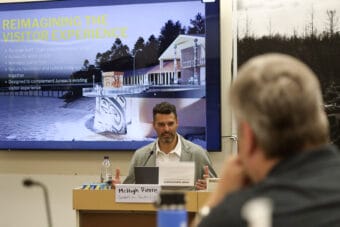
On Tuesday, the city’s planning commission will consider whether to approve a conditional use permit for the construction of a two-story retail and entertainment building called “Alaska Fly & Dive.”

According to the permit application, the project will bring tourists coming off cruise ships into an immersive theater experience of Alaska’s natural wonders, like local glaciers and underwater adventures. The development would include three large interactive theaters/rides, a retail store and some office space. 

The project, estimated to cost at least $60 million with hopes of opening in 2027, would turn into a civic and educational venue in the tourism off-season. 

This is a drawing of the proposed Alaska Fly & Dive building in downtown Juneau. (City and Borough of Juneau)

“I know it’s private property. They should be allowed to develop as they do, but I just don’t know that it will benefit Juneau, as I know it, or the Juneau that is here after the tourists leave,” former Juneau Assembly member Loren Jones said in an interview.  

Back in 2019, the Juneau Assembly negotiated a land swap with property owner Archipelago Properties LLC, a subsidiary of Morris Communications based in Georgia and the former owner of the Juneau Empire newspaper. The negotiation was so that the city could develop bus staging and additional pedestrian space along the seawalk. Plans for Morris Communications to develop something on their property have been discussed for at least close to a decade. 

Jones voted against the land trade deal. He was skeptical about how any development there would benefit the community as a whole. 

At the time of the deal, a representative for the property said they wanted to develop the lot into retail shops and restaurants starting in 2020. That never happened. 

Instead, the nearly 1-acre property adjacent to the downtown library and parking garage — along South Franklin Street and under the watchful eyes of the Elizabeth Peratrovich mural — has remained largely empty. That’s despite the property’s extreme proximity to where 1.7 million cruise ship tourists walk off ships and into downtown Juneau each summer.

Jones said he’s not totally against the current “Alaska Fly & Dive” project — but needs more convincing that it will actually benefit Juneau.

“I don’t see anything in there that tells me that somebody in the middle of winter is going to leave their home in the valley and go,” he said. “I can’t imagine any of us going down in the middle of winter to take a simulated boat ride or a simulated submarine ride.”

Still, the new project has received letters of support from the Juneau Economic Development Council, Travel Juneau, the Downtown Business Association and the Society of St. Vincent de Paul. According to its application with the city, the development is in collaboration with Melvern Entertainment, a company that develops theater attractions for Disney, Universal Studios and Six Flags.

The proposed theaters include a 60-person 4D theater, a 72-person flying theater, and three 20-person ocean simulator theaters. The flying theater and ocean simulator theater would also be rides, taking guests via immersive films to see local glaciers and landscapes, and on underwater adventures.

This is a concept design of the Alaska Fly & Dive’s flying theater. (City and Borough of Juneau)

Liz Perry with Travel Juneau said in an interview that she’s excited to see the empty lot turn into something new. 

“This would be a terrific year-round addition to our offerings for both visitors and residents — it will create something that hasn’t been in that lot,” she said. 

And before you ask – no, they’re not planning to build any housing there. At least not in this application. Alix Pierce is Juneau’s Visitor Industry Director. In an interview, she said she thinks the project could help with managing the number of tourists that come into town each day in the summer. 

“I think having something downtown on the waterfront that’s indoors and helps manage congestion by pulling people into an activity, is a positive thing,” she said. 

The applicant for the permit is Reuben Willis, a local insurance Agent for State Farm. He declined an interview with KTOO to speak about the project before the meeting on Tuesday. In the application, it states that he signed a sales agreement for the lot, which is in a “due diligence period.” Morris Communications has also not responded to multiple requests for comment. 

The Juneau planning commission will decide whether to approve a conditional use permit for the project’s construction, along with two other variance requests related to the project, on Tuesday at 6 p.m. at City Hall. 

‘Can you survive another crisis?’ New documentary chronicles pandemic in Skagway

Skagway residents attended a local screening of a new documentary about how the community fared during the pandemic.
Skagway residents attended a local screening of a new documentary about how the community fared during the pandemic. (Avery Ellfeldt/KHNS)

The smell of buttered popcorn wafted through the Skagway School as dozens of people streamed inside. They were there to watch a new documentary — one about their own community during one of its darkest periods in recent history.

The film depicts life in Skagway between 2020 and 2022, when the cruise industry shut down amid the COVID-19 pandemic. It’s named “Last Call in the North.”

Andrew Cremata was Skagway’s mayor at the time. He said the ordeal forced what may have been the community’s first serious reckoning over its complete dependence on the industry.

“I don’t think there’s ever been any real meaningful conversations about it as a community, either on a governmental level or on a social level,” he said.

That conversation was the film’s throughline, said Stan Bush, who wrote and directed the film.

“What happens when your main economic driver is completely shut off?” Bush said in an interview last week.

Former Skagway resident Stan Bush wrote and directed the film, “Last Call in the North.” (Avery Ellfeldt/KHNS)

In many ways, COVID-19 was Skagway’s worst nightmare. With the town’s tourism-based economy shuttered for one full season and much of a second one, families and businesses went without income for an excruciating 22 months.

Bush went to middle and high school in town, but he hasn’t lived here since then. He said he was developing a project idea in Skagway before the pandemic, focused on the struggling local newspaper.

But Bush pivoted when COVID-19 hit the community in earnest, and the industry that had fueled the town for decades disappeared overnight.

“We’ve seen that when things are going great, they’re going really great. And when things go bad, here, they go really bad,” Bush said. “I think that’s a conversation for the community to have. Can you survive another crisis like this?”

The film follows a few key characters, including Cremata, the former mayor. In an interview after the screening, he raised questions about the long-term sustainability of the town’s economy.

“My fear was that when things got back to normal, people would kind of just go back to normal, right? Go back to the way things were before the pandemic,” Cremata told KHNS. “That’s really exactly what’s happened.”

The film also focuses on struggling small businesses — a jeweler who had to leave town, the owner of an outdoor guiding company who eventually shut his doors, and the former co-owners of the Skagway News. That includes Melinda Munson, the current KHNS news director.

Another key voice was Jaime Bricker, Skagway’s tourism director and the president of the Skagway Traditional Council, a local tribe.

After the premiere, Bricker said she was impressed by the videography and storytelling. She added that she could imagine how difficult it would be to tell the full story in just 90 minutes.

“I think I’ve heard different observations from just about everybody I’ve talked to, and rightfully so,” Bricker said. “We’re all a bunch of individuals in this community, and there were so many pertinent stories of that period of time that, you know, weren’t showcased.”

Bricker added that she thinks the film presents an opportunity for renewed reflection.

“Are there opportunities to plan as we look towards the future, given this particular COVID experience?” Bricker said. “Are there things that we can be doing differently in the future, to better prepare for an economic stop?”

Bush said prompting conversation was one of his main goals – not only locally but in similar communities across the state, country and world. As he sees it, what happened in Skagway could happen anywhere where the presence of one industry is the difference between economic survival and economic collapse.

Disclosure: This film features KHNS News Director Melinda Munson and her family, when Munson was co-owner of the Skagway News. Munson did not review this story before publication.

Alaska’s summer ferry schedule is open for booking

A docked Alaska state ferry with snowy mountains in the background, across a body of water.
The Columbia, a mainliner in the Alaska Marine Highway System, docked in Skagway in early March, 2025. (Avery Ellfeldt/KHNS)

Travelers can now schedule ferry rides with the Alaska Marine Highway System for May through September. That’s after the summer schedule opened for booking Feb. 12.

The schedule looks a lot like recent years, with six of the state’s nine vessels sailing. There is not enough funding or staffing to run them all, said Shannon McCarthy, spokesperson for the state Department of Transportation.

“Our crew is relatively stable right now, but, you know, it’s not expanding rapidly,” McCarthy said. “Our budget is also a concern this year, so we will only be running one of the mainliners at any given time.”

Only one mainliner – the Columbia – is scheduled to travel weekly through Southeast to Bellingham, Washington. That means a round trip every two weeks for most residents.

A map of the Alaska Marine Highway System’s routes in Southeast Alaska. (Alaska Dept. of Transportation and Public Facilities)

McCarthy said the Kennicott will be on standby in case the Columbia needs repairs.

“The nice thing is, it is much better to have two vessels — main liners — that are able to be sailed at any point,” she said. “It puts the state in a much better position.”

The Tustumena will sail the southwest region between Homer and the Aleutians. That’s roughly two round trips per week from Homer to Kodiak, and one full Aleutian Chain run per month.

The day boat, Leconte will sail Prince William Sound. And Lynn Canal will be similar to last year, with the Hubbard doing nearly daily runs between Juneau, Haines, and Skagway.

U.S. Senator Lisa Murkowski helped secure hundreds of millions in federal ferry funds over the last five years. But the state is now waiting on a key federal grant for this year. DOT Commissioner Ryan Anderson is scheduled to be in DC this week to talk to the Alaska Delegation about it.

“Because this money is still available — it was written into the law,” McCarthy said. “So, we’re just trying to figure that out, to see if there is some relief there.”

With ongoing funding issues, the state is considering selling the Matanuska, a 63-year-old mainliner that’s been tied up in Ketchikan and used for housing new ferry workers. McCarthy says they’ll still be able to offer housing in the mainliner that’s not currently sailing.

Mariculture workshop in Juneau highlights growth potential for Alaska oyster farms

Thousands of young Pacific oysters grow in bins within the floating upweller system, or FLUPSY. (Photo by Alix Soliman/KTOO)

Listen to this story:

At the end of a dock in Auke Bay, an oyster farmer lifted a creaky hatch door on an unassuming floating platform. Inside were bins holding thousands of young oysters, called spat.

The platform is called a floating upweller system, or FLUPSY, and it’s one way oyster farms can keep more stock.  

“This is just a cheaper way to buy spat in a smaller size, much bigger quantity,” said Maranda Hamme, owner of Shinaku Shellfish Company, a small, family-run Pacific oyster farm in Klawock. Hamme was part of a small group that visited Juneau for a day-long mariculture workshop organized by Alaska Sea Grant and the Central Council of the Tlingit & Haida Indian Tribes of Alaska last week.

Nutrient-rich water flushes through the FLUPSY, so the tiny oysters can quickly grow big enough to fit into mesh bags out on a farm. The oysters in the FLUPSY are around the size of a penny — they’ve been growing here for roughly 9 months.

An oyster farmer opens a hatch on the FLUPSY in Auke Bay, where thousands of small oysters are growing. (Photo by Alix Soliman/KTOO)

The FLUPSY in Auke Bay belongs to Salty Lady Seafood Company, the only oyster farm in Juneau. Hamme said she’s planning to stock her own FLUPSY in Klawock because it can help her scale up, even when there are bottlenecks in the supply chain. 

“Currently, there’s only so many FLUPSYs in the state, and as a farmer, we’ve already not had seed needs met,” she said.

Most oyster farmers in Alaska, including Hamme, have to ship in spat from out-of-state hatcheries in Hawaii, Washington, Oregon or California. Sometimes there are shortages at those hatcheries. 

Spencer Lunda manages the University of Alaska Fairbanks’ mariculture research hatchery at Lena Point. He said developing in-state hatcheries can help solve that problem. 

The facility pumps in seawater that gets heated and flows into troughs filled with oysters, where Lunda and his team are studying ways to produce spat locally for farms across Alaska. 

“It would be nice to have spat production in the state, and be able to produce oysters that perform better in the conditions of Alaska, because the water is very cold here compared to where oysters are typically grown,” he said. 

Lunda said the ultimate goal is to breed oysters that grow relatively quickly in cold water and form a deep cup with a lot of meat — traits desirable for both farmers trying to turn a profit and consumers slurping them from the half-shell. 

Spencer Lunda holds a scallop shell covered in dozens of tiny oysters, called spat, in the oyster research hatchery at Lena Point. (Photo by Alix Soliman/KTOO)

Back on the dock, Hamme said the lease process to enter the industry is another issue that could be improved.

“I’m here sharing about being a farmer and the struggles and challenges that we face firsthand so other Indigenous farmers can get into the industry,” said Hamme.

She said it took two years to get an aquatic farm lease through the state. She also said the process doesn’t include tribal consultation to see whether proposed farm sites would overlap with subsistence seafood harvest sites.  

“I think it’s crucial that the state of Alaska incorporates tribal consultation, rather than just city government,” Hamme said. 

But developing mariculture operations could become a boon for Native communities, too. 

Frank Nix, the cultural foods manager for the Organized Village of Kasaan, attended the workshop to see how mariculture could bolster economic development and food security in his small village. 

Parent oysters, or broodstock, sit in a trough in the oyster research hatchery. (Photo by Alix Soliman/KTOO)

“Most of us are already working three or four jobs, and all of our facilities are running three or four programs,” Nix said after touring the small Auke Bay oyster hatchery. “So when it comes to looking at opportunities like, well, maybe we don’t have the manpower to run a farm — but, you know, it seemed like one or two people could manage a space of the size that we were just in.” 

He said he’s grateful to attend the workshop on a travel scholarship, and the recent availability of funding and training in Alaska mariculture makes the industry attractive. 

“I think one of the most valuable things that I’ve seen so far is that this seems perfectly doable,” he said.

New Amalga mining road proposal opens for public comment

Snow covers Herbert Glacier and Herbert River on Monday, Feb. 16, 2026. (Photo by Clarise Larson/KTOO)

A Canadian company with plans to mine for gold near the face of Herbert Glacier applied to punch an access road through state land in December. The state opened a public comment period for the road last week. 

Grande Portage Resources wants to build a 15 foot-wide and 1.3 mile-long unpaved road with helicopter pads connected to Glacier Highway around mile 27. The road between Herbert River and Eagle River would allow the company to stage drilling supplies for transportation to the proposed New Amalga mine site. 

This would be the first segment of road that will eventually reach the mine site if the U.S. Forest Service approves the operation, according to the company’s application to the state. 

The Forest Service approved exploratory drilling at New Amalga last spring. Grande Portage has been flying in prospecting supplies from Mendenhall Valley and wrote in its application that building a new staging site and access road will shorten the helicopter flights.

The road would cut through forest and wetlands in a popular recreation area near the Eagle Glacier Cabin trail, Herbert Glacier Trail and Windfall Lake Cabin Trail. 

The proposed mining road segment would end at the boundary between Alaska state land and the Tongass National Forest. (Image courtesy of Grande Portage Resources)

If approved, the company anticipates road construction will begin this spring. 

The deadline to submit public comments is March 13 at 5 p.m. and comments can be emailed to john.driscoll@alaska.gov

Some countries are cutting this source of marine pollution. Will Alaska do the same?

Two cruise ships docked in the foreground of a copper blue body of water, with snow-capped mountains on the opposite shore.
Cruise ships docks in Skagway during the 2025 summer season. (Avery Ellfeldt/KHNS)

In July, a state inspector boarded a cruise ship in Juneau for a routine review. The inspector’s report includes a photo that shows a metal drum full of chunky, black sludge — a mixture laden with sulfur and heavy metals.

That particular drum was slated to be offloaded on land, in British Columbia. But on many ships, systems known as scrubbers ensure the toxic sludge never materializes on board. That’s because it’s diluted with sea water and released back into the ocean.

Now, state Sen. Jesse Kiehl is looking to address the issue. The Juneau Democrat is drafting legislation in hopes of cracking down on the technology, which produces a largely invisible – and little regulated – source of water pollution.

“There’s still dirty fuel belching sulfur into Alaska. And that’s a problem,” Kiehl said in an interview last month.

The issue is not isolated to Alaska. And neither are efforts to address it. A growing list of ports, states and countries are zeroing in on the problem, which stems from rules adopted by the International Maritime Organization in 2020.

Cutting air pollution led to new water pollution

The IMO wanted to cut air pollution, namely sulfur pollution, from ships that burn heavy marine oil. While some cruise and shipping companies complied by using cleaner fuels, known as distillate fuels, others invested in scrubbers.

The technology allows them to continue burning dirty fuels by using seawater to remove pollutants from ship exhaust. So-called “open loop” systems send that contaminated water right back into the sea.

Experts say each individual open loop scrubber can produce up to 3,600 metric tons of water per hour. And some ships run multiple scrubbers at once.

When exhaust with high levels of sulfur and other pollutants is released into the air, they can increase the risk of cancer, respiratory complications and cardiovascular diseases. 

Scientists have been studying what happens when those pollutants are released into the ocean. But a growing body of research indicates it can harm marine life, including mussels and crustaceans, like crab, said Eelco Leemans, an advisor to the Clean Arctic Alliance, a global coalition focused on the shipping industry.

“The evidence is so clear that we have no reason to doubt that,” Leemans said.

Regulatory challenges

A tangled web of rules and regulations surrounds the issue. The IMO sets the global standard. And for now, the international body allows ships to use scrubbers to comply with its air pollution rules.

But there’s a growing push for that to change. Just this week, the agenda for an IMO subcommittee meeting in London featured more than a dozen proposals from member states and other organizations related to scrubber regulation.

“We believe that scrubbers do not provide the solutions that they were designed for, because basically they transfer air pollution to water pollution,” Leemans said during a recent webinar hosted by the Clean Arctic Alliance ahead of the meeting. “In the end, IMO should really do something about this.”

In the meantime, governments are taking matters into their own hands. In July, for example, 15 nations and the European Union moved to prohibit scrubber discharge in internal waters and port areas – and will consider extending the ban to about 12 miles offshore.

The U.S. has taken a less aggressive approach. The Environmental Protection Agency regulates scrubbers by way of a permit that sets limits for the concentration of pollutants in discharge. But at least in Alaska, the agency has rarely enforced those limits – despite hundreds of violations in some years.

The EPA did not respond to a request for comment by press time.

State regulators in Alaska, for their part, conduct routine environmental inspections on ships, which often entails observing scrubber operations and reviewing washwater data. In some cases, they flag problems for the EPA.

But in the end, the state Department of Environmental Conservation says it can’t enforce the EPA’s scrubber regulations themselves.

“Scrubber washwater is not addressed in State statutes, regulations, or the State’s general permit for vessels, and the State currently has no authority to enforce a federal permit,” Ben Eisenstein, DEC’s cruise ship program manager, wrote in an email.

Kiehl says that puts Alaska and other states in a bind.

“It’s really difficult with the federal government stepping in and telling the state: ‘You have nothing to say about scrubber discharge,'” he said.

Clean fuel regulations

So localities and states can’t punish ships for violating federal standards. But some are pursuing – or have already implemented – other ways to get at the problem.

Kiehl, the state lawmaker, didn’t provide more details about what his legislation might entail, or when he might introduce it. But he said he’s exploring a range of options, and nodded to other governments that have largely taken one common path: addressing the type of fuel that vessels use in the first place.

Most experts point to California. The state adopted a rule in 2008 that required ships to use cleaner, lower-sulfur fuels within 24 miles of shore. The goal was to reduce air pollution – plus cancer and other public health risks – from dirty fuels.

The California rule predated the proliferation of scrubbers. But it means the state dodged the problem before it even existed. Ships are already using low-sulfur fuels in California waters and don’t need to scrub them clean.

“We don’t have the issues with wastewater discharge because (scrubbers are) not a compliance option,” Bonnie Soriano, of the California Air Resources Board, told KHNS.

Soriano was among experts who said that cleaner fuels don’t require new technology or systems; ships can simply swap them in. She also said most vessels already carry them.

“There are some differences in prices, but likely they have the fuel on board if they’re doing a string that involves California,” Soriano said.

Meanwhile, in Washington state, the legislature is mulling a similar approach. A bill there would require cleaner fuels within 3 miles of shore.

State Rep. Debra Lekanoff is the bill’s sponsor. She’s originally from Yakutat but now represents communities in northern Washington, including the San Juan Islands. During a January hearing, she drew a connection between her two homes.

“What’s happening in my own backyard, where my Tlingit name Xixch’I See comes from, is the very impact that happens upon the Salish Sea,” Lekanoff said.

A growing list of tribes and organizations support Alaska taking a similar approach. Just one example: The Skagway Traditional Council in October adopted a resolution that called on the state to require the use of cleaner fuel – and on the shipping industry and the IMO to do their part, too.

Industry opposition

The cruise and shipping industries have opposed efforts to require clean fuels or eliminate scrubbers – a dynamic that is already playing out in Washington.

During the same hearing, industry representatives said a clean fuel requirement would be burdensome and unnecessary, and that it would amount to a roundabout attempt to address a water pollution problem by way of an air pollution regulation.

“This unnecessarily restricts authorized environmental technologies,” said Donald Brown, a vice president of Cruise Lines International Association.

The trade group did not respond to a request for comment. But pushback in Washington state and beyond suggests that any potential legislation in Alaska could have a long road ahead.

Aaron Brakel, of the Southeast Alaska Conservation Council, said he doesn’t expect any potential legislation would be signed into law this year.

“What’s really important, though, is getting a chance for the Legislature to start considering the issue,” Brakel said.

“To be having a conversation about the state of Alaska taking action on dirty fuel and exhaust scrubbers is a huge step in the right direction,” he added.

Site notifications
Update notification options
Subscribe to notifications