CBJ Assembly Meetings

The City and Borough of Juneau will now observe Juneteenth

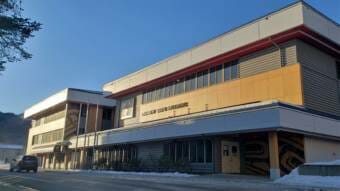
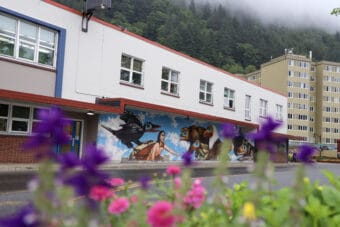
Flowers are blurry in the foreground of the side of the City Hall building that faces Egan Drive.
City Hall in downtown Juneau on Thursday, July 25, 2024. (Photo by Clarise Larson/KTOO)

Juneteenth will now be an observed holiday for most City and Borough of Juneau employees, starting next week. 

Juneteenth is already a national holiday and, for the first time this year, an Alaska state holiday. It commemorates the day when enslaved people in Galveston learned from a Union soldier that they were free — more than two months after the end of the Civil War. The holiday is recognized on June 19.

The change for most city staff comes after negotiations with a union representing some city employees resulted in the addition of the holiday and wage increases over the next few years. 

The city then passed a resolution granting the holiday and wage increases to non-union represented city employees in order to maintain equity across departments and to be a more competitive employer. Employees represented by two other unions won’t see the additional holiday or wage increase this year. Juneau’s city manager says the city is still in negotiations with those unions.  

The union that negotiated the change is the Marine Engineers’ Beneficial Association (MEBA).

Most city employees will also see a 3% wage increase this year and next, and a 5% increase in fiscal year 2028. They will also get two lump sum payments of $2,750 and $2,000 the next two years respectively. 

The addition of the Juneteenth holiday is effective immediately, and will be observed next Thursday.

Juneau Assembly delays second extension of Mendenhall River levee

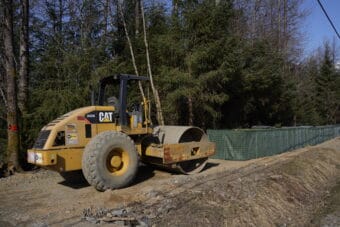
HESCO construction on Riverside Drive on April 2, 2025. (Photo by Alix Soliman/KTOO).

The Juneau Assembly voted to wait on a second extension of Juneau’s Mendenhall River levee until after this flood season. 

Assembly Member Greg Smith said the project to protect additional homes from annual flooding faces engineering and funding obstacles that can’t be solved before the flood expected later this summer.

“We don’t seem to have a way to fund this fairly this year, “ Smith said. “We don’t have a way to armor the bank and ensure the barriers are going to be properly installed this year… We want to do as much as we can, but this one just doesn’t seem to make sense to me.”

The city’s lawyer said there isn’t enough time to permit reinforcements for another section of the riverbank this summer. Without boulders to armor the bank from erosion, city officials said they aren’t confident that a second levee extension would hold up against a flood.

City officials also said the affected property owners would also need to vote on whether to create another local improvement district to divide the cost — estimated at more than $2 million

The levee extension, called phase 1B, would go from Kax̱dig̱oowu Héen Elementary School to Brotherhood Bridge on Glacier Highway. City Manager Katie Koester said the intention would be to protect 96 homes and commercial properties from an 18-foot flood. 

The likelihood of such a catastrophic flood is unknown, but the volume of water would have to be 50% higher than last year’s record-breaking 16-foot flood. 

“There would be 96 parcels if we did not do 1B that would flood in a 18-foot event. We would attempt to mitigate the impact on 30 of those parcels,” she said. 

Koester said this year the city will use large sandbags called supersacks to protect 30 properties on Meadow Lane that could see more water due to an initial levee extension that the Assembly approved last month.

The Assembly will consider the extension again next season, once city staff draft a plan to pay for it.  

The Juneau Assembly plans to raise the property tax rate. Here’s how that could cost you.

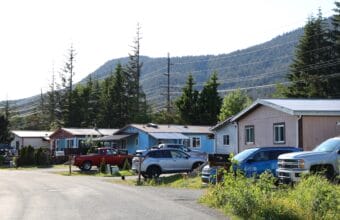
Vehicles park outside homes in the Lemon Creek area in Juneau on Monday, June 17, 2024. (Photo by Clarise Larson/KTOO)

Property taxes could go up for most Juneau residents. That’s if the Juneau Assembly moves forward with a plan to increase the rate it uses to calculate them in the next fiscal year. 

That’s as the city’s budgeting season is wrapping up. Over the last few months, Assembly members have been deliberating how the city should best use the money it takes in from its residents. 

At a finance committee meeting Wednesday night, Assembly member Wade Bryson said he thinks some residents aren’t exactly pleased with how it’s going. 

“I don’t know if anybody’s paid attention, but the community is not at the happiest with us right now,” he said.

That’s at least in part because of the proposal to increase the property tax rate by quite a bit. The current rate is at a historic low of 10.04. 

Property taxes help pay for a lot of bread-and-butter services and make up roughly 40% of the city’s general fund revenue. Property tax bills are calculated by multiplying the mill rate by a property’s value. This year, the average residential property assessments rose by less than 1%.

Essentially, if the mill rate goes up and property value does too, you’re most likely going to see a higher property tax bill. In contrast, even if the mill rate goes up, but your property value goes down enough, you may not see much of a difference. 
But lower property taxes mean the city has less money to work with and the Assembly has to decide whether to cut certain services or dip into savings to keep the city government running over the next year. 

That’s what the Assembly is facing right now. Throughout the budget cycle, they chose to tack on extra costs to the budget. As City Finance Director Angie Flick explained at the meeting, that means the budget is no longer balanced. 

“We just do the math on the items that the Assembly has added that are recurring to the budget already, that would require a mill rate of 10.44,” she said. 

Some Assembly members, like Bryson, argued that bumping it up that high would make people even more upset with the Assembly than he thinks they already are. 

He pointed to a new Juneau advocacy group called the Affordable Juneau Coalition, which is currently collecting signatures to cap the property tax rate at 9 mills. If approved, that would cut a sizable chunk of the city’s annual revenue. 

“We raise it tonight, while they’re gathering signatures to lower our tax rate, we absolutely will be looking at those guys being victorious. They’ll get their signatures,” he said. “I don’t think that we should do anything more to enrage the community.”

However, other Assembly members like Ella Adkison advocated for a higher rate because she wants to see the city’s budget balanced amid federal uncertainty. 

“I think that having a budget that we are safe in is most important right now, because we really can’t predict the future, and so I think this is the most responsible move we can have,” she said. 

After a bit of back and forth, members landed on a mill rate of 10.24, which would split the difference between last year’s rate and the rate they need to balance the budget. So, for a typical $500,000 home in Juneau, the annual property tax bill works out to about $5,120.

But that rate would mean they’ll need to dip into the city’s savings. Assembly member Alicia Hughes-Skandijs did not like that idea, but reluctantly agreed to move forward with it for now. 

“That just can’t be our budgetary process to hope that we’re going to be saved by our historically large reserve fund and hoping things go our way,” she said. 

The Assembly will still need to take public testimony on the rate and finalize the budget. That’s expected to happen on Monday, June 9, before the fiscal year begins on July 1. 

Juneau Assembly votes to oppose Board of Fish proposition to limit hatchery numbers by 25%

Douglas Island Pink and Chum Inc., or DIPAC, on Jan. 6, 2025. (Photo by Yvonne Krumrey/KTOO)

The Juneau Assembly voted this week to formally oppose an Alaska Board of Fisheries proposition that would limit Southeast Alaska hatchery production of pink and chum salmon by 25%.

The proposition is intended to address the effects of hatchery salmon on wild salmon. Studies show that hatchery fish that return to other spawning areas may be competing for resources with wild fish. 

The Assembly’s resolution says that more than half of Southeast Alaska’s 2024 commercial harvest value came from hatcheries, and a reduction would negatively impact the region’s economy. 

Assembly member Alicia Hughes-Skandijs objected to the resolution, saying she felt the city lacks the scientific expertise to weigh in on this issue, and that she would rather the Board of Fisheries use their knowledge to rule on the proposition. 

“I care about our wild stock tremendously, and I want to make sure fish are going to be here,” she said. “And if there’s any question that the hatchery fish are impacting wild fish and affecting genetic diversity, then I wouldn’t want to jump in and say, ‘Don’t do that.’ I would want them to review the data and make an informed decision, which I can’t do with this.”

The head of Juneau’s local hatchery attended the meeting to answer questions about the resolution. When asked about the impact of the Assembly not adopting it, Douglas Island Pink and Chum (DIPAC) Executive Director Katie Harms said the city would be out of alignment with other Southeast communities whose municipal governments already opposed the resolution.

“And then if this proposal at the Board of Fish were to pass, it would lead to significant economic harm in the Juneau community,” she said. “A 25% reduction in chum salmon production would lead to a likelihood of potential for the two seafood processors in town to be unable to operate year round.” 

Harms said that a reduction in hatchery fish would impact DIPAC’s future, and a “worst case scenario” would be DIPAC closing.

The Assembly passed the resolution seven to one, with Hughes-Skandijs opposing. 

Flood-prone Juneau homeowners remain divided on city’s plan to address glacial outbursts

Alyson Cooper of Meander Way testified in favor of the flood barriers and local improvement district. (Photo by Anna Canny/KTOO)

The debate over the City and Borough of Juneau’s controversial plan to fight glacial outburst floods continued during Monday’s Assembly meeting. 

The proposal to install military-grade HESCO flood barriers along key sections of the Mendenhall River, at a cost of $7.83 million for the first phase, has received mixed reception from residents in the Mendenhall Valley’s flood-prone neighborhoods. 

More than 20 people testified on Monday. Some expressed frustration and anger with the city’s approach. Others, like Brandi Tolsma, championed it as the best way to safeguard homes before next summer’s flood season. Tolsma’s home on Sharon Street was among the nearly 300 properties damaged during this August’s record-breaking outburst.

“Over four and half months later, my family and I are still piecing our home back together, trying to rebuild what we lost,” she said. “This choice is clear. These barriers are not a permanent fix. They are a bridge to a more comprehensive solution.” 

Glacial outburst floods have become an annual summer occurrence in Juneau, though the 2023 and 2024 floods were uniquely catastrophic. The city has maintained that the flood barriers, which were recommended by the U.S. Army Corps of Engineers, are the only viable flood prevention that could be quickly installed by next spring or summer.

To cover the cost of installing the barriers and reinforcing the riverbank to support them, the city would provide some funding via Juneau taxpayer dollars, while the rest would be split among nearly 500 flood-prone homes through the creation of a local improvement district, or LID. 

But before the district is created, more than half of those affected homeowners must support the plan. If they approve, homeowners at the greatest risk of flooding would have to pay a share over the course of the next 10 years. But many, like Molly Zaleski of Meander Way, have already said they’ll object. 

 “I feel like we’re being forced into this position,” Zaleski testified on Monday. “I feel like if you guys want to push forward with these HESCO barriers, then the city should pay for it.” 

The cost has been a sticking point in the plan’s rollout. The Assembly attempted to address that concern on Monday. The original plan outlined a 50/50 split for the project budget between the city and homeowners like Zaleski, who would have to pay nearly $8,000 each. The Assembly amended the plan to a 60/40 split, which would bring the cost for homeowners down to just over $6,000.

Still, some said they’d vote against the project even if it came at no cost to them. Residents raised a variety of objections on the basis of liability if the barriers fail, sacrifice of personal property along the riverfront or concern that the installation of barriers might distract from a more long-term solution at the source of the flood, either by proactively draining Suicide Basin or building a levee, dam or dike at Mendenhall Lake.

While waiting for a long-term solution, riverfront homeowners like John Cooper of Meander Way would have to host the flood barriers on private property for up to 10 years. In his testimony, Cooper said he’s willing to do it. 

“I’m going to lose a significant portion of my backyard to do so,” Cooper said. “But I’m ready to do that for the good of other people that are inside this flood area.” 

City manager Katie Koester has said that the city is committed to more permanent flood fighting too. The Assembly has already set aside $3 million in funding to develop that plan, and this week, the U.S. Forest Service committed an additional $1 million. But any long-term fix won’t come quickly.

“I can’t tell you how long it will take to find a long-term solution. I can tell you that it will require persistence on all of our parts to keep our federal partners feeling the same sense of urgency that we do” Koester said Monday. “Large expensive projects take a long time to design, engineer and, most importantly, find funding for.” 

In previous meetings, Koester has indicated that a failure to install the barriers may jeopardize federal support for a long-term fix down the line. 

In testimony as a private citizen, recently retired Assembly member Michelle Hale implored the Assembly to support the city’s plan. Hale, who lives in the Mendenhall Valley outside of the proposed improvement district, previously called the flood an “existential threat” to Juneau. 

“The Army Corps of Engineers are the experts at flood control, and their recommendation right now is to install the HESCO barriers,” Hale said. “A dike is a great idea, but there is way too much at risk to try and push through and install a dike this year, before the 2025 jokulhaup.”

The time-sensitive nature of this flood, which could return with similar or larger magnitude next summer, has repeatedly been stressed as the reason for the barriers. If the local improvement district fails to pass, the city has stated in writing that they would not have time to pursue an alternative flood mitigation project. 

Sam Hatch, who lives on the riverfront on Meander Way, said that stance has contributed to anger and resistance across the Mendenhall Valley. Hatch said he is supportive of short-term flood fighting, but he’ll refuse to host the flood barriers on his property if the local improvement district is approved. He asked the city to consider alternatives

“If the LID fails, will the city and Assembly take no action — as these documents indicate — and abandon our neighborhoods to the flood waters,” Hatch said, referring to written statements in the Assembly meeting packet. 

Hatch, and the 465 other homeowners in the proposed improvement district, will receive a mailer this week with more information about the plan. The city will also host a neighborhood meeting in January to share more information.

Affected homeowners must object in writing or they will be considered in favor of the plan. They have until Feb. 3 to object. If more than 50% do, then the plan fails, though there’s a slim chance that the Assembly could override that decision at its Feb. 3 meeting. 

Juneau’s tribal and city governments embrace collaboration on public safety and waste management

The Andrew Hope Building, pictured here on Feb. 10, 2021, houses the headquarters of the Central Council of Tlingit and Haida Indian Tribes of Alaska.
The Andrew Hope Building, pictured on Feb. 10, 2021, houses the headquarters of the Central Council of Tlingit and Haida Indian Tribes of Alaska. (Photo by Jeremy Hsieh/KTOO)

The City and Borough of Juneau will collaborate with the Central Council of the Tlingit & Haida Indian Tribes of Alaska on issues of public safety and composting moving forward.

The details of the partnership are outlined in two agreements passed unanimously by the Juneau Assembly Monday night.

The city and the regional tribe of Southeast already offer many of the same public services in Juneau. For instance, Tlingit and Haida operates its own public safety department and tribal emergency operations center in Lemon Creek.

After this summer’s record-breaking glacial outburst flood, the tribe worked with the city on clean-up and recovery. According to the tribe’s Environmental Program Manager Raymond Paddock III, the new agreements basically pave the way for more collaboration like that in the future.

“This agreement formalizes and strengthens the government-to-government relationship between Tlingit and Haida and the City and Borough of Juneau, recognizing both as key partners in addressing solid waste challenges and public safety for our shared community,” Paddock said during testimony he gave on Monday.

The public safety agreement commits the city and the tribe to annual meetings about public safety priorities and projects. That will likely include planning together for future glacial outburst floods. They’ll also participate in an annual training exercise to practice emergency response together.

The agreement on solid waste comes as both the city and the tribe have been awarded significant federal funding to support composting projects over the last couple of years. 

Both are in the very early stages of establishing composting operations, but Paddock said working with the city will be the most effective way to tackle shared community waste challenges, especially as the local landfill fills up.

“Through collaboration, we aim to promote sustainable waste management practices that will positively impact Juneau and serve as a model for other communities in Southeast Alaska, enhancing regional resilienceship and environmental stewardship,” Paddock said. “And lastly, I want to say that there is enough waste to go around.”

The owner of local private business Juneau Composts has expressed concern that establishing government-run composting facilities could put her out of business.

Moving forward, both the city and the tribe will maintain independent finances and operations, but they hope these agreements will create more efficient and impactful public safety and solid waste projects for Juneau.

Site notifications
Update notification options
Subscribe to notifications