CBJ Assembly Meetings

Filing period opens Friday for Juneau municipal election

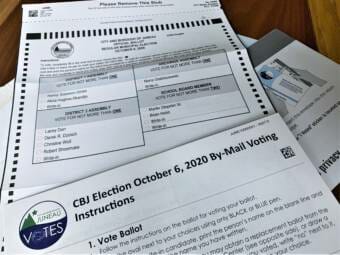
A ballot packet for Juneau’s 2020 by-mail election. (Photo by Adelyn Baxter/KTOO)

The window to file to run for local government in Juneau opens on Friday.

Anyone who is a qualified voter and has been a Juneau resident for at least a year can run for a seat on the Juneau Assembly or the school board. The application deadline is July 25. 

Positions up for grabs include two school board seats and three assembly seats — one areawide and one each in districts 1 and 2. All seats have staggered, three-year terms. 

The terms of Assembly Members Carole Triem, Greg Smith, and Wade Bryson are up this fall. Triem has declared an intent to run again. Bryson and Smith told KTOO they plan to run again as well. 

School Board members Deedie Sorensen and Emil Mackey are also up for reelection, if they chose to run again.

People who want to run must fill out declarations of candidacy forms and collect 25 signatures from registered voters on a nominating petition. An official candidate statement is also required, which includes questions about personal history and the candidate’s position on municipal issues.

The required forms can be found at the Municipal Clerk’s Office or the CBJ elections webpage.

Ballots for local elections will be mailed out in September. Juneau’s election is Oct. 4.

This story has been updated to reflect that Greg Smith says he does intend to run for reelection.

Juneau Assembly will take public comment on budget proposals at next meeting

The next regular Juneau Assembly meeting is Monday at 7 p.m. Major budget items for the upcoming fiscal year will be on the table for discussion and the public is invited to offer feedback.

Items up for comment include the proposed property tax rate increase, the city’s operating budget, the school district’s budget and the capital improvement program.

Members of the public can comment in person, via a sign-up sheet or on Zoom. To testify remotely, you have to call the Municipal Clerk’s Office at 907-586-5278 and give advance notice by 4 p.m. on Monday. Residents can also email comments to BoroughAssembly@juneau.org.

Video of the meeting will be streamed on Zoom and CBJ’s YouTube channel. The meeting will also be broadcast live on KTOO.

There will be two more opportunities for the public to comment on the city’s budget, and the next two assembly meetings, before it’s finalized. 

Juneau officials consider giving Lemon Creek ‘some love’ in the form of a new urban path

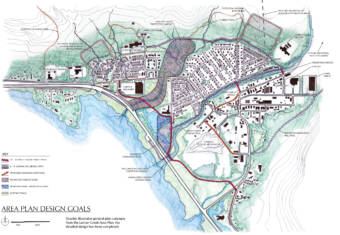
The Lemon Creek Plan, finalized by the City and Borough of Juneau in 2018, shows where a multiuse path through the Juneau neighborhood Lemon Creek could go.

For years, Juneau Assembly members have said they want to do a project for the Lemon Creek neighborhood. It’s been overlooked in the past for improvements and new projects.

But now, the Assembly says a multiuse path through the neighborhood is on top of its Legislative priorities list. That means the Assembly will prioritize the project in its requests for money from state and federal lawmakers. 

The city’s working title for the project is the Lemon Creek Multimodal Path — meaning it can be used by all kinds of people in all kinds of ways for recreation and to get around the neighborhood. 

The city’s community development director Jill Maclean said the project is complex and it will take a lot of time and money to complete.  

“This isn’t something that we could just make happen more easily as like a small playground within a neighborhood or something,” Maclean said.

The biggest reason for the project is because the city is trying to give the neighborhood the attention it deserves, Maclean said. 

“We’ve recognized, the city and the Assembly, that Lemon Creek may not have historically received as much attention as some other areas and it’s now time for Lemon Creek to get some love,” Maclean said.

Right now, the city doesn’t know where the path will be, what it will cost, or when it will be done. It needs money to make a plan for the multiuse path first. Once there is a plan, there will be a chance for the public to weigh in.

The project hits a few pieces of the city’s Lemon Creek Plan, including transportation and recreation. Maclean said that Lemon Creek deserves these amenities that other neighborhoods in Juneau have enjoyed for years. 

And Maclean said the Systemic Racism Review Committee has made city staff think more about how resources are distributed. 

“That has also put a focus much more closely on land use, how we use the land, how we undertake permitting and how we cite certain uses,” Maclean said.

Assembly member Carole Triem said when the city and Assembly decide how to spend its money — that’s when inequity can happen. 

Triem said the Systemic Racism Review Committee can be a check on the Assembly, but it isn’t just on the committee to think about systemic racism in allocating resources.  

“So I think the majority of the responsibility is on the Assembly to make sure that the Assembly is keeping this in mind and not forgetting about it,” Triem said.

During an Assembly Finance meeting on March 12, Assembly members talked about putting one million dollars into the Lemon Creek path. And the capital budget has $150,000 set aside for planning. But these aren’t final budgets yet.

“We need to be focusing more on Lemon Creek. And when we talk about equity, we can start putting our money where our mouth is,” Triem said.

Triem is also hoping to put some money to some other smaller projects in Lemon Creek, like adding lights at Sigoowu Ye Park. 

Second graders reject rooster ordinance in mock vote at Juneau Assembly

Juneau Mayor Beth Weldon answers questions from Diane Antaya's second grade Harborview Elementary class on Friday, Feb. 4, 2022.
Juneau Mayor Beth Weldon answers questions from Diane Antaya’s second grade Harborview Elementary class on Friday, Feb. 4, 2022. (Photo by Bridget Dowd/ KTOO)

Juneau City Hall was a little busier than usual on Friday as second graders from Harborview Elementary made their way in from the snow, following instructions from their teacher, Diane Antaya. 

Antaya said the kids made the trek because they’ve been learning a lot about cities.

“Coming to City Hall is very empowering, even for young children,” Antaya said. “They get the sense of the importance of working together to make something great like Juneau.”

The class filed into the Juneau Assembly chambers where Mayor Beth Weldon started showing them around.

“You can see all of the names of our Assembly members,” Weldon said. “That’s one of the things I like to ask the adults if they can name all the Assembly members and most of the time they can’t.”

She told the second graders a little bit about what Assembly members do and explained her role as their executive officer. 

“My job is to try to keep them in line, probably like your teacher in your classroom,” Weldon said. “Sometimes she does a good job keeping you guys in line and sometimes it’s a little hard for you wiggle worms to hold still and do what you’re told, so very similar to the Assembly.” 

A second grade student raises her hand to ask Juneau Mayor Beth Weldon a question on Friday, Feb. 4, 2022.
A second grade student raises her hand to ask Juneau Mayor Beth Weldon a question on Friday, Feb. 4, 2022. (Photo by Bridget Dowd/KTOO)

She went on to tell the class about some of the things that make Juneau a unique city, like the fact that it owns an airport and a ski resort.

A few students had the chance to ask Weldon a question. One student asked if Weldon liked being the Mayor.

“Most of the time,” Weldon said. “Not all the time. COVID has been a bit of a challenge for all of us, but it’s really fun getting to meet lots of new people and to try and find laws that help people.”

Other students had more complex questions, like how the city keeps Juneau’s landfill from filling up.

Second grade students from Diane Antaya's Harborview Elementary class pretend to be members of Juneau's assembly on Friday, Feb. 4, 2022.
Second grade students from Diane Antaya’s Harborview Elementary class pretend to be members of Juneau’s assembly on Friday, Feb. 4, 2022. (Photo by Bridget Dowd/KTOO)

“This is going to be an interesting question,” Weldon answered. “We’re not. The landfill will just keep getting more giant … By regulation, it can only go so high. We’re trying to figure out ways to make that smaller or else we’re going to have to ship it out of town.”

To end their visit, the second graders had an opportunity to sit in Assembly member chairs and take part in a mock vote. They were asked to decide whether roosters should be allowed in neighborhoods.

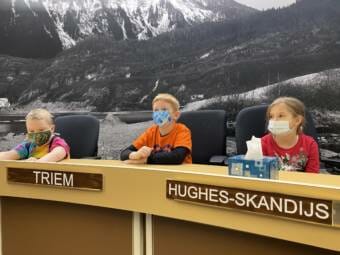
Willym Koester sat in Assembly member Carole Triem’s chair and gave his opinion on the rooster issue.

“I think no,” he said. “Because they can nip at you and that sometimes hurts.”

The rooster ordinance failed 7-2. 

Juneau’s Systemic Racism Review Committee flags legislation for the first time

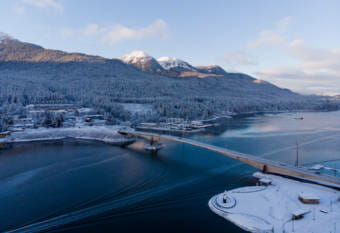
Douglas Bridge in Juneau in December 2018. (Photo by David Purdy/KTOO)

Juneau’s Systemic Racism Review Committee has flagged legislation for the first time since its creation in 2020.

In early January, the committee looked over a plan from a local developer, Travis Arndt, who wants a piece of property on North Douglas to be rezoned. Right now it’s residential, and he wants it zoned commercial so he can build boat storage and other buildings on the property. 

To review legislation, committee members ask a list of questions about whether the law would perpetuate systemic racism. Questions like: What could be the impact of this legislation and who will be affected by it? And does this benefit one group of people at the expense of another?

Committee vice-chair Grace Lee had some concerns with the legislation because of Arndt’s plans to build boat storage. 

“I realize this is Alaska, and a lot more people have boats, but boat storage affects a group of people who can afford boats and then also afford to store them,” Lee said. “And so I think that just asking that question, does this perpetuate systemic racism? Yes, it takes away the possibility of housing, and gives it to people who have boats.”

From Lee’s perspective, the proposal benefits people with more income to the detriment of community members struggling to find affordable housing. And that has the potential to perpetuate systemic racism because people of color are more likely to struggle to find affordable housing in Juneau. 

This wasn’t the first time someone said they had issues with how this specific rezone would affect housing in Juneau. During an August Assembly meeting, Mayor Beth Weldon said that one of the Assembly’s goals is to increase housing in the community, and she was concerned about taking 15 acres of land from residential to commercial. 

Assembly member Wade Bryson thought changing the zone to commercial would give more opportunity for housing because it would allow 50 units per acre — the maximum density for housing.

“I’m just, I’m super confused on how we got it wrong,” Bryson said, “Because it sounded like I think the same thing that you guys are thinking. More housing is good, or higher density is better right?”

In his public testimony on this project, Arndt said he didn’t plan to increase residential density, but wanted to build buildings with and without housing.

Arndt didn’t respond to phone calls or emails seeking his perspective on the committee flagging his plans.

Lisa Worl chairs the Systemic Racism Review Committee. She said its members are not comfortable with the rezone because it opens up the possibility for many kinds of development. 

A rezone cannot be conditional to a certain project, so while more high-density housing is theoretically possible, it’s not a guarantee. 

“When you accept it, you accept all the possibilities,” Worl said. “When you are selling it to any particular person and it’s already been rezoned, they may say one thing, but then it’s still a possibility, they may change their mind.”

Worl said the committee also had concerns about the lack of input people who live near the property. Only the developer and one other person testified. Both are on the city’s planning commission. 

The committee recommended that the Assembly get more public comment from residents in the area. City leaders listened, and now there will be another public hearing at the next Assembly meeting on Feb. 7. 

The process of pointing out how a project can contribute to inequity in Juneau is new for everyone involved. But advocates of the systemic racism review process say these are important steps toward creating a more equitable community. 

When the committee was created in the summer of 2020, it was amid a nationwide reckoning on racism after police killed George Floyd.

The Juneau Assembly listened to residents about their experiences of racism in the community. Afterward, former Assembly member Rob Edwardson suggested creating a committee to look for systemic racism. 

“When I was on the Assembly, there were a lot of ordinances that were needlessly rushed,” Edwardson said. “There was absolutely no urgency to push them how fast that they were being pushed.”

He said when legislation moves too fast, there’s greater likelihood the legislation will further systemic racism. 

This is the first time the committee has flagged a piece of legislation since it started reviewing legislation last April.

Afterwards, the Juneau Assembly held a meeting with members of the committee to hear about why they flagged the rezoning.

Edwardson said this is exactly what he envisioned the committee doing with ordinances. He hopes current and future Assembly members will get in the habit of thinking about systemic racism when they’re looking at legislation.

“What I think what might happen is, there might be a lot of reports that come out that report the same thing as this most recent report,” Edwardson said. “But then that’ll die out over time as people become more accustomed to looking at equity and inclusion in ordinances.”

Worl said the scope of the committee is limited — it only looks at potential laws that come before the full Assembly.

“Which I think is adequate, but it’s hard sometimes to look at ordinances, policy only by itself,” Worl said. “It’s pretty hard to tease out or not look at the impacts without looking at the implementation as well.”

Worl thinks the Systemic Racism Review Committee is a good start but that the Assembly may want to look at other ways to weed out systemic racism too. 

Juneau residents split over city’s response to impacts of tourism, according to survey

A view from the Goldbelt Tram of a Princess Cruises ship docked in Juneau on Aug. 31, 2021. (Photo by Jennifer Pemberton / KTOO)

The results of a public opinion survey on tourism in Juneau are out, and about 2,400 Juneau residents weighed in. 

To participate, people had to live in Juneau during the summer of 2019 — the last big tourism season before the pandemic. 

On the overall effects of tourism, 36% of people who responded said they thought it had a positive impact on them; 33% said tourism had both positive and negative impacts; 20% said it didn’t have any impact and just 8% of people said tourism has a negative impact. 

These trends are similar to results from past surveys in 2002 and 2006. The McKinley Research Group, formerly the McDowell Group, conducted the survey for the city. The McDowell Group had been conducting these surveys since the 1990s.

Heather Haugland from McKinley Research Group presented the survey findings to the Juneau Assembly on Nov. 29. She thought it was significant that the results were so similar for the past 19 years, considering how much the tourism industry has changed during that time. 

“So between 2002 and 2021, or 2019, we almost doubled our cruise passenger volume. But really, these responses did not change very much within four percentage points and some in just two or three percentage point change,” Haugland said. “So even though it might seem boring, it’s actually pretty remarkable that these responses are so consistent.”

Residents who live in downtown or Thane were more likely to respond with negative impacts of tourism than those who live in other parts of the city. And people who live in those areas or on Douglas said that they felt more impacts overall from tourism than people who lived in Lemon Creek, the Mendenhall Valley or Out the Road. 

More people also responded that they were negatively impacted by tourism online than through the phone survey. Haugland said this could be because people who felt impacted by tourism were more likely to take the survey. 

“Online responses were, felt more impacted by tourism. They also were twice as likely to be from downtown, you know, much less likely to be from the Valley,” Haugland said.

People are split on the city’s response to tourism. Almost half of the responses said the city isn’t doing enough to manage the impacts of tourism on the community. The other half said the city is doing enough or more than enough. 

Two pie charts showing result from a survey.
Slide from a presentation Heather Haugland from the McKinley Research Group gave to the Juneau Assembly committee of the whole on Nov. 29, 2021 about the results from a public opinion survey on tourism. (Screenshot)

Almost two-thirds of the people who responded said they support limits on the number of large cruise ships per day. When asked about what that limit should be, the top answer was five ships, then three, then four. 

Fifty-six percent of people support Norwegian Cruise Line’s plans for a new dock and 33% were opposed.

People were then asked if their support would change if certain things were incorporated into the project, like a cruise ship limit, a park and an ocean center.

Haugland said that these factors did change some people’s level of support between 20-40%.

“The number one preference would be a cap of five large ships per day in Juneau’s harbor,” Haugland said.

Site notifications
Update notification options
Subscribe to notifications