Lyndsey Brollini

Local News Reporter

I bring voices to my stories that have been historically underserved and underrepresented in news. I look at stories through a solutions-focused lens with a goal to benefit the community of Juneau and the state of Alaska.
Juneau reentry program is helping justice-involved people get housing

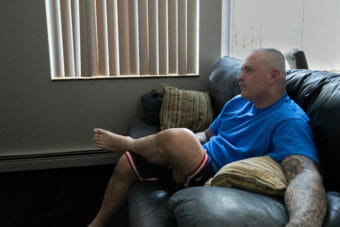
Angel Muñoz sits in his apartment in Juneau, Alaska on April 28, 2022. He was able to secure the apartment through a reentry program run by JAMHI Health & Wellness. (Photo by Lyndsey Brollini/KTOO)

A Juneau mental health organization is helping people formerly involved in the justice system get housing, and the program is working.

Nathan Block is a reentry case manager with JAMHI Health & Wellness. He works with people before they are released from incarceration to develop a plan once they are out so they can reenter society successfully.

One of the big challenges is housing. People don’t want to rent to them because of their background.

One way to increase housing for justice-involved people is to create housing specifically for them. And there are currently some places in Juneau that do that.

But Block said that also has its problems sometimes. Some former inmates have a stigma with those houses and don’t want to stay in a place where they think people aren’t trying to work on themselves.

When it comes to employment, there are fidelity bonds available — those lower the risks and financial burden on employers. Block would like to see a similar program for housing too.

“So then landlords who in the past haven’t wanted to be a part of the voucher programs will see that they’re insured,” Block said. “So that if there ever is a situation, they don’t have to spend a lot of their own personal money updating the facility or the apartment, etcetera for the next person.”

When people are released, Block said that sometimes a person will have a big family in town who they can rely on, but that’s not common. Sometimes they are put up in hotels, which he said doesn’t really solve anything.

And they can’t just look on Facebook or Craigslist for a place; it’s next to impossible for them to find housing that way.

Block said that solving the housing problem for justice-involved people is going to require effort not just from those people, but from the community too.

“Most people who are involved in the justice system don’t just wake up in the morning and say, ‘Oh, what crimes can I commit today?’” Block said. “It’s a result of untreated trauma. It’s a result of a history of colonialism. And it’s also really a result of a community who doesn’t want to help them.”

Block has personal experience with incarceration, mental health and substance use. But he went through a program that helps people in his situation go to college, and it changed his life.

He got his bachelor’s and master’s, and now he’s helping other justice-involved people better their own lives, like Angel Muñoz.

After doing 7 1/2 years at Lemon Creek Correctional Center in Juneau, Muñoz was living in a situation he didn’t want to be in. He heard about the reentry program when he was going to see his parole officer and decided to check it out.

At first, progress felt slow, like nothing was happening.

“But you gotta want to help yourself before they can help you, you know what I mean?” Muñoz said. “So they’re not going to do all the work for you, they want you to do some of the work.”

And he did the work; going to counseling, AA and working two jobs.

And then they secured him a spot at the Breakwater Inn. But the funding for it ran out, and Muñoz started panicking.

“I didn’t know what to do. I felt like I was hopeless. I didn’t have control of my life,” Muñoz said. “And I go, ‘What?’ I’m doing this just to get to back where I was starting? I go, ‘No.’”

Eventually, he got housing at St. Vincent de Paul. The reentry program paid for a few months there so he could save his paychecks up for a deposit on an apartment. And now he has an apartment he’s been in for about four months now.

He did the work to make life better for his son, so he could start fresh and have a place for him.

“Because I do love him, and I need to show him I love him by doing all this,” Muñoz said. “Because, you know, if I tell him I love him, and I’m going back to jail, that’s not showing him I love him. That’s telling him I really don’t care, you know.”

Muñoz said that people who were in his position should all go through the reentry program. He said it isn’t easy, but if they put the work in and do everything honestly, something will work out.

He said he’s grateful for all the people who helped him get where he is today and didn’t give up on him – people who saw him as a person who deserved a second chance.

Resurrection Lutheran Church finishes first winter as Juneau’s cold weather shelter

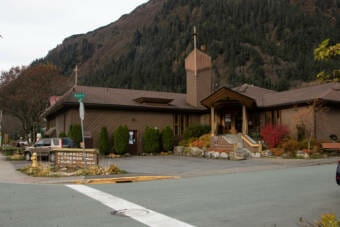
The Resurrection Lutheran Church is located on the corner of W. 10th St. and Glacier Avenue in the Flats neighborhood in downtown Juneau, Alaska. (Photo by Lyndsey Brollini/KTOO)

The Resurrection Lutheran Church finished its first year of running Juneau’s cold weather emergency shelter and just got its permit renewed for another two years to house the shelter. 

The shelter is open from Nov. 15 through April 15 on nights it’s expected to be below freezing. 

Pastor Karen Perkins said the cold weather shelter was busy this year. The shelter was open almost every night and most nights were close to capacity.

“We were scrambling to find cots,” Perkins said. “I mean, we weren’t going to put somebody out on the street to freeze to death. So the staff had to get creative about some safe places to put people.” 

The shelter was started by the City and Borough of Juneau in 2017. In recent years, the city has contracted with organizations in town to run it.

The shelter’s start last fall was last minute — after the nonprofit St. Vincent de Paul pulled out of its contract with the city to provide the shelter. The Resurrection Lutheran Church offered to take over the contract, but it needed to get a permit first

The church got the permit, but only a week before the shelter had to be up and running. And the church pulled it off. Within a week, they found all the staff they needed. Most of the staff stayed for the entire season. 

The capacity of the shelter was 28 because of COVID-19, and sometimes staff had to figure out where to put people when it was past capacity. 

“At one point, we had to make space for cots in what was functionally a storage room,” Perkins said. 

The actual church building also went through some strain while housing the shelter, and it was hard on the building’s plumbing. 

Before the shelter opened, businesses and residents in the area had concerns about the shelter’s impact on the neighborhood. Perkins doesn’t think it was a strain on the neighborhood, with the exception of some noisy nights, and said they were able to handle any issues that came up quickly.

“And so a lot of people who said they had anxiety have since either changed their mind or said, ‘Okay, went well this year,’” Perkins said.

Some of the people who used the shelter this year had never stayed in a shelter before. Perkins thinks it’s a result of Juneau’s housing crisis — people with housing vouchers can’t get housing, people call within an hour and a place is already taken, or people have to move because their landlord is selling. 

Perkins said it was heartbreaking for her to see. 

“It’s hard to face somebody and say, ‘I know that there’s no place to live,’” Perkins said. “And the amount of courage that it takes for somebody to walk the first time into a shelter for the first time, into a food pantry or whatever, is extraordinary. It’s really really tough.”

This year, 263 people used the shelter. Perkins said most of them were there for less than 20 days. 

Now that the church’s permit is renewed, the church is allowed to house the shelter for another two winters. But that doesn’t mean the church will. It would need to extend the contract with the city first. 

Perkins said they renewed the permit to be prepared in case the church needs to house the shelter again. They don’t want to be scrambling at the last minute like last year.

There are a few things they would change based on the lessons they learned this past winter, like training staff more and making sure people who use the shelter regularly don’t store their things around the church. 

Perkins wants to ask people who use the shelter what their recommendations are, and to share their stories on the church’s Facebook. 

“The more the community learns about people’s lives and how it is to not have your own spot, it’ll be helpful for everybody,” Perkins said.

Perkins said the church doesn’t want to become a long-term shelter. It’s hard work to run. But there aren’t better options right now, and this shelter is needed in the community.

“We don’t want people out there on the streets just because we don’t have a better, better plan,” Perkins said.

Perkins said people want to find a long-term solution to the cold weather shelter, but that solution isn’t here yet. So the church is doing what it can by providing an option, if it’s needed. 

Tlingit and Haida delegates reelect president, pass resolutions at Tribal Assembly

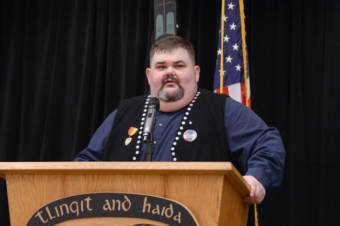
President Chalyee Éesh Richard Peterson. (Photo courtesy of CCTHITA)

Delegates voted last week for their executive council and considered resolutions in the annual Tribal Assembly for the Central Council of the Tlingit and Haida Tribes of Alaska. 

They elected the tribe’s president, six vice presidents, an associate justice, a citizen of the year and an emerging leader. 

President Chalyee Éesh Richard Peterson was reelected for a fifth term at the tribe. This year he was running against Tasha Hotch, a vice president of the tribe. 
There were some changes to the tribe’s vice presidents. The first vice president is now Jaqueline Pata, the CEO of Tlingit and Haida Regional Housing Authority. The previous first vice president, Catherine Edwards, is now the third vice president.

Some resolutions the delegates passed include protecting citizens from sexual violence, reducing bycatch, amending laws so Alaska Native veterans can select lands in the Tongass National Forest and mandating cultural trainings for educators in Alaska.

The full list of resolutions will be made available on the tribe’s website.

The full Tribal Assembly is available to watch on Tlingit and Haida’s Facebook page

Landless communities advocate for action at Tlingit and Haida’s Tribal Assembly

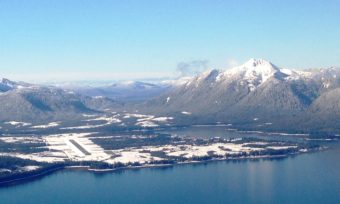
Petersburg seen from the air in February 2014.  (Photo by Ed Schoenfeld, CoastAlaska News)

Five communities in Southeast Alaska were left out of the Alaska Native Claims Settlement Act: Ketchikan; Wrangell; Petersburg; Haines and Tenakee Springs, and it’s left more than 4,000 Native people in the region without land.

Getting land to these communities was a big theme during the 87th Tribal Assembly meeting of the Central Council of the Tlingit and Haida Indian Tribes of Alaska this week.

Cecelia Tavoliero is from Petersburg and part of the organization Alaska Natives Without Land. She said getting Native land into Native ownership is a win for all Native people. And the land back movement has helped the cause. 

“Land back has highlighted important issues like ours and has helped us build awareness, and even support, from among groups historically opposed to a land solution,” Tavoliero said.

The controversy is around the land selections landless communities have made. The communities want to get land as close to home as possible, but selections are limited and people in neighboring communities — and groups outside of Alaska — have doubts about some of the selections.

But Tlingit and Haida citizens want progress to be made. Delegates repeatedly brought the issue up with the tribe and with Sealaska, the regional Native corporation. 

Delegate Joe Williams Jr. of Saxman urged the tribe and the corporation to make this the year that the landless people get their land. 

“As the Alaska Native Claims Settlement Act in 1971 was made history, we once again need to make history for our very own people,” Williams said.

Jaeleen Kookesh is a vice president at Sealaska. She said that this issue has been a top priority for Sealaska and that the lack of success isn’t from a lack of trying. 

She has met with legislators and groups concerned with the land selections. She said that they need the help of tribal citizens in key states that have representatives in the Natural Resources Committees in the House and Senate. Especially Senator Maria Cantwell of Washington and Representative Raúl Grijalva of Arizona.

“Mainly because they want to protect the Tongass and keep those lands in public ownership as opposed to Native ownership,” Kookesh said.

And she hopes that whoever gets elected to Alaska’s Congressional seat in the House understands the landless issue and continues to be an advocate in D.C. as late Congressman Don Young was.

Alaska’s congressional delegation has been working on the issue for years, and there are currently bills in the House and Senate. Senators Lisa Murkowski and Dan Sullivan spoke about their continued commitment to the issue in their addresses to the Tribal Assembly. 

Getting land to the five communities will require an amendment to ANCSA, a law that has been amended over 100 times. 
Mock M&M election teaches Alaskans about ranked choice voting

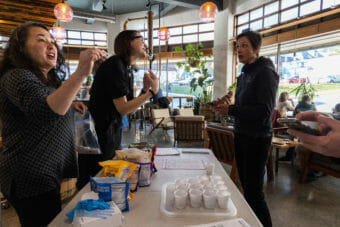
Alaskans For Better Elections hosts an event educating people about ranked choice voting at Amalga Distillery in Juneau, Alaska on April 19, 2022. (Photo by Lyndsey Brollini/KTOO)

Alaskans will be trying out the state’s new ranked choice election system in June. One group is helping educate voters about how it works — with M&Ms.

Near the entrance to Amalga Distillery in Juneau, there are paper cups each with eight different flavors of M&M. The flavors represent the primary candidates for this mock election.

People scan a QR code and then vote for their favorite M&M. They can only pick one — that’s how Alaska’s new primary will work.

Once there are enough votes in, the top four M&Ms will face off in the general election. That’s when people will rank candidates.

Caroline Storm wasn’t a fan of the peanut butter flavor when she was tasting the candidates. She gave the rest to her partner.

Storm is from Anchorage and was in town for a few days, so she wanted to visit the distillery. She also wanted to learn more about the open, “pick-one” primary and ranked choice voting, so the event was a double win for her.

Amanda Moser from Alaskans For Better Elections talks with Caroline Storm about the mock M&M election. Alaskans For Better Elections is holding events throughout the state educating people about how Alaska’s new election system works. (Photo by Lyndsey Brollini/KTOO)

“I’m really excited it’s an open primary for the first time,” Storm said. “I think that’ll be more representative of Alaskans’ actual views on politics and the candidates, versus closed primaries.”

She said the M&M election is a fun way to engage with ranked choice, and she did learn more about how the process works.

“I found out just a little bit ago that you only get to choose one and not four for the primary. So that was new information to me,” Storm said.

And before the event, she didn’t quite understand how the candidates got eliminated in the general election.

Amanda Moser is with Alaskans For Better Elections. The group is responsible for writing the ballot measure in 2020 that changed how the state’s elections are held. Now they want to make sure Alaskans know what to do with those changes.

She said a lot of people have had the same confusion as Storm about the primary, which is why the group is traveling around the state to show people how it works with M&Ms.

“And the best thing about it is that it’s an interactive way for voters to familiarize themselves, reconnect with the great M&M flavors and feel confident with the process moving forward,” Moser said.

Moser said to remember that in the primary, you only pick one candidate. Then, in the general election, people rank the four candidates by preference, with the preferred candidate ranked first.

If a candidate gets 50-plus-one percent of the votes in the general election, they win. But if there isn’t a candidate with that many votes, that’s when the fourth place candidate is eliminated.

Moser explained how this works with the M&M election.

“So if our top four vote-getters are pretzel, caramel, peanut butter and dark chocolate, and dark chocolate is the fourth place vote getter, all the people who voted for dark chocolate — whoever they voted for for their second choice — those votes get redistributed to pretzel, caramel and peanut butter,” Moser said.

Eight flavors of M&Ms are distributed in cups for people to taste before voting for their favorite. (Photo by Lyndsey Brollini/KTOO)

If there isn’t a candidate with 50-plus-one percent of the votes after the first elimination round, the process is repeated with the third-place candidate.

Peanut butter ended up winning in the M&M election. Pretzel got second, caramel third and dark chocolate fourth.
The special election primary to fill Alaska’s Congressional seat will happen on June 11, where people will vote for one out of 48 candidates. The special general election, when people rank the candidates, will be on Aug. 16. And just to make things more complicated, Aug. 16 is also the date for the regular primary election.

Juneau fire department is distributing opioid overdose rescue kits

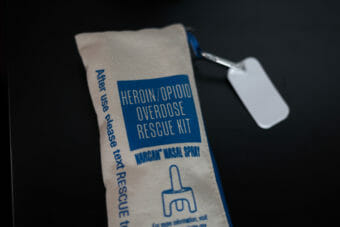
An overdose rescue kit that Capital City Fire and Rescue distributes to people when they get a 911 call for an overdose in Juneau, Alaska on April 15, 2022. (Photo by Lyndsey Brollini/KTOO)

Juneau’s fire department is getting more opioid overdose rescue kits out to people who need them in the community. 

Emergency responders carry overdose kits when they respond to 911 calls. They can give them to people ahead of potential overdose situations or they can replace a kit that’s already been used. 

In each kit are two doses of Narcan, which is a nasal spray that stops someone from overdosing on opioids. There’s also a fentanyl testing strip so people can test their own opioids for contamination and a safe bag to dispose of pills in the kit.

A statewide initiative called Project Hope is getting the overdose rescue kits out to people throughout the state. Andrew Pantiskas, an emergency medical services officer for Capital City Fire and Rescue, said the program is getting Narcan out to more people who need it. 

Capital City Fire and Rescue EMS Officer Andrew Pantiskas at the fire station in downtown Juneau, Alaska on April 15, 2022. Pantiskas runs a program that distributes overdose rescue kits to people in Juneau who call 911 for an overdose. (Photo by Lyndsey Brollini/KTOO)

“Because a lot of the time we show up and someone’s overdosed on opiates, and we administer Narcan or they administer Narcan, a lot of those people don’t actually go to the hospital,” Pantiskas said. “They just stay home, or they go about their day. And we never know about it.”

Sometimes responders get there too late when someone is experiencing an overdose. But if they have an overdose kit, it gives emergency responders more time to get there and prevents people from going into cardiac arrest. 

Pantiskas said there shouldn’t be a stigma around having Narcan around and that having Narcan is about being safe and prepared. 

“Everyone’s in a different place in their life and everybody is on a different path,” Pantiskas said. “And you know, just because they might have Narcan or need Narcan doesn’t mean that they’re abusing anything.”

The fire department doesn’t usually distribute the kits outside of the 911 calls and the program wasn’t meant to give out a lot of first-time kits. 

Some places in Juneau to get a kit for the first time include Bartlett Regional Hospital and Southeast Alaska Regional Health Consortium. 

Site notifications
Update notification options
Subscribe to notifications