Alaska Native Corporations

The Pentagon is reviewing a program that helps Alaska Native corporations get federal contracts

Secretary of Defense Pete Hegseth on April 9, 2025.
Secretary of Defense Pete Hegseth on April 9, 2025. (Senior Airman Madelyn Keech/U.S. Air Force Senior Airman Madelyn Keech | Department of Defense)

The federal government is reviewing a business program that brings contracting opportunities to Alaska Native corporations and tribes.

U.S. Secretary of Defense Pete Hegseth said in a video posted on X Jan. 16 that his department will review the 8(a) Business Development Program. The program falls under the federal Small Business Administration and supports businesses owned by socially disadvantaged individuals or tribal entities, including Alaska Native corporations.

Hegseth said in the video that the program promotes diversity, equity, and inclusion framework and race-based contracting.

“We are taking a sledgehammer to the oldest DEI program in the federal government,” Hegseth said. “Our goal is to spend your money to build our defense industrial base with businesses, large and small, that share our mission.”

Quinton Carroll, the executive director of the Native American Contractors Association, originally from Utqiaġvik, said that Native participation in the program is not a diversity, equity and inclusion initiative.

“It is grounded in the unique political and legal status of tribal nations under U.S. law and fulfills longstanding federal trust and treaty obligations to tribes, Alaska Native Corporations and Native Hawaiian Organizations,” Carroll said.

Tribal participation in the program

Alaska Native Corporations rely heavily on federal contracts, which they often secure through the 8(a) program.

In 2021, corporations received more than $11 billion from federal contracts, which were their primary source of revenue, according to data from the Federal Reserve Bank of Minneapolis. More than a half of that revenue came through the 8(a) program, and the majority of those contracts were with the Department of Defense, according to that research.

Christopher Slottee, an attorney who ‎works with Alaska Native villages, regional corporations and tribal governments, said that makes the Pentagon’s review of the program “a significant concern” for tribes and corporations.

“They often rely on those contracts to generate the revenue that lets them provide the benefits to their shareholders and tribal members,” he said.

Slottee said that tribal entities are subject to the same standards, reviews and compliance requirements as everyone else, but they do have a few advantages in the program.

Slottee said tribal entities, unlike individuals, don’t have to prove their social disadvantage. They can also have multiple companies in the program, while individuals can only have one. Plus, tribal entities have significantly higher limits for certain awards, he said.

Slottee said a government agency also might want to contract with an Alaska Native organization because they often have more experience than some of the traditional small businesses. And there are treaty obligations to fulfill, he added.

“There is a general, government-wide encouragement for agencies to contract with entities owned by tribes and ANCs, as part of the government’s responsibility to Alaska Natives and Native Americans,” he said.

The DoD review of the program 

Hegseth ordered a line-by-line review of 8(a) contracts that are over $20 million in value. He said in a memorandum to the Pentagon leadership that the department would get rid of contracts that don’t make the country’s military more lethal.

“We have no room in our budget for wasteful DEI contracts that don’t help us win wars,” he said in the social media video.

Carroll, with the Native American Contractors Association, said that Native federal contractors have been partners of the Department of Defense, working to strengthen readiness and the military industrial base.

Hegseth also said the department would make sure that the businesses with contracts were actually doing the work. He claimed that small businesses often receive a contract, take a fee and then pass the job on to a larger firm that’s not eligible for the program.

In June, the Small Business Administration ordered an audit of the 8(a) program following a fraud investigation. The Treasury Department has also been looking into potential misuse of the program.

Carroll said Native contractors support the elimination of fraud and waste within the program.

“It is critical that oversight efforts preserve a program that has proven its value — strengthening national security, reinforcing the defense industrial base, and supporting economic growth in Native and surrounding communities,” Carroll said.

Other threats to the program

The 8(a) program has faced recent scrutiny from other directions as well.

President Trump signed an executive order in April directing the rewriting of federal contracting regulations. Slottee, the attorney, said the revision has been completed, but it’s not clear yet how the changes will affect tribal entities.

He said that there is more focus now on the use of larger contracts, which can be harder for smaller corporations and tribes to access.

“It’s going to take a little bit for folks to actually see the kind of on-the-ground downstream impact, but we definitely anticipate seeing that in the course of 2026,” Slottee said.

Earlier this month, the Small Business Administration issued an announcement that, among other things, described a massive reduction in how many applications were approved for the program.

“The Trump SBA accepted just 65 new 8(a) firms into the program last year – compared to over 2,100 who were accepted during the Biden Administration,” it said.

Slottee said that the many Native-owned businesses felt that reduction.

“There is a concern that ANCs and tribes will have to start looking for alternatives,” he said. “If the SBA is not going to be approving new 8(a) applications, even though they should be under the rule established by Congress, that’s going to be a downstream impact on ANCs and tribes.”

Goldbelt reveals details of proposed $500M cruise port on Douglas Island

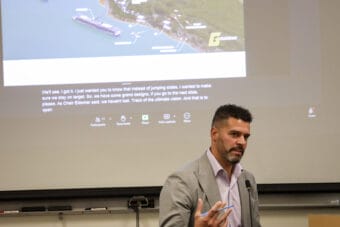
Goldbelt Incorporated’s President and CEO, McHugh Pierre, presents to the Juneau Assembly about a proposed cruise ship port on Douglas Island on Monday, Sept. 29, 2025. (Photo by Clarise Larson/KTOO)

Goldbelt Incorporated is finally sharing more about its proposed $500 million cruise ship port on the backside of Douglas Island.

Its president and CEO, McHugh Pierre, presented the plan to the Juneau Assembly for the first time at a committee meeting Monday night. 

“We have some really big, bold ideas,” he said. 

Last fall, the local Alaska Native corporation announced plans to develop the new port in partnership with Royal Caribbean Group. At the time of the announcement, city officials said they felt blindsided by the news. 

But on Monday, Pierre and Goldbelt’s board chair presented to the Juneau Assembly in front of a packed audience to explain exactly what’s in store for the development called Goldbelt Aaní. 

Pierre said the goal of the semi-private cruise destination is to uplift Lingít culture and support Juneau’s economy moving into the future.

“We believe it’s our mission to invest in the community, grow opportunities, build certainty and provide that foundation for families to grow and have confidence to remain in Juneau,” he said. 

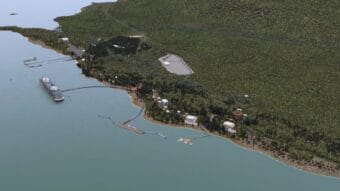
Goldbelt owns roughly 1,800 acres of land along the northwest coastline of Douglas between False Outer Point and Point Hilda. The port will be located on about 250 acres just beyond where the road ends on North Douglas.

The plan is to develop the port in phases, starting out with basic dock and welcome center infrastructure before moving into broader ambitions like developing a child care center, employee housing and a replica Lingít village.

This is a conceptual design of the Goldbelt Aaní port proposed by Goldbelt Incorporated on Douglas Island. (Courtesy of Port of Tomorrow)

Once developed, the land would be subject to property taxes. Pierre estimates the project will cost $500 million. Goldbelt says it would catapult the corporation to become the city’s #1 property taxpayer. 

“We’re excited to contribute to the community, to have a strong community, and to put our money where our mouth is,” he said. 

Assembly members had a lot of questions. Wade Bryson questioned the Douglas Highway’s ability to handle the traffic the port would bring.

“That’s the thought that is on many of our minds, ‘How do we deal with North Douglas Highway and trying to accommodate this development?’” he said. 

Mayor Beth Weldon asked how the corporation intends to curb concerns that the new port would overwhelm the community with cruise tourism. Pierre said Goldbelt believes the new port will actually help alleviate visitor traffic and congestion by containing visitors at the port. 

Pierre didn’t commit to a firm timeline for when the port will open. That’s because of all of the hurdles the corporation still needs to jump over to get permitting approvals with the city and other governmental agencies. The project’s website states 2028 as its grand opening. 

The project is adjacent to a lot of city land. City leaders say they want to thoroughly plan for the North Douglas area before Goldbelt starts development. Pierre pushed back at that. 

“Goldbelt would be happy to work with the city concurrently, but Goldbelt would not be happy to be sidelined and stopped altogether from development because the city wants to do something on its land or plan something around its land,” he said. 

The project will need approvals from both the city planning commission and the Juneau Assembly to move forward. Goldbelt has yet to apply for any city permits.

Pierre said the corporation intends to provide updates to the community as the project moves forward.

Sealaska announces first woman to lead the corporation as new president

Sarah Dybdahl sports an “Aunties Vote” sticker during the Nov. 8, 2022 election. (Photo by Paige Sparks/KTOO)

Southeast Alaska’s regional Native corporation has announced its new president. Aanshawatk’i Sarah Dybdahl will be the first woman to hold the position since Sealaska’s founding in 1972. 

The corporation’s board of directors voted to appoint Dybdahl, according to a press release. She currently directs the Office of the President at the Central Council of the Tlingit and Haida Indian Tribes of Alaska, and previously led the Huna Heritage Foundation. 

In her new role, she will manage Sealaska’s local operations, like their workforce development program.

Board Chair Richard Rinehart said the search for a president took longer than he imagined. But he said Dybdahl’s background in Alaska Native leadership made her a strong candidate.

“We wanted somebody that was going to have a new, fresh perspective, but still be very knowledgeable of where we’re at and what we’re trying to achieve,” Rinehart said. “And I think she has all of that.”

Sealaska changed its leadership structure amid the 2023 departure of Anthony Mallott, who served as both president and CEO. Now, the roles are separate. Terry Downes, the current Sealaska CEO, leads Sealaska’s business investments. Joe Nelson has served as interim president since last year and will continue to serve on Sealaska’s board.

Dybdahl was unavailable for comment Tuesday. 

“It is an honor to serve Sealaska and our shareholders,” Dybdahl said in the release. “Growing up in Klawock, I was shaped by the strength of our people and our culture, and I look forward to building on that foundation to create opportunities that uplift our communities for generations to come.”

Dybdahl’s salary is undecided, but Rinehart said it will be “competitive.” She starts next month.

Goldbelt shares more about proposed cruise dock project on North Douglas

This is a conceptual design of the Goldbelt Aaní port proposed by Goldbelt Incorporated on Douglas Island. (Courtesy of Port of Tomorrow)

Goldbelt Incorporated has unveiled more information about its proposed cruise ship port on the backside of Douglas Island, but city officials say they are still largely in the dark. 

Earlier this summer, the local Alaska Native corporation released a new website for the project that includes a timeline for the port’s opening, details about tourist attractions on the site, and conceptual drawings. The project is named Goldbelt Aaní.

Goldbelt originally announced plans to develop the new port last fall, in partnership with Royal Caribbean Group. At the time of the announcement, city officials said they felt blindsided by the news. And now, more than nine months later, Juneau’s Visitor Industry Director Alix Pierce said she still doesn’t know much about the project. 

“We haven’t received any sort of permit applications, we haven’t had any formal dialogue about their plans,” she said. 

Goldbelt President and CEO McHugh Pierre said the corporation plans to submit a conditional use permit application to the city, but declined to comment further.

Goldbelt is the beneficiary of the Alaska Native Claims Settlement Act and owns land along the northwest coastline of Douglas between False Outer Point and Point Hilda. The port will be located on about 250 acres just beyond where the road ends on North Douglas.

This is a conceptual design of the Goldbelt Aaní port proposed by Goldbelt Incorporated on Douglas Island. (Courtesy of Port of Tomorrow)

On its website, Goldbelt describes the port as an “immersive Tlingit-themed and inspired modern cruise destination.” It’s designed to replicate a Lingít village from the 1800s. The corporation says it plans to offer other tourist attractions like floatplane and whale watching docks, and wants to develop on-site employee housing and a child care center. 

The corporation says the new port will help reduce downtown visitor traffic and congestion, and will uplift Alaska Native culture in Juneau. 

The company has begun the groundwork for permitting the dock and amenities with the state and the U.S. Army Corps of Engineers. 

The project will need approvals from both the city’s planning commission and the Juneau Assembly to move forward. Pierce said it’s hard to say how long that process will take. According to the website, Goldbelt expects to welcome its first cruise ship during the 2028 tourism season. 

“There are a lot of considerations to developing in that area, but without seeing a formal application from them, it’s very difficult to speak to the process,” she said. 

Goldbelt’s plan coincides with another dock development by Huna Totem Corp., an Alaska Native village corporation based in Hoonah. The Assembly approved the corporation’s plan to build a new cruise ship dock in downtown Juneau earlier this year.

Huna Totem Corporation opens enrollment to descendants

Huna Totem Corporation’s CEO Russell Dick at the corporation’s 2025 annual meeting on June 21, 2025. (Courtesy of Huna Totem Corporation)

Huna Totem Corporation shareholders adopted open enrollment last week at the village corporation’s annual meeting. That means that lineal descendants of original shareholders can now enroll and receive their own shares in the corporation. 

The vote wasn’t close — 71% of voters approved opening enrollment to descendants.

“It’s a recognition that we’ve got a future generation of leaders that are ready to come in and put their fingerprints on the future of not only the company, but of our culture and our heritage,” said Huna Totem CEO Russell Dick. 

He said the board discussed opening enrollment for decades. 

“They just said, ‘Look, this is time to get this done.’ It’s been 50 years of ANCSA, and it’s time for us to recognize the future generation.”

The Alaska Native Claims Settlement Act, or ANCSA, passed in 1971, creating the Alaska Native corporation system. It limited shareholders to those born before it became law — for Huna Totem, that was roughly 1,650 people. 

Until now, those original shareholders could gift shares to their family members or leave them to their descendants in their will. But often, their shares would be divided among multiple children, leaving younger generations with unequal shares to their parents and grandparents, Dick said.

“And for us to be able to come out and say, ‘you are a regular shareholder of this company, here’s what that means: you are the next generation of leaders for Huna Totem Corporation, the community of Hoonah,’ I think it’s a huge, huge thing,” he said.

Each descendant who enrolls will receive 100 shares, the same number as the original shareholders. Huna Totem did a study to see how many people qualify, and it estimated that 1,540 descendants of original Huna Totem shareholders are eligible.

Sealaska  — Southeast Alaska’s regional Alaska Native corporation — opened enrollment to descendants in 2007, and removed its blood quantum requirement that limited the enrollment of people with mixed heritage in 2022. Huna Totem may be the first village corporation in Southeast Alaska to open enrollment. 

Several corporations throughout Alaska have made similar moves in recent years. 

Drilling application filed with the state to explore new cruise port on Douglas Island

North Douglas Highway on Wednesday, Oct. 16, 2024. (Photo by Clarise Larson/KTOO)

A construction company has applied for a permit with the State of Alaska to study an area off the coast of Douglas Island for the design of a new cruise ship facility. 

The project is in cooperation with Goldbelt Incorporated, a local Alaska Native corporation, which owns the land on and adjacent to where the study would occur. The data gathered would inform the design of two separate cruise ship docks, and facilities for a small boat harbor and boat launch. 

A public notice of the proposed study was posted on the state’s website on Thursday. 

Last fall, Goldbelt announced a partnership with Royal Caribbean Group to develop a new cruise ship facility on the backside of Douglas Island. But since then, little information about the project has been shared with the public or city officials. 

This is a map of the proposed location of a new cruise ship facility on Douglas Island. (State of Alaska)

On Thursday afternoon — the same day the notice was posted — a representative for the cruise line was part of a public meeting with the Juneau Assembly alongside other cruise lines to discuss a variety of industry-related topics. 

During the meeting, the representative dodged questions from the Juneau Assembly about the status of the project.

Goldbelt owns nearly 2,000 acres of land along the northwest coastline of Douglas between False Outer Point and Point Hilda. Satellite imagery over the past month shows portions of the land have been cleared of trees. Officials with the company have not shared whether the activity is related to the dock project and did not respond to a request for comment Friday. 

According to the application with the state, Goldbelt plans to partner with Turnagain Marine Construction, a construction and engineering firm based in Anchorage. The study would involve mooring a barge in Stephens Passage and drilling approximately 28 geotechnical boreholes to study the marine environment of the area. 

The application states the project would “provide safe harbor for two cruise ships and passengers during the visitor season, while helping to decrease cruise ship visitor traffic in downtown Juneau.”

The study would last five months, between June and October. The actual start date would depend on a few factors like contractor availability, permit authorizations and environmental factors.

The application is currently open for public comment. The deadline to submit comments is May 7. 

Site notifications
Update notification options
Subscribe to notifications