Energy & Mining

New Amalga mining road proposal opens for public comment

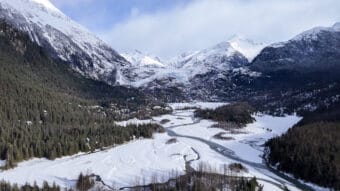
Snow covers Herbert Glacier and Herbert River on Monday, Feb. 16, 2026. (Photo by Clarise Larson/KTOO)

A Canadian company with plans to mine for gold near the face of Herbert Glacier applied to punch an access road through state land in December. The state opened a public comment period for the road last week. 

Grande Portage Resources wants to build a 15 foot-wide and 1.3 mile-long unpaved road with helicopter pads connected to Glacier Highway around mile 27. The road between Herbert River and Eagle River would allow the company to stage drilling supplies for transportation to the proposed New Amalga mine site. 

This would be the first segment of road that will eventually reach the mine site if the U.S. Forest Service approves the operation, according to the company’s application to the state. 

The Forest Service approved exploratory drilling at New Amalga last spring. Grande Portage has been flying in prospecting supplies from Mendenhall Valley and wrote in its application that building a new staging site and access road will shorten the helicopter flights.

The road would cut through forest and wetlands in a popular recreation area near the Eagle Glacier Cabin trail, Herbert Glacier Trail and Windfall Lake Cabin Trail. 

The proposed mining road segment would end at the boundary between Alaska state land and the Tongass National Forest. (Image courtesy of Grande Portage Resources)

If approved, the company anticipates road construction will begin this spring. 

The deadline to submit public comments is March 13 at 5 p.m. and comments can be emailed to john.driscoll@alaska.gov

Washington and other Democratic-led states drop lawsuit against Arctic Refuge oil drilling in Alaska

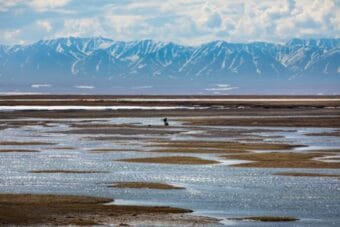
A tundra landscape half covered in ice
The Arctic Coastal Plain. (Department of Interior)

Fifteen Democratic-led states have dropped a six-year-old lawsuit challenging the legality of a federal plan that allowed oil and gas drilling in the coastal plain of the Arctic National Wildlife Refuge in Alaska.

The states announced their plans in a notice filed Monday in the U.S. District Court for the District of Alaska, where the lawsuit was filed in February 2020.

The state of Washington was the lead plaintiff. Mike Faulk, deputy communications director for the Washington State Attorney General’s office, confirmed that the states are dropping their case but said they will continue their opposition to ANWR drilling.

“Washington is proud to have led the multistate lawsuit challenging the 2020 actions regarding the Arctic Refuge,” he said. “New congressional and administration actions require a new course of action on our part. We are evaluating the best path forward to continue to advocate for a clean and healthy Arctic, including supporting the litigation of Alaska Native organizations and community groups.”

The coastal plain is to the east of the vast Prudhoe Bay oil deposits and is believed to hold similarly large amounts of oil and gas. The Trump administration has made drilling in the refuge a top priority as it seeks to expand American oil and gas production.

The other participating states were California, Connecticut, Delaware, Illinois, Maine, Maryland, Massachusetts, Michigan, Minnesota, New Jersey, New York, Oregon, Rhode Island and Vermont.

A group of environmental and tribal groups had filed suit in 2020 at the same time as the Democratic-led states. Last month, that coalition renewed their suit.

Faulk declined to say whether the Democratic states would be siding with the coalition.

While two oil and gas lease sales have taken place in the refuge and additional sales are expected, no oil drilling or seismic surveying has occurred to date.

The Alaska Industrial Development and Export Authority, Alaska’s state-owned investment bank, won several leases in the first lease sale, which took place in 2021, and is seeking to keep the refuge’s coastal plain open to development.

Last year, Judge Sharon Gleason ruled that the Biden administration had illegally canceled AIDEA’s leases. That ruling has since been appealed to the 9th U.S. Circuit Court of Appeals.

Those cases are separate from the lawsuits challenging the overall legality of the oil and gas program in the refuge.

Opponents of mining site near Haines target new owner at industry conference

An electronic billboard on the side of the Canada Place building in Vancouver displays the anti-mine message "No means go"
Chilkat Forever placed ads on digital screens and in three major newspapers to target Vizsla Copper, the new owner of the Palmer Project. (Photo courtesy of Kim Strong)

Representatives from the mining industry gathered in Vancouver, British Columbia last week for an annual conference.

But opponents of a mineral exploration project outside Haines seized on the opportunity for their own purpose. They wanted to send the industry one key message: “Leave our valley.”

In 2024, the Chilkat Indian Village launched an effort, dubbed Chilkat Forever, to lead public opposition to the Palmer Project, a zinc, copper, gold, silver and barite exploration site upstream of the Native Village of Klukwan.

The project has changed hands a number of times since then. That included in November, when Vancouver-based mineral exploration company Vizsla Copper acquired the project and declared its intent to earn community approval.

In response, Chilkat Forever has ramped up its messaging.

“We just want to make it very clear that there isn’t social licensing here in the Chilkat Indian Village,” said Kimberley Strong, the president of the Chilkat Indian Village.

The effort entailed placing ads on large digital screens around the conference, which was put on by the British Columbia Association for Mineral Exploration. That included a billboard fastened to Canada Place, a convention center in Vancouver. They also placed print and digital ads in newspapers including the Vancouver Sun, the Seattle Times and the Anchorage Daily News.

In bold, all-caps text, the ad read: “No means go.” Below that, in orange, it said “leave our valley.” The group communicated the same message in a video released in January.

The campaign came the same week that Vizsla announced plans for the project for this year – and touted a formal letter of support from Gov. Mike Dunleavy.

Dunleavy pledged his “full support” for the project in a letter dated Jan. 22, according to a copy obtained by KHNS. He added that the project stands to “strengthen Alaska’s role” in meeting federal mining objectives while also benefiting the state.

During a public speech in Vancouver last week, Vizsla CEO Craig Parry said Dunleavy had requested a meeting with him in Juneau.

“I’ve never seen such great access to government and to the permitting authorities. So the fact that we’ve been on the ground here a month now, and the governor in Alaska has asked for a meeting in Juneau is an extraordinary outcome to my mind.”

A Dunleavy spokesperson said in an email that the governor “supports responsible resource development in Alaska.”

The company is still finalizing the details of its plans for the summer, but it has brought on several contractors, Vizsla said in a release last week. That includes a $600,000 contract with a marketing company it says will carry out a “comprehensive media marketing campaign.”

As to this summer’s exploration efforts, the company plans to conduct up to 10,000 meters of diamond drilling focused on copper, zinc, silver and gold. The company also plans to focus more on barite and for the first time will include the mineral in the project’s overall value estimate.

Raising oil, corporate taxes is least-painful option for reducing Alaska deficits, ISER concludes

A man sits in the audience of a presentation holding a flyer titled "Alaska's Fiscal Options"
Rep. Kevin McCabe, R-Big Lake, reads a document entitled “Alaska’s Fiscal Options” while listening to a presentation by the Institute for Social and Economic Research of the University of Alaska Anchorage on Thursday, Jan. 29, 2026, at Centennial Hall in Juneau. (James Brooks/Alaska Beacon)

A new nonpartisan report by the Institute of Social and Economic Research at the University of Alaska Anchorage has concluded that raising oil and corporate taxes to balance Alaska’s budget likely has the lowest negative side effects for Alaskans’ jobs and income.

The report, eagerly anticipated by state lawmakers and experts, comes as legislators consider ways to balance Alaska’s expenses and revenue over multiple years.

Commissioned by the administration of Gov. Mike Dunleavy, the report was released days after the governor debuted a plan intended to bring Alaska’s expenses and revenue in line.

Since 2015, when oil prices plummeted, Alaska has struggled to balance its budget on an annual basis despite steep cuts to state services. At times, the tug-of-war between services and the Permanent Fund dividend has driven the state to the brink of a government shutdown.

Figures from the Legislative Finance Division, which advises the Legislature on fiscal issues, show state agencies have had their budgets cut by 16.6% when adjusted for inflation since Fiscal Year 2015.

During the same period, lawmakers have passed no significant revenue measures. Dunleavy, who opened his first year in office by proposing massive budget cuts, hasn’t proposed significant reductions in recent years and is now suggesting a statewide sales tax and other revenue measures are needed for the state to keep up with spending.

ISER’s analysis of the situation was keenly awaited by state legislators and other experts, who crowded into a ballroom at Juneau’s convention center on Thursday morning to hear its economists deliver their report.

A 2016 analysis by ISER remains widely consulted in the capitol and was a contributing factor to lawmakers’ decision to begin using the Alaska Permanent Fund as a trust fund two years later. Legislators installed an annual transfer from the fund to the treasury for dividends and services, and it’s now the No. 1 source of general-purpose state revenue for Alaska, accounting for almost two-thirds of the state’s flexible spending each year.

The report released Thursday concluded that Alaska’s unstable fiscal situation has created so much uncertainty that it’s lowered Alaska’s real gross domestic product growth by 2-3% over the past decade, the equivalent of billions of dollars, said Brett Watson, an economist with the Institute of Social and Economic Research and the lead author of the report.

Brett Watson of the Institute for Social and Economic Research of the University of Alaska Anchorage delivers a presentation about Alaska’s fiscal options on Thursday, Jan. 29, 2026, at Centennial Hall in Juneau. (James Brooks/Alaska Beacon)

Alaska’s GDP — the value of all goods and services in the state — is about $70 billion and ranks near the bottom of U.S. states in terms of growth over the past decade.

ISER examined 11 different options to balance the state budget, including spending cuts, cuts to the Permanent Fund dividend, income taxes, sales taxes and business taxes.

Raising business and oil taxes would have the lowest negative impact on jobs and income, while cuts to services would have the biggest negative effect on them, the report found.

Reducing the Permanent Fund dividend to balance the budget — which has been the existing legislative policy for the past several years — has similarly large negative effects on income, but smaller negative effects on employment. Poor Alaskans are affected more by a PFD reduction than rich Alaskans, making it the most regressive option.

Among statewide taxes, a progressive income tax would have the biggest negative impact on high-income Alaskans and the lowest negative impact on low-income residents.

Nonresidents would pay 27% of a statewide sales tax with many exclusions — food, utilities, and health care, for example — making it the option with the least direct impact on individual income among broad-based taxes.

Corporate and oil taxes have a lower impact overall, ISER concluded.

Making a sales tax higher in the summer and lower in the winter “shifts the burden toward visitors, reducing the impact on Alaska families by 2-5 percentage points per dollar raised,” ISER concluded.

Dunleavy’s fiscal plan includes a seasonal sales tax as one of its pillars.

ISER also concluded that its models suggest that it is possible to come up with “a budget neutral combination that stimulates growth.”

“For example,” its report states, “coupling a less distortionary revenue source (like property tax) with expansionary spending (like capital project investment) can result in a net increase in total employment.”

Alaska Gov. Mike Dunleavy opens a presentation by the Institute for Social and Economic Research of the University of Alaska Anchorage on Thursday, Jan. 29, 2026, at Centennial Hall in Juneau. (James Brooks/Alaska Beacon)

Imposing a statewide property tax and a broad corporate tax cut in combination, ISER suggested in a slide presented to lawmakers, would result in increased employment and personal income by 2050, it estimated.

The effect of each tax or cut was examined independently, Watson said, in $100 million chunks.

“You can think about these as items on a buffet, and you kind of scoop from them different serving sizes as you construct a plate that is a state fiscal plan,” he said.

ISER also considered things linearly — economists didn’t try to predict whether Alaskans would react differently if a sales tax went from 5% to 6% instead of from 0% to 1%.

“In reality, it is likely that there are certain important thresholds that if you turn that dial too far, consumers start reacting in more and more aggressive ways to it, but we assume that their reaction is the same, regardless of what the level set is,” he said.

Watson said there is a cost if lawmakers do nothing. In addition to the GDP penalty caused by uncertainty, the state remains vulnerable to what’s called the “Alaska disconnect.”

Imagine, he said, if “something crazy would happen and one of the Silicon Valley tech giants were to announce that they were going to create a Silicon Valley of the north somewhere in Alaska and that they would move 100,000 employees somewhere in Alaska and create this northern hub of tech.”

“It would be absolutely catastrophic from the standpoint of the state of Alaska budget,” he said. “There would be 100,000 new Permanent Fund dividends to pay, the children of 100,000 new employees to educate, more roads to maintain, more state services to provide, without any additional revenue collected for any of those individuals. And so there’s this disconnect now that’s growing between our private sector economy and what goes on in our public sector.”

Investigation continues over massive oil rig toppling on North Slope as Nuiqsut residents raise concerns

Doyon Rig 26 after it toppled over on Jan. 23, 2026.
Doyon Rig 26 after it toppled over on Jan. 23, 2026. (Photo from the Alaska Department of Environmental Conservation situation report.)

The oil rig that crashed into the frozen ground on the North Slope near Nuiqsut Friday remains too unstable for responders to access the scene, state officials said. While no serious injuries were reported, days after the incident, there were still many unknowns for the companies involved and the nearby community.

Doyon Rig 26 was commissioned in 2016 by ConocoPhillips and built, owned and operated by Doyon Drilling, a subsidiary of Doyon, a regional Native corporation based in Fairbanks. The 10-million-pound machine, also known by the nickname “The Beast,” was being moved on a gravel road on Friday afternoon, when it suddenly toppled over, 6 ½ miles from Nuiqsut, an Iñupiaq village of about 500.

ConocoPhillips said in a statement that no one was seriously hurt. Two workers, who were on the rig when it crashed, as well as six responders, were taken to nearby clinics, treated and released.

The company also said there was no damage to community infrastructure, with no impact to oil pipelines and fuel deliveries.

The Department of Environmental Conservation said in a situation report that the rig had a capacity of 8,400 gallons of diesel on board. But DEC said it has been unable to get close to the wreckage, due to worries that metal from Rig 26 might fall on response team members.

“Structural hazards continue to limit access,” the report said. “A safety team has been dispatched to evaluate concerns.”

The cause of the accident remains unknown, officials said. According to the DEC report, the wreck happened near a tributary to the Colville river.

ConocoPhillips said Doyon is in charge of a unified command that is managing the response. Neither company agreed to an interview about the incident.

Neither ConocoPhillips nor Doyon have said what can be salvaged from the wreckage – or whether it’s a total loss. It is believed to be one of the largest mobile land drilling rigs in North America.

Community concerns and a lawsuit

The North Slope Borough released a statement about the incident, and a local tribe, Inupiat Community of the Arctic Slope, sent out an alert about it to residents.

But Nuiqsut resident Colleen Sovalik said she did not receive any official communication about it for many hours, and when she did, it did not bring her reassurance.

“Unfortunately, that was not any information that allowed community members to feel at ease and only heightened concern because we didn’t know if there was more that was happening, and nobody told us about it, or what to expect,” she said. “Also, it didn’t give us any reassurance with any information provided that they were going to do any assessments, independent of what industry was reporting.”

Sovalik said she was also concerned about whether the conditions were too warm to move the rig. The temperatures in the area were around and above freezing on the day of the incident.

“The weather was real warm,” Sovalik said. “I don’t know where that rig was headed… If it was moving (on) the ice, it was not a good decision.”

Rosemary Ahtuangaruak, a former Nuiqsut city mayor and a long-time environmental activist, lives in the community. She said the event highlights the worries some have had about the development in the area.

“We’re very concerned about what this means to our community and whether or not we’re safe in our lands and waters where they’re developing,” she said.

Last month, an environmental law organization Earthjustice filed a lawsuit, challenging the winter-exploration program near Nuiqsut. The lawsuit centered around concerns over how the project will affect subsistence activities and ecological resources, especially near Teshekpuk Lake.

Ian Dooley, an attorney with Earthjustice, said the Doyon rig was being moved for the exploration program.

“One thing that this points to is a concern that we’ve raised from the very beginning about the agency rushing to permit this project without proper or adequate process, without considering the comments and the concerns that have been raised,” Dooley said.

The plaintiffs requested a preliminary injunction to halt the program and are awaiting a legal ruling.

Dooley also said there were also immediate concerns about contamination because the wrecked rig, with diesel on board, is so close to the Colville river tributary.

Record-setting oil rig

In 2022, ConocoPhillips and Doyon set a new long distance drilling record of almost seven miles with Rig 26. Tim Bradner, publisher of the Alaska Economic Report, said both companies were proud of the rig, which they designed and built especially for the Arctic drilling. Bradner said the module was a huge success story for both companies.

“It was significant because it was very specialized for the drilling of these long-distance extended reach wells,” Bradner said. “That enabled a lot of pockets of oil and reservoirs that were difficult to teach from the surface.”

Bradner said Drill 26 was an important milestone for Doyon, capping decades of hard work.

In a court filing over the pending environmental lawsuit, ConocoPhillips said the accident wouldn’t impact its winter drilling plans. It said it would use a substitute drilling rig from Doyon.

Editor’s note: The link to the DEC incident report has been updated with a more permanent webpage. 

Proposed surcharge on oil would help pay for responses to climate-related disasters in Alaska

A fish camp in the Nome area, seen on Sept. 24, 2022, shows damages wreaked by the remnants of Typhoon Merbok. The day before, then-President Biden declared a major disaster for a vast stretch of western Alaska that had been slammed with high winds and floods caused by the remnants of that typhoon. The storm is among several recent disasters in Alaska that scientists link to climate change. (Photo by Jeremy Edwards/Federal Emergency Management Agency)

Landslides, storm-driven floods, infrastructure-damaging permafrost thaw and intensifying wildfires are among the expensive disasters that scientists link to Alaska’s rapidly changing climate.

Now a state legislator is proposing to levy a 20-cent surcharge on every barrel of Alaska-produced oil to fund programs that respond to and prepare for disasters related to climate change.

Rep. Andy Josephson, D-Anchorage, introduced the measure, House Bill 247, in advance of the legislative session scheduled to start on Jan. 20.

To explain why the state needs such a fund, Josephson ticked off a list of recent disasters in Alaska that imposed heavy costs — and, in some cases, killed people. Those events, which include deadly landslides in Southeast Alaska, landslides that have blocked roads, severe flooding in Western Alaska last October from the remnants of Typhoon Halong and similar damage in 2022 from the remnants of Typhoon Merbok, all had some links to climate change that is caused by greenhouse gas emissions from fossil fuel burning, he said.

“It’s a true statement that a lot of the disaster dollars we need right now are related to climate change. That, in my opinion, is sort of inarguable,” he said.

Disasters like those that have occurred in recent years are expected to continue in the future, he said: “We’re in a new normal.”

The bill is logical from a fiscal standpoint, Josephson said.

As of now, the state’s disaster relief fund is “basically a sub-fund of the general fund,” and it gets whatever lawmakers are able to appropriate, he said. But if there is a new stream of money as proposed by his bill, “we would free up those dollars we’re otherwise spending in the disaster relief fund.”

At 20 cents per barrel, the proposed surcharge would raise about $30 million a year, he said.

In comparison, Gov. Mike Dunleavy in December proposed that lawmakers approve a $40 million appropriation for the state’s existing disaster relief fund. The need could increase from that total if the Trump administration fails to reimburse 100% of the costs for Typhoon Halong relief rather than the normal 75%. The Biden administration in 2022 approved 100% reimbursement for Merbok-related costs.

As introduced by Josephson, the bill would give the Alaska Department of Environmental Conservation oversight over the money generated by the surcharge. It would distribute fund money in the form of grants to local governments and other entities for purposes like disaster response, disaster preparation and upgrades that make infrastructure better protected against climate change.

The surcharge idea has precedent in Alaska. The Department of Environmental Conservation already administers another fund with money coming from a per-barrel fee on oil produced in the state.

Debris dovering the Zimovia Highway in Wrangell is seen in the aftermath of the deadly landslide that struck on Nov. 20, 2023. (Photo provided by Alaska Department of Transportation and Public Facilities)

After the 1989 Exxon Valdez oil spill, the state began levying a 5-cent-per-barrel surcharge on oil that goes into the state’s Oil and Hazardous Substance Release Prevention and Response Fund. The fund itself was created by the legislature in 1986, with the surcharge established after the disastrous Prince William Sound spill.

That surcharge and rules concerning the fund’s operations have been modified over the years, broadening the purposes for which the fund can be used and boosting DEC’s reporting requirements, according to the department.

In its current configuration, each 5-cent-per-barrel surcharge sends 1 cent into a spill response account, to be used for spills that have been officially declared disasters. The other 4 cents goes into a spill prevention account, which can be used to address spills that have not been declared disasters, among other functions.

In 2015, refined petroleum products were added to the program. The state added a small surcharge, 0.95 cents per gallon, on refined fuel projects sold, transferred or used at the wholesale level, according to the DEC.

The idea of a similar levy to raise money for climate change preparedness and response is not new.

Rick Steiner, a retired University of Alaska marine conservation professor who founded and leads an environmental organization called Oasis Earth, has been advocating for the approach for several years.

“The legislature has so far seemed unable or unwilling to connect the dots between the many climate-related disasters we are experiencing — typhoon Merbok, wildfires, landslides, floods, coastal erosion, permafrost thaw, storm damage, infrastructure damage, subsistence impacts, commercial fishing impacts, etc..– to see the larger picture of the threat and costs these interrelated climate disasters pose,” he said in a letter to lawmakers sent last September. “The money to address these issues will have to come from government.”

In advocating for what he called an Alaska Climate Resilience Fund, Steiner said funding issues have become more pressing because of federal cutbacks.

The climate-response surcharge idea is not unique to Alaska, either.

Hawaii has put its version of a climate surcharge into law, a measure that seeks to raise money for responses to future disasters like the deadly 2023 Lahaina wildfire on the island of Maui.

In May, Hawaii Gov. Josh Green, a Democrat, signed a bill that increases the state’s hotel and lodging tax by less than a percentage point. The increase is applied to the state’s Transient Accommodations Tax, known at TAT. The governor said the increase would amount to an additional charge of about $3 on a $400-a-night hotel room fee. It is expected to generate about $100 million a year, according to state officials.

Site notifications
Update notification options
Subscribe to notifications