Northern Journal

Indigenous nation to get $7,250-per-person payments as a mine advances upstream of Alaska

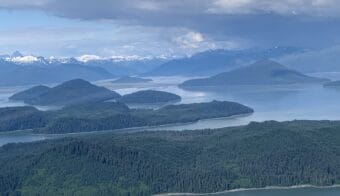
The Stikine River Flats area in the Tongass National Forest is viewed from a helicopter on July 19, 2021. The Stikine River flows from British Columbia to Southeast Alaska. It is one of the major transboundary rivers impacted by mines in British Columbia. Alaska tribes and communities are seeking some new protection to avoid downstream impacts. (Photo by Alicia Stearns/U.S. Forest Service)

This story is co-published by the Wrangell Sentinel and Northern Journal.

An Indigenous community is locked in a debate about the pros and cons of a major new mine on their traditional lands — and a big cash payment promised by the developer.

There is strong support, and fierce opposition. A lot of money to be made, and a wild river to protect. The community faces a pivotal choice.

Though this story sounds like it could be unfolding in rural Alaska, a version of it has actually been playing out just across the border with Canada, in northwest British Columbia. Still, it has implications for the Alaskans who live downstream from the proposed mine site.

In a referendum after weeks of heated debate, members of the Tahltan Nation earlier this month voted overwhelmingly to approve a deal with a Canadian mining company that hopes to revive a huge gold and silver mine, called Eskay Creek, which stopped producing in 2008. The project is located above the Unuk River, which flows into Alaska near Ketchikan.

The Tahltans’ backing is a major step forward for the project, and it comes as the Canada and B.C. governments intensify efforts to build more mines in the name of national security and economic growth. Several of the projects are near the border with Alaska, where state and federal elected officials are separately pushing mines that could help wean the U.S. off a foreign supply of minerals used in energy, electronics and weapons.

Just one day after the Tahltan vote, Canada’s federal government announced that it had approved a merger between two multinational mining firms with a condition that calls for advancing two other proposed mines in Tahltan territory. Both projects sit above tributaries of the Stikine River, a major, salmon-bearing waterway that straddles Canada and the U.S. and empties into the ocean near the small Southeast Alaska town of Wrangell.

Louie Wagner Jr., a Tsimshian and Tlingit resident of Metlakatla, a Native community at the southern tip of Alaska’s panhandle, said he’s concerned about the health of the Unuk River and its future with mines in its watershed.

Wagner and his family have fished and hunted moose along the Unuk for generations.

“That little river cannot handle it,” Wagner said in a recent phone interview. The Unuk is notable, he added, for its abundance of eulachon, a small, oily fish also known as hooligan that’s a staple for Indigenous communities in Southeast Alaska.

Though rarely discussed in Alaska circles, the Tahltan Nation’s approach to mining has major implications for the industry’s future in the transboundary region. A top U.S. Department of Interior official visited the region last year to learn more about models for how Indigenous nations can partner with mining companies.

There are more than a dozen early-stage mining projects in Tahltan territory, many above rivers that flow into Alaska. And the Eskay Creek vote could serve as a preview of future deals between the Tahltan government and the for-profit mining companies promoting development.

For months, members of the First Nation debated whether to approve a deal, known as an impact benefit agreement, that Tahltan elected leaders had negotiated with Vancouver-based Skeena Resources, the company pushing Eskay Creek.

The Eskay Creek mine is accessible off British Columbia’s Stewart-Cassiar Highway. (Photo by Max Graham/Northern Journal)

The specifics of the agreement have not been made public. But Tahltan officials have said it guarantees benefits worth more than $1 billion over the life of the mine, mostly in cash but also in contracts and wages.

The deal also calls for an upfront payment from Skeena, intended to be distributed to individual Tahltan members — to the tune of $7,250 each, according to Tahltan officials. And the agreement reportedly gives the First Nation government some environmental oversight over the mine.

The nation backed the deal with support from more than 77% of the roughly 1,750 Tahltans who voted, according to the Tahltan Central Government. Payments are expected to go out to members in 2026.

“Tahltan Central Government is not standing on the sidelines,” Tahltan president Kerry Carlick said in a statement after the vote.  “We are embedding ourselves directly into the governance of environmental protection.”

Tahltan leaders have long worked to navigate political tensions between an expanding mining industry and efforts to protect traditional lands and wildlife.

The Tahltan government has entered into a number of agreements with mining companies. But it also has opposed efforts to mine coal and drill for natural gas near the headwaters of major rivers in the region.

And some Tahltan members have been outspoken critics of the Eskay Creek project and the company promoting it.

In the leadup to the recent vote, arguments erupted on social media, and relationships among community members grew strained, some Eskay Creek opponents said in interviews.

“This is causing internal conflicts,” said Tamara Quock, a Tahltan member who lives in northern B.C. some 350 miles east of the mine site.

Quock said she thinks the promise of the direct payments “enticed” some people to vote in favor of the agreement. Debate over the project, she added, grew more intense after that condition was added to the deal.

Quock said she feels Skeena is “using the Tahltan people” to generate its own profits.

She and other critics have voiced concerns about a perceived lack of transparency and potential conflicts of interest within the First Nation’s government. They also say they are worried about possible environmental impacts from the project, which would involve digging two open pits and storing millions of tons of mining waste above the Unuk River.

Skeena didn’t respond to requests for comment.

Alaska Native leaders, fishermen and environmental advocates who live downstream, in Southeast Alaska, for years have expressed concerns about Eskay Creek and other proposed mines in the region, saying they don’t trust Canadian regulators to safeguard Alaskan interests.

“You can’t cut these watersheds in half and expect to adequately protect them,” said Guy Archibald, executive director of the tribally led Southeast Alaska Indigenous Transboundary Commission. “Right now they’re cutting the baby in half and ignoring the effects on the Alaska side of the border.”

The commission last month filed a legal challenge in B.C. court, asserting that regulators had failed to consult Alaska tribes on several proposed mines in the region, including Eskay Creek.

Meanwhile, after a major spill last year at a Canadian gold mine in the Yukon River watershed, Alaska’s congressional delegation called for more oversight of Canadian mines near transboundary rivers like the Unuk and Stikine. The statement from the delegation — which has strongly supported mine development in Alaska — called for “binding protections, financial assurances, and strong transboundary governance.”

“As British Columbia seeks to advance numerous mines just upstream from Alaska, we are still asking them to fully remediate legacy sites and firmly commit to binding protections for Alaska interests,” Joe Plesha, a spokesperson for U.S. Sen. Lisa Murkowski, said in a recent statement. “Senator Murkowski is actively considering new ways to make our B.C. neighbors take Alaskans’ concerns seriously.”

U.S. Sen. Lisa Murkowski’s office says she’s pushing the British Columbia provincial government on protections for Alaska interests as Canada advances mining projects in transboundary watersheds. (Photo by Nathaniel Herz/Northern Journal)

Ottawa and B.C.’s provincial government, meanwhile, are funding new infrastructure projects and prioritizing permitting for energy and resource development projects, including Eskay Creek and the expansion of a huge copper and gold mine in the Stikine watershed, called Red Chris.

Canadian officials say existing regulations are geared to minimize impacts in the shared watersheds. Major projects undergo thorough environmental assessments before they’re approved, a spokesperson with the B.C. agency that leads those reviews, the Environmental Assessment Office, said in an email.

“Making sure large-scale projects are properly assessed is critical to making sure development is sustainable — to ensure good jobs and economic growth while also protecting the environment and wildlife, and keeping communities healthy and safe,” said the spokesperson, Sarah Plank.

Tahltan officials declined an interview request and did not respond to questions about Alaskans’ concerns or the First Nation’s agreement with Skeena.

Supporters of Eskay Creek say it could be transformational for the Tahltan Nation. Among proponents of the deal is Chad Norman Day, a former Tahltan president who has worked in the mining industry and now runs a consulting firm that does mining-related business.

“The benefits which flow to the Tahltan Nation from here will empower the people and territory unlike anything we have ever seen,” Day said in a statement after the vote.

Many Tahltan people work in mining, and the First Nation already generates revenue from Red Chris and another large operating mine, Brucejack, which started producing gold in 2017.

In 2019, Tahltan citizens voted in favor of an agreement with a different mining company pushing another, much bigger proposed mine partially in the Unuk watershed, called KSM. The outcome of that vote was nearly identical to the recent Eskay one, with about the same percentage in favor.

The first nation also, in the past five years, has entered into two joint decisionmaking agreements with the B.C. government for regulatory reviews of mining projects, including Eskay Creek.

Before it can start producing, Eskay Creek needs an environmental approval from the provincial government. A decision is expected early next year.

National Democrats are ‘salivating’ over a Mary Peltola bid for US Senate. But Alaska’s governor’s race could be ‘wide open’ too.

Mary Peltola speaks at a community celebration last year, Founder’s Day, in the Indigenous community of Metlakatla, south of Ketchikan. (Nathaniel Herz/Northern Journal)

Democrat Mary Peltola, who was Alaska’s sole member of the U.S. House, lost her re-election bid last year.

But her margin of defeat of less than three percentage points, in a state that Donald Trump won by double-digits, showed that Peltola remains a formidable candidate.

And that means “every national Democrat is salivating” at the idea that Peltola could challenge incumbent Republican U.S. Sen. Dan Sullivan next year, said Jim Lottsfeldt, a longtime Anchorage political consultant.

“I’ve been asked by some famous ones, by some less famous ones, ‘What can you do to convince her?’” Lottsfeldt said.

But many Democrats inside Alaska see Peltola as the party’s strongest candidate for governor next year, when Republican incumbent Mike Dunleavy is barred by term limits from seeking re-election. And they’re waiting to see which race she enters.

“If she chooses to run for either U.S. House or U.S. Senate, I will absolutely run for governor,” said Tom Begich, the Democratic former state senator from Anchorage. “If she doesn’t choose to do that, but chooses to run for governor, then I’ll be supporting her.”

As for the potential candidate herself?

She’s biding her time.

Peltola, who declined to comment, earlier this year took a job with a national law and lobbying firm, Holland & Hart, where she works with her former chief of staff, Anton McParland.

Peltola has not made up her mind about whether to run for governor, U.S. Senate or U.S. House, said Elisa Rios, a former campaign manager for Peltola who still speaks with her regularly.

“It’s really just where she can make the greatest impact for Alaskans,” Rios said. “She is going to make that decision on her own time.”

While some operatives and prospective candidates may be impatient for Peltola to make up her mind, the filing deadline for the 2026 elections isn’t until June 1. And she can afford to wait, said Joelle Hall, president of the Alaska AFL-CIO, the state’s largest organized labor group.

One poll earlier this year found that Peltola had higher favorability ratings than all three members of the Alaska congressional delegation, as well as Dunleavy.

“She’s Mary Peltola — she has 100% name ID, and she will raise money,” Hall said. “Is waiting, in any way, a problem for Mary? Absolutely not. She can decide on her own terms.”

Alaskans elected Peltola to the U.S. House two times, in quick succession, in special and regular elections in 2022 after the death of Republican Don Young, who held the seat for a half-century.

Peltola, a former member of the Alaska House, defeated Republican former Gov. Sarah Palin in both elections; she quickly became a star in national Democratic circles as the first Alaska Native woman elected to Congress.

In the U.S. House, Peltola established herself with a brand of centrist politics unique to her state: supporting abortion rights, crusading against factory fishing and salmon bycatch while also endorsing large-scale mining and oil projects.

Her term, however, was marked by the death of her husband Buzzy Peltola, who was killed when the small plane he was piloting crashed in September 2023.

Mary Peltola ran for re-election last year but lost to Republican Nick Begich III. Begich, a nephew of Tom Begich, won by a final margin of 2.5 percentage points after two other candidates’ support was redistributed in Alaska’s count of ranked choice votes.

Peltola  has largely kept a low profile since her loss. But in recent days, she has emerged publicly. On July 1, the same day Sullivan voted in favor of President Donald Trump’s “One Big Beautiful Bill,” Peltola made her first post to social media in nearly five months.

“We can not secure Alaska’s future by increasing healthcare and energy costs for regular Alaskans, so millionaires, like many of my former colleagues in Congress, and their billionaire donors, can get even richer,” Peltola said.

Peltola also served as grand marshall at Anchorage’s Pride parade last month, sporting a rainbow scarf and flag as she told an enthusiastic crowd that it was “so good to be here with all these people who are pro-love.”

Officials with the Senate Democrats’ recruitment and campaigning arm, the Democratic Senatorial Campaign Committee, did not respond to requests for comment.

But Jessica Taylor, who tracks U.S. Senate races for the nonpartisan Cook Political Report, said that if Peltola decides to challenge Sullivan, she would “put that seat into play.”

“I think Sullivan would certainly not want to run against her, because she’s won statewide before,” Taylor said.

A spokesman for Sullivan’s campaign declined to comment.

Winning a U.S. Senate race would net Peltola a six-year term — two more years than she’d get by winning a gubernatorial race.

She has also proven to be a formidable fundraiser in federal elections, bringing in more than $12 million total for her campaign in 2023 and 2024.

But political observers say there are also reasons that a U.S. Senate campaign might be less attractive for Peltola.

If elected, she’d have to resume a 3,300-mile commute to Washington. She’d likely face millions of dollars in attack ads from conservative groups.

A U.S. Senate campaign could also complicate her job at Holland & Hart, the law and lobbying firm.

While Peltola is barred from lobbying Congress for a year after leaving office, the the firm, whose clients include oil and gas companies, mining businesses and pharmaceutical giant Bayer, does have contact with members of Congress.

That includes Sullivan, who Peltola would be running against. McParland, Peltola’s former chief of staff, has visited Sullivan’s office in his new role at the law firm, according to a person with knowledge of the visit.

In a bid for governor, meanwhile, Peltola would not have to face an incumbent. Of the multiple Republicans who have announced campaigns so far, only Lt. Gov. Nancy Dahlstrom has held statewide office.

“When she enters, it’s going to be Snow White versus the seven dwarfs,” said Lottsfeldt, the consultant. “The governor’s race is just wide open for her.”

Lottsfeldt, citing the state’s economic woes, said he wants Peltola to run for governor — even though he often earns substantial sums as a local consultant for national Democratic groups when high-profile candidates like her run for congressional races.

“It would be a crazy amount of money. And, you know, I suspect I would do very well — you can quote me,” he said. “But I live in Alaska. The state is failing. The need for a governor is our highest priority right now. And so we have to focus on that.”

Amid gas crunch, Alaska could revoke leases from a company whose drilling has stalled

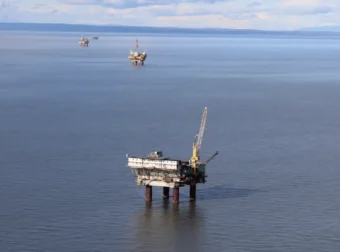
Natural gas production from offshore platforms in Cook Inlet, outside of Anchorage, has declined over the past several decades. The area’s dominant producer, Hilcorp, has warned electric and heating utilities that they should not expect their supply contracts to be renewed when existing ones expire. (Photo by Nathaniel Herz/Northern Journal)

Gov. Mike Dunleavy’s administration is threatening to strip a company of oil and gas leases in Cook Inlet outside Anchorage, saying it’s sitting on deposits that could delay an impending shortage of gas needed for heating and power generation in urban Alaska.

The Alaska Department of Natural Resources recently placed in “default” the Cosmopolitan Unit, a block leased by Texas-based BlueCrest Energy, saying it hasn’t met commitments to drill.

The company has held leases at Cosmopolitan for more than a decade. It conducted initial drilling several years ago but has not drilled any new wells since 2019, according to state records.

Company executives say that BlueCrest experienced a cash crunch when, amid a budget crisis beginning in 2014, the state of Alaska chose not to pay tax credits to oil firms that had spent money on drilling. BlueCrest has also had to ask Alaska’s economic development agency to approve delays in paying back a $30 million state loan.

The state’s new notice to BlueCrest, signed in May by Commissioner John Boyle, gives the company until Aug. 21 to show proof that it’s secured investment to drill a $55 million new oil well, as well as to advance development of a new offshore platform that would target natural gas.

That platform could cost $350 million or more, according to BlueCrest officials.

“We want to see aggressive, defined momentum towards putting our resources into active production,” Boyle said in an interview Thursday. “We need to see some drilling. We need to see some action.”

BlueCrest is negotiating with multiple companies about potential investment, Benjy Johnson, its chief executive, said in a phone interview.

“We’re hopeful that we’ll get it done,” he said. “I think we will.”

Johnson said he understands the state’s perspective, but added that defaulting BlueCrest’s leases is “not the solution to the problem.”

“The solution to the problem is helping us get funding to drill these wells, and to get the gas development going,” he said.

BlueCrest is one of the smaller companies active in the Cook Inlet basin, where the vast majority of the gas is produced by a large independent oil business, Hilcorp.

Hilcorp has warned urban Alaska’s heating and electric utilities that they shouldn’t expect Hilcorp to renew their gas supply contracts when they expire in the coming years.

In response, those utilities are advancing plans to import liquefied natural gas — but they also say that new local gas production could delay the need for imports. The supply crunch is serious enough that utilities and regulators have recently been discussing contingency plans for rolling blackouts.

BlueCrest says its leases contain large “proved reserves” of gas — an industry term meaning that a deposit’s flow has been tested and that an engineering firm has validated it can be produced with 90% probability or higher.

But building an offshore platform to access the gas would cost some $350 million.

One of the other small companies operating in Cook Inlet, HEX, has moved ahead with gas drilling in each of the past two years — with help from a decision by Dunleavy’s administration to reduce the royalty payments due from HEX to the state.

Boyle, the natural resources commissioner, described the royalty reduction as a “carrot.”

“But there’s also the potential for sticks, if we don’t see active movement on developing the rest of (HEX’s) leased acreage,” Boyle said. “And the same for BlueCrest and anyone else that we don’t feel is fulfilling their obligations.”

The state has a range of options if BlueCrest doesn’t advance its drilling program, Boyle said. In his notice to the company, he wrote that his agency could shrink BlueCrest’s Cosmopolitan Unit, or “terminate” it.

If the state takes back some of BlueCrest’s leased acreage, Boyle said, there are “definitely companies and entities that are willing to put money there to bring that gas to market.”

BlueCrest could also decide to sell its leases to another company, or find a business partner that could help advance development, according to Boyle.

BlueCrest and Hilcorp previously discussed a partnership to develop the Cosmopolitan Unit’s gas, Northern Journal reported in 2023. But the discussions broke down because the two companies couldn’t agree on how to divide potential costs and profits.

Nathaniel Herz welcomes tips at natherz@gmail.com or (907) 793-0312. This article was originally published in Northern Journal, a newsletter from Herz. Subscribe at this link.

Fueled by trade tensions and foreign wars, a rush for an obscure mineral heats up in Alaska

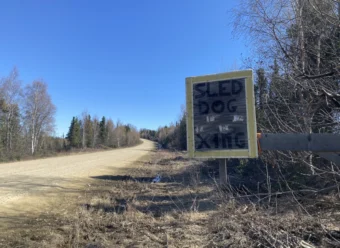
A sign warns of a sled dog crossing along Old Murphy Dome Road outside Fairbanks. The road leads to a site where an Australian company called Felix Gold could begin mining antimony. (Max Graham/Northern Journal)

Alaska hasn’t produced antimony — a shiny mineral used in weapons, flame retardants and solar panels — in almost 40 years.

That could change this summer, according to the executives of a Texas company that has snatched up more than 35,000 acres of mining claims in Alaska.

Dallas-based U.S. Antimony Corp. is looking to the state as a new source of antimony for its smelter in Montana, the only plant in the United States that refines the mineral.

Alaska’s antimony, the company says, could help the U.S. overcome a recent ban on exports of the mineral from China, the world’s top antimony producer. Antimony is among several minerals — many of which are used in renewable energy — that the U.S. has sourced primarily from China and other countries in recent decades. Efforts to build more mines in the U.S. have accelerated amid worsening trade tensions and growing demand.

With no active antimony mines, the U.S. in recent years has imported roughly 60% of its antimony from China. Meanwhile, need for the mineral has surged as antimony-laden arms flow to wars in Ukraine and the Middle East.

The price of the mineral has quadrupled in the past year, rising from around $13,000 to $55,000 per ton.

U.S. Antimony is now expanding its Montana smelter and rushing to find more ore to supply it. Alaska is its “primary focus” for boosting production, an executive said in an interview last week.

In the past eight months, a U.S. Antimony subsidiary, Great Land Minerals, has acquired claims in three different areas of Alaska’s Interior: outside Fairbanks; near the small town of Tok; and along the Maclaren River off the Denali Highway, a scenic road that runs outside the national park.

U.S. Antimony says it’s looking to truck antimony ore some 2,000 miles from Alaska to its processing plant in Montana. That operation could start as soon as September, executives said on a recent call with investors.

“We can’t get that antimony from Alaska to Montana fast enough,” Joe Bardswich, U.S. Antimony’s chief mining officer, said on the call.

A chunk of stibnite, which contains more than 70% antimony, from Felix Gold’s Treasure Creek project near Fairbanks.
A chunk of stibnite, which contains more than 70% antimony, from Felix Gold’s Treasure Creek project near Fairbanks. (Max Graham/Northern Journal)

The company’s plans coincide with a separate effort by an Australian company to start up its own small-scale antimony mine near Fairbanks.

Felix Gold is seeking to restart production this year at a long-shuttered antimony mine that sits within a few miles of a residential subdivision, Hattie Creek.

The company also is eyeing prospects near the hamlet of Ester on the outskirts of Fairbanks — where U.S. Antimony’s subsidiary has claims, too.

The potential developments are generating a mix of responses locally.

Some residents worry about environmental impacts of mining and its potential to transform tranquil Fairbanks-area neighborhoods into noisy industrial sites.

“I don’t want to be all NIMBY. But it literally is my backyard,” said Lisbet Norris, who lives in Hattie Creek, about 10 miles north of downtown Fairbanks. “It’s just so close.”

Norris, a dog musher, runs sled tours on trails that cross Felix Gold’s claims on state land, and she’s concerned that mining might impede her business. She’s also worried about heavy industrial use of the dirt road that connects her neighborhood — and Felix Gold’s potential operations — to the rest of town.

Other Fairbanks residents, however, say they support mining in the area; some cite the town’s early history as a gold mining town and the potential economic benefits of new mines.

“It’s because of mining that Fairbanks is what it is,” said Roger Burggraf, a local prospector who owns some of the claims that Felix Gold has leased to study the feasibility of antimony mining.

Roger Burggraf is leasing mining claims to one of the companies looking for antimony in the Fairbanks area.
Roger Burggraf is leasing mining claims to one of the companies looking for antimony in the Fairbanks area. (Max Graham/Northern Journal)

Burggraf said he understands the concerns of people who live near gold and antimony prospects. But when they bought their properties, “they should have realized that if a mine developed, that might change their lifestyle,” he added.

Felix Gold has a permit only for mineral exploration, not active mining.

The company aims later this year to apply for additional state permits, and to finish studying the profitability of developing a small antimony mine near the Hattie Creek subdivision.

U.S. Antimony also has applied only for a permit to search for antimony, though it hopes to apply for more permits and start mining within a year. If its exploration efforts show a mine would be profitable, it would propose an underground operation, said Rodney Blakestad, U.S. Antimony’s vice president of mining.

The footprint would be small, more similar to the family-run placer mines in the area than to a large-scale hardrock mine, according to Blakestad.

“We’re not Fort Knox,” he said, referring to Fairbanks’ huge open pit gold mine.

But before U.S. Antimony begins mining, it wants to buy antimony ore from existing placer gold mines.

Antimony often appears alongside more-valuable gold, and gold miners have typically thrown it aside.

Now that antimony prices are surging, though, U.S. Antimony representatives say every little bit is valuable. A 25-ton truck could carry some $600,000 worth of minerals, Bardswich said in an interview.

That means small loads of antimony ore from shallow, exploratory trenches that the company intends to dig at its Alaska prospects this summer also could be worth driving 2,000 miles to the Montana smelter, company executives said.

In the meantime, they intend to launch an advertising campaign to share their interest in buying the mineral from placer miners.

“People don’t realize this: Gold is not the best mineral to be mining, if you’re looking for really good value,” said Blakestad. “Antimony is.”

Northern Journal contributor Max Graham can be reached at max@northernjournal.com. He’s interested in any and all mining related stories, as well as introductory meetings with people in and around the industry.

This article was originally published in Northern Journal, a newsletter from Nathaniel Herz. Subscribe at this link.

New Alaska Bitcoin mine would use as much power as the state’s largest coal plant produces

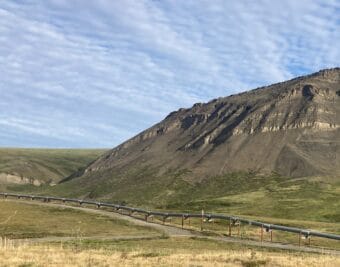
An above-ground section of the Trans-Alaska Pipeline System near the Toolik Lake Research Station in the North Slope Borough. (Photo by Rashah McChesney/Alaska's Energy Desk)
An above-ground section of the Trans-Alaska Pipeline System near the Toolik Field Station in the North Slope Borough. (Photo by Rashah McChesney/Alaska’s Energy Desk)

A startup company is proposing to build a large Bitcoin mining operation on Alaska’s North Slope later this year that’s expected to be powered by the region’s abundant natural gas — a test of an operation that it wants to grow into the largest in the nation.

The project from Wasilla-based Stax Capital Partners would be the first of its kind for the state, and the company wants to “create the playbook for sustainable, at-scale Bitcoin mining in Alaska,” said chief executive Sparrow Mahoney. She said Alaska is “the only place this makes sense, long term, for the industry.”

Stax recently applied for a permit with state land managers to set up shipping container-like pods housing natural gas generators and computers at a site some 30 miles south of the massive Prudhoe Bay oil field. The generators would be fueled by the basin’s huge stores of “stranded” natural gas — an industry term for gas that doesn’t have a pipeline connecting it to potential customers.

Bitcoin mining doesn’t have the same type of impact as hard rock mining — it’s a digital process that uses computers to create valuable cryptocurrency.

Nonetheless, the rapid proliferation of Bitcoin mining operations and other data centers is drawing increasing public opposition tied to their demand for electricity and property in Lower 48 communities.

Alaska policymakers have recently been pitching companies on the state’s ample unsettled land and, potentially, the ability to generate power using the large quantity of stranded gas at the North Slope oil fields, which is otherwise reinjected underground.

But developing new industries in the region is challenging due to its remote location and steep construction costs. And oil companies on the North Slope haven’t ever sold large quantities of gas for Alaska-based data centers or Bitcoin mining, so it’s not yet known whether their asking price would be low enough to offset the higher costs of building and operating infrastructure in the Arctic.

Stax’s gas generators would have the capacity to produce 50 megawatts of electricity — about the same amount as Alaska’s largest coal plant, in the Interior community of Healy. The company is “in conversation” with a number of potential natural gas suppliers on the North Slope, Mahoney said, though it has not yet signed a contract with any of them.

The company’s plans dwarf another test Bitcoin project on the North Slope that was proposed last year — a 1.4-megawatt partnership between oil company Hilcorp and a small infrastructure firm. Mahoney declined to reveal the exact cost of Stax’s project, but confirmed it would exceed $10 million.

Mahoney also would not say how Stax expects to move the gas the 30 miles from the oil fields to its proposed site — located at the Franklin Bluffs pad, which was built during construction of the trans-Alaska oil pipeline. But one option could be to tap into a small, existing gas line that runs along the oil pipeline, which carries fuel used by the oil pipeline’s pumps.

The proposed Bitcoin mine comes as numerous Alaska lawmakers are separately pushing the construction of an enormous new gas export project that would connect the North Slope oil fields to a port on the Kenai Peninsula. There, the fuel would be liquefied and transferred to cargo ships that would deliver it to buyers in Asia.

While that project has drawn renewed political support from President Donald Trump’s administration, it’s also struggled to draw investors in part because of its price tag of $44 billion or more.

Stax’s project would be an “innovative” way to profit from North Slope gas without requiring construction of the export project, according to Phil Wight, an energy historian at the University of Alaska Fairbanks.

But the Bitcoin mine could also come with significant impacts, he added: further industrialization of the environmentally sensitive Arctic region, as well as the carbon emissions that stem from burning natural gas.

“It just gets into this really problematic situation where, suddenly, we are burning gas that we wouldn’t otherwise burn, and we are not executing an energy transition,” Wight said.

Mahoney said her project would require “no new drilling” and that its location 30 miles south of the main North Slope oil fields is aimed at avoiding additional air pollution there.

Mahoney grew up in Alaska, graduated from Wasilla High School and once worked for Frank Murkowski when he was a U.S. senator. She has worked in the cryptocurrency industry before, helping the Iditarod develop its own “Iditacoin.”

Stax was only established a year ago. But it’s working with multiple established players in Alaska, Mahoney said.

Anchorage finance firm McKinley Alaska Private Investment has committed the money needed for the pilot project, she said, and another advisor to her company is Brian Murkowski, an energy consultant and brother of current U.S. Sen. Lisa Murkowski. Jim Shine, an attorney and former high-level official at the state’s land management agency, is handling some of the permitting work.

Stax aims to begin construction by the end of 2025, Mahoney said. If the initial, temporary project is successful, the company aims to expand; it’s eyeing power generation with a capacity of a gigawatt, or 20 times the size of the initial development.

But even the pilot 50-megawatt project would be considered significant in the Lower 48, where a New York Times analysis of what it called the nation’s 34 “largest” Bitcoin mines only examined operations larger than 40 megawatts. The country’s biggest mine, currently, is a 700-megawatt facility in Texas run by a company called Riot Platforms.

Mahoney said that Alaska could benefit from Stax’s proposed project by selling its own gas to the company; the state owns a royalty share, typically at least 12.5%, of gas produced by companies operating on the North Slope.

“What we’re doing is showing that there’s a large, viable, commercial opportunity based on infrastructure and resources that exist today,” Mahoney said. “We can monetize this together, today. And it represents an opportunity of tremendous magnitude for the state and for everyone.”

This piece was originally published in Northern Journal, a newsletter and news website. Subscribe here.

Coastal Alaskans see commercial fishing limits as a ‘crisis.’ Lawmakers don’t.

Butch Laiti is president of the Douglas Indian Association, a tribal government in Juneau. The association has purchased a fishing boat and wants to buy a commercial fishing permit for its members to share, but a state law bars it from doing so. (Photo by Nathaniel Herz/Northern Journal)

For decades, an economic catastrophe has been unfolding in the Indigenous villages along the Gulf of Alaska, with lost jobs and the destruction of a traditional way of life: hauling fish from the sea.

That destruction is still playing out. More than 80% of people who responded to a recent survey sponsored by an economic development nonprofit said that Southeast Alaska and Kodiak Island villages are in a “crisis of sustainability” because of lost access to fisheries.

Indigenous leaders across the Gulf say it’s imperative that Alaska legislators pass reforms to the state law that they blame for the mess: a landmark 1973 statute that effectively prevents many residents of those coastal villages from earning a living by fishing for salmon.

New fishermen can only participate in the commercial harvest if they buy or inherit a state permit that, in some cases, can cost upward of $100,000 — putting it out of reach for young rural residents with no credit histories.

“We all have kids and grandkids that want to continue doing what their grandparents were doing a long time ago,” Joe Nelson, a top official with Southeast Alaska regional Native corporation Sealaska, said at a reception for lawmakers in Juneau last month.

a person speaking at a microphone
Joe Nelson, interim president of Southeast Alaska regional Native corporation Sealaska, spoke at a reception for state lawmakers and their aides in April. His green commercial fishing permit cards hung from his neck. (Photo by Nathaniel Herz/Northern Journal)

But just up the street from Sealaska’s offices, at the Alaska Capitol, the issue barely registers.

Many lawmakers in Juneau represent urban districts or regional population centers and aren’t aware of the crisis playing out in the state’s rural, coastal communities; instead, they’re focused on state schools funding and a widening budget deficit.

Those who do represent coastal areas say they have to balance the interests of village constituents with the interests of another, politically connected group: existing fishermen in hub towns and urban areas who depend on their harvests to feed their families — and who could be negatively affected by legislative change.

There’s also still no consensus among advocates about how, precisely, the law should be adjusted.

The result is that despite growing discontent with the 1973 law, and a widening coalition of stakeholders who support changing it, the issue has gone nowhere in Juneau. Advocates hoped for a hearing on the subject during this year’s legislative session, but one never materialized, and lawmakers have proposed no bills to address the problem.

“We’re operating under a law that’s been in place for 52 years, and it’s broke — it’s not meeting the demands of today,” said Robin Samuelsen, a Native leader from the salmon-rich region of Bristol Bay. The system needs to be changed, he said, or rural Alaska communities “are not going to survive.”

“One by one, they’re going to disappear,” he said.

a portrait of a man
Robin Samuelsen, a longtime fisherman and Alaska Native leader from the Bristol Bay salmon fishing hub town of Dillingham, posed for a photo there last year. (Photo by Nathaniel Herz/Northern Journal)

The 1973 law, known as the Limited Entry Act, was designed to make commercial fishing more profitable and sustainable by limiting the number of boats on the water.

Skippers who had been operating at the time largely qualified for permits without having to buy them. But a provision called “free transferability” meant those permits could be sold on the open market.

Over the years, rural Native communities have lost hundreds to Alaska’s larger population centers and other states as owners sold out or took permits with them when they moved.

Earlier this year, Northern Journal sent a survey on limited entry and rural fisheries access to 16 state senators and representatives whose districts border the Gulf of Alaska; none completed it. Approached by a reporter at the Capitol, several lawmakers declined to discuss the issues; some pleaded ignorance.

“We’re going to work on it, and we’ll try to do all we can,” Senate President Gary Stevens said. “But I don’t see any reason I need to meet with you on this.”

a man smiles at a meeting table
Senate President Gary Stevens has represented Kodiak Island in the Legislature for more than two decades. (Photo by Jenn Gifford/Courtesy of Alaska Senate Majority)

Stevens for 25 years has represented Kodiak Island, whose Indigenous villages were once home to proud commercial fishing fleets and a multi-generation heritage of fish-related trade.

Those communities have seen some of the state’s steepest permit losses since lawmakers approved limited entry more than 50 years ago.

One village, Ouzinkie, has a single skipper left in its harbor.

‘What’s the holdup?’

Butch Laiti started in the commercial fishing industry as a teenager in Juneau, where his family was part of a big Native fleet that harvested salmon from the Taku River outside of town.

At 76 years old, he’s watched for decades as members of his local tribe have sold off their boats and permits — making them largely bystanders as others harvest the salmon once claimed as tribal property.

Today, Laiti says he’s one of the few Native fishermen left in his area. And the Tlingit elder wants to pass his decades of maritime expertise and knowledge to a new generation.

Laiti is the president of a local tribal government, the Douglas Indian Association, and under his leadership, the tribe acquired a parcel of waterfront property in Juneau where it hopes to one day build a communally owned fish processing plant.

And, in 2022, the tribe spent $210,000 on a commercial fishing boat: a 42-foot gillnetter, which will double as a marine debris cleanup vessel.

a boat called "Ocean Gold"
The Douglas Indian Association’s F/V Ocean Gold was docked in a Juneau harbor in April. (Photo by Nathaniel Herz/Northern Journal)

Then, Laiti went to the state agency that oversees access to Alaska’s commercial fisheries to ask: Could the tribe also buy a permit to harvest salmon? That would give Laiti and other aging skippers the chance to take turns running the vessel and training aspiring young fishermen.

But the answer from the agency’s chairman was a hard no: The limited entry law only allows ownership by individuals, not by collectives such as companies or tribes. The lawmakers who designed the system in the 1970s wanted to keep fishing from being taken over corporate interests.

If the members of Laiti’s tribe want to own a permit and operate their boat collectively, they would have to change the law — a daunting proposition for an organization with no lobbyist and little muscle in Alaska’s Capitol.

But a broader network of advocates has also been readying an organized push for legislative reform. It includes the Indigenous-owned regional corporations for Southeast Alaska, Bristol Bay and Kodiak, along with The Nature Conservancy.

Those groups haven’t decided on specific legislative changes to push. But Laiti says that tribal ownership would be one straightforward fix to the limited entry law.

“This is ours. It always has been ours, and because we joined the United States of America, somehow we have lost control of everything that has belonged to us,” Laiti said. “If we’ve got to buy back our heritage, then so be it.”

He added a question for lawmakers: “What’s the holdup?”

‘Fiercely’ opposed

One reason for the holdup: the thousands of commercial fishermen who already own permits entitling them to chase a share of the harvest.

islands and boats in an ocean
Salmon fishing boats operate outside of the Southeast Alaska town of Sitka. (Photo by Nathaniel Herz/Northern Journal)

One group of such fishermen — a trade organization representing Southeast Alaska’s fleet of salmon gillnetters — ”fiercely” opposed a previous legislative proposal to allow community trusts to own permits, according to one of its leaders.

In an email, Max Worhatch, executive director of the United Southeast Alaska Gillnetters Association, rejected the idea that lawmakers should change the permit system to boost rural fishermen.

Native corporations and a regional fisheries nonprofit in Bristol Bay have plenty of capital, Worhatch said, and both can “easily afford” to support rural residents seeking state loans that are available to all Alaskans.

In fact, that regional fisheries nonprofit, Bristol Bay Economic Development Corp., already has a program that subsidizes local permit ownership. But it hasn’t stopped permits from leaving the region, and in fact, the losses have still accelerated in recent years, according to state data.

“We don’t have enough candidates from our communities stepping forward,” said Samuelsen, who served as the nonprofit’s board chair for three decades. “A lot of them say, ‘We don’t have the capital or the money to get involved.’”

Defenders of the current system say that the decline of the commercial fishing industry in remote villages is less about the limited supply of permits and more about the lack of demand for them.

“There are not tons of folks breaking down the doors to get into fishing,” Jerry McCune, a longtime Cordova-based fisherman and trade group lobbyist, wrote in a response to a Northern Journal survey of industry players.

a blue building says "Fishermen's Building" on the side
The Alaska Fishermen’s Building in Juneau houses the United Fishermen of Alaska, or UFA, one of several industry trade groups with a presence at the Alaska Capitol, which is just down the street. (Photo by Nathaniel Herz/Northern Journal)

McCune and some other industry veterans argue that factors outside the state’s control are at play: closures of processing plants in remote areas, shifts in salmon runs and reduced competition among the seafood companies vying to buy each vessel’s catch.

They also worry that even small changes to the permit regime risk upending the whole limited entry system — and, potentially, invite legal challenges.

“Limited entry is a very complicated document,” McCune said. “Change one thing and limited entry could collapse.”

Attorneys for the state have raised questions about the constitutionality of ideas like permit trusts.

But Jim Brennan, a longtime Alaska attorney who provided legal support to the attempt to create those trusts a decade ago, dismissed McCune’s concerns. The overall permit system, he said, has survived previous court challenges.

“I think that’s kind of a scare tactic,” he said. “It’s not a house of cards.”

‘Does it force the other side down?’

Lawmakers say they need to approach the issue of permit access deliberately — balancing the needs of rural communities with those of existing fishermen.

Kodiak Rep. Louise Stutes, who chairs the House Fisheries Committee, said in a statement that any legislative proposals would have to accommodate different constituencies.

“I certainly support reducing barriers to accessing fisheries for Alaskans and keeping permits in rural communities,” she said. “However, I also believe that any potential change to limited entry needs to be the result of a stakeholder-driven process with existing permit holders, rural constituents, affected communities and the Department of Fish and Game.”

a woman in a meeting room
Rep. Louise Stutes of Kodiak chairs the House Fisheries Committee. (Photo by Loren Holmes/Anchorage Daily News)

The Alaska fishing industry’s own broader economic crisis is making the policy discussion even more sensitive. Oversupply, flagging demand and growing global competition have depressed prices paid to fishermen in recent years — putting many skippers in the red.

Sitka Rep. Rebecca Himschoot, who represents multiple Southeast Alaska fishing hub towns, as well as small Native communities that have seen sharp losses in permit ownership, said that the increasingly tough outlook for the industry has complicated the task for lawmakers.

“It’s really hard to say we’re going to come in and fix this problem that’s been cooking since 1970 — when people in the fishery now can’t even make their living,” she said.

boats in a line
Commercial fishing boats sit in the harbor in the Kenai Peninsula town of Homer last year. (Photo by Nathaniel Herz/Northern Journal)

Nonetheless, Himschoot added, she’s alarmed by permit losses in villages in her district and wants to explore ways to restore them without harming current permit owners.

But she acknowledged that the issue is politically delicate.

“When we lift up one side, does it force the other side down?” she asked.

This piece was originally published in Northern Journal, a newsletter and news website. Subscribe here.

Site notifications
Update notification options
Subscribe to notifications