Aleutians

Alaska pollock processors drop foreign worker program, citing uncertainty

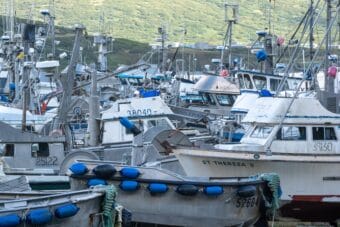
The UniSea processing plant in Unalaska in Jan. 2019. (Berett Wilber/KUCB)

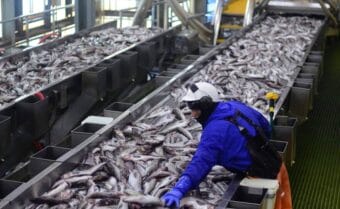
Some of Alaska’s largest pollock processors are abandoning a foreign worker visa program that once supplied up to half their workforce, citing rising costs and uncertainty under stricter immigration policies.
Tom Enlow is the president and CEO of UniSea Seafoods, Unalaska’s largest seafood processor. He said the company is moving away from the H-2B visas to save money on an inconsistent system.

“The H-2B program, I think was good for Alaska at a time when we really needed them, you know, during the pandemic, and little bit pre-pandemic, but really it’s cost prohibitive to bring workers all the way from Eastern Europe to Alaska,” Enlow said.

The H-2B visa program allows employers to bring foreign workers to the U.S. to fill temporary non-agricultural jobs during shortages. The visas can be difficult to obtain. Companies have to first show they can’t fill the jobs, then they have to apply, and then the U.S. Department of Homeland Security and the U.S. Department of Labor issue the visas through a lottery system.

Enlow said the processing plant moved back to a 100% domestic workforce this summer and will do the same for the upcoming “A” season — a major pollock season that starts later this month and brings thousands of workers to Dutch Harbor.

The main reason for that is cost. He said the Trump administration’s approach to hiring foreign workers has also made a difficult and expensive process even more complicated.

“It doesn’t make for good planning for processors, when you are bringing 200 or 300 people in from Eastern Europe and you don’t know for sure if you’re going to get supplemental visas, if [they’re] going to get approved in time, if they’re going to be in Alaska when you need them, when the season’s started,” he said.

UniSea started participating in the H-2B program in 2019, and prior to that, the company employed 100% U.S. domestic workers, according to Enlow. Some of those were green card holders or permanent residents, living in the U.S. — most from the Philippines.

When the company was actively using the special visas, as many as half of UniSea’s workers were foreign.

The company still employs a handful of Ukrainian employees who were hired through a special program designed to help those who were displaced from the Russian invasion, and will continue to work for the processor, Enlow said.

“They’re not bound by some of the rules and restrictions of the H-2B program,” he said. “They can stay extended periods of time. They can work full time, year round, they don’t have to be necessarily processors. They can work in other jobs, in other areas.”

UniSea isn’t the only regional processor filling jobs with American workers. Trident Seafoods — one of the largest seafood processors in the nation — said it employs almost an exclusively domestic workforce.

A spokesperson for the company said the processor — which has facilities across Alaska, from the Aleutians to Southeast and Bristol Bay — has been moving away from the H-2B program since 2023, in an attempt to strengthen long-term, local employment.

Westward Seafoods, another shore-based processor in Unalaska, would not provide information on employment data.

Alaska: the ‘poster child for foreign labor’

Brian Gannon is the vice president of global partnerships for LaborMex, a Texas-based company that helps connect U.S. businesses with foreign nationals for temporary or seasonal work. He said when it comes to handling and packaging Alaska’s massive seafood exports, especially for cod and pollock, the state has a very small local employment pool to work with.

“For 100 years, people have been coming from somewhere else to process fish in Alaska,” Gannon said.

Processing fish involves long hours, and often tough, repetitive and pungent work. Considering there is an entire area of plants often referred to as the “slimeline,” it can be difficult to fill those jobs.

Gannon, who started his career as a guest worker from Montana at a processing plant in Chignik in 1990, said despite the lackluster appeal of processing work, Alaska has done a good job attracting seasonal workers from afar.

“Alaska is really a poster child for foreign labor, in as much as the oil industry and forestry and mineral extraction and seafood production, etc., in Alaska for 150 years, [has] been built on a small amount of available local labor and a large amount of labor coming from somewhere else,” he said.

The Alaska Department of Labor found that in 2023 the state’s seafood industry employed nearly 22,000 workers, roughly 83% of which were nonresidents of the state. That year, the Alaska pollock industry directly employed over 8,000 workers, according to a report from Northern Economics on the contributions of the state’s pollock industry. Most were workers from the U.S., roughly 31% from Alaska, and about 12% were residents of other countries.

H-2B visa program helps fill employment gaps

Gannon said about 10 years ago, the seafood industry’s domestic workforce started to run dry. The industry’s pool of seasonal workers wasn’t replenishing. And that was especially challenging for cod and pollock processing, which unlike salmon, for example, don’t have peak seasons in the summer. He said salmon can have an advantage because it’s a summer fishery, and people sometimes have that season off. Ultimately, Gannon said companies just couldn’t match the shortfalls.

“And that’s where that H-2B visa came in quite handy,” he said.

The H-2B visas weren’t really used in Alaska’s seafood industry until about 12 years ago, according to Gannon. Congress currently doles out 66,000 for the entire fiscal year, and Gannon said they can get about 250,000 requests. Congress sometimes approves special increases for those visas.

Within the pollock processing industry, the program has been used among all sectors of processors. However, the catcher-processor fleet — that processes at sea — is required by law to employ 75% American citizens and green card holders. According to officials in the industry, they’ve never made any significant use of the H-2B program.

For a while the visas, while complicated to obtain, worked well. But Gannon said over the past several years a lot has changed in the pollock industry.

Changes in the industry spark a return to domestic labor 

“So many things have upended the apple cart, and the pollock processors are not necessarily producing as much,” he said.

Gannon said things like the COVID-19 pandemic, the war in Ukraine, changes in the nation’s political dynamics and competition from China and Russia have made it hard for pollock processors to make ends meet.

Gannon said Alaska seafood companies also likely had trouble matching the prevailing wage requirements for H-2B visa holders, which he said had surpassed Alaska’s minimum wage at one point. He said the Department of Labor sets those wages, and they have to be matched or exceeded for all processors at the plant.

The seafood industry in general has also seen increases in processing costs, wages, energy prices, as well as drops in sale prices for every major species group in 2023, according to the National Oceanic and Atmospheric Administration.

Enlow said UniSea won’t be saving much, if any, money right away by switching back to an American workforce, because he’s expecting a high attrition rate.

“And so you’re going to need to hire more and bring up more people than you actually would need over time, because you’re going to lose some of those workers,” he said.

But Enlow said that should eventually be offset by avoiding uncertainties around international travel and immigration concerns.

Negotiations underway to keep Aleutian seismic stations online

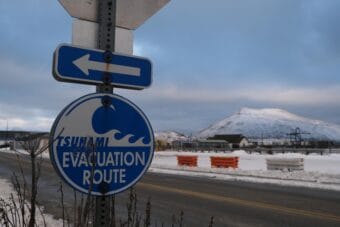
tsunami sign
A tsunami evacuation sign in Unalaska. (Kanesia McGlashan-Price/KUCB)

The Alaska Earthquake Center is in negotiations with the National Oceanic and Atmospheric Administration to restore funding for nine seismic stations.
In late September, NOAA advised the center it would no longer fund its real-time seismic data flow to the National Tsunami Warning Center, a service the federal organization had been funding for decades.

In a statement in mid-December, a NOAA spokesperson said the federal government was working on a “potential funding mechanism” to maintain the stations. A spokesperson for the Alaska Earthquake Center said they expect to have the funding by mid-January.

Dave Snider, tsunami warning coordinator at the National Tsunami Warning Center in Palmer, said scientists can make better decisions faster with more seismic stations. He said the speed of earthquake detection is key to tsunami detection.

“We are built for speed, so we have to do that part very quickly,” he said. “Our aim is to get that first message out within five minutes of detecting the earthquake.”

Several of the stations listed to go dark are in the Aleutians, a region where large earthquakes are very common as the Pacific plate slides beneath the North American plate.

Snider said the Aleutian seismic stations matter most for nearby coastal communities, where every minute counts when detecting a tsunami.

“For a really strong nearby quake, if there’s one that’s happening right along your coastline, it could be immediate,” said Snider.

He said how quickly a tsunami could hit a community depends on the earthquake’s strength, depth and exact location.

Snider said losing the nine seismic stations in the Aleutians could delay earthquake detection by up to a minute.

“Earthquake signals travel out and away from that epicenter really quickly,” he said. “So even if there’s, you know, one sensor is out in your community, there’s going to be another one behind it and another one behind that.”

One of the nine seismic stations at risk of shutting down is in Unalaska, a city of more than 4,000 people, that sits right along the coast, facing the Bering Sea.

Ben Knowles, Unalaska’s fire chief and director of emergency services, said funding is always an issue.

“We want good funding for these agencies that help communities like ours with early warning and early detection that’s extremely important for us,” he said.

When a large earthquake strikes near the Aleutian region, Knowles said, there’s a whole process that follows.

“The National Tsunami Warning Center has an entire center of people that are dedicated to monitoring these things,” he said. “We also partner with places like the Alaska Volcano Observatory, the Alaska Earthquake Center, the National Weather Service, and so they all work hand in hand.”

If there is a tsunami threat, Knowles said the city alerts residents through the Nixle system, social media and if necessary, sound sirens. KUCB also broadcasts emergency information on 89.7 FM and KUCB.org.

Alerts are also notified on the FEMA app, at tsunami.gov and through NOAA weather radio.

Whether the Aleutians seismic stations stay on or not, Snider is confident his team can keep communities safe. But the more seismic stations, the merrier.

“There’s always room for more data,” he said. “And any scientist would never disagree with that.”

In the meantime, the University of Alaska Fairbanks is temporarily funding the stations, so that earthquakes in the island region are detected quickly.

Third humpback whale found dead in Unalaska since October

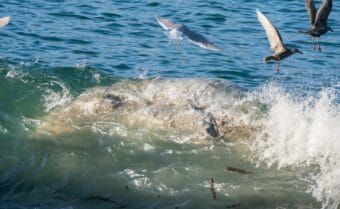
The Alaska Department of Fish and Game reported the whale in Unalaska Bay to the National Oceanic and Atmospheric Administration on Dec. 4. The Alaska Marine Mammal Stranding Network said there is no cause of death. (Photo courtesy of Ellis Berry)

A dead humpback whale was spotted in Unalaska Bay on Dec. 4, the third reported dead whale to wash up on the island since Oct. 16.

The Alaska Department of Fish and Game reported the whale to the National Oceanic and Atmospheric Administration the same day. The Alaska Marine Mammal Stranding Network said there is no cause of death.

Fish and Game staff were told to wait for better weather and for the whale to beach before trying to collect more information.

But this isn’t the only dead whale you can see in Unalaska.

The carcasses of two other dead humpbacks remain on the beach at Morris Cove after washing up Oct. 16. There is no cause of death for them either, though NOAA said one showed extensive rake marks from orcas — scratch marks left when orcas drag their teeth across another animal’s skin.
NOAA said 54 humpback whales have been reported stranded in Alaska so far this year and that multiple whales washing ashore in the same area is not unusual due to ocean currents.

Tribes and environmental groups sue to stop road planned for Alaska wildlife refuge

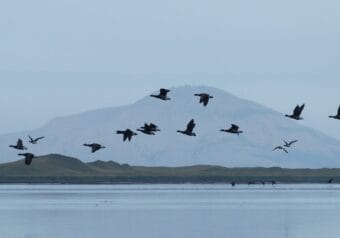
Brant fly over the water on Sept. 28, 2016, at Izembek Lagoon in Izembek National Wildlife Refuge. The refuge supports the entire Pacific population of black brant, a species of goose.
(Kristine Sowl/U.S. Fish and Wildlife Service)

Three tribal governments and several environmental groups sued the Trump administration on Wednesday to try to block a land trade that would allow a road to be built through a national wildlife refuge in southwestern Alaska.

The land swap, approved by the U.S. Department of the Interior last month, would open up a section of the Izembek National Wildlife Refuge.

Supporters argue that the road is needed to connect the community of King Cove, home to about 750 people, with a legacy military airstrip that can accommodate jets. That would give King Cove’s residents access to safer medical evacuations if needed. Opponents say the proposed road — to run 18.9 miles in total, most of that within what is currently refuge land — would damage world-class bird habitat that is in the heart of the refuge.

Wednesday’s challenges came in three lawsuits filed in U.S. District Court in Anchorage. All assert that the land trade and road development pose dire threats to migratory bird populations that use Izembek’s wetlands, including species with Endangered Species Act listings, and to the wider ecosystem. All say the trade and planned road violate the Alaska National Interest Lands Conservation Act and other federal laws.

The three lawsuits have their individual characteristics as well.

One of them, filed by tribal governments in the Yukon-Kuskokwim Delta villages, focuses on threats to traditional subsistence hunters who depend on the birds that use Izembek’s wetlands. The tribal plaintiffs are the Native Village of Paimiut, Native Village of Hooper Bay and Chevak Native Village.

“Izembek’s eelgrass wetlands are a lifeline for emperor geese, black brant and other birds that feed our families and connect us to Indigenous relatives across the Pacific,” Angutekaraq Estelle Thomson, traditional council president of the Native Village of Paimiut, said in a statement. “Trading away this globally important refuge for a commercial corridor devalues our lives and our children’s future. We are joining this lawsuit because defending Izembek is inseparable from defending our subsistence rights, our food security and our ability to remain Yup’ik on our own lands.”

The Center for Biological Diversity, an environmental organization, is also a plaintiff in the case.

A second lawsuit, filed by Friends of Alaska National Wildlife Refuges, Wilderness Watch, the Alaska Wilderness League and the Sierra Club, puts a special focus on the process used to achieve the land swap and what it may mean for all wildlife refuges.

“Trading the ownership of refuge lands that Congress designated for conservation is a terrible precedent for the privatization of public lands. Building a road will have tremendous impacts on fish and wildlife habitat and could also greatly increase both disturbance and sport hunting pressure on vulnerable species,” Marilyn Sigman, president of Friends of Alaska National Wildlife Refuges, said in a statement.

The third complaint, filed by Defenders of Wildlife, puts a focus on the wider environmental impacts.

Green eelgrass appears at low tide in the vast wetlands of Izembek Lagoon, at the edge of Izembek Refuge. (Kristine Sowl/USFWS)

The planned road enabled by the land trade would “result in incalculable and irreversible damage” to myriad wildlife species, including marine and land mammals as well as migratory birds, that lawsuit says. The lawsuit alleges that the land deal violates both the National Wildlife Refuge System Improvement Act and the federal Wilderness Act.

“Under the Trump administration, the Interior Secretary entered into an illegal deal done in the darkness of a government shutdown: a sellout of one of our country’s largest and most pristine wildlife refuges and wilderness areas,” Jane Davenport, a senior attorney in Defenders of Wildlife’s Biodiversity Law Center, said in a statement. “Our treasured public conservation lands belong to all Americans. Defenders of Wildlife will stand up in court to hold this administration to account for recklessly and unlawfully trading them away.”

The Izembek Lagoon area, where the road is planned, holds the largest single stand of eelgrass in the world and the largest bed of seagrass along the North American Pacific Coast, according to the U.S. Fish and Wildlife Service. The entire Pacific population of black brant, a type of goose, uses the refuge’s lagoon area, feeding on the eelgrass. The refuge and its eelgrass support several other bird and mammal species; about half the world’s emperor geese use the refuge as a migratory stopover, according to biologists.

A Department of the Interior spokesperson declined to comment Wednesday on the lawsuits.

Last month, however, Interior Secretary Doug Burgum touted the land exchange and planned road as long overdue.

He spoke about the project during an event called “Alaska Day,” a gathering in Washington with Gov. Mike Dunleavy and the state’s three-member congressional delegation. The Izembek land exchange was one of the pro-development Alaska actions announced at the event.

“It just seems preposterous to me that somehow, it’s taken 40 years for us to put people first,” Burgum said at the event. “Because I know one thing as a governor of a state: You can actually do things like build 18 miles of gravel road and still take great care of wildlife.” Burgum was North Dakota’s governor before being appointed as Interior secretary.

The land trade he approved would convey a little less than 500 acres of refuge land, most of it designated wilderness, to the Native-owned King Cove Corp. The corporation would give 1,739 acres of its land to the U.S. Fish and Wildlife Service to be added to the refuge, and the federal government would also pay the corporation for the land.

The idea of a road linking King Cove to the World War II-era military runway at Cold Bay dates back decades. The legal and political battle over the proposal has also been long. Some of the plaintiffs in the new cases were plaintiffs in previous lawsuits over proposed land trades. The dispute was being considered by the 9th Circuit Court of Appeals, but that court in 2023 determined that the case was moot and dismissed it because the Biden administration was not pursuing the plan endorsed by the first Trump administration.

Green eelgrass appears at low tide in the vast wetlands of Izembek Lagoon, at the edge of Izembek Refuge. (Kristine Sowl/USFWS)

Alaska crab fishery shows signs of recovery after massive crash

Fish and Game says survey results show increases in all sex and size groups of snow crab compared to last year. Large males remain at historic lows, but the population is showing signs of stabilization and recovery after the recent collapse.
Fish and Game says survey results show increases in all sex and size groups of snow crab compared to last year. Large males remain at historic lows, but the population is showing signs of stabilization and recovery after the recent collapse. (Laura Kraegel/KUCB)

Bering Sea crabbers will see a boost in catch limits this season, after years of cancellations and small harvests due to low snow and king crab stocks.

The Alaska Department of Fish and Game announced Monday that it’s nearly doubling the harvest for the upcoming Bering Sea snow crab commercial fishing season from last year’s totals.

Fish and Game set the cap at 9.3 million pounds. That’s a low number compared to historic levels. In 1991, crabbers harvested more than 320 million pounds of snow crab.

The catch limit was set at 45 million pounds back in 2020, the year before the snow crab stock crashed. And the next year, the fishery closed for two seasons after more than 10 billion snow crabs disappeared from the region.

Researchers blamed warming waters from climate change for the crash.

Fish and Game now says survey results show increases in all sex and size groups compared to last year. Large males remain at historic lows, but the population is showing signs of stabilization and recovery after the recent collapse.

Officials said a return to colder ocean conditions and increased numbers, especially in juvenile crab, are reasons to be optimistic.

And for the first time, a portion of the harvest will be reserved for a hybrid snow-tanner crab. Those are crabs that share some characteristics of both snow and tanner crabs, like eye color and tooth shape.

Regulators said recent surveys show an “unprecedented” amount of the hybrid crab. To incentivize harvest of them, Fish and Game designated about 11% of the total snow crab catch to the snow-tanner mix. According to officials, the fleet will be encouraged to harvest about a million pounds of the hybrids from the “hybrid grounds.”

Meanwhile, Fish and Game also boosted the Bristol Bay red king crab catch limit by about 16% from last year, with a total harvest of about 2.7 million pounds. Tanner crab harvests more than doubled for the western district of the Bering Sea but dropped by almost 40% for the eastern area.

All of those fisheries open Oct. 15. The lucrative Bristol Bay red king crab has the highest priority harvest, as that fishery closes shortly after the new year. Snow and tanner crab both close in the spring.

Six years after fatal Unalaska plane crash, jury finds PenAir liable for nearly $17 million

PenAir's Saab 2000 airplane landed in Unalaska almost exactly six years ago, on Thursday, Oct. 17, 2019, <a href="https://www.kucb.org/regional/2019-10-17/ntsb-arrives-in-unalaska-to-investigate-fatal-crash-city-aims-to-move-damaged-plane-on-saturday"target="_blank"   >overrunning the short runway</a> and sliding into ballast rocks overhanging the harbor.
PenAir’s Saab 2000 airplane landed in Unalaska almost exactly six years ago, on Thursday, Oct. 17, 2019, overrunning the short runway and sliding into ballast rocks overhanging the harbor. (Courtesy of Megan Dean)

A Washington state jury awarded $16.9 million to the family of a man who died in a 2019 airplane crash on Unalaska’s runway.

After a six-week trial and about three days of deliberation at a Kent, Washington courthouse, jurors found Peninsula Aviation Services, Inc. liable for the death of David Oltman of Washington.

Miller, Weisbrod, Olesky, Attorneys at Law — the Texas-based firm representing Oltman — said the case marks the nation’s first fatal commercial airline crash trial in more than a quarter of a century.

PenAir’s Saab 2000 airplane with about 40 passengers, including 38-year-old Oltman landed in Unalaska almost exactly six years ago, overrunning the short runway and sliding into ballast rocks overhanging the harbor.

Shrapnel from a propeller flew into the cabin, fatally wounding Oltman. Nine others were injured. Oltman was traveling from his home in Wenatchee, Washington to Unalaska and purchased his flights through Alaska Airlines.

After a two-year investigation by the National Transportation Safety Board, investigators found faulty wiring, lax oversight by regulators and inexperienced crew to blame. Specifically, officials said the probable cause of the accident was bad wiring of an antiskid brake system that likely sent the plane over the runway, and happened during a previous overhaul.

According to the report, PenAir’s flight crew knew a significant tailwind was present at the time, and a landing in the opposite direction of the flight crew’s approach that day would have favored the wind pattern.

Now, a jury says the company that provided the overhaul and cross-wired the brakes is partially responsible for the incident, but PenAir is mostly at fault and owes the family for their negligence, according to the firm’s press release.

Site notifications
Update notification options
Subscribe to notifications