KUCB - Unalaska

KUCB is our partner station in Unalaska. KTOO collaborates with partners across the state to cover important news and to share stories with our audiences.
Newly proposed legislation aims to curb Alaska bycatch

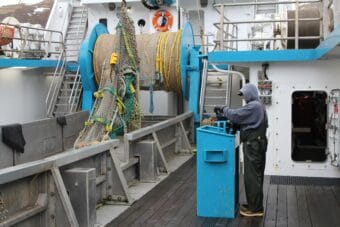
A crewmember on the fishing vessel Progress wraps up the 2025 pollock season in Unalaska. A storm caused millions of dollars in damage to the 130-foot trawler during the 2018 fishing season. Those kinds of incidents are rare, thanks in part to NOAA's marine forecast service.
The proposed legislation would establish a fund for fishermen to purchase updated technology and trawl gear to limit seafloor contact and bycatch. (Theo Greenly/KUCB)

Alaska’s congressional delegation introduced legislation Wednesday that aims to reduce bycatch in parts of southwest Alaska using better marine data, technology and gear.
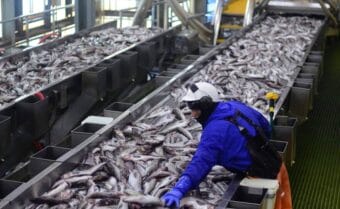
The Bycatch Reduction and Research Act, introduced by U.S. Sens. Dan Sullivan, Lisa Murkowski and Congressman Nick Begich, would address research gaps in environmental data and improve monitoring of fisheries in the Bering Sea, Aleutian Islands and Gulf of Alaska. It would also establish a fund for fishermen to purchase updated technology and trawl gear to limit seafloor contact and bycatch. That’s when harvesters accidentally catch species they’re not targeting.

The proposed legislation builds on recommendations from the federal Alaska Salmon Research Task Force, which concluded in 2024 and aimed to better understand how humans cause declines in fish and crab species, including through factors like bycatch.

The legislation would revive the salmon task force under the new name of the Bycatch Reduction and Research Task Force. The group would review National Oceanic and Atmospheric Administration research on Alaska salmon and trawl gear impacts on the seafloor, and provide recommendations for future research.

“In recent years, Alaskans have witnessed unprecedented declines among some fish and crab species in parts of the state while, in other parts, runs have been strong and historic,” Sullivan said in a press release. “We need to get to the bottom of all potential causes of this increased variability, including concerns about bycatch and trawl gear habitat impacts, to strengthen the sustainability of our fisheries.”

For years, fisheries stakeholders have debated if and how fishing gear types, especially trawl gear, impacts marine species and seafloor habitats. Conservation and tribal groups and various stakeholders have pushed fisheries managers to take stronger action on limiting both bycatch and seafloor contact in trawling.

Representatives in the trawl industry have supported stricter regulations around bycatch, but also cautioned that more extreme limitations could be burdensome to the massive pollock industry, which is a major economic driver to some Western Alaska communities, including Unalaska.

The regional council that manages Alaska’s federal fisheries will discuss chum salmon bycatch management at its upcoming meeting in early February.

The proposed legislation still has to pass both the Senate and House before it would go to the president to be signed into law.

Alaska pollock processors drop foreign worker program, citing uncertainty

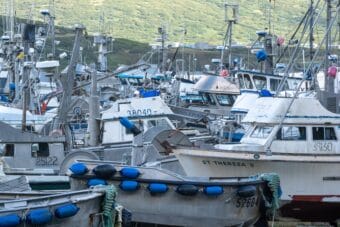
The UniSea processing plant in Unalaska in Jan. 2019. (Berett Wilber/KUCB)

Some of Alaska’s largest pollock processors are abandoning a foreign worker visa program that once supplied up to half their workforce, citing rising costs and uncertainty under stricter immigration policies.
Tom Enlow is the president and CEO of UniSea Seafoods, Unalaska’s largest seafood processor. He said the company is moving away from the H-2B visas to save money on an inconsistent system.

“The H-2B program, I think was good for Alaska at a time when we really needed them, you know, during the pandemic, and little bit pre-pandemic, but really it’s cost prohibitive to bring workers all the way from Eastern Europe to Alaska,” Enlow said.

The H-2B visa program allows employers to bring foreign workers to the U.S. to fill temporary non-agricultural jobs during shortages. The visas can be difficult to obtain. Companies have to first show they can’t fill the jobs, then they have to apply, and then the U.S. Department of Homeland Security and the U.S. Department of Labor issue the visas through a lottery system.

Enlow said the processing plant moved back to a 100% domestic workforce this summer and will do the same for the upcoming “A” season — a major pollock season that starts later this month and brings thousands of workers to Dutch Harbor.

The main reason for that is cost. He said the Trump administration’s approach to hiring foreign workers has also made a difficult and expensive process even more complicated.

“It doesn’t make for good planning for processors, when you are bringing 200 or 300 people in from Eastern Europe and you don’t know for sure if you’re going to get supplemental visas, if [they’re] going to get approved in time, if they’re going to be in Alaska when you need them, when the season’s started,” he said.

UniSea started participating in the H-2B program in 2019, and prior to that, the company employed 100% U.S. domestic workers, according to Enlow. Some of those were green card holders or permanent residents, living in the U.S. — most from the Philippines.

When the company was actively using the special visas, as many as half of UniSea’s workers were foreign.

The company still employs a handful of Ukrainian employees who were hired through a special program designed to help those who were displaced from the Russian invasion, and will continue to work for the processor, Enlow said.

“They’re not bound by some of the rules and restrictions of the H-2B program,” he said. “They can stay extended periods of time. They can work full time, year round, they don’t have to be necessarily processors. They can work in other jobs, in other areas.”

UniSea isn’t the only regional processor filling jobs with American workers. Trident Seafoods — one of the largest seafood processors in the nation — said it employs almost an exclusively domestic workforce.

A spokesperson for the company said the processor — which has facilities across Alaska, from the Aleutians to Southeast and Bristol Bay — has been moving away from the H-2B program since 2023, in an attempt to strengthen long-term, local employment.

Westward Seafoods, another shore-based processor in Unalaska, would not provide information on employment data.

Alaska: the ‘poster child for foreign labor’

Brian Gannon is the vice president of global partnerships for LaborMex, a Texas-based company that helps connect U.S. businesses with foreign nationals for temporary or seasonal work. He said when it comes to handling and packaging Alaska’s massive seafood exports, especially for cod and pollock, the state has a very small local employment pool to work with.

“For 100 years, people have been coming from somewhere else to process fish in Alaska,” Gannon said.

Processing fish involves long hours, and often tough, repetitive and pungent work. Considering there is an entire area of plants often referred to as the “slimeline,” it can be difficult to fill those jobs.

Gannon, who started his career as a guest worker from Montana at a processing plant in Chignik in 1990, said despite the lackluster appeal of processing work, Alaska has done a good job attracting seasonal workers from afar.

“Alaska is really a poster child for foreign labor, in as much as the oil industry and forestry and mineral extraction and seafood production, etc., in Alaska for 150 years, [has] been built on a small amount of available local labor and a large amount of labor coming from somewhere else,” he said.

The Alaska Department of Labor found that in 2023 the state’s seafood industry employed nearly 22,000 workers, roughly 83% of which were nonresidents of the state. That year, the Alaska pollock industry directly employed over 8,000 workers, according to a report from Northern Economics on the contributions of the state’s pollock industry. Most were workers from the U.S., roughly 31% from Alaska, and about 12% were residents of other countries.

H-2B visa program helps fill employment gaps

Gannon said about 10 years ago, the seafood industry’s domestic workforce started to run dry. The industry’s pool of seasonal workers wasn’t replenishing. And that was especially challenging for cod and pollock processing, which unlike salmon, for example, don’t have peak seasons in the summer. He said salmon can have an advantage because it’s a summer fishery, and people sometimes have that season off. Ultimately, Gannon said companies just couldn’t match the shortfalls.

“And that’s where that H-2B visa came in quite handy,” he said.

The H-2B visas weren’t really used in Alaska’s seafood industry until about 12 years ago, according to Gannon. Congress currently doles out 66,000 for the entire fiscal year, and Gannon said they can get about 250,000 requests. Congress sometimes approves special increases for those visas.

Within the pollock processing industry, the program has been used among all sectors of processors. However, the catcher-processor fleet — that processes at sea — is required by law to employ 75% American citizens and green card holders. According to officials in the industry, they’ve never made any significant use of the H-2B program.

For a while the visas, while complicated to obtain, worked well. But Gannon said over the past several years a lot has changed in the pollock industry.

Changes in the industry spark a return to domestic labor 

“So many things have upended the apple cart, and the pollock processors are not necessarily producing as much,” he said.

Gannon said things like the COVID-19 pandemic, the war in Ukraine, changes in the nation’s political dynamics and competition from China and Russia have made it hard for pollock processors to make ends meet.

Gannon said Alaska seafood companies also likely had trouble matching the prevailing wage requirements for H-2B visa holders, which he said had surpassed Alaska’s minimum wage at one point. He said the Department of Labor sets those wages, and they have to be matched or exceeded for all processors at the plant.

The seafood industry in general has also seen increases in processing costs, wages, energy prices, as well as drops in sale prices for every major species group in 2023, according to the National Oceanic and Atmospheric Administration.

Enlow said UniSea won’t be saving much, if any, money right away by switching back to an American workforce, because he’s expecting a high attrition rate.

“And so you’re going to need to hire more and bring up more people than you actually would need over time, because you’re going to lose some of those workers,” he said.

But Enlow said that should eventually be offset by avoiding uncertainties around international travel and immigration concerns.

Negotiations underway to keep Aleutian seismic stations online

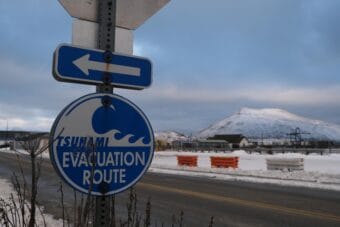
tsunami sign
A tsunami evacuation sign in Unalaska. (Kanesia McGlashan-Price/KUCB)

The Alaska Earthquake Center is in negotiations with the National Oceanic and Atmospheric Administration to restore funding for nine seismic stations.
In late September, NOAA advised the center it would no longer fund its real-time seismic data flow to the National Tsunami Warning Center, a service the federal organization had been funding for decades.

In a statement in mid-December, a NOAA spokesperson said the federal government was working on a “potential funding mechanism” to maintain the stations. A spokesperson for the Alaska Earthquake Center said they expect to have the funding by mid-January.

Dave Snider, tsunami warning coordinator at the National Tsunami Warning Center in Palmer, said scientists can make better decisions faster with more seismic stations. He said the speed of earthquake detection is key to tsunami detection.

“We are built for speed, so we have to do that part very quickly,” he said. “Our aim is to get that first message out within five minutes of detecting the earthquake.”

Several of the stations listed to go dark are in the Aleutians, a region where large earthquakes are very common as the Pacific plate slides beneath the North American plate.

Snider said the Aleutian seismic stations matter most for nearby coastal communities, where every minute counts when detecting a tsunami.

“For a really strong nearby quake, if there’s one that’s happening right along your coastline, it could be immediate,” said Snider.

He said how quickly a tsunami could hit a community depends on the earthquake’s strength, depth and exact location.

Snider said losing the nine seismic stations in the Aleutians could delay earthquake detection by up to a minute.

“Earthquake signals travel out and away from that epicenter really quickly,” he said. “So even if there’s, you know, one sensor is out in your community, there’s going to be another one behind it and another one behind that.”

One of the nine seismic stations at risk of shutting down is in Unalaska, a city of more than 4,000 people, that sits right along the coast, facing the Bering Sea.

Ben Knowles, Unalaska’s fire chief and director of emergency services, said funding is always an issue.

“We want good funding for these agencies that help communities like ours with early warning and early detection that’s extremely important for us,” he said.

When a large earthquake strikes near the Aleutian region, Knowles said, there’s a whole process that follows.

“The National Tsunami Warning Center has an entire center of people that are dedicated to monitoring these things,” he said. “We also partner with places like the Alaska Volcano Observatory, the Alaska Earthquake Center, the National Weather Service, and so they all work hand in hand.”

If there is a tsunami threat, Knowles said the city alerts residents through the Nixle system, social media and if necessary, sound sirens. KUCB also broadcasts emergency information on 89.7 FM and KUCB.org.

Alerts are also notified on the FEMA app, at tsunami.gov and through NOAA weather radio.

Whether the Aleutians seismic stations stay on or not, Snider is confident his team can keep communities safe. But the more seismic stations, the merrier.

“There’s always room for more data,” he said. “And any scientist would never disagree with that.”

In the meantime, the University of Alaska Fairbanks is temporarily funding the stations, so that earthquakes in the island region are detected quickly.

State begins permitting process to build Izembek road

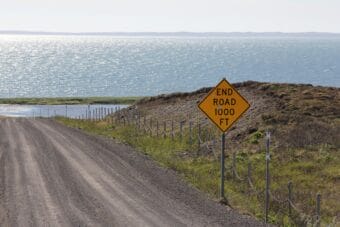
The end of the road leading out of King Cove. June 2024
The end of the road leading out of King Cove. June 2024 (Theo Greenly/KUCB)

A controversial stretch of road connecting two Eastern Aleutian communities is heading toward construction.

The Alaska Department of Transportation has applied for a U.S. Army Corps of Engineers permit to build the road and is taking public comments on the proposed work until Jan. 12.

The 19-mile road would pass through the Izembek National Wildlife Refuge, connecting King Cove residents to nearby Cold Bay. King Cove community leaders say the single-lane, unpaved road could provide life-saving access to Cold Bay’s all-weather airport, but conservation groups have fought the proposal for decades.

In October, federal officials announced a land exchange agreement with the King Cove Corp. to facilitate the road. That wasn’t the first time a swap agreement had been approved, but local leaders said it was the first time the land had actually switched ownership into the hands of the for-profit Native corporation.

The refuge will swap 490 acres of land for the road, in exchange for about 1,700 acres of the corporation’s land. According to the permit, King Cove Corp. also relinquished its selection rights under the Alaska Native Claims Settlement Act to 5,430 acres of land within the Izembek Refuge, which means it gave up its legal ability to select those parcels under ANCSA in return for the agreed land exchange.

Several environmental groups and dozens of Alaska tribes have called for the road to be stopped. They say the refuge shouldn’t be developed because it would threaten wildlife, some of which are precious subsistence resources for communities across the state.

Subsistence is also part of King Cove’s argument in favor of the road. The tribal government says the road would help them access their own subsistence lands, much of which is inaccessible except by boat.

According to the Corps, the road would cross numerous streams, some of which are home to spawning salmon. The project area also covers the habitat of endangered and threatened species, like the Steller’s eider and the short-tailed albatross.

The corps will consult with various organizations, including the U.S. Fish and Wildlife Service, the State Historic Preservation Office and federal tribes before issuing permits. They are also accepting public comments during the application process.

Comments can be submitted via email or sent to the Army Corps field office in Fairbanks. You can find more information on the Army Corp’s website.

Federal shutdown disrupts quota-setting for pollock

Trawlers like the F/T Alaska Ocean, pictured here in Dutch Harbor in 2023, will be able to catch just under 1.4 million metric tons of pollock in 2026.
Trawlers like the F/T Alaska Ocean, pictured here in Dutch Harbor in 2023, will be able to catch just under 1.4 million metric tons of pollock in 2026. (Theo Greenly | KUCB)

Last week, members of the body that oversees federal fisheries off Alaska’s coast recommended keeping next year’s catch limits for the sprawling Bering Sea pollock fishery about the same as this year.

Managing the nation’s largest commercial fishery is never simple, but North Pacific Fishery Management Council member Anne Vanderhoeven said during the meeting that this year had unprecedented challenges.

“Because of the lapse in federal funding and the subsequent government shutdown, updated stock assessments are not available,” she said.

Without those assessments, the council had to rely on older data and partial updates.

Fisheries biologist Diana Stram runs the groundfish plan team, which presents annual reports to the council. She says the team had to cancel its meeting last month when the federal government shut down for over six weeks.

And that meant the organization recommending catch limits could be doing it without the most recent information.

“We’re not able to get new stock assessments from our federal authors because they were on furlough and did not have the time to complete those new assessments,” she told the council last week. “We don’t have a groundfish plan team report as a result.”

It’s the latest hurdle for federal fisheries managers since the start of President Trump’s second term. Layoffs at the National Oceanic and Atmospheric Administration’s Alaska Fisheries Science Center started earlier this year. Many of those workers help with surveys that inform how fisheries should open. The credit cards used to purchase supplies for summer research trips were frozen just as the boats were gearing up. And the council itself saw dramatic budget reductions, leading to its last meeting being moved online.

Still, at the council meeting this month, NOAA scientists emphasized that last year’s assessment models were strong and built on decades of survey work. They told the council the projections from last year were reliable enough to guide 2026 limits.

Scientists and council members said that some quotas could have increased if this year’s data was included.

Despite the disruptions, council members said the process held together well enough to set this year’s recommendations. But they acknowledged that Alaska’s largest fishery is increasingly vulnerable to forces outside the water.

Third humpback whale found dead in Unalaska since October

The Alaska Department of Fish and Game reported the whale in Unalaska Bay to the National Oceanic and Atmospheric Administration on Dec. 4. The Alaska Marine Mammal Stranding Network said there is no cause of death. (Photo courtesy of Ellis Berry)

A dead humpback whale was spotted in Unalaska Bay on Dec. 4, the third reported dead whale to wash up on the island since Oct. 16.

The Alaska Department of Fish and Game reported the whale to the National Oceanic and Atmospheric Administration the same day. The Alaska Marine Mammal Stranding Network said there is no cause of death.

Fish and Game staff were told to wait for better weather and for the whale to beach before trying to collect more information.

But this isn’t the only dead whale you can see in Unalaska.

The carcasses of two other dead humpbacks remain on the beach at Morris Cove after washing up Oct. 16. There is no cause of death for them either, though NOAA said one showed extensive rake marks from orcas — scratch marks left when orcas drag their teeth across another animal’s skin.

NOAA said 54 humpback whales have been reported stranded in Alaska so far this year and that multiple whales washing ashore in the same area is not unusual due to ocean currents.

Site notifications
Update notification options
Subscribe to notifications