KUCB - Unalaska

KUCB is our partner station in Unalaska. KTOO collaborates with partners across the state to cover important news and to share stories with our audiences.

North Pole Council urges water-system expansion to help Moose Creek deal with tainted groundwater

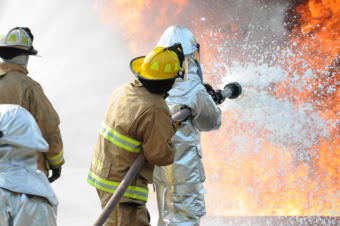
U.S. Air Force and New Jersey state fire protection specialists from the New Jersey Air National Guard's 177th Fighter Wing battle a simulated aircraft fire with Aqueous Film Forming Foam at Military Sealift Command Training Center East in Freehold, N.J. on June 12. Firefighters can spray the foam across the fire blanketing it so the oxygen is cut off and the fire is smothered. Airmen from the Wing hold annual training here to maintain mission readiness. (U.S. Air National Guard photo by Airman 1st Class Amber Powell/Released)
U.S. Air Force and New Jersey state fire protection specialists from the New Jersey Air National Guard’s 177th Fighter Wing battle a simulated aircraft fire with Aqueous Film Forming Foam at Military Sealift Command Training Center East in Freehold, N.J. on June 12. (U.S. Air National Guard photo by Airman 1st Class Amber Powell/Released)

Officials with the Air Force and other agencies are asking members of the public to weigh in on several proposals to provide drinking water to Moose Creek residents who can’t use their wells because of groundwater contamination.
The pollution came from Eielson Air Force Base’s use of firefighting foam in years past.

North Pole City Council members made it clear Monday that they believe expanding their municipal water system to Moose Creek is the best alternative.

The North Pole City Council unanimously passed a resolution in Monday’s meeting stating its support for expanding the city’s water system to Moose Creek.

Mayor Bryce Ward said it’s the best long-term solution to providing drinking water to the community.

“We just wanted to let (the) Air Force know that if this is something that the community is interested in, the city could be a viable option,” Ward said.

Ward said expanding the water system is the best of seven alternatives outlined in an Air Force study of the groundwater contamination that’s spread from nearby Eielson Air Force Base.

The study, which will be presented in a town hall meeting at the Moose Creek Fire Station, includes other alternatives, such as setting up tanks or water-filtration systems at each residence or business affected by the contamination.

“Y’know, (over) the period of 30 years, that water delivery or the maintenance of a water-treatment filter system is quite a bit higher and quite comparable (cost), if you will, to that of a water system,” Ward said.

The Air Force’s Interim Feasibility Study estimates to expand the system about four miles south to Moose Creek and maintain it over 30 years will cost $34 million to $40 million.

Ward says that’ll provide water to 169 parcels in the area where two types of perfluorinated compounds have been found in groundwater at levels that could harm human health.

“Although it is not necessarily the cheapest option, it provides the least amount of liability to those involved and affected, and the greatest security over that 30-year period and even longer,” Ward said.

The Air Force will pay the estimated $25.3 million to build the system, Monte Garroutte said.

He manages the state Department of Environmental Conservation’s Eielson contamination-remediation project.

“The infrastructure and all that – yes, they’ll definitely be paying for that,” Garroutte said.

Garroutte said the federal government probably will not pay for maintenance and operation of the expanded water system.

He said once the Air Force and community come to an agreement on a drinking-water solution, the agency will then focus on cleaning up the contamination.

“We still have to go through all the investigation and the feasibility study for the remediation as well, to determine what the possible solutions are,” Garroutte said.

Ward said North Pole knows quite a bit about that process, because for years it’s had to deal with a bigger groundwater-contamination problem caused the leakage of sulfolane, an industrial solvent, from the Flint Hills refinery, which the company shut down in 2015.

Ward said the city hopes to hire a contractor this year that, if all goes well, will begin work in the spring on a larger water-system expansion project for homes and business affected by the sulfolane contamination.

That project is estimated to cost nearly $100 million, 80 percent of which will be paid-for by Flint Hills.

The mayor said adding the second expansion to Moose Creek would enable the city to take advantage of the economies of scale that would result from both projects.

Survivors look back on the Japanese bombing of Unalaska 75 years ago

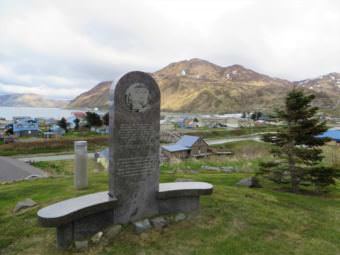
A memorial overlooking downtown Unalaska is dedicated to the Unangax who were forcibly evacuated during WWII and the Aleutian villages that were never resettled. (Photo by Laura Kraegel/KUCB)
A memorial overlooking downtown Unalaska is dedicated to the Unangax who were forcibly evacuated during World War II and the Aleutian villages that were never resettled. (Photo by Laura Kraegel/KUCB)

Japan bombed Unalaska 75 years ago, killing more than 40 Americans and triggering the evacuation of hundreds.

In the aftermath, many Aleutian residents survived. But the number is dwindling as decades pass.

Forty-three veterans and evacuees are gathering in Unalaska this weekend to commemorate the events of World War II.
The attack on Dutch Harbor turned the Aleutian Islands into a war zone.

While the military dug in and fought the Japanese, the region’s Native residents were forcibly evacuated by the U.S. government.

Organizers say they’ve planned a commemoration that honors both halves of that painful history.

Planning committee member Janice Krukoff said the two groups may have had different experiences of World War II, but marking the anniversary is really about one thing.

“Being able to see the veterans and the evacuees come together, it’s a long time in the making,” Krukoff said. “Continue moving forward in a positive way, our story never to be forgotten.”

That story is personal and urgent for Krukoff. Her parents were among the 881 Unangan people taken from their homes and sent to internment camps in Southeast Alaska.

They survived, despite the crowded conditions and meager supplies. But not everyone was so fortunate.

Krukoff said she’s approaching this weekend as a chance to recognize the Unangax who died during the war — and to learn from those still living today.

“The majority of them are elderly now,” Krukoff said. “This may be the last hosting of something of this magnitude.”

Time also is passing quickly for veterans of the Aleutian campaign.

Only eight servicemen are making the trip to Unalaska.

Historian Jeff Dickrell said that’s far fewer than the last major anniversary.

“For the 50th, there were probably 100 veterans,” Dickrell said.

This weekend, Dickrell will tell the story of the Japanese attack in detail, with help from visiting veterans.

Their talk is just one part of a packed agenda that includes storytelling sessions, memorial services and historic flyovers.

Those won’t feature the Japanese fighter planes that flew over Unalaska during the 50th anniversary. Dickrell said that sight was too intense for many who lived through the real thing.

“Everybody just fell silent,” Dickrell said. “We all realized that it was kind of a dichotomy of cool history, but also you’re replicating the deaths of Americans and war.”

This time around, pilots are sticking with North American military aircraft — an amphibious Grumman Goose and a bright yellow T-6 Texan.

The commemoration started Friday and continues all weekend.

Alaska Highway 75th anniversary: A tribute to veterans who helped build ‘road to civil rights’

Alaskans will celebrate the 75th anniversary this year of the Alaska Highway. Organizers of those celebrations plan to include tributes to the African-American soldiers who helped carve the road out of rugged wilderness.
A roomful of people at the Greater Fairbanks Chamber of Commerce meeting got to meet one of the soldiers Tuesday.

Leonard Larkins was sent to Alaska with about 1,200 other black troops in the segregated 93rd Engineer Regiment soon after he joined the Army in 1942. (Photo courtesy of Larkins Collection, Leonard Larkins)
Leonard Larkins was sent to Alaska with about 1,200 other black troops in the segregated 93rd Engineer Regiment soon after he joined the Army in 1942.
(Photo courtesy of Larkins Collection, Leonard Larkins)

Leonard Larkins was a skinny 21-year-old buck private from Louisiana when he arrived in Skagway in May 1942, along with about 1,200 other black soldiers with the Army’s segregated 93rd  Engineer Regiment.

Those soldiers were part of a force of more than 10,000 U.S. soldiers who hacked their way through wilderness to build a 1,500-mile overland supply route to help defend Alaska from attack by Japan.

The 93rd worked on the road until it was completed in October 1942, and then they had the pleasure of spending the winter in Interior Alaska in tents,” said Meadow Bailey, a state Transportation Department spokeswoman who introduced Larkins in a talk she gave on the Alaska Highway during Tuesday’s chamber meeting at the Carlson Center.

“They worked on the road until it was complete, and then they were sent to the Aleutian Islands because of that threat from the Japanese,” she said. “Leonard remained in the Aleutian Islands for the rest of World War II.”

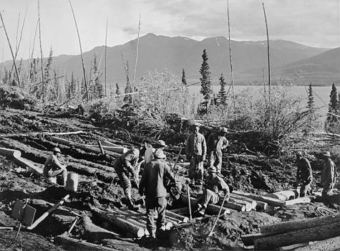
Black soldiers serving in the Army's segregated units often didn't have enough heavy equipment, so they had to work with hand tools and their ingenuity for such tasks as building "corduroy roads" with logs to stabilize the roadway through boggy muskeg areas. (Photo courtesy National Film Board of Canada)
Black soldiers serving in the Army’s segregated units often didn’t have enough heavy equipment, so they had to work with hand tools and their ingenuity for such tasks as building “corduroy roads” with logs to stabilize the roadway through boggy muskeg areas. (Photo courtesy National Film Board of Canada)

Historians say despite harsh treatment and lack of equipment, the 3,500 or so black soldiers in four segregated Army units excelled in their work on the highway, a project some say rivaled the Panama Canal.

“According to historian Douglas Brinkley, the Alaska Highway was not only the greatest engineering feat of the Second World War, it was also a triumph over racism,” Bailey said.

But the black soldiers’ role in the project and its role in desegregating the military remained an historical footnote until recent years, when prominent national leaders such as former Sen. Ted Stevens and former Secretary of State Colin Powell began to insist the soldiers be given their due.

“The achievements of these soldiers set the stage for the desegregation of the armed forces in 1948,” Bailey said, “and thus earned the Alaska Highway that distinguished nickname of being the road to civil rights.”

Leonard Larkins talks with reporters after Tuesday's chamber meeting, as program presenter Meadow Bailey looks on. (Photo courtesy Greg Martin / Greater Fairbanks Chamber of Commerce)
Leonard Larkins talks with reporters after Tuesday’s chamber meeting, as program presenter Meadow Bailey looks on. (Photo courtesy Greg Martin / Greater Fairbanks Chamber of Commerce)

After the meeting, Larkins told reporters he didn’t have any idea that he’d be working on such an historically significant project.

The soft-spoken 97-year-old veteran says he was cutting sugar cane in Louisiana for 5 bucks a ton and enlisted in the Army to get a job that would pay better.

“At that time, about $20 a month,” he said, referring to his soldier’s salary.

Larkins said after he got out of the Army, he worked at a U.S. Public Health Service hospital in New Orleans until he retired.

And like a lot of veterans, he really didn’t talk much about his Army service, according to his son, Kirby, who along with two other brothers accompanied their father on his return trip to Alaska.

“He told me, ‘I didn’t talk to you all much about that because I tried to put that behind me – because it’s was so rough.”

But Kirby Larkins said his dad has been sharing more memories about the highway project over the past year, since he was visited and interviewed by a couple of authors who are writing a book about the project.

The Larkinses will travel to Delta Junction later this week to take part in Alaska Highway 75th anniversary celebration Saturday at Fort Greely. Then they’ll travel to Anchorage next week for more commemorative events to be held there.

Leonard Larkins will be honored in a ceremony to be held Saturday at Fort Greely’s Allen Army Airfield.

The event will include historic displays, music, food and family fun. Gates open at 10 a.m.

Magnitude 6.4 earthquake shakes near Adak

A series of earthquakes, including a strong 6.4-magnitude quake near Adak, shook the Aleutian Islands the morning of Monday, May 8, 2017.
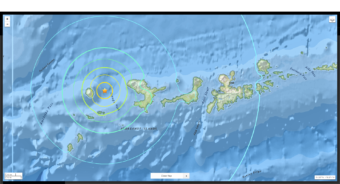
A series of earthquakes, including a strong 6.4-magnitude quake near Adak, shook the Aleutian Islands the morning of Monday, May 8, 2017. (Image courtesy U.S. Geological Survey/Alaska Earthquake Center)

A series of earthquakes shook the Aleutian Islands Monday morning, including a strong 6.4 magnitude quake near Adak.

According to the Alaska Earthquake Center, the big event struck at 9 a.m. about 80 miles west of the community, where about 350 people live.

“I would suspect that it was close enough to Adak that they should have felt it, but it’s probably not big enough to cause damage,” said seismologist Natalia Ruppert.

Ruppert said the earthquake center has since detected a flurry of aftershocks. The small events have registered magnitudes around 4.0, but the center hasn’t ruled out another large quake.

“It’s possible there will be another magnitude-6.0 earthquake,” said Ruppert. “In 2008, we actually had magnitude-6.4 and -6.6 earthquakes in the same location, just a day apart.”

While earthquakes of that magnitude aren’t unusual for the region, Ruppert said Monday’s event did strike in an uncommon spot.

“This was a shallow, coastal earthquake located underneath the island arc,” she said. “What we typically see in the Aleutian Islands is that stronger earthquakes are located south of the arc, more offshore.”

The earthquake center is continuing to monitor seismic activity in the region. Officials say there is no danger of a tsunami.

Site notifications
Update notification options
Subscribe to notifications