History

Author Ernestine Hayes says Elizabeth Peratrovich’s advocacy work isn’t over

Crystal Worl’s Elizabeth Peratrovich mural in downtown Juneau on Friday, Feb. 13, 2026. (Photo by Clarise Larson/KTOO)

Monday is Elizabeth Peratrovich Day, an Alaska State holiday honoring a Lingít activist who testified before Alaska’s territorial legislature in Juneau to demand civil rights for Alaska Native people.  
In the 1940s, the Alaska Native Brotherhood and Sisterhood began petitioning Alaska’s territorial governor for civil rights protection. That included equal access to public facilities and services, banning racial discrimination in businesses open to the public, and no more signs that said things like “No dogs, no Natives.”

Elizabeth Peratrovich Day marks the anniversary of the Alaska Anti-Discrimination Act passed in 1945. It was the first anti-discrimination act to become law in any state or territory in the United States and came years before the Civil Rights Movement gained momentum.

Lingít author Shaankaláx̱t’ Ernestine Hayes said Peratrovich and her legacy inspire her, especially as she reads the news today. 

“Not only are we facing the same challenges as she faced,” she said. “But we have her as a model, and if we stop and consider ‘what would she be doing right now, today?’ then we can use her example as the choices we should make.”

Hayes has written two memoirs, chronicling her life in and out of Southeast Alaska in the wake of Peratrovich’s advocacy.

She was selected as Alaska State Writer Laureate in 2016. In 2021, she was named the Rasmuson Foundation’s Distinguished Artist. Two years later, she was awarded a United States Artists fellowship.

One way Hayes thinks we can embody Peratrovich’s mission today: making sure that Alaska Native people continue to have a seat at decision-making tables. 

“We need to ask ‘Has that discrimination that Elizabeth Peratrovich fought, has it just moved out of the restaurants and into the boardroom and into the organizing committees?’” she said.

And Hayes said Peratrovich’s fight against discrimination isn’t over – especially when it comes to pointing the mirror at ourselves.

“If we speak out, demonstrate against or protest against an administration that, as policy, is trying to destroy diversity and inclusion,” she said. “Then we really should be modeling that ourselves.” 

She said having a state holiday to celebrate Peratrovich’s advocacy is a step toward deeper and more meaningful acknowledgement of the role Alaska Native people have had and continue to have in shaping our community. 

“It’s certainly not our ultimate goal, which is inclusion, but I think it’s a good step, as long as we always remember there’s no real final step in nurturing our values,” Hayes said. “There’s always more to do.”

Peratrovich’s testimony is often credited with swaying the territorial legislature. Though no audio recording of her actual testimony exists, a version of it for kids has been memorialized in an episode of the PBS Kids show “Molly of Denali.”

A voice for change: Remembering Marlene Johnson, a pioneer in the fight for Native rights

Marlene Johnson (middle) seated between Sealaska Heritage Institute President Rosita Worl (left) and Byron Mallott, former Sealaska CEO.
Marlene Johnson (middle) seated between Sealaska Heritage Institute President Rosita Worl (left) and Byron Mallott, former Sealaska CEO. (Sealaska Heritage Institute)

Those who knew and loved Marlene Johnson say she was in constant motion — either behind the scenes, or on the forefront of the major issues that have shaped life for Alaska Natives for more than 60 years.

The Lingít leader died on Jan. 25 at the age of 90.

Early family photo of Marlene Johnson. (Courtesy of Vera Starbard.)

“People don’t realize how different Alaska would be without her, certainly Alaska Native lives,” said Vera Starbard, Johnson’s granddaughter, known for her poetry and as a screenwriter for national programs like the PBS hit series Molly of Denali and the TV drama, Alaska Daily.

Starbard says her grandmother sent her a steady stream of job leads, a sign that she found her chosen career to be too quiet and sedentary. Yet it has given Starbard plenty of time to reflect on her grandmother, enough to begin work on a play about how she became a voice for change.

Advocacy for ANCSA

Johnson’s role in the passage of the Alaska Native Claims Settlement Act is one of her biggest legacies. Today, ANCSA remains the nation’s largest land claims settlement in history – legislation she helped to steer through Congress during the 1960s, legislation that changed Alaska forever.

It wasn’t an easy time to be a Native in politics, or a woman.

“The men had the voice. They were out front, and they were the speakers,” Irene Rowan said. “But somehow, Marlene became a voice among all those men. I often wondered, how did she do it?”

Back then, Rowan worked for the federal government and became part of an ANCSA support group called “Alaskans on the Potomac.”

As a woman trying to navigate a male-dominated world, Johnson was an inspiration, said Rowan. “She was royalty. People looked up to her. She was rich. She was rich with knowledge and with enthusiasm,” she said.

Rosita Worl, another up-and-coming Lingít leader in those days, also learned from Johnson.

“She exemplified what we know and recognize as a leader, and they don’t come along very often,” Worl said, maybe once in a lifetime.

I don’t think people thought of her as a woman or a man. They just admired her leadership capabilities,” Worl said.

Breaking barriers

Vera Starbard says she marvels at how her grandmother was able to break through gender and race barriers.

“She always insisted on being taken seriously,” Starbard said, “but at the same time, she had to figure out how to maneuver in that world, let her voice be heard, when literally some people would not hear it.”

Starbard says people forget that Johnson was a single mom, who not only raised six kids, but was also a businesswoman. She co-owned a regional air taxi service in her home village of Hoonah and became one of the first women to lead a Native corporation. For more than a decade, she served on the Sealaska board. Johnson also helped to found many of the educational organizations and non-profits that make up today’s social service safety net.

Sealaska directors sign the Sealaska articles of incorporation in 1972 with Assistant Secretary of the Interior Harrison Loesch. Pictured L to R: Clarence Jackson, Jon Borbridge, Jr., Marlene Johnson, Harrison Loesch, Dick Kito, Leonard Kato . (Courtesy of Sealaska Heritage Institute)

A 2009 interview with Dr. Thomas Thornton, an ethnologist at Sealaska Heritage Institute, offers clues about the source of Johnson’s passion for public service. Johnson told him about the racism she encountered in Juneau, where her family moved in the late 1940’s so she could attend high school.

Marlene Johnson as an elder and a student. (Courtesy of Vera Starbard,)

“I shouldn’t confess doing anything wrong in my life,” Johnson laughed, as she described an ongoing late-night mission that she and her girlfriends carried out.

“A few of us that were considered “Breeds” would go down the street and rip the signs off the bars, and there were bars all up and down South Franklin Street that aren’t there now, that said ‘No Coasties. No Indians. No dogs allowed.'”

She said Coasties was slang for Coast Guard members, who had a reputation for getting into fights—and like Natives and dogs, were unwelcome.

The path to power

Somewhere along the line, Johnson evolved from an activist into a statesman, and Native corporations, with their growing wealth and resources, became a vehicle for change.

“Without ANCSA, we would be back where we were in the early ’60s, where discrimination would still be here? I am a firm believer of that,” Johnson said.

Emil Notti, the first president of the Alaska Federation of Natives, the main group which led the land claims fight, said Johnson overcame the chauvinism of the day through her hard work and understanding of the issues.

“She stood on her own, her qualifications,” Notti said. “She wasn’t put there because she was a woman. She was put there because she was an effective advocate.”

Notti says Johnson worked well with different factions of Alaska Natives, who resisted compromise, a role pivotal to the passage of ANCSA. Notti believes her experience with the Alaska Native Brotherhood honed her skills as trusted and persuasive negotiator.

Tireless advocacy

Over the years, Notti said, he watched her sphere of influence continue to grow.

Marlene Johnson at Sealaska Heritage Institute’s 2013 groundbreaking for the Walter Soboleff Building. (Brian Wallace/Sealaska Heritage Institute)

In a 2011 interview with the late journalist Nellie Moore, Johnson mapped out how Alaska Natives could become agents of change.

“Alaska Natives, I don’t care where you’re from, need to be involved. They need to sit on boards. They need to sit on commissions,” she said. “The Alaska Native perspective needs to be heard, that we aren’t sitting on a stump doing nothing — that we are just like everybody else,” Johnson said. “We have a brain, and we use it. We have muscles and we use it. And we have respect for each other, and we don’t call other people names like they sometimes call us.”

Not long before Johnson died, Notti and Willie Hensley, another leader in the claims fight, visited Johnson in Juneau. Notti said, when he realized her time was almost over, he felt a wave of loneliness — because there are only about a dozen people still alive who really know the story of ANCSA.

“There are 500 stories. Everybody who was involved has a story. You look at the same event, see it different. You get all kinds of stories. But in there, somewhere, is what really happened,” Notti said. Now there is one less voice in the ANCSA band of warriors.

Notti says every momentous historical event spawns a “greatest generation,” and ANCSA was one of those that brought out the best in Alaska Natives, who accomplished what many believed was impossible.

As the Northern Lights danced, Marlene Johnson departed

And for Rosita Worl, Marlene Johnson was one of those who rose to the occasion and became a force to be reckoned with.

“The night before she left us, we had just spectacular Northern Lights. That said to me, those are our warriors, ready to embrace this leader in the spirit world.”

But for her family, Johnson’s exit was more down-to-earth. Vera Starbard says her grandmother, in her last days, was telling jokes — bad ones at that. “And she said, ‘Boy I better talk more. Those will be my last words,” Starbard said. “She was very aware of what was happening and still going to make a joke out of it.”

Marlene Johnson shows of t-shirt given to her as a joke. (Vera Starbard)

When everybody laughed, Starbard was reminded that it was Johnson’s keen sense of humor that was her secret weapon in life. It disarmed her opponents and endeared her supporters.

“It was a mass of privilege being Marlene Johnson’s granddaughter,” she said, “but I miss the woman who made wild strawberry jam really well.” “

MLK Day events in Juneau celebrate King’s legacy of activism

Photo of Dr. Martin Luther King Jr.
Dr. Martin Luther King Jr. on the steps of the Lincoln Memorial on the day he delivered his famous “I Have a Dream” speech during the Aug. 28, 1963, March on Washington. (Photo Courtesy of National Park Service, CC BY 2.0 https://creativecommons.org/licenses/by/2.0, via Wikimedia Commons)

Martin Luther King Jr. Day is coming up on Monday.

It’s a day to remember the legacy of the famous civil rights leader and a national day of service, and local organizations and volunteers will host events to mark the occasion. 
The Black Awareness Association of Juneau will also host a virtual MLK Day event on Monday from 1 to 2 p.m. It’s advertised as a family-friendly service featuring soulful music and accounts from people whose lives were impacted by Dr. King. 

More information is available at baajuneau.org, where participants can also register for the event. 

The Alaska Bar Association, in partnership with the Alaska Court System, Alaska Legal Services Corporation, ACLU of Alaska, will host a free legal clinic at Ḵunéix̱ Hídi Northern Light United Church in the Flats neighborhood from 10 a.m. to 1 p.m. and at St. Paul’s Catholic Church in the Mendenhall Valley from 9 a.m. to 2 p.m. 

Local lawyers, judges and legal professionals volunteer their time to help advise people on legal matters. Kevin Higgins from the Alaska Bar Association shared information about the clinic on Juneau Afternoon Wednesday. 

“Really anything can bring you in the door,” he said. “And a lot of times what we’re able to do at the clinic, you know, it’s a very limited representation. I’s not like we’re going to be coming into court with you over the life of a potential case, but we can really kind of help you figure out how to orient yourself with the court system and what steps you can take next.”

Higgins said they can help with any stage of a legal situation, including how to potentially avoid one. No appointments are required. You can find more information at alaskabar.org/MLK. Similar clinics are also happening Monday in Anchorage, Bethel and Fairbanks.

Family videos from mid-20th century Juneau get a new life on screen

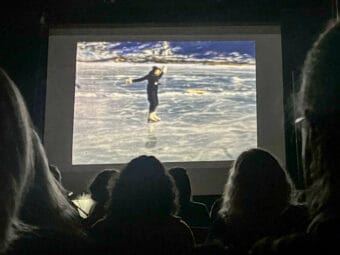
A clip of someone ice skating on Mendenhall Lake plays at the Gold Town Theater on Oct. 16, 2025. (Photo by Yvonne Krumrey/KTOO)

In the packed and dark Gold Town Theater, Karen Miceli watched home movies flick across the screen, while a two-man band played along. They were her own family’s videos, filmed in Juneau between the 1930s and 50s. 

Miceli’s grandparents, Harry and Lucille Stonehouse, lived in Juneau in the mid-20th century. Harry worked for the railroad and made enough money to buy a piece of advanced technology — a Kodachrome film camera.

But until now, Miceli had never seen the footage from her mother’s childhood.

“We heard stories about fishing and ice skating and when the lake was frozen, or when Mendenhall Glacier lake was frozen, and my mom would talk about ice skating on it,” she said. 

Two years ago, Miceli’s sister donated the family’s 36 color film reels to the Juneau-Douglas City Museum, and with a grant from the Alaska State Museum, the curators sent the reels to Anchorage to be digitized. 

Miceli came to town from Washington state to see the films. They show a part of her family history that had only lived in stories before now, and it brought her to tears. 

“So that’s why I think I’m so emotional, is just, you know, seeing my mom when she was little,” she said. 

Museum staff organized clips into a presentation according to the season, and many of the shots feature landscapes around Juneau. A much larger Mendenhall Glacier drew gasps from the audience. People ice skate on frozen lakes, and ski down sharp turns. Cows lie down in a pasture in Mendenhall Valley. Men and women fish for salmon together along a rocky shoreline. A toddler plays on the beach at Auke Recreation Area.  

Some footage shows the 1946 Fourth of July parade, with its marching band, intricate floats and the beloved soapbox derby — where young men built mini cars and raced them through the streets of downtown Juneau.

But some shots were just snapshots of everyday life. Museum Director Beth Weigel said it’s exciting to see even the more mundane parts of life from that time, like kneeling in the flower garden and having a picnic at Sandy Beach, as often, that isn’t what people would choose to document in expensive color film.  

“There’s only a limited amount of what we can see into the past,” Weigel said. 

And even though this isn’t her family’s footage, Weigel said it can make anyone sentimental. 

“They’re just sort of, ‘Oh, what a time to have that ability to be with your family so much and picnic and hang out and do fun things,’” she said. 

But, Weigel said, so much of that joy and connectedness is a part of Juneau today. 

“I think Juneau’s like that, though, still in many ways,” she said. 

And Miceli, with the Stonehouse family, said the full theater gave her a sense of Juneau’s community.

“So many people came out,” she said. “I mean, that’s just amazing to us, because we thought it would be the four of us, and then the Museum people. And then to have this whole thing practically full when we got here—I mean, that’s pretty amazing, the community support and all of that.” 

Museum staff say they plan to make some of the digitized films available online in the future. 

Juneau descendants of boarding school survivors sing to remember what wasn’t lost on Orange Shirt Day

People sing at an Orange Shirt Day event at the Zach Gordon Youth Center on Tuesday, Sept. 30, 2025. (Photo by Clarise Larson/KTOO)

Tuesday was Orange Shirt Day, a day of remembrance for Indigenous children who were separated from their language, families and culture and sent to residential schools across North America from the late 1800s well into the 20th Century.

At the Zach Gordon Youth Center, people wore orange shirts and came together to educate young people about the history of residential schools and to celebrate Native languages and cultures that thrive in spite of that history. 

There was drumming, singing and dancing, and tables with crafts like beading or tea-making. 

Ha’naxgm Ggoadm ‘Tsoal Naomi Leask stands at a table with a bowl of medicine — Labrador tea, which is called s’ikshaldéen in Lingít. 

Leask is with Haa Tóoch Lichéesh Coalition, a local nonprofit focused on healing.  She said 26 members of her family were taken to the first, and one of the most notorious, residential schools in the United States: Carlisle Indian Industrial School in Pennsylvania. It’s a part of her family’s history. 

“That’s where my grandma’s uncle escaped,” she said. “That’s over 3000 miles away. He ran and he ran and he ran and he ran, and when he made it back to British Columbia, they hid him away at grease camp.”

Ha’naxgm Ggoadm ‘Tsoal Naomi Leask asks the audience to answer her questions about the history of residential schools at an Orange Shirt Day event at the Zach Gordon Youth Center on Tuesday, Sept. 30, 2025. (Photo by Clarise Larson/KTOO)

Áak’w Ḵwáan elder Seikoonie Fran Houston said her mother went to the Wrangell Institute as a child. It was a boarding school in Wrangell intended to assimilate Alaska Native children into white culture. Years later, her family learned more about her time there.

“We looked at my mother’s report card,” she said. “You know what was on there? It had nothing to do with reading, writing, arithmetic, science, history, none of that. It was sewing, cleaning, cooking, washing clothes, being a housemaid, and if she didn’t do that, she got punished. Speaking her language, she got punished.”

Houston said she asked her mother for years why she didn’t teach her the Lingít language. Her mother told her she didn’t want Houston to experience the violence she did at school. 

As Xeetli.éesh Lyle James prepared to lead a song, with his drum in his hand, he said not every child made it back home. Many died at these schools, from abuse and neglect, and the government lied to their families. 

“We know that there were many families who were told that their kids ran away,” he said. “We don’t know what happened to them. They disappeared, but in reality, they had passed away, and they didn’t tell the truth.”

James said Indigenous families are left with the loss of loved ones, and that can’t be fixed. But gatherings like this, he said, help with building a path toward healing. 

“We’re not forgetting where they’re at,” he said. “That their memory doesn’t leave when they disappear, it’s going to multiply like sand every time we sing, every time we talk about our history.”

And as Leask said, those efforts to erase language and culture didn’t work. There is still singing. 

Declan Whitson, 2, and Emma Lott, 8, play drums at an Orange Shirt Day event at the Zach Gordon Youth Center on Tuesday, Sept. 30, 2025. (Photo by Clarise Larson/KTOO)

‘Always in our hearts’: September is an important month for boarding school survivors

James Nells, Navajo, a U.S. combat veteran, carries an eagle staff as part of the color guard presentation beginning the “Road to Healing” hearing at Riverside Indian boarding school in Anadarko, Oklahoma, on Saturday, July 9, 2022. Survivors of boarding schools told then-U.S. Interior Secretary Deb Haaland, Laguna Pueblo, of the abuses they sustained at the schools. (Photo by Mary Annette Pember/ICT)

WARNING: This story contains disturbing details about residential and boarding schools. If you are feeling triggered, here is a resource list for trauma responses from the National Native American Boarding School Healing Coalition in the U.S. In Canada, the National Indian Residential School Crisis Hotline can be reached at 1-866-925-4419.

For Ponka-we Cozad, the National Day of Remembrance for Indian boarding school survivors is personal.

Members of her family attended boarding schools and shared hurtful stories about their days in the schools.

“In some way, shape or form, as Native peoples, we all have a story to share about the Indian boarding school era,” said Cozad, director of policy and advocacy at the National Native American Boarding School Healing Coalition. Cozad is Tohono O’odham Nation of Arizona and the Ponca Tribe of Indians of Oklahoma.

“This is why I’m doing this work; when we talk about something always being in our hearts, it’s personal,” she told ICT.

The annual National Day of Remembrance for U.S. Indian boarding school survivors on Sept. 16 in Washington, D.C., includes a special event sponsored by the coalition, known as NABS, from 5-7 p.m. EST at the Indian Gaming Association building.

The theme of this year’s event is “Always in our hearts.”

A number of other gatherings are scheduled across Indian Country to commemorate the Day of Remembrance with vigils, prayers, and other events in museums, churches and local communities.

September is an important month on both sides of the U.S. border. September 30 is the National Day for Truth and Reconciliation in Canada, known as Orange Shirt Day, in memory of the residential school students and the harsh conditions they endured. It became a national holiday after more than 1,000 unmarked graves were found at residential schools, including at the Kamloops Indian Residential School.

In the U.S., where thousands of Native children died in boarding schools, the National Day of Remembrance provides an opportunity for tribal leaders, survivors, descendants of survivors as well as congressional members and the public to come together to honor and recognize children who never returned home from the schools.

This year, the event coincides with the National Congress of American Indians Tribal Unity Impact Days, Sept. 16-18, also in Washington, D.C.

During the Impact Days,  NCAI organizes sessions in which tribal leaders can meet with members of Congress and federal agency officials in order to advocate for priorities such as fiscal year 2026 appropriations, public safety, economic development, housing, self-determination and other issues.

The Day of Remembrance also coincides with the fall session of the U.S. Congress, which convened on Sept. 2, giving lawmakers another opportunity to consider passing the Truth and Healing Commission on the Indian Boarding School Policies  Act (S.761). The act would establish a commission to investigate, document and report on the histories of Indian boarding schools, develop recommendations for federal efforts based on those findings and promote healing for survivors and descendants.

Although the bill passed  the Senate with a unanimous vote in December 2024, the House of Representatives did not bring the bill up for a vote before the legislative session ended.

In March, 2025, U.S. Sens. Lisa Murkowski, a Republican from Alaska, and Elizabeth Warren, a Democrat from Massachusetts, reintroduced the bill. It is now awaiting further consideration and a full vote in the Senate.

At the event in Washington, a light reception and candlelight vigil will be held, and will include remarks from Deb Parker, the chief executive officer of NABS and a citizen of the Tulalip Tribe and descendant of the Yaqui and Apache tribes.

This story was originally published by ICT.

Site notifications
Update notification options
Subscribe to notifications