History

Alaska’s ‘Nazi Creek’ is no more, as federal geographic names board approves traditional alternative

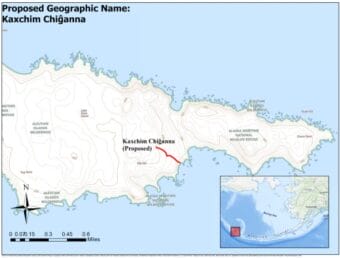
This map from the U.S. Geological Survey shows the former Nazi Creek on Little Kiska Island. (U.S. Geological Survey photo)

A small creek on Alaska’s Little Kiska Island has been renamed, more than 80 years after it was named after Germany’s Nazi Party by World War II soldiers fighting in the Aleutians.

Nazi Creek was the last landmark in the United States to bear the Nazi name. Its new name is Kaxchim Chiĝanaa, meaning either “gizzard creek” or “creek or river belonging to gizzard island” in Unangam Tunuu, the language of the Indigenous Unangax̂ people.
On Thursday, the Domestic Names Committee of the U.S. Board on Geographic Names voted 17-0 to approve the new name, without discussion.

The board’s decision allows the federal government to officially change the creek’s name in federal databases that are the official repository of geographic names. That repository is used by federal agencies and commercial companies that provide maps to the general public.

The board also approved the renaming of nearby “Nip Hill,” named by soldiers using a derogatory term for Japanese people. That hill was renamed “Kaxchim Qayaa,” or “gizzard hill,” again using the traditional name for Little Kiska Island, which is not far from Kiska Island, site of a World War II battle.

Michael Livingston, an employee of the Aleutian Pribilof Islands Association, has been working for almost two years to have the names changed. Moses Dirks, an expert on Unangam Tunuu, recommended the new names.

“I think that’s pretty awesome. I think elders … and others are happy about it. It really should have never been there in the first place,” Livingston said of Thursday’s vote.

“Like one of my teachers … used to say, if you know something that can make our community better, our villages better, be brave and stand up and say something about it, do something about it,” Livingston said.

The new names were previously recommended by the Alaska Historical Commission, which considered them in April. The changes were endorsed by local Native tribes and Native corporations, the Museum of the Aleutians, the manager of the Alaska Maritime National Wildlife Refuge, Congregation Beth Sholom of Anchorage, and the Alaska Chapter of the Japanese American Citizens League, among others.

Kiska Island is located 242 miles west of Adak, at the far end of the Aleutian Islands. The area has been mostly uninhabited since World War II, when invading Japanese forces took 42 people on Attu Island prisoner. More than half died in Japanese internment camps.

The United States forcibly relocated almost 900 Unangax̂ residents of the Aleutian Islands, housing them in unsuitable internment camps in Southeast Alaska and elsewhere. Many became sick and died from the conditions imposed by the government.

Aleutian Islands residents subsequently received reparations from the federal government under legislation that also paid reparations to Japanese Americans also interned during the war.

Livingston’s work isn’t yet complete. He’s also seeking to rename Quisling Cove, a small body of water named after the Norwegian Nazi collaborator Vidkun Quisling. That name change remains pending.

Archaeologists find evidence of villages and one site from 7,000 years ago on Shuyak Island

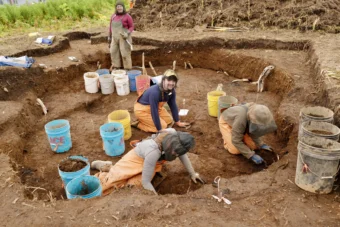
Archaeologists with the Alutiiq Museum dig into layers on layers site at Karluk Lake called site 309, which revealed a ‘super structure’. This is separate from what was surveyed on Shuyak Island. (Courtesy of Alutiiq Museum Archaeology Department & Repository)

A archaeological survey of an island near Kodiak has discovered new Alaska Native village sites, including one believed to be the island’s oldest.
Shuyak Island is one of several located in the Kodiak Archipelago and like many islands in the area has a rich history. The Alutiiq Museum’s archaeological team has been surveying sites on the island for a couple years and they have pieced together more of the historical timeline of the island’s use.

Patrick Saltonstall, the archaeology curator with the Alutiiq Museum, is heavily involved in site surveys and excavations around the Kodiak Archipelago.

This spring, Saltonstall and staff from the museum’s archaeology team finished surveying Shuyak Island, which is located approximately 54 air miles north of Kodiak.

“A lot of the old research had focused on the northwest part of Shuyak Island and we surveyed the whole island. And we found a lot of really big villages on the east side,” he said.

Last summer they surveyed the western half of the island and this year they did the eastern half. Saltonstall said they surveyed one site that dates back to roughly 7,000 years ago, which he suspects is the oldest found on that island thus far.

“I think we found that one village that had 11 house pits, probably had two to three hundred people living in it, you know, 300 years ago,” he explained. “Shuyak has always sort of been a place where I think it seems like there were fewer people up there. But finding that, you know what your preconceptions are and what you actually find often don’t match.”

Alutiiq/Sugpiaq people have inhabited areas around Kodiak Island for at least 7,500 years, according to archaeologists. And thousands of archaeological sites have been documented across the archipelago.

According to the Alutiiq Museum, Shuyak Island was an integral part of that history with at least two established Alutiiq villages. But Russian fur trader Gregorii Shelikov destroyed one of the villages and by the late 1700s there were no communities left on the island.

By the 1920s the island was home to a herring saltery and family fishing operations providing food for human consumption and animal feed for a, “growing fox farming industry.” The Sklaroff & Sons smoked fish establishment from 1892, in Port William on the south end of Shuyak Island, was turned into a fish processing facility or cannery, which was operated by the Washington Fish and Oyster Company until 1976.

After the Exon Valdez oil spill in 1989, part of the cleanup work involved surveying and protecting various archaeological sites on the island. According to Saltonstall, many of those sites were reported to be eroding and at risk of disappearing into the water.

The word Suu’aq [Shuyak] in Alutiiq means “rising out of the water”. And true to its name, Saltonstall said the island itself is rising at a faster rate than the sea level is; so the threat of eroding sites is not as prevalent today.

“What we found up there is that’s not happening anymore. All the sites are much more stable,” he said. “You see grass growing on all the beaches, and it demonstrates…the land sank in 1964 and it’s rebounded ever since, and it’s outpacing sea level rise up there.”

Molly Odell, the director of archaeology at the Alutiiq Museum, said that growth provides natural protection for the sites on Shuyak Island.

“It’s really good news that the sites aren’t eroding as much as they were even 30-40 years ago, because it means they’re stable and they’re not being lost. And it also makes them a little bit more protected from looting,” she said. “You know people going and collecting artifacts off the beach or digging them up used to be more of a problem.”

Odell adds that people should not dig in archaeological sites and should not collect artifacts, which are owned by the landowner even if they’re on the beach. [WEB: If you come across artifacts or cultural sites around the island, you can report that information and share pictures with the Alutiiq Museum by calling 844-425-8844.

Most of the island is now owned by the state and is included in the Shuyak Island State Park.

Odell said the museum was doing survey work in partnership with the Shuyak Island State Park and Alaska State Parks system. Later this summer they plan to update the archaeology display at the Big Bay Ranger station on the island.

Skagway set to celebrate 125 years as Alaska’s first city – despite what the Internet says

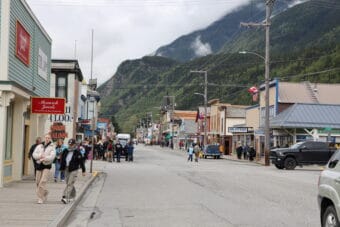
Skagway’s original City Hall, where residents voted to incorporate the city 125 years ago. (Photo by Melinda Munson/KHNS)

Skagway resident and historian Steve Hites says the Internet is wrong.

“If you look up on Wikipedia and the AI that generates online, they’ll say Ketchikan was the very first city because they call it ‘The First City,’ right? And it’s incorrect,” Hites said. “So don’t trust the computers and don’t trust your AI and don’t trust your Wikipedia … Skagway was the very first incorporated city in Alaska.”

In 1900, the tiny valley of Skagway housed thousands of people, who remained after the heat of the Klondike Gold Rush cooled. Hites described what the town looked like.

“We were a growing, booming, extremely busy community,” he said. “Clubs were forming — the Eagles Club, the Elks Club, the photography club, the Skagway Alpine Club. There were children and mothers arriving. People were making Skagway their home.”

Hites said the focus would soon turn to Nome’s gold rush. But for now, Skagway was still king.

“But at that particular moment in time, with the railroad being completed, with the docks in place, the town was humming,” he said. You can imagine, it’s just after the solstice and the sun is up. It’s a beautiful time to be alive and a great time to be in Skagway, Alaska. Anything was possible.”

That year, Congress passed an act allowing cities in Alaska to elect a representative government. Skagwegians quickly petitioned Judge Melville C. Brown to incorporate the town.

“And this petition is still on file with the state of Alaska archives, signed by 91 citizens of our town – they only needed 60 to petition the judge,” Hites said. “And it described the boundaries, how many houses there were, and that there were, quote: 3,500 souls that lived in Skagway. That was a little bit much more than there were.”

On June 28, 1900, residents gathered for a vote at Skagway’s City Hall — which still stands today. It’s a small log cabin on Fifth Avenue, between a bakery and an axe-throwing shop. It’s wrapped in Tyvek to protect the deteriorating wood.

The vote to incorporate won by a 4-1 landslide, with 246 for and 60 against. John Hyslop, the chief engineer for White Pass & Yukon Route Railway, became the first mayor of Skagway.

And it came just in time to secure Skagway’s place in the record books. The vote to incorporate beat Juneau by one day. Ketchikan incorporated about two months later.

Hites said that anyone who wants to learn more about Skagway’s history, should turn to another local historian.

“Compliments to Jeff Brady for his amazing book, ‘Skagway City of the New Century,’ which much of this information I’m giving you is taken right out of …” Hites said.

Hites, who came to Skagway in 1972, started by washing dishes at the Golden North Hotel. He now owns a tour company and performs a one-man-show, with his guitar and harmonica, aboard cruise ships that berth in Skagway’s docks.

“I do a 40 minute production which covers 30,000 years of Alaska history, from the Ice Age right up through till now, including Alaska statehood,” Hites said. “…But  I believe it’s a way that we can tell people, after their day in town, why the ship stopped here. And why this place is important, in terms of Alaska’s story.”

And that story continues. Skagwegians interested in securing their place in the history books can gather for a town photo at Shoreline Park from 4 to 5 p.m. this Saturday. Gold rush costumes are encouraged. Refreshments and a self-guided historical walking tour will be available.

Canonized on the Kuskokwim: Orthodox faithful descend on Kwethluk for the glorification of St. Olga

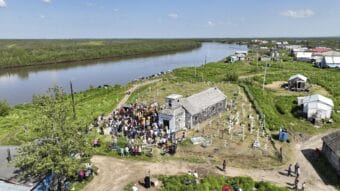
Orthodox pilgrims and clergy gather in the old St. Nicholas Russian Orthodox Church cemetery to take part in the glorification ceremony for St. Olga in Kwethluk on June 19, 2025.
Orthodox pilgrims and clergy gather in the old St. Nicholas Russian Orthodox Church cemetery to take part in the glorification ceremony for St. Olga in Kwethluk on June 19, 2025. (Photo by Katie Baldwin Basile)

Shots rang out over the Kwethluk River as a mass of pilgrims lining the muddy banks sang a hymn of blessing on the eve of the summer solstice. At last, leaders of the Orthodox church had arrived in Kwethluk for the glorification of St. Olga – the first-ever Yup’ik saint and first female Orthodox saint in North America.

Metropolitan Tikhon, leader of the Orthoodox Church in America arrives in Kwethluk, Alaska for the glorification of St.Olga on June 19, 2025. (Katie Baldwin Basile)

For Kwethluk, the glorification is a long-awaited honor for Olinka “Arrsamquq” Michael, or Matushka Olga, a local midwife who gained a reputation as a gifted healer of deep-seated trauma during her life. Since her death in 1979, accounts of her miracles have spread throughout the Orthodox world, culminating in this historic moment.

In the crumbling cemetery of the old St. Nicholas Russian Orthodox Church, priests set Olga’s wooden casket on blocks, just feet from the spot where they exhumed her remains seven months earlier. It’s something that hadn’t been done in Alaska since the exhumation of St. Herman on Spruce Island near Kodiak in 1970.

As local priest Fr. Vasily Fisher explained, before Olga could be venerated as a saint, her final funeral rite, or panikhida, needed to be performed. Going forward, the day of her death will be celebrated instead as her birth as a saint.

“Everything is done as if going backwards; they come back to the church in the presence of life. Our faith is about life. Sainthood is about life,” Fisher said.

Some gathered in the cemetery had tears in their eyes. Others patted beads of sweat from their foreheads. Olga’s descendants stood transfixed among headscarved pilgrims from nearby villages and from as far away as Romania and Australia. The head of the Orthodox Church in America (OCA), Metropolitan Tikhon, traveled from Washington, D.C.

As Archbishop Alexei of Alaska read a passage from the Book of Psalms, a sudden gust of wind from nowhere cut through the otherwise still afternoon. It was hard to not get swept up in the feeling that something miraculous was afoot.

After the funeral rite, a procession featuring flowing robes, golden banners, puffs of incense, and a couple curious village dogs bore the casket along a short dusty track to the church in the section of Kwethluk known as downtown.

During the four-hour service that followed, it was standing room only, which worked out well for a religious tradition that doesn’t make use of pews. The chanting and choreography, what Alexei referred to as an “elaborate, beautiful dance,” ended when St. Olga’s casket was opened for pilgrims to kiss her sacred relics and receive her blessing.

One of Olga’s nieces, Bertha Howard, summed up her memories of her aunt succinctly.

“Ikayurluki yuut, naklegtarluni (she helped, she was compassionate), that’s all I can say,” Howard said.

For Olga’s granddaughter, Atan’ Winkelman, the inclusion of Yugtun in many of the glorification services was a highlight.

Atan’ Winkelman, granddaughter of St. Olga. (Katie Baldwin Basile)

“It’s very cool to see actual Yugtun words… to recognize the Yupik people, to use the word ‘Elders’ in song. I’ve never heard that anywhere else in any of our venerating any other saint,” Winkelman said.

As pilgrims filed by outside the church, Winkelman said that the scene was a lot to process.

“I’m finding the whole exhuming of her body, the whole glorification, canonization, very strange. Because she was an actual person to me that would hold me, and piggyback me, and we would sit and eat together, or I would sit and watch her sew,” Winkelman said.

Olga’s youngest surviving daughter, Matushka Helen Larson, remembers the many women who would pay visits to her childhood home in Kwethluk to sit down to tea with her mother.

Matushka Helen Larson is the youngest daughter of St. Olga of Kwethluk, Alaska, who was glorified as a saint in the Orthodox Church in America this past week, June 19-20, 2025. (Katie Baldwin Basile)

“They’d talk for hours, but I wouldn’t listen because she wouldn’t want me to listen,” Larson said. “But I knew she was helping someone. [They would] come in looking very heavy, you know. And then when they go, they’re lighter.”

With Kwethluk cast further into the spotlight of the Orthodox world, Larson said that she hasn’t lost perspective.

“I still think of her as just my mom,” Larson said.

For many others, Olga has become “St. Olga, Matushka of All Alaska,” a symbol of compassion, modesty, and empathy that appears to resonate just as much across the Yukon-Kuskokwim Delta as it does the world.

Katie Basile contributed reporting to this story.

Federal board rejects ‘Mount Carola’ for unnamed summit in Denali National Park

This map by the state of Alaska shows the location of Mount Carola in the Alaska Range. (State of Alaska image)

The federal Board of Geographic Names has rejected a proposal to name a summit in Denali National Park and Preserve after a longtime mining pioneer.

Michele Stevens, daughter of Carola June Young, proposed naming the peak “Mount Carola” to honor her mother, and the proposal had been supported by the Talkeetna Historical Society, the Matanuska-Susitna Borough Planning Commission, the Alaska Miners Association and the Alaska Historical Commission, which voted 6-1 to support the nomination.

But on June 12, the domestic names committee of the U.S. Board on Geographic Names rejected the nomination. The board, along with the secretary of the interior, is responsible for maintaining geographic names in the country.

Wendy Sailors, community engagement manager for Alaska State Parks, said that the federal board rejected the Mount Carola name because it violated the policy for names in wilderness areas.

That policy states in part that the board “will not approve proposed names for unnamed features within wilderness areas, including unpublished names in local use, unless an overriding need can be demonstrated by the proponent.”

The unnamed mountain that was to be christened Mount Carola is located just inside the southern border of Denali National Park, inside an “eligible wilderness” area.

That area was added to the original McKinley National Park in 1980 as part of the Alaska National Interest Lands Conservation Act.

Eligible wilderness is not designated wilderness but is managed to preserve its wilderness character, according to National Park Service policy.

Sailors said that the National Park Service did not support the Mount Carola name, and its opposition was shared with federal board members before the final vote.

It is somewhat unusual for an Alaska name nomination to be rejected at the federal level because names must be vetted by the Alaska Historical Commission beforehand.

In December, the federal board approved the names for Arkose Peak and Souvenir Peak in the Hatcher Pass Planning Area. Those names had been suggested by local skiers and mountaineers to clear up a discrepancy between local use and what was actually listed on the map.

On July 10, the board is expected to take up the renaming of “Nazi Creek” and “Nip Hill” in the Aleutians. Those landmarks, on the southeastern side of Little Kiska Island, were federally named in World War II and are expected to be renamed using local Unangax terminology.

Both are located within the Aleutian Islands Wilderness of the Alaska Maritime National Wildlife Refuge.

Sealaska Heritage Institute wants help identifying people in a late Lingít elder’s photo collection

A woman in a fur coat looks at the photographer, while a boy smiles at her. From the Cyril George Photo Collection.

In the basement of Sealaska Heritage Institute in Juneau sit thousands and thousands of photographs. They were taken by a Lingít elder who has since passed on, but for decades, he documented important events and everyday life. Now, the organization wants help identifying people and places in the photos.

Listen:

Ḵaalḵáawu Cyril George Sr.’s family unearthed the photo collection in the wake of his death 11 years ago. His granddaughter, Lillian Woodbury, says she was astounded at the volume of photos he kept in his small Juneau condo.  

“That tiny little room had been harboring all of these memories he captured in photo,” she said. “I mean, every time we thought we’ve got them all, we pulled out another box or another container, and I’m like, ‘oh my god, Mom, it’s another box of photos.’”

To Woodbury, George was “grandpa.” But Ḵaalḵáawu Cyril George Sr. left a mark on thousands of people in Southeast Alaska. He was a Lingít leader from Angoon who lived to be 92 years old. Videos of his speeches are used for Lingít language classes, and a collection at the University of Alaska Southeast library is named after him.

A family friend suggested to his family that they donate George’s photographs to Sealaska Heritage Institute, to preserve and store them. For the last few years, archivists like Emily Galgano have been combing through them. 

A boy jumps over a bar as his peers look on. From the Cyril George Photo Collection.

“There’s so much just joy in these photos,” she said. It’s one of my favorite things, looking through them and seeing people just having a good time, people dancing, people talking to each other, cooking out on the beach.”

Photos of everyday life

Some of the photos are now online, and printed in books that are available in Juneau and Angoon for elders to look through. 

SHI hopes people will recognize some of the faces.

“The first thing is, we tried to find photos where you could see people’s faces clearly, because the point of the book is really to try to get some identifications,” Galgano said.

There are 20,000 photos in the full collection. A lot of them are pet photos and landscapes. But of the 1,600 SHI has made available, most are of people: dancers in full regalia, fishing trips with strung up halibut, graduations and meetings. 

Two men and a boy look on from a boat. From the Cyril George Photo Collection.

The photos are full of life — basketball games and Fourth of July parades. They show Lingít people living, working, teaching and making art. They show elders, and babies, and elders with babies. And those babies may be elders now themselves.

Lingít photographer Brian Wallace helped SHI scan the photos. He knew George growing up, and looking through the photos, he was surprised by how many there are of everyday life. 

“They seem mundane at the time,” he said. “But looking back into the whole scope of things, it’s just an amazing body of work.”

Wallace said the photos of ku.eex and early Celebrations stand out to him — that they show how Southeast Alaska Native cultures have endured. 

“They’re thriving when he took the photos, and still thriving,” he said.

Cyril George Sr.’s legacy

Some of the photos were deeply personal for Wallace. 

“And then I loved finding the photographs that he had of my parents,” Wallace said. “And to see some of those photos, and then also lots of photos of my aunts. My aunties cooking dinner or singing songs or just in the background of photos. It was always fun to see those.”

An older man and woman sit together. Brian Wallace's parents Amos and Dorothy Wallace at the National Congress of American Indians in 2000. From the Cyril George Photo Collection.
Brian Wallace’s parents Amos and Dorothy Wallace at the National Congress of American Indians in 2000. From the Cyril George Photo Collection.

Woodbury, George’s granddaughter, said it was hard to part with the collection. The memory of his loss is still fresh, more than a decade later. 

“But we also didn’t want a lifetime of him making sure he carried that camera around to be lost,” she said.

She hopes that others, like Wallace, will look through the collection and find photos of loved ones who have passed on.

“I think if people walk away seeing these photos and they feel like he gave them that one moment in time back, that makes me happy,” Woodbury said. “And that will be a small part, a small part of this legacy.”

Another part of his legacy is Woodbury herself – she’s a photographer, too.

“I think I was 16, the first time he gifted me a camera. And that was all it took,” she said. “That was all it took.”

If you recognize any of the people, places or objects in the photos, you can contact SHI’s Archives and Collections Department at SHIArchives@sealaska.com

Here are more images from the Cyril George Photo Collection. You can expand by clicking on any slide. 


Site notifications
Update notification options
Subscribe to notifications