KMXT is our partner station in Kodiak. KTOO collaborates with partners across the state to cover important news and to share stories with our audiences.
A computer-generated mockup of the new Tustumena replacement vessel, which will be bigger, carry more people and vehicles as well as be more efficient. (Alaska Marine Highway System)
After years of delays, the build contract to replace the Alaska Marine Highway System’s ferry Tustumena is out to bid. The state’s project notice calls for the new mainliner ferry to be completed by the beginning of 2029 with an estimated price tag of more than $300 million.

The new ferry will be a more efficient, diesel-electric vessel with capacity for 250 passengers and 58 cars at a time.
“It is really delightful, even just to talk about. You can probably hear the smile on my face,” Louise Stutes said.
State Representative Stutes, a Republican from Kodiak, is a longtime advocate of the Alaska ferry system. Especially the more than 60-year-old Tustumena, which regularly sails from Homer to Kodiak Island communities.
Captain John Mayer (left) of the M/V Tustumena presented Rep. Louise Stutes (right) a hand painted piece of the Tustumena’s hull for her longtime support of the Alaska Marine Highway System in August of 2024. (Brian Venua/KMXT)
She commended Craig Tornga, the head of the state ferry system, for getting the Tustumena replacement project to this point.
“And there are several shipyards that are interested in it as opposed to the first time it went out where no shipyards were interested,” she said.
“So, they kind of had to reassess it, redesign a few things and we’re good to go,” Stutes said.
Tornga went back to the drawing board on the ferry’s design and overhauled the contract over the last several years. Tornga has previously said that one of the hurdles that delayed the project so long was a requirement that 70% of the money spent on the Tustumena replacement has to go to American companies.
Serjoe Gutierrez, one of the first H1B recipients at the Kodiak Island Borough School District, on a recruiting trip to the Philippines in February 2025. (Brian Venua/KMXT)
In an executive order, President Donald Trump announced he would hike the price of H1B work visas, which used to cost about $5,000. Those visas will now cost $100,000 per person, per year, according to the new executive order.
H1B visas are generally used to fill high-skill jobs, like nurses, and allow for longer careers in the U.S. by providing a path to permanent residency, like a green card. In recent years, H1B visas have become increasingly popular for Alaska schools to hire teachers from abroad.
But there’s concern that many Alaska school districts can’t afford the price hike.
“With a pen stroke, we possibly have ruined the future of education for Alaska students,” said Cyndy Mika, the Kodiak Island Borough School District’s superintendent. She said she texted that to another superintendent in Alaska after she heard the news this weekend.
“I can’t imagine what our classes would look like without our classes would look like without those international teachers filling the need.”
There are over 30 teachers in Kodiak’s school district who were hired abroad, many of whom currently hold H1B visas. And earlier this year, Mika organized a recruiting trip to the Philippines for administrators representing the Nome, Bering Strait, and Kenai Peninsula school districts.
Much of the justification outlined in Trump’s executive order, however, targets large information technology firms. But immigration lawyers, like Anchorage attorney Margaret Stock, say multiple industries – like Alaska’s public education system – are collateral damage.
“It’s been complete chaos since last Friday,” Stock said.
She said Alaska’s university system, healthcare, accounting, and financial service, and tourism sectors all use H1B visas, too. And Trump and his team haven’t had consistent messaging about how they might be affected.
“It’s hard to figure out what to do when the president issues a proclamation that is then contradicted by everybody who works for the president,” said Stock. “It’s just hard to advise clients.”
She’s seen the White House and various federal agencies issue conflicting statements surrounding the new H1B fees. A staffer with Sen. Dan Sullivan’s office said via email on Tuesday that previously approved visa applications won’t be subject to the new fees. Mika’s heard something similar from the school district’s legal team.
But it’s unclear what final decisions will be made.
“They seem to be motivated mainly by collecting a lot of money from people, but they didn’t even roll out a way to pay this $100,000 per person fee,” Stock said.
Mika said she’s already working with Alaska’s congressional delegation to find some kind of solution for Kodiak and other school districts.
Rep. Nick Begich III, who was in Bethel this week, said he’s already brought up how important internationally hired teachers are with the Trump administration.
“I do support the ability to bring in J1 and H1Bs to support as a supplement to local Alaskans and Americans generally,” Begich said on a visit to KYUK in Bethel on Tuesday. “The education workforce in rural Alaska – we know it’s a hard job to fill and when you’ve got positions that go unfilled, it means kids are going uneducated.”
Staffers for Senators Sullivan and Lisa Murkowski both also said via text and email on Sept. 23 that there’s a lack of clarity and want schools to have the resources they need.
For now, the consensus is that everyone’s waiting for more details from the White House.
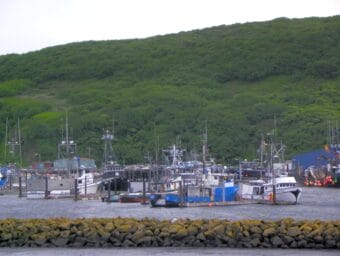
Fishing boats in the harbor near Sand Point. (J. Stephen Conn/Creative Commons)
Update, 3:20 p.m.:
The National Weather Service has lifted a tsunami advisory for communities on the Alaska Peninsula and Kodiak Island after a magnitude 7.3 earthquake struck about 55 miles south of Sand Point. The advisory was lifted at 2:43 p.m. Wednesday.
The Weather Service at first issued a tsunami warning, which was later downgraded to an advisory for the Alaska Peninsula and Kodiak Island, including the cities of Sand Point, Cold Bay and Kodiak, where sirens went off intermittently Wednesday afternoon.
The earthquake struck at about 12:37 p.m. local time Wednesday at a depth of about 9 miles, according to the Alaska Earthquake Center. The Alaska Earthquake Center reported about 30 aftershocks in the two hours after the quake. The largest aftershock so far had a magnitude of 5.2.
This is a developing story.
Original story:
The National Weather Service has issued a tsunami warning for communities on the Alaska Peninsula and Kodiak Island after a magnitude 7.3 earthquake struck about 50 miles south of Sand Point. The warning includes the southern end of the Alaska Peninsula, along the coast, and up to both sides of Cook Inlet.
The earthquake struck at about 12:37 p.m. local time Wednesday at a depth of about 12 miles, according to the USGS.
It is not known yet if the earthquake generated significant tsunami waves, but anyone in a tsunami inundation zone should start looking for higher ground.
Archaeologists with the Alutiiq Museum dig into layers on layers site at Karluk Lake called site 309, which revealed a ‘super structure’. This is separate from what was surveyed on Shuyak Island. (Courtesy of Alutiiq Museum Archaeology Department & Repository)
A archaeological survey of an island near Kodiak has discovered new Alaska Native village sites, including one believed to be the island’s oldest.
Shuyak Island is one of several located in the Kodiak Archipelago and like many islands in the area has a rich history. The Alutiiq Museum’s archaeological team has been surveying sites on the island for a couple years and they have pieced together more of the historical timeline of the island’s use.
Patrick Saltonstall, the archaeology curator with the Alutiiq Museum, is heavily involved in site surveys and excavations around the Kodiak Archipelago.
This spring, Saltonstall and staff from the museum’s archaeology team finished surveying Shuyak Island, which is located approximately 54 air miles north of Kodiak.
“A lot of the old research had focused on the northwest part of Shuyak Island and we surveyed the whole island. And we found a lot of really big villages on the east side,” he said.
Last summer they surveyed the western half of the island and this year they did the eastern half. Saltonstall said they surveyed one site that dates back to roughly 7,000 years ago, which he suspects is the oldest found on that island thus far.
“I think we found that one village that had 11 house pits, probably had two to three hundred people living in it, you know, 300 years ago,” he explained. “Shuyak has always sort of been a place where I think it seems like there were fewer people up there. But finding that, you know what your preconceptions are and what you actually find often don’t match.”
Alutiiq/Sugpiaq people have inhabited areas around Kodiak Island for at least 7,500 years, according to archaeologists. And thousands of archaeological sites have been documented across the archipelago.
According to the Alutiiq Museum, Shuyak Island was an integral part of that history with at least two established Alutiiq villages. But Russian fur trader Gregorii Shelikov destroyed one of the villages and by the late 1700s there were no communities left on the island.
By the 1920s the island was home to a herring saltery and family fishing operations providing food for human consumption and animal feed for a, “growing fox farming industry.” The Sklaroff & Sons smoked fish establishment from 1892, in Port William on the south end of Shuyak Island, was turned into a fish processing facility or cannery, which was operated by the Washington Fish and Oyster Company until 1976.
After the Exon Valdez oil spill in 1989, part of the cleanup work involved surveying and protecting various archaeological sites on the island. According to Saltonstall, many of those sites were reported to be eroding and at risk of disappearing into the water.
The word Suu’aq [Shuyak] in Alutiiq means “rising out of the water”. And true to its name, Saltonstall said the island itself is rising at a faster rate than the sea level is; so the threat of eroding sites is not as prevalent today.
“What we found up there is that’s not happening anymore. All the sites are much more stable,” he said. “You see grass growing on all the beaches, and it demonstrates…the land sank in 1964 and it’s rebounded ever since, and it’s outpacing sea level rise up there.”
Molly Odell, the director of archaeology at the Alutiiq Museum, said that growth provides natural protection for the sites on Shuyak Island.
“It’s really good news that the sites aren’t eroding as much as they were even 30-40 years ago, because it means they’re stable and they’re not being lost. And it also makes them a little bit more protected from looting,” she said. “You know people going and collecting artifacts off the beach or digging them up used to be more of a problem.”
Odell adds that people should not dig in archaeological sites and should not collect artifacts, which are owned by the landowner even if they’re on the beach. [WEB: If you come across artifacts or cultural sites around the island, you can report that information and share pictures with the Alutiiq Museum by calling 844-425-8844.
Odell said the museum was doing survey work in partnership with the Shuyak Island State Park and Alaska State Parks system. Later this summer they plan to update the archaeology display at the Big Bay Ranger station on the island.
Serjoe Gutierrez sits at a piano to work with his first violinists to focus on intonation. (Photo by Brian Venua/KMXT)
Schools across the United States are facing a challenging teacher shortage as fewer people join the profession compared to the number of folks who retire or leave. To keep schools running smoothly, many districts are looking abroad — namely to the Philippines. This is Part 1 of Mabuhay sa Alaska, from KMXT’s Brian Venua, who reports that schools in Alaska are more desperate than most.
Serjoe Gutierrez stood above the Kodiak High School Orchestra, violin in hand, as students rifled through their sheet music for pieces like “The Barber of Seville” and “Canyon Sunset.”Gutierrez often plays with his students instead of conducting them.
Gutierrez, who was born and raised in the Philippines, was in his fifth year of teaching there when he decided he wanted to try to work in another country.
“I think it’s time for me to come out of my comfort zone, explore a lot of opportunities, since I’m still young,” he said.
Alaska wasn’t high on his list. Kodiak barely made it on his radar.
“Kodiak was the last school district I applied to because it was the last school district that pop(ped) out of my Google browser,” Gutierrez said. “And I told myself, ‘Well if not in Kodiak, maybe the United States is not for me.’”
He’s now in his third year of teaching here.
Gutierrez’s immigration story is one of hundreds already playing out in schools all over Alaska, from the Aleutians to the North Slope to Southeast, as dozens of school districts have hired from the Philippines amid a national shortage of certified teachers.
School districts are cutting out the middleman
Gutierrez has become well known in Kodiak. Parents chat with him at student concerts, and he hosts a Filipino music show on KMXT. He plays piano at a local church, as well as violin for charity auctions and in the community’s theater.
He has even joined the Kodiak Island Borough School district’s efforts to recruit more teachers from his home country. In January, Gutierrez helped lead a group of Alaska school administrators on a recruiting trip to the Philippines.
Gutierrez answers questions about the immigration process to a crowd of teaching candidates. (Photo by Brian Venua/KMXT)
Until recently, school districts have relied on third-party agencies to recruit teachers. But with demand up and opportunities to cut out middlemen, Kodiak’s district has led the way to recruit directly from the Philippines.
Some parents and Kodiak community members have criticized the practice for being too expensive. Kodiak Island Borough School District spent about $28,000 to send a team of 4 people this year, including Gutierrez. Teams like that screen hundreds of candidates in a single trip.
Working with lawyers and visa fees cost an additional $7,000 per teacher hired. Districts also can pay another $2,400 if they want to work with immigration lawyers to extend visas.
Hiring through an agency can cost a district about $27,000 per teacher.
And districts aren’t the only ones that pay when going through agencies. When Gutierrez started looking for work abroad three years ago, he had to pay $50 just to learn how to apply for jobs in other countries. Many teachers in the Philippines make only about $400 per month. He’s heard of some agencies charging teachers thousands of dollars once they’ve been placed in the U.S.
“The best of the best”
It took the group of administrators about two days to travel from Anchorage to the Philippines for the most recent recruitment trip. On the first day of recruiting, in a hotel conference space near Manila, candidates wore Western dresses and suits – even tuxedos. Others wore traditional Filipino formal wear, like embroidered shirts called barong tagalogs and distinctly shouldered filipinianas.
One teaching candidate on a call back wore a filipiniana while interviewing with Kodiak High School Assistant Principal Matt Bieber. (Photo by Brian Venua/KMXT)
The room was full of candidates with graduate and postgraduate degrees. Some of the administrators said that on recruiting trips within the U.S., candidates were often fresh from their undergraduate colleges.
The Bering Strait School District has hired up to 60 teachers in a single year – about a third of its total teaching staff. The district has hired international teachers through an agency before, but this was its first time sending someone to recruit directly.
Tera Cunningham leads the district’s human resources. She’d never seen so many people vying for teaching jobs in Alaska.
“It’s exciting to see so many well-trained, well-prepared people who genuinely just want to help kids,” she said.
Recruiters like Tera Cunningham work in teams of two to screen eight people at a time. (Photo by Brian Venua/KMXT)
The candidates had only a few minutes to introduce themselves and impress the administrators. Out of the first group of 120 candidates, less than a third had callbacks that day.
“It is intense to do it this way, and we know we’ll get the best of the best here,” Cunningham said.
She said meeting candidates in person helps her visualize them in action.
“And so I’m excited to see who that looks like, what that looks like when they make it through and they’re finally at our sites,” she said.
But not every school district can afford to visit the Philippines. That’s part of why Jennifer Schmidt with the Alaska Council of School Administrators joined the group. She said that the trip makes sense for districts with many openings, but some have only one or two.
The council, which handles the Alaska teacher and personnel system, received grant money from the U.S. Department of Education to improve the state’s retention and recruitment.
Kodiak’s school district has led the recruiting trips so far, but Schmidt said the eventual goal is for her to take the lead. She said ideally, schools wouldn’t need to recruit from abroad, but there just aren’t enough American and Alaska-grown candidates.
“It’s going to take a lot of turnaround and a lot of change in the state of Alaska for us to have enough teachers in Alaska and in the U.S. that are going to want to come and teach there,” she said.
An aerial view of the City of Kodiak, April 9, 2025. (Brian Venua/KMXT)
U.S. Immigration and Customs Enforcement, commonly known as ICE, arrested a Philippine national in Kodiak last week, according to a post on X on April 16.
When contacted, the family declined to comment and asked for privacy so KMXT is not publishing his name. KMXT could not confirm his immigration status or if this was the only arrest made during the agency’s visit to the island.
Both Alaska State Troopers and Kodiak Police say ICE did not request any assistance for the arrest. The city’s police chief, Tim Putney, said that’s normal when federal agents plan arrests on the island.
“There are times they might need a patrol car to transport somebody,” he said. “But normally, they take care of all their logistics – so to speak – the paperwork and conducting the arrests.”
ICE presence is unusual for Kodiak though, and comes as the Trump administration has ramped up deportation activities. The agency also arrested a Mexican citizen in Sitka according to another post on X last month.
ICE posted on X that the Kodiak man was picked up over a previous conviction for sexual assault of a minor. According to court documents, he pleaded guilty after felony charges were filed in 2017. He was also a minor at the time and was in compliance with terms of his release per court records when he was picked up by ICE.
Margaret Stock, an Anchorage-based attorney and expert on immigration law, said it’s hard to get exact information about his particular case. But she said individuals picked up in these circumstances still have a right to a hearing with a judge and hire an attorney. Serious crimes are still a deportable offense even for legal immigrants.
“Ordinarily, when somebody gets charged with a crime in Alaska, after they finish their criminal case and they get out of criminal custody, at that point immigration steps in and tries to do the immigration court case – which is a civil matter,” Stock said.
The man is currently being detained at the Anchorage Correctional Complex, according to ICE’s website.
Close
Update notification options
Subscribe to notifications
Subscribe
Get notifications about news related to the topics you care about. You can unsubscribe anytime.