KMXT - Kodiak

KMXT is our partner station in Kodiak. KTOO collaborates with partners across the state to cover important news and to share stories with our audiences.
Alaska’s congressional delegation addresses federal changes at ComFish 2025

Sen. Lisa Murkowski smiles as she’s introduced to the room with a short biography at the ComFish convention in Kodiak on Tuesday, April 15, 2025. (Brian Venua/KMXT)

It was standing room only during Sen. Lisa Murkowski’s address at ComFish in Kodiak on Tuesday. Murkowski broke some of the tension with a joke about giving a talk to high schoolers, who she met with ahead of her remarks to the conference.

“My team that was with me said afterwards ‘Toughest interview ever,’ so questions from you guys? Gonna be easy peasy after your high school students,” Murkowski said.

Then she took a turn to talk about the elephant in the room since the Trump administration took over – tariffs.

“We don’t have the certainty that we would like with regards to the tariffs coming out of Washington, D.C. right now. I think the certainty that we know is that even without knowing, even without having the tariffs put in place, we’re already seeing and feeling the impacts on Alaska’s economy and really, the economy as a whole,” she said.

Murkowski said she’s aware that tariffs could increase the costs of consumer goods and how that can be exacerbated in rural places like in Kodiak.

“When we’re talking about the issues that you are all engaged with when it comes to Alaska – seafood and your ability to access and to compete fairly on the global markets – the reality is that tariffs just make everyday life more expensive,” she said.

Murkowski said she’s also concerned about the layoffs at NOAA, particularly as preparations are underway for the summer trawl survey for various species.

She said she’s reminding anyone who will listen why the National Oceanic and Atmospheric Administration’s fisheries departments are important.

Sen. Sullivan checks his notes during his talk at ComFish via zoom. The junior senator from Alaska attended ComFish in person in 2024. (Brian Venua/KMXT)

Sen. Dan Sullivan has faced criticism recently for not speaking with constituents amidst the federal changes. He called into ComFish via video conferencing this year, and focused on some of the Trump administration’s policies he believes are helping Alaska.

“What I keep doing is brandishing this executive order from the president on Alaska,” Sullivan said. “This thing is all about unleashing Alaska’s economy (and) resources, including fish and our fisheries.”

He said he reminds other officials of that when working with Elon Musk’s controversial Department of Government Efficiency, or DOGE. President Trump and DOGE have already slashed NOAA staff. The administration is proposing massive cuts to the organization’s budget by about $1.5 billion next year.

Sullivan, however, didn’t address the proposed cuts directly.

“I’ve been working with the DOGE guys, the leadership, and when they’ve made mistakes, particularly as it relates to anything in this executive order that’ll hurt Alaska’s economy, including our fisheries,” he said. “I have very strongly advocated for ‘Hey guys, you got to reverse some of this stuff. Can’t do stuff that hurts our economy.'”

He said he’s also trying to work with administration officials on how to provide some consistency for the seafood industry despite the president’s on-again-off-again tariffs. Sullivan said he wants to get fisheries included on a relief program available to farmers negatively affected by trade wars. Although, any efforts to get seafood related support into the farm bill have so far stalled in Congress.

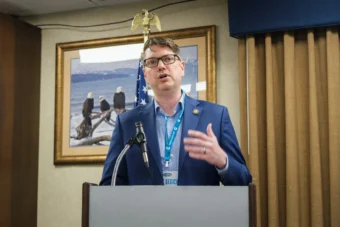
Rep. Nick Begich III speaks at the podium at ComFish 2025. (Brian Venua/KMXT)

Alaska’s newest member of the congressional delegation, Rep. Nick Begich III, faced criticism during a telephonic town hall early in the Trump administration, and this time spent time in person at ComFish. He told the crowd he’s generally in favor of Trump’s changes and that one of his top concerns for fisheries is to improve domestic markets.

“When it comes to seafood exports, Alaska should have the advantage, not just the level playing field,” Begich said.

He also said he wants to see better representation of Alaska seafood in programs like school lunches and distinguishing Alaska-origin products in stores.

Begich echoed some of the same rhetoric on tariffs as Sullivan. He said it’s unfair for Russia and China to undercut Alaska and sell in U.S. markets.

“We’re looking at ways to harmonize those international standards and ensure that there is full reciprocity,” he said. “When folks want to enter our markets, we should be able to enter their markets on the same terms – that is the backdrop for this tariff discussion.”

Begich said he’s concerned about the national debt and applauded DOGE’s efforts to curb excess spending.

Kodiak family accused of more than 30 fishery violations

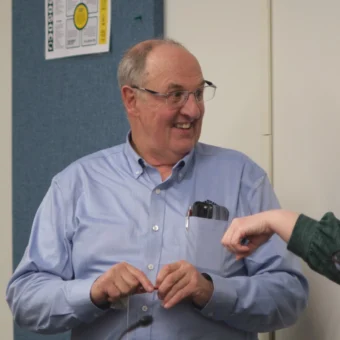
Duncan Fields has served on the Kodiak Island Borough School District’s Board of Education for years. (Brian Venua/KMXT)

Alaska Wildlife Troopers are accusing four members of Kodiak’s Fields family as well as their fishing business, Fields & Sons Inc., of allegedly generating $1.17 million in illegal revenue between 2020 and 2024.

That’s according to a dispatch from Alaska State Troopers on Tuesday, April 8.

Duncan Fields, 69; Wallace Fields, 64; Beth Fields, 66 and Leslie Fields, 67 – all of Kodiak – are charged with perjury and lying on fish tickets. Duncan and Wallace Fields are also both charged with multiple counts related to fraud, theft, and other fishery violations.
Duncan Fields serves on multiple boards, including the Alaska Seafood Marketing Institute and the Kodiak Island Borough School District’s Board of Education.

Duncan Fields said in a text message that the family and crew have been gifting permits to each other for 30 years. He said it “is a common practice in the industry,” and added that he thinks his family has “been singled out to try to set an example.”

Fields said that the charges aren’t supported by the facts.

The charges, however, come after a year-long investigation by Wildlife Troopers, according to the dispatch, after they received a tip in March of 2024 about suspicious fishing permit activity. During the investigation, troopers claim to have found the family was falsely gifting salmon setnet permits to crewmembers and later reclaiming them.

Troopers interviewed 21 crewmembers, according to the dispatch, and say there was a coordinated scheme involving family members lying under penalty of perjury as well as defrauding the state and fish buyers.

When distress calls near Kodiak go unheard by the Coast Guard, Juneau’s Marine Exchange comes in

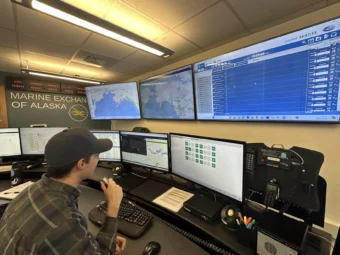
Operators at Marine Exchange of Alaska in Juneau split shifts to provide 24/7 coverage and connect distressed mariners to U.S. Coast Guard search and rescue teams when needed. (Courtesy of Marine Exchange of Alaska)

For several years the U.S. Coast Guard’s emergency VHF radio system has experienced outages across Southeast and the Gulf of Alaska. There’s been progress fixing the problem, but some mariners’ distress calls are still falling through the cracks. So another entity has stepped in to help fill the communications void.

Some distress calls, like the one sent out from the F/V Defender in the Gulf of Alaska via VHF radio last May, are going unheard by the Coast Guard’s towers in various areas of the Gulf, specifically around Kodiak Island. That’s mainly due to harsh weather conditions, aging equipment and remote geographic areas where the communications infrastructure is set up.

And when there is an outage at one of the VHF towers, the Coast Guard typically doesn’t service those themselves. Tatitlek Federal Services Inc., or TFSI, a subsidiary of the Alaska Native Tatitlek Corporation headquartered in Anchorage, is the contractor that services the remote fixed facilities on Kodiak Island. A public affairs officer with Coast Guard District 17, Mike Salerno, said via email that Tatitlek has been the sustainment contractor since June 2022.

Since 2018, the Coast Guard has noted widespread VHF outages within its Rescue 21 Alaska system, which includes 33 sites equipped with radio towers that allow the Coast Guard to monitor and respond to emergency calls from boaters across Southeast Alaska, the Gulf and areas around Kodiak Island.

The Rescue 21 Alaska coverage map shows that there are gaps between the Coast Guard’s towers around Kodiak Island and elsewhere, where calls on VHF radio may not be received from a boat in that area. (Courtesy U.S. Coast Guard)

Gaps or recent degradation in the system can lead to potentially fatal incidents on the water.

“And until we started installing equipment, we didn’t necessarily know what calls were going unreceived or unmonitored,” said Bryan Hinderberger, chief technical officer for Marine Exchange of Alaska. “But we quickly started to realize that there were events occurring out there on the water that maybe the Coast Guard was not aware of.”

The Marine Exchange of Alaska, a nongovernmental agency based out of Juneau, has been acting as a 24/7 middle man between mariners and the Coast Guard across Alaska’s waters for multiple years. It has had a contract with the U.S. Coast Guard since 2006 for delivering Automatic Identification System Service data, but in 2022 transitioned from a concept to what Hinderberger described as “lifesaving action.”

The nonprofit is currently working to expand its coverage and add more marine safety sites around the Gulf of Alaska and Southeast.

“We started out targeting areas that we already knew the Coast Guard had deficiencies or experienced trouble in so that we could kind of fill the gaps, so to speak,” Hinderberger said. “We aren’t trying to replace Rescue 21. We’re trying to supplement it and provide some additional redundancy to it.”

Coast Guard officers agree that redundancy is a good policy, as they encourage mariners to always have a backup communication device like a cell phone or a EPIRB, in addition to a VHF radio onboard.

The Coast Guard gave an updated report to Congress detailing the status of its Rescue 21 Alaska system back in the summer of 2023, after addressing outages at roughly a third of its VHF towers in Southeast from a few years prior.
The Coast Guard Commandant at the time, Linda Fagan, who was recently relieved of her position, committed to upgrading the system to reduce its VHF tower outages. And since then, the Coast Guard says it has made progress on addressing these outages across Southeast.

Lieutenant Jake Carlton, the Chief of Security with Coast Guard District 17, which encompasses all of Alaska’s coastlines, told KMXT in a phone call on Jan. 28 that as of Dec. 31, 2024, the Rescue 21 Alaska network reported an operational availability or up-time of 97.2%.

Towers like the one on top of Elbow Mountain on Kodiak Island are installed with MXAK equipment in partnership with Kodiak Microwave Systems (KMS) and other telecom companies across the state, to help fill the gaps in the U.S. Coast Guard’s Rescue 21 Alaska’s coverage. (Courtesy Marine Exchange of Alaska)


While the outages are less common than they were several years ago, there are still some instances that VHF calls aren’t getting through to the Coast Guard.
Some of those gaps overlap with areas where the Marine Exchange maintains its own equipment around Kodiak Island, in places like Elbow Mountain, Pillar Mountain and McCord Mountain.

The organization also helps fill those gaps elsewhere on Alaska’s coastline with its own infrastructure, and it collects data from more than 60 marine safety sites, many of which can receive and transmit distress calls. Rescue 21 Alaska does not include VHF coverage in Western and Northern Alaska as the Coast Guard’s sites can’t receive distress calls north of Bristol Bay and the Aleutians.

Hinderberger said Marine Exchange’s equipment, which uses VOIP VHF for distress signal communications and still has a line of sight capability, is set up at higher elevations, and at sea level too, which makes it easier to maintain and prevents prolonged outages.

“We don’t just strictly install up on mountaintops, because we know mountaintops in Alaska are some of the harshest environments to operate and exist in,” he explained. “And it degrades equipment faster this time of the year, when the weather is far more harsh than in the summer.”

One incident when Marine Exchange heard a distress call that the Coast Guard did not receive via VHF was a search and rescue in Marmot Bay – north of the city of Kodiak – back in November. It ended positively after several attempts to contact the distressed boat. But Hinderberger said the result could have been much worse.

“Based on the fact that the Coast Guard went back the next day to locate the vessel and it was no longer present, (that) indicates that it either floated out to sea or sunk, is what we’re assuming to have happened,” he said. “And if those three mariners were unable to have been extracted from that event, it very likely would have ended far more tragically.”

Other examples include the Pan Viva in Unalaska in October of 2024 and the F/V Tanusha sinking near Kodiak earlier this month.

A timeline to modernize the Rescue 21 Alaska system that the Coast Guard gave in a report to Congress in July of 2023. Officials told KMXT the Coast Guard is on track to replace all base station radios by the end of Fiscal Year 2026. (Courtesy U.S. Coast Guard)

According to a proposed timeline from the Coast Guard, the agency plans to replace all of its Alaska Rescue 21 base station radios, spread across 33 remote sites, by the end of fiscal year 2026. The Coast Guard says this will significantly improve the system’s up-time and reduce outages by replacing the end-of-life radios with “internet protocol (IP) capable solution, which enables remote management and troubleshooting, and will result in increased operational availability and reduced downtime by allowing significant troubleshooting activities to occur without traveling to the remote site.”

Head of Alaska Aerospace sees Kodiak Island spaceport as solution for national congestion

Blue Origin’s New Glenn on the launch pad at Launch Complex 36 in Cape Canaveral, Fla., on Dec. 27 2024. Rocket launches like these are increasing across the nation’s three main spaceports, resulting in more demand for additional spaceport space. (Blue Origin)

No rocket launches are scheduled as of yet for this year at the spaceport on Kodiak Island, but the head of the Alaska Aerospace Corporation is hoping to capitalize on what’s becoming a national shortage of launch space in the Lower 48.

According to reporting from the Wall Street Journal, there were a record 145 orbital missions launched from the U.S. in 2023. That’s a five time increase since 2017.

The bulk of these launches are conducted by the U.S. government and companies like SpaceX or Blue Origin, which had its New Glenn rocket successfully launch from Florida on Jan. 16 for its inaugural flight into orbit. These entities mainly use three key spaceports: Cape Canaveral in Florida, which is federal, Vandenberg Space Force Base in California, which is also federal, and the SpaceX Starbase in Texas.

Alaska Aerospace’s president and CEO John Oberst went on NBC’s “Today” show earlier this month to discuss what is being described as a “traffic jam” at the country’s spaceports and how Alaska’s facilities could relieve that congestion.

“Now is the time because we offer availability. We can take a customer and get them up on time,” Oberst said. “We are not congested.”

At the Pacific Spaceport Complex-Alaska, near Narrow Cape on Kodiak Island, potential customers could launch satellites, support space missions or test government defense projects.

The spaceport is licensed by the Federal Aviation Administration to have up to nine launches per year. That facility’s last successful launch was in 2022. Two other attempts, one each in 2023 and 2024, all failed.

But at this point, Oberst said via email that no commercial launches are on the books yet for the island spaceport. He added that new customers are interested in launching from Kodiak Island. But he said he cannot release any more information until they sign commitments.

California-based companies ABL Space Systems and Astra are already usual customers. SpaceX is not one of those customers and does not launch from the Pacific Spaceport Complex-Alaska on Kodiak Island, but the company does have an antenna set up at the facility.

Oberst previously told KMXT that he expects at least a few launches this calendar year, featuring both commercial and government customers.

When a launch is scheduled, a public notice must be given 30 days in advance.

Dunleavy wants to give $10M to Alaska seafood agency he vetoed funds for

Gov. Mike Dunleavy unveils his budget on Wednesday, December11, 2019, at the Capitol in Juneau, Alaska. (Photo by Rashah McChesney/KTOO)

Gov. Mike Dunleavy’s proposed budget for fiscal year 2026 would give the Alaska Seafood Marketing Institute $10 million spread out over three years. The move comes after he vetoed similar funding included in last fiscal year’s budget.

At the unveiling of his budget last week, Dunleavy was asked if this was a reversal of his line-item veto of $10 million, which state lawmakers approved for ASMI last year. Dunleavy said that the FY 2025 funding was only for one year, and he wanted to see a more detailed marketing plan on how the money would be spent.

“What was missing last year was a marketing plan and a marketing approach that utilized those resources to make sure we can get into new markets,” he said. “So that’s the discussion we’re going to have in the Legislature, but it’s different from last year in terms of it being spread out over three years.”

ASMI Executive Director Jeremy Woodrow was excited by the governor’s announcement. He said if the funding goes through, the institute will have more certainty during a turbulent time for the seafood industry. Woodrow added that the majority of ASMI’s revenue is tied to statewide ex-vessel value, so if those prices are down, then so is the institute’s funding.

“The seafood industry has been through an incredibly tough time the last two years and we look forward to using these funds to help the seafood industry here in Alaska find opportunity in the U.S. market and return a greater value back to Alaska,” Woodrow said.

According to the state’s description of ASMI’s marketing plan from the FY2025 supplemental budget, the institute will spend the three-year funding to “capitalize on the Russian import ban and increase U.S. domestic sales of Alaska seafood by over $151 million,” and “increase Alaska seafood brand recognition of key species by 10% … with an emphasis on Alaska sockeye, pink, and keta salmon, as well as sablefish, pollock and surimi.”

None of the money is yet finalized, and the governor’s $14.2 billion capital and operating budget proposal remains subject to lawmakers’ approval.

The state Legislature begins its work on the budget in its next session, which starts on Jan. 21. Dunleavy is expected to release an amended version of his budget on Feb. 19, the 30th day of the session.

‘I thought I died’: Burn victim recalls Kodiak bonfire explosion

Cassandra’s face and arms were both badly burned. (Courtesy Gustavo Canaveral)

One of eight Kodiak teenagers severely injured in an explosion on a local beach is talking about the aftermath, as well as her hopes and worries about her recovery.

“I thought I died, because, just, that’s all I saw,” Cassandra Canaveral said in an interview from her hospital bed. She was among the five victims medevaced after the Nov. 10 blast, caused by a fuel drum thrown into a bonfire. “All I saw was light for a couple seconds, and then the fire got extinguished.”

Cassandra was about a week from her 17th birthday, at a bonfire in the middle of a stormy weekend, when the explosion on White Sands Beach sent her to a hospital in Anchorage. She was still there being treated last week when she discussed the incident.

Cassandra said she noticed her head and facial injuries first.

“I started feeling my hair and I could pull out some chunks, and I was like, ‘I got burned bad,’” she said. “So I looked for my friends and I was kind of just – I remember what I was saying the whole time. I was just talking like, ‘I got burned.’”

Her friends tried to reassure her as they poured cold water on her face as a sort of first aid, but she knew she needed to see a doctor. Her brother called their parents. Gustavo Canaveral, their father, agreed.

“I met her at the hospital and then I just learned from what she and my son told me – that the kid threw the barrel into the fire and exploded,” he said.

It was a harrowing reunion.

“She said, ‘Papi, I got burned,’ and I’m thinking like, ‘Yeah, you sure did,’” Gustavo recalled. “It was like the blisters on the skin was sort of like, melting off her face, and her hands were just bloody and black. It was pretty shocking and frightening.”

Cassandra was glad to see him though.

Cassandra Canaveral before a Nov. 10, 2024 explosion on Kodiak’s White Sands Beach sent her to the hospital. (Courtesy Gustavo Canaveral)

“I had a small wave of relief then because it was like, OK. It was kind of grounding to (be) seeing my dad there and being like ‘OK, I’m going to get through this,’” she said.

And she did. Or at least, she’s still getting through it.

By the time she comes home, Cassandra will have spent about two weeks in the hospital. Some of her peers might be there longer. Their injuries have spurred an outpouring of support from the community. But recovering from the explosion – physically and emotionally – will take time.

Scott Ellis is the chief of the Bayside Fire Department. He was the first emergency responder on the scene. The initial call was for an uncontrolled fire. Then he heard that several children were injured. But when he got there, all the teenagers had left.

Ellis and his team found the metal barrel about 10 feet away from the still-burning fire, and the area smelled of fuel. He said he’s glad the barrel didn’t rupture, or injuries could have been much worse.

“That would have been catastrophic,” he said. “You would have had the metal of an everyday 55-gallon metal barrel fracturing catastrophically and moving at very high speeds in multiple directions, shrapnel everywhere.”

He said he hopes people will pay more attention to fire safety now.

Alaska State Troopers have said an unnamed suspect who allegedly threw the fuel drum was taken into custody and held by the state Division of Juvenile Justice.

The explosion shook the Kodiak community, but people didn’t just reel – they organized. At least six GoFundMe pages were set up, and nearly all of them hit their goals right away. Some even doubled their original asks, including the one for Cassandra’s family. Other victims who solicited donations included Alexia CobbanMia VasquezBrian Dierich, and Kavik Wolfe. The only page that hasn’t hit its goal is for a victim who wanted to be anonymous.

One community member, Chislyn Hoen, even set up an account at a local Credit Union 1 branch for donations, to avoid GoFundMe’s fees. That money is expected to be split evenly among the affected families.

Artists and businesses are supporting the victims, too. Robert Wagner auctioned off a painting, while Highmark Marine and Outdoor Kodiak are hosting a drive-in movie and paintballing as fundraisers.

The support has helped give Cassandra hope.

“I feel so blessed and lucky to have such a tight-knit community,” she said. “For a wide majority of people I see everyday come together and be so willing to give so much money to people they don’t even know.”

Her father said he’s grateful, too – he’s not sure if their insurance will cover the emergency flight.

Teachers and school administrators have already begun preparing for Cassandra and her peers to return. The school district’s superintendent, Cyndy Mika, said there’s already a policy for it called a medical 504 – a sort of specialized education plan to help kids with specific needs.

“If the burns are to the hands, they probably won’t be able to use their hands for a while. So schoolwork is going to look different for them, right?” Mika said. “So that’s what we will be working individually with each family: to come up with plans to meet the needs of their students.”

The district is also prepared for the mental health impacts – it increased its counseling services after the explosion, and the superintendent acknowledged it might be a while to heal what she called “hidden injuries.”

Cassandra said she knows things will be different when she comes back. She still wants to play basketball, but she won’t be as competitive as she had hoped. And her teachers and friends all know why she’s been away.

She just hopes things don’t change too much.

“I am looking forward to seeing everybody again,” she said. “I hope that my recovery is kind of at a good point, to where people aren’t going to be shocked when they see me. Because I don’t want my appearance to change the way people treat me.”

She also knows that she’s probably changed, too.

“My biggest takeaway that’s always going through my mind is valuing life,” she said. “It was just so crazy how quickly my life just could have been gone, and I didn’t realize how much I cherished my life until I was just sitting in the car, realizing that I almost, fully, could have died.”

Cassandra was hoping to be discharged from the hospital and back in Kodiak soon.

Site notifications
Update notification options
Subscribe to notifications