KMXT - Kodiak

KMXT is our partner station in Kodiak. KTOO collaborates with partners across the state to cover important news and to share stories with our audiences.
Spike in salmon shark sightings near Kodiak stumps researchers

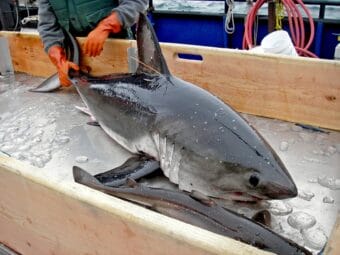
A salmon shark caught as bycatch on a commercial fishing boat and tagged for research. (From NOAA Fisheries)

Salmon sharks appear to be turning up in Kodiak fishermen’s nets and washing up on public beaches around Kodiak Island in greater frequency this summer. But there isn’t enough data to determine if the shark population is growing off the coast of Alaska.

On Sunday, a Kodiak resident stumbled upon a salmon shark washed up on Boy Scout Beach, near the Buskin River. And a few fishermen around Kodiak have reported seeing or catching more sharks than usual in their fishing gear this summer too.

The species is a cousin to the much larger great white shark. It looks menacing, but Oregon State University researcher Alexandra McInturf says it is harmless to humans.

“Historically they were called salmon sharks because they were seen at the river mouths up in Alaska eating salmon,” McInturf said.

McInturf researches salmon sharks, among others species, at what Oregon State calls its Big Fish Lab. Even though Kodiak Island has seen dwindling runs of pink salmon and Chinook this summer, McInturf said salmon sharks are known to eat a variety of forage fish, mainly ones that are commercially viable like pollock, herring and even squid. Salmon sharks’ eating habits also depend on several other factors like their age and gender.

“They do not seem to be salmon specialists,” McInturf stated. “And so if there are poor salmon runs, then they might have to shift their foraging patterns to exploit other resources and that could be why they are being encountered by different (fishermen) than previously.”

Research over the last decade, from 2016-2021, suggests these predators play a role in the dwindling Chinook salmon numbers. But the direct link between king salmon declines and salmon shark predation is unclear.

Similarly, it’s difficult to determine the total number of salmon sharks in Alaska waters and the differences between stocks migrating from place to place up and down the West Coast, along the California current to places like Baja, and into the Gulf of Alaska and Bering Sea. More data is being gathered on the animals’ habitat range as the Alaska Department of Fish & Game is tracking the movements of salmon sharks like Ada, an 8-foot female, tagged in the Northern Bering Sea a couple years ago.

McInturf also points out that even if more sightings of salmon sharks are being reported around Kodiak Island this summer, the sharks could have already been in the area in greater numbers.

“They don’t occupy two-dimensional space, right? Like they could be around but at depth. So in addition to thinking about their distribution geographically, we also have to think about their distribution throughout the water column,” McInturf explained. “So even if we haven’t been seeing them at the surface, they could have been around but perhaps feeding on something more at depth.”

Salmon sharks have been seen as far north as the Bering Strait, around the Nome area, in recent years and could continue to migrate further as climate change pushes their prey into colder waters. They are one of several shark species that can regulate their own body temperatures and are classified as warm-blooded, according to McInturf.

Fisheries biologist Cindy Tribuzio, with the Alaska Fisheries Science Center which is part of the National Marine Fisheries Service, agrees with McInturf; there is not enough catch data to support the idea that the amount of salmon sharks being caught in fishermen’s nets, as bycatch, is increasing in the Bering Sea and Gulf of Alaska.

“What’s being observed (in Kodiak) could represent population changes. It could also just represent the stocks being condensed in a certain area because of a certain food source. There are so many different things that could be leading into this observation that is going on right now,” Tribuzio said.

Tribuzio works at the Auke Bay Lab in Juneau and handles the stock assessments for sharks in the Bering Sea. She said it’s hard to estimate the number of salmon sharks, and other shark species overall in Alaska, partially due to a lack of data coming from the state’s commercial fisheries.

Since salmon sharks are not targeted for a specific commercial fishery, the latest research suggests there is no overfishing occurring in the Bering Sea or Gulf of Alaska (Aleutian Islands region).

The last stock assessment of salmon sharks in Alaska, and others like Pacific spiny dogfish, Pacific sleeper shark, was released in 2022 and the next one won’t be completed until 2026. In the meantime, a new forage study about salmon sharks’ diet from McInturf’s team at Oregon State University is expected to be released later this year.

NOAA study links massive Bering Sea snow crab loss to climate change

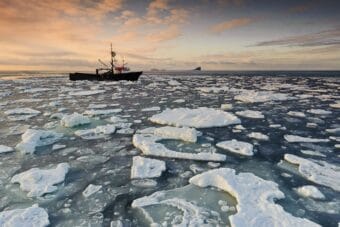
A vessel working with NOAA Fisheries travels through the Eastern Bering Sea while some ice is still intact. (From NOAA Fisheries)

Scientists had previously linked the crash of the Bering Sea snow crab population in recent years to warming ocean waters. But a new study released Wednesday by the National Oceanic and Atmospheric Administration deepens the connection between human-caused climate change and the die-off.

Snow crabs are well suited for Arctic conditions. But Mike Litzow — the lead author of the report, which was published in the journal “Nature Climate Change” — said the southeastern Bering Sea is changing to more sub-Arctic conditions through a process called borealization. St. Matthew Island to the south, nothing north of 60 degrees’ latitude is included in the southeastern Bering Sea. It’s a process that’s also happening in terrestrial ecosystems in Alaska.

“Like an Arctic terrestrial ecosystem around Kotzebue is traditionally tundra, you don’t have shrubs. But as you borealize, you get more shrubs, even trees,” said Litzow, who is also the director of NOAA’s Alaska Fisheries Science Center in Kodiak. “So you can imagine what a huge transition it is to go from tundra to forest. And it’s the same type of thing going from ice-associated to no ice all year.”

This borealization, brought on by human-caused climate change, means warmer conditions and more negative effects for snow crab in the southeastern Bering Sea. That includes a greater abundance of predator species like Pacific cod, shifts in food availability for crabs and increased bitter crab disease which can be fatal. These were all evident in 2018-2019 when the thermal barrier — a cold pool of water in the Bering Sea — vanished, bringing on extreme ecosystem shifts that allowed different species of groundfish to migrate further north.

Litzow and his team had previously confirmed that a combination of these factors caused the crash of snow crab populations between the years 2018 and 2019, when the stocks declined greater than 90%. The population still hasn’t recovered. And after the last two back to back years without a commercial fishery, which is estimated to be worth roughly $227 million of ex-vessel value annually, fishermen have also not fully recovered. And the snow crab most likely never will.

The new report indicates the fishery may be entirely displaced in the coming decades. Litzow said the recent changes are not part of a one-off event and ecosystem-wide changes are expected to continue to affect snow crab populations into the future.

“So it’s not like we are going to lose snow crab anytime soon, but we should expect the southern limit of their range to be retracting north, fairly rapidly,” Litzow said.

There is still hope for a short-term recovery of snow crab over the next five years however, based on favorable abundance seen during a 2022 bottom trawl survey. The Alaska Fisheries Science Center conducts an annual bottom trawl survey in the eastern Bering Sea, but won’t do a survey this year in the Northern Bering Sea.

Otherwise, Litzow and his team said the southeastern Bering Sea may only see Arctic conditions 8% of the time in the years to come.

As for this year’s snow crab commercial fishing season, the North Pacific Fishery Management Council, and the Alaska Department of Fish & Game, are expected to make a decision on opening or closing the fishery in October.

Editor’s Note: Mike Litzow is on KMXT’s board of directors, which has no input on this article or any of its other news coverage.

Coast Guardsman’s death prompts mental health conversations at Base Kodiak

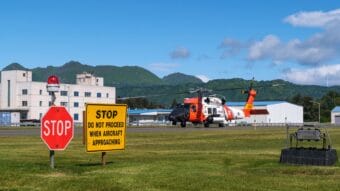
A U.S. Coast Guard rescue helicopter lands on a runway before it parks near an Air Station Kodiak hangar. (Brian Venua/KMXT)

The death of a Kodiak-based U.S. Coast Guardsman this summer has sparked a new wave of conversations about mental health on the base.

U.S. Coast Guard Air Station Kodiak held a ceremony on July 26 to honor the life and service of a rescue swimmer who died on June 25.

The Coast Guard said the investigation into the service member’s death is ongoing, but no foul play is suspected. It did however renew a push for addressing mental health in the military.

Coast Guard officials declined to say whether the death was a suicide. But a social-media group for Coast Guardsmen described it as one, urging comrades to “find something that keeps you going.”

Cameron Snell, a public affairs specialist for the Coast Guard, said Air Station Kodiak officials have been open about encouraging members to use mental health services.

“The air station had a stand-down to inform everybody working there about what had happened, and they immediately offered grief (and) loss counseling for those service members, also for the service members in the barracks,” he said.

A stand-down means operations were paused for air station staff to meet.

Suicide rates are higher within the military, and in response, mental health programs for service members have been on the rise in recent years. Now that includes pushes from the Coast Guard’s Air Station and Base Kodiak, as well as ships that are homeported on the island too.

Snell said officials have been encouraging people to use CISM, or the Coast Guard’s Critical Incident Stress Management program.

The goal is to serve members who have faced potentially traumatic experiences, like when a peer dies or after stressful search and rescue missions. He said it’s not a perfect system, but those kinds of resources are important.

“Suicide is a troubling statistic in the military,” Snell said. “And we can never completely eliminate that statistic, but we can offer as many resources as we can to prevent that at every step of the way.”

The base also provides other resources to burn stress, like borrowing boats or other outdoor equipment from its Morale, Wellness, and Recreation Department. Snell said the Work/Life Office also provides members services like financial guidance or help finding child care.

Members of the Coast Guard have mandatory mental health screenings as part of their annual health assessments and are encouraged to report their peers if they have any concerns. Snell said commanding officers can also refer members they’re concerned about to counseling.

“(This) incident was a tragedy – one being one too many here – and we hope to be able to make the resources that we have available known,” Snell said.

Mental health emergencies on or off base should be reported by calling 911.

Providence Kodiak Island Medical Center and the Kodiak Area Native Association both offer mental health counseling in town, but waitlists can take months. Providence psychiatrists can be seen much sooner though, and emergency services are always available.

The national suicide and crisis lifeline is available by calling or texting 988. The Veterans Crisis Line is available by dialing 1 during a 988 call or by sending a text message to 838255. Online chats are also available at 988lifeline.org.

The Coast Guard also has plans to promote mental health services in September for National Suicide Prevention Month.

Alaska Public Media’s Chris Klint contributed information to this story.

Kodiak celebrates state ferry Tustumena’s 60 years of service

The Tustumena arrives in Kodiak Wednesday, Aug. 7, 2024 after sailing under the bridge to Near Island. (Brian Venua/KMXT)

Kodiak residents gathered Wednesday to honor the state ferry Tustumena, which began service 60 years ago in 1964 and has become an icon for the Alaska Marine Highway System.

Affectionately known as the “Trusty Tusty,” the boat has been the sole ferry to serve Kodiak Archipelago communities the last few years.

The ferry was a few hours late because of the weather, but still hours ahead of the party planned for her. She has sometimes been called the “Rusty Tusty” when there are delays like this one.

John Mayer captained the ferry as she finally pulled in, greeted by folks waiting for friends and family to arrive. He spent nearly his entire 23-year career with the Alaska Marine Highway System on the Tustumena.

He said his favorite part is getting to meet the people he shuttles between communities.

“I love seeing us bring families into Kodiak and they’ll (be) waving to their family members on the dock and bringing people together,” he said.

Tustumena Captain John Mayer says he never gets tired of the views from the boat, but his favorite part of the ship is his bed, and sometimes the bar. (Brian Venua/KMXT)

He shuttles more than just passengers though. Over the years the Tusty’s brought many cars, vendors for Crab Fest, and even livestock to Kodiak Island.

The Tustumena is an icon in the state ferry fleet. She first arrived in 1964 from a shipyard all the way in Wisconsin. For the last several years she’s been running the Kodiak and Aleutian route and faced some of the toughest weather a boat can.

That wear is starting to show now though – the ship has spent extra time in yards for repairs and her hull has rust and a few cracks on her sides. Sixty years marks about double the amount of time her designers expected her to be in service.

Mayer said that’s why he talked to state Rep. Louise Stutes, R-Kodiak, about throwing the Tusty a 60th anniversary celebration.

“The genesis of this party idea was just over lunch one day, I was speaking with Representative Stutes, I said ‘Yeah, we should have a party,’ and now see what happened!” the captain said.

The Tusty’s horn blared to call the crowd’s attention as state Rep. Louise Stutes, R-Kodiak, began the lineup for speeches. (Brian Venua/KMXT)

Stutes has been a frequent voice of support for the ferry system to the Alaska State Legislature.

For the 60th anniversary, she partnered with several local businesses, nonprofits, and City of Kodiak Police to set up a block party at the ferry dock in town.

“It’s a feel-good for the community,” she said. “It really is a wonderful thing.”

Hundreds of people came for the celebration, with some sporting ferry-themed shirts and hats. People shared stories, learned about the vessel’s history, the Alutiiq Dancers performed, and there were even guided tours of the old boat. There were also free hot dogs and burgers in addition to food trucks nearby.

Kodiak Ferry Terminal Manager Amanda Becker said that although the terminal is visited by other ferries, named after the state’s glaciers, there’s something special between the Tusty and the island town.

“I mean Kennicott comes too and it’s okay,” she said. “But the Tusty is, she’s our old girl and she’s got character, she’s got an incredible crew.”

Becker is also usually the person to announce to Kodiak when the ship has maintenance delays and cancellations.

One of the overarching questions though is: When will the ship be retired?

The Tustumena’s replacement is expected to cost over $315 million, but the state has only set aside about $180 million for it.

The aging ferry has had several renovations like expanding its length and replacing several parts throughout its service. (Brian Venua/KMXT)

Stutes said progress getting funds to replace the Tusty is slow but she’s hoping for the best.

“I’m an optimist – we’re moving forward and in the meantime they’re doing a good job keeping the Tustumena safe for passengers and for operation,” She said.

Mayer said he’s been trying to take care of the Tustumena the best that he can.

“This ship isn’t getting any younger, – and I’m not either,” he said. “Y’know, 20 years ago they would take her out in rougher weather than I’m doing now, but I’m trying to be kind to the ship.”

Ryan Anderson, the commissioner of Alaska’s Department of Transportation, said his team is working to find any way they can to secure more funding from the federal government like through a toll credit program.

“It turns out that the Federal Highway Administration has a program that when you invest in your ship, so all the maintenance, all the overhauls, we use our revenues and we invest in those things, we can get credit for that,” Anderson told KMXT.

State Transportation Commissioner Ryan Anderson shows off his painted piece of the historic ferry’s hull. (Brian Venua/KMXT)

All of that money goes towards the state’s side of matching contributions for federal grants. The department has already started soliciting designs for parts of the replacement ferry like its elevator for cars.

“That elevator that’s on the Tustumena – that’s a very unique thing for a ferry and so we actually have to use that elevator as a model to design the new one,” he said. “So we’ve already got the contracts out for things like the elevator design.”

The Tustumena’s elevator can lift up to about 4,000 pounds at a time and spins to make loading easier. (Brian Venua/KMXT)

He also gave a speech at the party recognizing the importance of Alaska’s ferry system and shared some of the plans for the replacement.

“The new vessel is going to be bigger, it’s going to be longer, it’s going to be wider,” Anderson told the crowd. “It’s going to hold more people, it’s going to hold more cars and it’s going to be more efficient on top of that and the operating costs will be less.”

He said he hopes to have a new boat as soon as 2027.

There were also speeches from other high-profile individuals like Alaska Senate President Gary Stevens, City of Kodiak Mayor Pat Branson, Kodiak Island Borough Mayor Scott Arndt, Homer Mayor Ken Castner, and a poem written by Stutes’ husband, Stormy. U.S. Sen Lisa Murkowski was also slated to make an appearance but had last-minute plans with her family.

Mayer said he hopes to see that new boat and let the “Trusty Tusty” retire soon.

“In the maritime industry, it’s amazingly remarkable yet regrettable that she’s made it to 60 years,” Mayer said. “It behooves us to take a look back and see how much effort and funding and muscle and sweat that went into keeping her going all these years.”

For now though, the Tustumena is scheduled to sail the Kodiak and Aleutian route until it docks in the winter for repairs.

The Tustumena was decorated from the stern all the way to her bow with flags waving in a light breeze. (Brian Venua/KMXT)

‘The Hungry Games’ offers viewers another helping of Katmai National Park fat bears

Katmai bears fish at Brooks Falls. (Photo courtesy National Park Service)

A new streaming series about Alaska has joined the ranks of TV shows like “Deadliest Catch,” “Bering Sea Gold” and dozens of others, this time focused on the fat bears of Katmai National Park and Preserve.

The latest series, “The Hungry Games: Alaska’s Big Bear Challenge,” features narration from a well-known New Zealand star. Rhys Darby, who has appeared in the HBO comedy series “Flight of the Conchords” and the recent “Jumanji” films, describes himself as a “comedian, actor, leg model, cryptozoologist, artist, and author.”

In a brief preview clip for the series, which premiered Thursday, Darby is narrating a scene where a Katmai bear known as Boldface tries to cross a flowing channel with her three cubs. The mama bear goes in first to test the waters and then calls for the younglings to follow.

“Boldface is waiting for them about halfway across the river. If they can swim to her, she can carry them the rest of the way. C’mon kids, hurry up and get to your mom,” Darby narrated.

Boldface, and other Katmai bears like her, are the focus of a new streaming series that claims to be the first natural history competition show of its kind.

The show will also include a ranking system similar to Katmai National Park’s Fat Bear Week tournament, where several brown bears in the park are pitted against each other and the public votes for their favorite fattest bear. Darby, however, will add more context and commentary to the bears’ activities while they bulk up for winter.

In “The Hungry Games,” the large brown bears are given scores based on their actions, like eating hundreds of pounds of food over the course of 150 days. The three categories they’ll be measured in are Beefiness, Ingenuity, and Grit – an acronym that spells out B.I.G.
Once the show is over, the highest scoring bear will be crowned the Hungry Games champion.

The first season is streaming on Peacock with three episodes released so far.

Alaska’s seafood industry is in trouble. Processors and policy makers blame Russia.

Boats offload to Kodiak’s myriad of shoreside processing plants. (Brian Venua/KMXT)

Alaska waters produce the most seafood in the country, and many of the state’s coastal communities depend on commercial fisheries to sustain their economy.

But Alaska’s fisheries are facing a massive economic slump right now, and policymakers are increasingly blaming flooded global markets. The private sector and federal policymakers are teaming up to try to stop the bleeding.

Last year was brutal for the seafood industry. Processing companies and fishermen alike suffered amid cratering prices, and they blamed Russia for flooding markets. Republican U.S. Sen. Dan Sullivan, from Alaska, pointed his finger at the country at a news conference on May 23.

“Russians have essentially admitted they’re not just at war in Ukraine, they’re at war with the American fishing industry,” he said.

Alaska’s other federal delegates, Sen. Lisa Murkowski and Rep. Mary Peltola, shared similar sentiments at ComFish, a fisheries trade show in Kodiak.

The U.S. and Russia have been fighting over their seafood trade for years.

Recent highlights include a Russian ban on American goods in 2014.

The U.S. government didn’t put its own ban on Russian goods in place until Russia invaded Ukraine in 2022.

Despite that embargo, there was a loophole in the U.S. restrictions, at least for seafood. Russian-caught fish processed in third-party countries, namely China, could still be sold in American markets.

That lasted until late last year. Then, amid intense lobbying from the U.S. seafood industry, President Joe Biden signed an executive order that finally closed the loophole and any chances for Russian fish getting to America.

The move could boost demand for Alaska fish in the U.S., but America is just one of three major markets for Alaska seafood — it’s sold all over the world.

Many kinds of fish can be harvested around Alaska like cod, halibut, salmon, and pollock as well as shellfish like king and tanner crab. Fishermen often target multiple species throughout a year. (Brian Venua/KMXT)

“It’s like a balloon – and so when you push in one area, you have a reaction in another area,” said John Sackton, the founder of the online trade publication SeafoodNews.

Japan and European countries are also major markets for Alaska fish, and Sackton said they’re still allowing Russian seafood imports.

Alaska pollock is the largest fishery in the U.S. by volume, and prices for that species took a major hit last year. Sackton said that’s in part because Russia began selling surimi, a paste made from pollock, into Japanese markets at low prices.

“So all of a sudden, the prices of surimi collapsed,” he said. “And now the surimi market in Japan, which used to be a mainstay of Alaska, is now primarily Russian pollock.”

He said a similar story played out in Europe and drove down the prices for pollock filets, as well.

That’s caused major problems for seafood processors in Alaska. Sackton said that unless Europe and Japan put their own bans in place, the continued sale of Russian fish into those markets will likely blunt the impact of the Biden administration’s recent action.

“This is a sign that there’s a lot of pain in the industry,” Sackton said. “And so the pollock ban – lobbying for the pollock ban – was a short-term benefit. People probably didn’t have any choice except to try to get whatever short-term benefits they could, but it’s not going to change the overall dynamic.”

Sen. Sullivan recently met with the U.S. commerce secretary, Gina Raimondo, whose department regulates the American fishing industry. He’s lobbying the Biden administration to convince a group of foreign allies known as the G7 to establish their own bans.

“There is a G7 leaders meeting coming up in the next three weeks,” Sullivan said. “We covered language on what we think would be good for the leaders to agree to, and I’ll just end with this – the key really is follow through.”

The G7, or Group of Seven, is made up of the U.S. and six other countries with major economies around the world including Canada, France, Germany, Italy, Japan, and the United Kingdom. The European Union is what’s called a “non-enumerated member.”

The industry’s slowdown has had major consequences for seafood companies. Trident Seafoods, the biggest processing business in the United States, announced last year that it would sell about a third of its Alaska plants, partly because it said that competing with Russian-origin seafood has been tough.

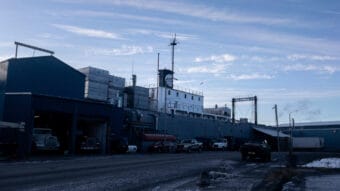
One of the facilities Trident listed for sale is its Star of Kodiak plant, the largest plant in its namesake town. (Brian Venua/KMXT)

But a Trident subsidiary in Europe is still buying the Russian fish that its executives say are undercutting Alaska seafood prices. That’s according to a recent report by Undercurrent News, a trade publication.

Trident Chief Executive Officer Joe Bundrant was also on Sullivan’s press call. He said that while he’d prefer to support the fishing fleet that sells to the company’s Alaska processing plants, Trident can’t lower margins enough to compete with Russian production.

“Our mission every day is to wake up and drive value for wild Alaska seafood, and it pains me greatly to make that decision,” Bundrant said. “But until there’s some support from G7 countries, it’s an economic necessity for survival.”

Bundrant said in some cases, Russian pollock is sold for up to $1,000 per ton less than Trident can produce itself.

The market pressure even caused at least one company, Peter Pan Seafoods, to close indefinitely.

Seafood companies and fishermen often target multiple species to reduce their risk, but the current price collapse is almost across the board.

Pink salmon sold at docks for just 24 cents per pound across regions on average in 2023. That’s about half what fishermen were paid in 2022, according to state data.

Bristol Bay sockeye sold at docks for as little as 50 cents per pound last year – the lowest price paid in decades, when adjusted for inflation. Intrafish reports Silver Bay Seafoods will pay at least 80 cents per pound for Bristol Bay sockeye this year, but did not respond to request for comment. The company is also expected to pay $1.10 per pound for chilled fish, with more bonuses for bleeding them before selling to the processor.

The announcement is months ahead of when processors usually announce prices for salmon in late summer.

Citing recent news reports, Sen. Sullivan claims that fish from Russia sell for so little in part because that country, and China, use forced labor in their processing facilities.

“That’s what we have to compete against,” he said. “We should be promoting high standards globally, not allowing for a race to the bottom.”

The senator’s staff have also confirmed that he has been in contact with officials in Japan and the European Union to push for banning Russian seafood. His staff did not have an estimate how long it would take to convince other nations to establish bans.

Sullivan said he hopes to include fisheries-related provisions in the upcoming renewal of the federal farm bill to provide more stability for the industry – a mutual goal among all of Alaska’s congressional delegation.

Site notifications
Update notification options
Subscribe to notifications