KMXT is our partner station in Kodiak. KTOO collaborates with partners across the state to cover important news and to share stories with our audiences.
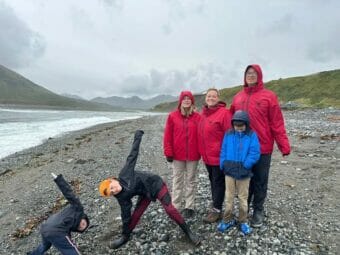
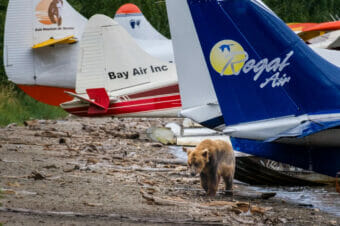
Katmai National Park is famous for bear watching and because it’s off the road system, most people get to the park via planes. (Brian Venua/KMXT)
A de Havilland Beaver operated by Alaska’s Enchanted Lake Lodge Inc. and a Bell 206L-4 LongRanger helicopter operated by Maritime Helicopters collided in mid-air over Katmai National Park during Labor Day Weekend. The plane’s pilot and passengers reported no injuries, but the helicopter’s pilot was injured in the crash.
The accident took place at about 4:30 p.m. on Monday, near Lake Coville in a northern area of Katmai National Park and Preserve.
“It was struck in the tail rotor section over there, the back of the helicopter basically was damaged,” said Clint Johnson, the National Transportation Safety Board’s Alaska region chief. “The airplane was able to make an emergency landing in a nearby creek and the helicopter descended uncontrollably into an area of tundra and tree covered terrain.”
The helicopter pilot was able to walk away from the incident, but he was still brought to Anchorage for further medical examination.
Katmai National Park doesn’t have an air traffic control tower to coordinate take-offs and landings. Mark Sturm is the park’s superintendent; he said pilots usually communicate over radios to prevent collisions like this one.
“Pilots that come into the park essentially are in touch with each other and try to manage the traffic locally by talking to each other about how they’re approaching, what they’re doing, and being in contact with planes on the ground,” Sturm said. “But obviously, in this case, these two aircraft were not in communication and the accident happened as a consequence.”
The aircraft were about 1,000 feet above ground when they collided, according to preliminary information. Johnson, with the NTSB, says investigators are still talking to both pilots.
“What we’re trying to do now is trying to figure out how these two airplanes came together – ultimately determine if each one of the pilots were able to see each other and the circumstances that led up to it,” he said.
Johnson says a preliminary report is expected later this month.
In July, a different Bell 206L-4 operated by Maritime Helicopters crashed on the North Slope, killing the pilot and three state scientists.
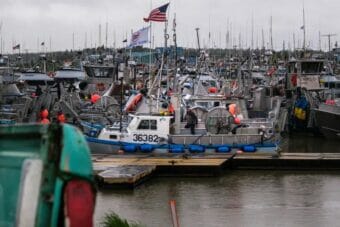
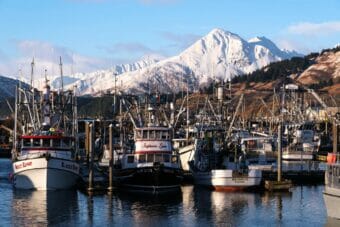
Before the salmon season, harbors like this one in Dillingham were filled with boats and crews anticipating another large season. (Brian Venua/KMXT)
Kodiak fisherman Mike Friccero has fished for salmon for over four decades. He said he was expecting a low price for Bristol Bay salmon this summer, but didn’t think rumors were true about how low it would drop.
“Our processor gave us a letter, a narrative before the season started, saying that pricing conditions weren’t great but that they were going to go after it with all the resources that they utilized last year as far as tendering and logistics and resources in general,” he said. “And they asked if we would do the same.”
It’s been a tough year for commercial salmon fishermen. Three years of huge returns in Bristol Bay created a surplus of sockeye in the market. Towards the end of the season, processors announced a base price of just 50 cents per pound – the lowest price in decades, when adjusted for inflation.
Fishermen can get bonuses for better quality, but Friccero said even with the boost, he was better off gearing up to fish for other species like halibut.
“If you’re catching 5,000 pounds and you’re thinking 80 cents, then your crew’s share might be $400,” he said. “Well that’s worth doing for folks, but once it drops into the lower figures, if you have crew that have talent, they’ve got other things they want to get over to.”
Friccero said he usually leaves shortly after the peak anyway, but he wasn’t the only one packing up before August.
The Bristol Bay base price for sockeye was one of the lowest prices for Alaskan salmon in recent history. Since then, Trident has dropped their price for chum down to just 20 cents per pound in response to massive harvests in Russia and announced they will stop buying salmon from most communities in Alaska, starting Sept. 1.
Fishermen across the state are wondering how long the low salmon prices will last. Some are even considering selling their boats.
Gunnar Knapp is an economist who specializes in the state’s fisheries. He said for the sake of both fishermen and processors, he hopes that this is just a one-year blip instead of the beginning of a long term pattern.
“To get the lowest price you’ve ever gotten while you’re working just as hard as you ever did, and other expenses like fuel have gone up – it puts fishermen in a really tough position,” Knapp said. “I think processors would also say that they’re in a really tough position and their companies are on the line.”
Knapp was visiting family in Maryland when he saw in retail stores that wild caught seafood is now selling for the same price as farmed fish. He said he’s not surprised but still disappointed knowing the amount of work processors and fishermen do to produce high quality products.
“I was in a local Costco yesterday, and I saw in that Costco, farmed Atlantic filets from Chile and farmed Atalntic filets from Norway and wild Alaska sockeye all selling for $10.99 a pound,” he said.
The Alaska Seafood Marketing Institute is funded by the State Legislature to stir demand for Alaskan products. Greg Smith, the institute’s communications director, said there just isn’t enough demand to keep up with the glut of fish.
“There’s difficult issues in the global marketplace – inflation, increased cost of living, shipping costs, the Russian invasion of Ukraine, so there are just significant challenges,” he said.
Fishermen started the season with some processors still holding frozen product from last year’s harvest.
The seafood marketing institute received an extra $5 million in funding this year to better compete in global markets. But even with extra funding, staff are unsure if their short-term efforts like retail displays and working with food writers will help much. Smith said one of the institute’s bigger projects is investing in new markets across the globe.
“We’re focusing on emerging markets, Latin America, parts of Africa, we’re doing some things in Israel but it is just really trying to build off the strength of the brand,” Smith said.
Smith said they’ve had some success with retail and restaurants, and even worked with the U.S. Department of Agriculture to include salmon in purchases for school lunches and food banks. Alaska’s senators also brought the ranking member of the Senate Agriculture committee to Kodiak to make the case that fishermen should be included in the upcoming farm bill.
Friccero said with lower salmon prices, he’s able to keep a decent paycheck but will have to be wary of his budget for next year. He said he hopes market conditions improve over the winter.
The low prices this year has pushed several fishermen to call for better transparency from processors. Friccero said a guaranteed minimum price would be the best possible starting point to build more trust.
“Looking for transparency, anything would improve it right – because there’s almost none,” he said. “That doesn’t necessarily mean that we’re being mistreated in any way, it’s just very hard to have a conversation with no information.”
Regardless, Friccero said he’ll be back to fish more next year.
Commercial fishing vessels docked in the St. Paul Harbor in Kodiak; Feb. 6, 2023 (Brian Venua/KMXT)
The National Oceanic and Atmospheric Administration has released a sweeping five-year plan to prioritize and promote the country’s commercial fishing industry.
NOAA Fisheries announced its National Seafood Strategy on Wednesday. The agency said in a press release that the plan will “outline the direction” of the country’s seafood sector. It’s the first time NOAA has released an overall strategy aimed at addressing industry needs – the agency says it will complement other federal policies that are already in place.
The new plan outlines broad priorities, like investments in sustainability, research and aquaculture, and calls for making the country’s seafood sector more competitive – both within the U.S. and on the global market. It also outlines current challenges to the nation’s seafood industry, like labor shortages and lingering market disruptions caused by the pandemic. Climate change is also identified as a main present – and future – challenge to fishing communities.
The National Seafood Strategy is vague on costs and timelines, and doesn’t provide any regional insights into how the strategy might be implemented in places like Alaska. But it comes as processors are blaming competitive market conditions for lower payouts to fishermen across several of the state’s fisheries, and a string of cuts to catch limits and all-out closures.
NOAA estimates the dockside value of the country’s seafood industry at $6.3 billion – as of 2020, Alaska accounted for 60% of all commercial landings and 31% of the industry’s overall value.
Bear 480, Otis, matched his latest appearance to the falls yet. The last time he appeared on cameras this late was also on July 26, back in 2021. Photo from July 2023. (F. Jimenez/National Park Service)
Katmai National Park has a 24-hour live stream of Brooks Falls every summer. Hoards of bears gather there to catch salmon and it’s a popular spot for crowds to watch them. Bear 480, also known as Otis, arrived at Brooks Falls on July 26, the latest he’s been noticed yet.
Fans feared the bear had passed away, but the elderly ursine just slept in before making his first appearance on the national park’s cameras. Otis has become sort of a fan favorite and a consistent contender for the fattest bear.
Felicia Jimenez, a media ranger for Katmai National Park, said his late appearance is most likely because of a later salmon run in Bristol Bay.
“Things are a little bit slower to wake and we’re definitely seeing that with the salmon run,” Jimenez said. “The water level’s a little bit higher, the water has been colder, so we’re seeing the salmon a little bit slower to arrive – I’d say about a week or two late.”
Bear 480 usually comes out in late June or early July. Some fans thought he might not have survived the winter, but Otis finally showed up on the park’s cameras last week.
Bears aren’t the only wildlife that can be seen from the live stream, several birds also scavenge on leftovers. (Brian Venua/KMXT)
Jimenez said most bears that get to that age usually rely more on scavenging or begging for fish from other bears, but the public ought not worry about Otis. Bears usually live to about 20 years old, but she said he’s still pretty spry for a 27-year-old.
“There’s still really good signs that we’re seeing from him,” she said. “He’s super old, but he’s still very active. When he showed up, he was immediately catching fish and those are positive signs. He’s still active, he’s still moving around.”
Viewers of the park’s live cameras can identify him with a few grey and white swirls in his brown coat and some damage to his left ear.
“He is also missing a lot of teeth – he only has about two teeth,” Jimenez said. “So if you see a bear with a floppy left year, who’s pretty old and he’s got like two teeth, that is definitely 480.”
Otis is also a consistent contender for the title of fattest bear at the falls during the national park’s annual Fat Bear Week in early October. Park rangers create a bracket of some of the biggest bears that wander the area and the public can vote online for the fattest bear around.
“That competition is pretty subjective,” Jimenez said. “Some people vote for their favorite or which bear they think embodies fat, healthy bears the most. And so even though he’s not the fattest bear anymore, he’s usually up there in the finalists pretty much every year.”
Two bears vying for a prime fishing spot near Brooks Falls. (Brian Venua/KMXT)
Otis has won four times so far. Some of his rivals for the title include Bear 747, sometimes called Bear Force One, who won last year, and Bear 435, also known as Holly.
With a later arrival though, Otis will have his work cut out for him if the old man wants to be declared the park’s fattest bear a fifth time.
It triggered a tsunami warning for the Alaska Peninsula and Kodiak Island. Sirens sounded in local communities, with officials urging residents to seek higher ground. The tsunami warning was later downgraded to an advisory and was canceled altogether by 1 a.m. Sunday.
The National Tsunami Warning Center said the maximum observed height of waves off King Cove and Sand Point was half a foot. It said some areas may continue to see small sea level changes.
The tsunami warning also stirred Anchorage residents late Saturday, with some reporting that they got the emergency alert on their phones.
Some Anchorage residents got this alert to their cellphones late Saturday. (Tegan Hanlon/Alaska Public Media)
Geologists have previously said it’s unlikely that an earthquake could generate a large tsunami in Anchorage. The Tsunami Warning Center has had issues in the past with the alerts going to city residents.
At 11:32 p.m. on Saturday, the National Weather Service posted on Twitter: “Anchorage is NOT in the area affected by the Tsunami Warning. We will look into this issue.”
Alaska Public Media’s Tegan Hanlon and KUCB’s Theo Greenly contributed to this story.
Karluk Spit and village of Karluk. (U.S. Fish and Wildlife Service)
Fishing, camping, kayaking, and a year of all-expenses-paid living: those are some of the promises that the Karluk Tribal Council made in an advertisement that went viral this month.
The community is looking to pay two families with four children each to move to the village in an effort to get state funding and re-establish a school.
Within a week, between four and five thousand people responded to the poster. Kathryn Reft is the Karluk Tribal Council’s secretary and treasurer. She said they never could have anticipated the response.
“We just figured we tried to do something like this just to see if we get any kind of attention,” she said. “We never knew it was gonna blow up to be this huge!”
The Native Village of Karluk is on the southwest end of Kodiak Island. The village has just 37 year-round residents. There’s two children there now, but villages need at least 10 students in order for the state to fund a school. That’s why the Tribe is looking for two families with four children each to move there.
Reft said the remote village has been looking to grow for a while now.
“We had our feelers out there,” she said. “We tried going through agencies and we just couldn’t find any interest and then somebody brought up ‘Why don’t we get a poster out there?’ and that’s what we did.”
The Tribe has heard from families across the country as far as Florida and even internationally from Canada and the Philippines about its ad.
“Our main focus right now is to have the 10 students here in Karluk,” she said.
Karluk’s school closed back in 2018 due to low enrollment and continued to dwindle since.
The Kodiak Island Borough has kept maintaining the former school building by paying for its heat and electricity. Borough staff recently visited the building to assess its condition, and with minor maintenance, it could reopen and host classes again.
In order to get more students, the Tribe is willing to pay housing, utilities, moving expenses, and even a food stipend for a full year. For the right family, they’ll also train them for jobs to become a more permanent fixture in the community.
Cyndy Mika is the Kodiak Island Borough School District superintendent. She said the district was caught off-guard by the poster but is open to helping the village.
“If they make those 10 students, we’ll have to do something,” Mika said. “But at this point, it’s going to be very difficult staffing at this late of a date and it’s not part of this budget at all.”
Mika said she understands the struggle Karluk is facing without a school.
“I know that the villages need schools and that the schools are what makes them be able to grow in population,” she said. “It’s really hard to grow if you don’t have a school for your students or your children out there.”
The clock is ticking, though. The state counts student populations for schools in October. Reft, the Tribe’s secretary and treasurer, said they hope to bring new families soon.
“We’re going to try to get families here before the end of August, before the school year, have them settled in their house, and ready for school,” she said.
The Tribal Council will start looking over applications next week.
Close
Update notification options
Subscribe to notifications
Subscribe
Get notifications about news related to the topics you care about. You can unsubscribe anytime.