KMXT is our partner station in Kodiak. KTOO collaborates with partners across the state to cover important news and to share stories with our audiences.
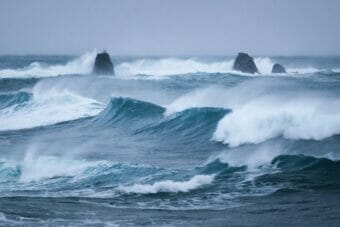
Waves from a winter storm near Kodiak on Dec. 26, 2022. (Brian Venua/KMXT)
The National Oceanic and Atmospheric Administration has declared this year’s climate to be an El Niño year based on conditions in the Pacific Ocean.
El Niño and La Niña are Spanish for “the boy” and “the girl,” respectively. But when it comes to climate, they’re part of an irregular cycle of sea surface temperatures in the Pacific Ocean near the equator.
This year, NOAA declared conditions are most in line with El Niño. That means Alaskans will likely see slightly higher temperatures and more storms, especially around the Gulf of Alaska. But high altitude winds like the jet stream are weaker in the summer, so the effects won’t be noticeable until later this year.
“It’s really as we move into the fall time and the storming increases again that we see the main effects of El Niño,” said University of Alaska Fairbanks climate specialist Rick Thoman.
He said just a few degrees difference near the equator changes where tropical storms form and can affect weather all around the ocean.
“Variations in ocean surface temperatures of one or two degrees 1,000 miles from Hawaii can wind up affecting our weather because those big, giant tropical thunderstorms can control how the jet stream flows and meanders at higher latitudes,” he said.
But Thoman was also quick to point out that while El Niño is the current prediction, weather can be fickle. El Niño and La Niña stack the deck towards certain conditions, but they’re just one factor forecasters take into account.
“There have been El Niño years when it has wound up colder than normal but we’re loading the dice to be warmer than normal for the upcoming winter,” he said.
El Niño conditions typically last nine to 12 months. The longest El Niño recorded lasted about a year and a half from summer 1986 through spring 1988, but it could dissipate as early as spring of next year.
Federal and state researchers in Kodiak hope work being done in the lab will provide more information about how Bering Sea crab populations handle climate change. (Elyssa Loughlin/Alaska Public Media)
The snow crab population in the Bering Sea off the western coast of Alaska has fluctuated for decades. An increase in young crabs back in 2018 gave way to optimism that fishing would be good for years to come, but the hope was short-lived.
Gabriel Prout and his family own the fishing vessel Silver Spray in Kodiak, Alaska.
He said it was obvious something was wrong the last few years. The Bering Sea fishing grounds are usually covered in sea ice in the winter. But there wasn’t much ice, and they fished further north than usual. Finding snow crabs was still difficult.
“It was just very poor fishing,” said Prout. “We searched for miles and miles and miles and really didn’t see anything.”
The fishing vessel Silver Spray has been tied up at the dock in Kodiak since the Bering Sea snow crab season for this year was canceled. (Elyssa Loughlin/Alaska Public Media)
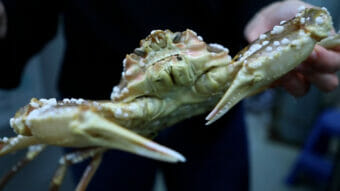
More than 10 billion Bering Sea snow crabs disappeared in Alaska between the years 2018 and 2022, devastating a commercial fishing industry worth $200 million just last year. The population crash coincided with a marine heat wave that hit the Bering Sea. Now, fishermen and researchers are working to figure out what happened, and they think warmer ocean water could be to blame.
Bycatch, which is the catch of a non-target species, has also drawn criticism from fishermen for its effect on the snow crab fishery. Even with the fishery closed to crabbers, the bycatch limit for the trawl sector is 3.6 million individual snow crabs this season.
But such a large, sudden die-off and the lack of sea ice was a red flag for scientists like Erin Fedewa, a research fishery biologist with the National Oceanic and Atmospheric Administration.
“That was an immediate potential smoking gun when we saw this Arctic species suddenly in decline,” she said.
That’s because sea ice is an important ingredient in the snow crabs’ life cycle. In the winter, it accumulates on the water’s surface. And during the summer, the ice melts, sending cold, dense water sinking to the ocean floor, where it hovers just above freezing at around 35 degrees.
Scientists call it the cold pool, and it’s a sanctuary for young crabs. Warmer temperatures can lead to starvation, and higher rates of disease. At the Kodiak Fisheries Research Center, state and federal researchers are piecing together how all those factors contributed to the crabs’ collapse.
Tanks filled with seawater pumped in from the bay replicate conditions on the seafloor.
“And then we can hold the different portions of the same population in, say, five degrees Celsius, eight degrees Celsius. And we can begin to look at the response of those species once they’re in these warmer temperatures,” said Fedewa.
Researchers study juvenile crab populations at the Kodiak Fisheries Research Center in Kodiak, Alaska (Elyssa Loughlin/Alaska Public Media)
Scientists use the pools to study how different temperature and pH levels affect the crabs’ development — how fast they grow and how quickly they die.
“We know that increases in temperature increase metabolic rates of fish and crab, causing them to need to eat more and more,” said Fedewa.
In a shrinking cold pool, that means more crabs pushed into the smaller space, fighting for less food. Across the hall from the federal lab, Ben Daly, a research coordinator with Alaska’s Department of Fish and Game, is also trying to figure out how a smaller cold pool affects crabs in the Bering Sea.
“That’s part of what we’re doing now is trying to untangle the what happened part. That’s only half of the challenge. The other half of the challenge is what do we do next,” he said.
His team has been tagging crabs in the wild with satellite transponders that will track their movement over time. He’s hoping the tags provide more detailed information about the distribution of crabs across the cold pool.
And in March, a group of state and federal researchers headed out on the Silver Spray to continue studying crab populations outside the lab. Federal scientists complete population assessments in the Bering Sea annually in the summer.
Ahead of the trip, Gabriel Prout said this winter survey is a big step in understanding more about the species overall.
“We’ll be doing 20 days of pot survey and pot pulling, measuring the crab, sexing the crab, and sizing the crab,” he said.
And tagging the crabs with Daly’s satellite transponders.
Prout and his family are grateful for the work. The many fishermen that rely on snow crabs for income are left with more questions than answers right now.
“We’re sitting tight trying to count our pennies and figure out how to make our way forward,” Prout said.
Scientists say it will likely take years before the snow crab population rebuilds. If another marine heatwave hits the Bering Sea, it could be even longer. But they’re hopeful that lessons learned from snow crabs might provide insight into how other marine species handle climate change as the ocean warms.
This story was created in collaboration with NOVA with major funding from the Corporation for Public Broadcasting.
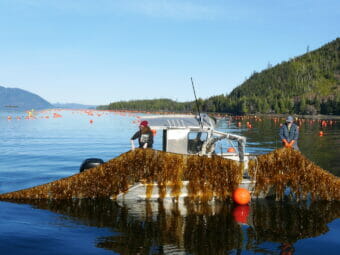
Tiffany Stephens, left, works at the Seagrove Kelp farm in Doyle Bay near Craig on April 14, 2021. Seaweed farming is seen as a promising new industry in Alaska, with both economic and environmental benefits. But seaweed cultivators face several challenges. (Photo by Jordan A. Hollarsmith/NOAA Fisheries, Alaska Fisheries Science Center)
Alaska’s mariculture industry was awarded $49 million in federal funding last year to develop the state’s burgeoning kelp market. Now, industry leaders are looking across the Pacific Ocean for inspiration on how to keep the state’s kelp scene growing.
Nick Mangini is a kelp farmer and mariculture director for the Southwest Alaska Municipal Conference, one of the organizations in charge of distributing the funds. He was in South Korea earlier this month touring kelp farms and processing facilities. Asian countries – including South Korea – make up the bulk of the world’s kelp market.
“Every time I go to a conference or something where it’s all mariculture-related business people, whether that be farmers or industry, you kind of get this buzz and everybody gets excited,” said Mangini. “And it’s what keeps us going right now.”
Mangini and his colleagues are looking to countries like South Korea for inspiration as Alaska overcomes well-documented hurdles in its own budding industry. For one, the state has a processing gap when it comes to kelp – that’s where Mangini says the South Korean farmers have a big advantage.
“They bring in the kelp and hand lay it out in a field and let it air dry, where we don’t have that climate that would allow that, number one,” he said. “And rules through the FDA [Food and Drug Administration] are just going to be way too stringent to make something like that happen.”
Mangini said many kelp farms in South Korea also use seaweed and shellfish cultivation in tandem to maximize their crop.
“So, 70% of the species of kelp that’s most similar to what I grow comes straight off a farm and goes straight into an abalone culture to feed the abalone year round,” he said.
The South Korea visit was sponsored by the World Wildlife Fund and included other kelp farmers and processors from North America and Europe. Mangini said connecting with them was just as informative as meeting with the trip’s South Korean hosts.
“Possibilities for future collaborations with people from the East Coast and the West Coast, people from Canada and Alaska, even into Europe. Just seeing the different products and species and processes that everyone uses was a big part of this for us all too.”
Mangini was one of Alaska’s first kelp farmers. He put in his application for a plot by Near Island – right near the City of Kodiak – in 2016 and harvested his first crop the year after that. Two other people started out the same year as him.
It’s taken off since then; there’s currently 82 mariculture operations in the state, according to the National Oceanic and Atmospheric Administration, and just last year, Alaska kelp farmers harvested 650,000 pounds of seaweed.
That’s a tiny fraction compared to South Korea’s production. But Mangini says Alaska’s mariculture industry has the potential to be a leader by volume — just like its finfish fisheries. He said another big step is getting commercial fishermen to see the industry’s value as a source of income in between fishing seasons.
“I would just hope that we could work together and they could see this as an opportunity for them to use their boats or even, you know, have their own farms in the future,” he said.
Mangini said with federal funds on the way there’s real momentum for the industry in the state. He’s hopeful lessons from the trip will help ease some of the growing pains.
The boardwalk to high ground in Hooper Bay was wiped away by floodwaters. (Photo by Will McCarthy/KYUK)
The state of Alaska recently received $38 million from the Department of Housing and Urban Development with the aim to ease the burden of climate change.
Margaret Salazar is HUD’s Northwest Regional Administrator. She oversees HUD programs in Alaska, Oregon, Washington, and Idaho. Last week she attended Arctic Encounter, the largest annual arctic policy event in the country, where she made the announcement.
Salazar says the new funding is to help villages get ahead of natural disasters.
“We’re helping folks work upstream with things like technical assistance to start planning ahead for housing development, as opposed to just funding the sticks and bricks part of housing supply,” she said.
The money was made available through the Community Development Block Grant Disaster Recovery Program. These funds are aimed at helping communities better rebound from presidentially declared disasters, but Salazar says the state will be allowed to allocate the new funds for preventative measures.
“Now when the state of Alaska, who’s our grantee, when they get those dollars, they can use some of them for that planning work,” she said. “This is brand-new policy that we’ve rolled out.”
Salazar says she hopes to fund plans before natural disasters happen.
“Village relocation, and rising water levels and soil erosion are forcing folks to make some impossible choices about relocating their homes,” she said. “And one of the exciting opportunities we have right now is the opportunity for HUD to align and join forces with our other federal agency partners.”
Some of the departments she listed include the Environmental Protection Agency, the Department of Energy, and the Department of Transportation.
But climate change isn’t the only issue Alaskans face when it comes to housing. Unlike communities on the road system, folks in bush Alaska can’t commute for work, so housing can be a limiting factor for growth.
Salazar said her trip to Kodiak last week gave her a new perspective on the issues Alaskans face when compared to their rural counterparts in the lower 48.
“What we see and what we heard today in Kodiak was just the lack of being able to expand economic opportunities because of a lack of housing,” she said. “So if we can’t find ways to house our folks, we can’t find ways to expand job opportunities and it becomes a cycle.”
But developing new housing is especially difficult for communities that aren’t directly connected to Anchorage. Rural communities often face high costs for shipping, difficulty accessing building supplies, and even finding workers to do the construction.
To reduce some of the barriers local governments face, Salazar says HUD also approved new grants to help them work out regulations that prevent housing development.
“Whether it’s things like zoning or building codes or permitting process, we can be a partner in terms of federal dollars but we want to make sure that the local folks are doing their work to have a plan ready to have shovel ready dirt so that when we can funding housing development, we can get that done quickly,” she said.
And while she praised local entities like the Kodiak Island and Cook Inlet Housing Authorities, Salazar says there’s still more work to do and looks forward to continuing partnerships with entities around Alaska.
Sen. Lisa Murkowski and Rep. Mary Peltola addressed attendees virtually for the kickoff forum of ComFish on Thursday, March 16, 2023. (Brian Venua/KMXT)
Alaska’s congressional delegation says species collapse in Alaska’s fisheries is nearing crisis levels. Sen. Lisa Murkowski and Rep. Mary Peltola discussed the monumental challenges faced by Alaska’s fishermen and coastal communities during their legislative update on the opening day Thursday of Kodiak’s annual commercial fishing trade show, ComFish.
Murkowsi and Peltola kicked off ComFish’s federal legislative update with a brief acknowledgement of the Willow project’s recent approval — calling the $8 billion oil development a win for the state of Alaska. Sen. Dan Sullivan was not at Thursday’s forum due to a scheduling issue. He’ll speak on Saturday instead.
But much of their time was spent detailing the uncertainties caused by species collapse in the waters off Alaska’s coast. Murkowski said the declines in salmon, crab and halibut fisheries across the state are at crisis levels.
“I don’t like to use the word ‘crisis’ lightly, but I think crisis is the appropriate word here. I wish that we could tell you the exact causes, I wish there was one single thing to explain everything,” she said.
Population declines that were once “acts of God are becoming trends of nature,” Murkowski said, adding that current fisheries management doesn’t always reflect what’s happening in the water.
“Our management systems are not inherently nimble. And that’s a challenge for us,” Murkowski said.
Alaska’s congressional delegation has been pushing for more funding to study the effects of ocean variability caused by climate change.
Murkowski said that includes money for more bottom trawl surveys, and programs through the Pacific Salmon Treaty. Murkowski said nearly $3 million had been allocated for the research in the Bering Sea through the Bering Sea Fisheries Research Foundation. And money from the Bipartisan Infrastructure Law will also help coastal communities facing reduced revenue streams from crashing fisheries.
Peltola took time to call out bycatch, which is the incidental catch of a non-target species, saying not enough is being done to understand and address the issue.
“I just really want to be clear that I personally feel like we can be doing better. Progress has been made, but we can’t settle for the status quo, we need to make changes at a much faster pace than we are today,” Peltola said.
In a followup forum later that day, members of the state’s Bycatch Review Task Force detailed some of what those changes might be.
The group published a series of recommendations late last year, including the development of a statewide bycatch policy — bycatch is currently regulated federally under several federal policies, including the Magnuson-Stevens Act – and updating the types of gear and how much bycatch is allowed for certain vessels.
But according to the task force, shifting distribution patterns of marine species as ocean temperatures change also presents a hurdle to developing effective solutions.
Murkowski said there needs to be a collaborative approach to address the whole problem.
“We need to be working together to find these solutions because the challenges really are too great for anybody to face alone,” Murkowski said.
That process will take time, although Peltola noted that probably wasn’t satisfying for anyone in the room.
“Even if we do everything right starting today, it still could take 30 years for our fisheries to fully recover, and we really need to be clear about the timeline that we’re looking at. But we can’t let the perfect be the enemy of the good, we can’t hold ourselves back from making every marginal improvement that we can,” she said.
Peltola and Murkowski spoke for about an hour including a question and answer session. Both also addressed the lawsuit against Southeast Alaska’s king salmon fishery brought by a Washington-based environmental group, saying it was an effort to bully the fleet, and they would stand united in fighting it.
Safeway’s produce section was nearly cleaned out after rough weather delayed food shipments to the island; March 4, 2023. (Kirsten Dobroth/KMXT)
Grocery store shelves in Kodiak were bare this weekend after rough weather delayed food deliveries to the island. An emergency cargo flight filled with provisions landed in Kodiak Sunday morning to help fill the gap.
Kodiak depends on barges to bring in everything from milk and meat to cereal and bread. The last barge delivery was nearly two weeks ago, on Feb. 22.
Safeway on Mill Bay Road is the only large grocery store on the island. And store management expected a resupply stop ahead of this past weekend. But snowstorms and gusty weather, including hurricane-force winds, scuttled those plans.
“In my entire career, I’ve never seen two successive bypasses,” said Mike Murray, the store director of Kodiak’s Safeway.
He said with the exception of some nonperishable goods, the store had been nearly cleaned out by this weekend.
“Frozen foods was catastrophic,” said Murray. “I have just a few bags of frozen vegetables and pizzas, etc. And then on into the dairy aisle where we ran out of milk, virtually all milk products, eggs, cheese, probably 85% of our yogurt, and 70% of our juice products.”
The store’s produce shelves were also nearly empty. The bread aisle took a big hit. So did the meat department. Several restaurant owners also posted in a popular community Facebook page that they were running low on supplies.
Management from Safeway and shipping company Matson chartered a military transport plane to fly in an emergency food delivery on Sunday morning. Kodiak-based Advantage Air Freight helped unload supplies once they landed.
Murray said they were able to source some provisions from the grocery chain’s Anchorage warehouses, but it took a boots-on-the-ground effort to get other products back to the island.
“Whatever milk or meat products we got was a handful of people in Anchorage going from store to store picking up what they could, what those stores could spare so that we could fill that airplane out,” he said.
Murray said it’s only a fraction of what they needed, and shelves were almost bare again Sunday night. The next barge was scheduled to arrive in Kodiak on Monday evening.
Close
Update notification options
Subscribe to notifications
Subscribe
Get notifications about news related to the topics you care about. You can unsubscribe anytime.