Food

That figure you’ve heard on how much food Alaska imports? It’s not real.

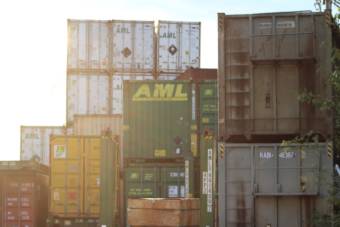
A stack of shipping containers
Shipping containers in Wrangell. (Photo by Sage Smiley / KSTK)

When people talk about Alaska’s reliance on imported food, they nearly always cite the same number: 95%.

The figure has been around for decades – appearing again and again in executive orders, media reports, state-commissioned analyses and speeches. But food systems experts can’t trace the number back to a verifiable, data backed source – or crunch it themselves.

“I think it is a very useful thing to just note that it is made up,” said Rachel Lord, policy director at the Alaska Food Policy Council, a Homer based nonprofit.

That’s not to say the figure is totally off base. It’s well established by now that the vast majority of food Alaskans purchase is imported from elsewhere. And Lord is among those who have said 95% is a reasonable ballpark estimate.

But uncertainty around the figure underscores the complex nature of tracking whether Alaska is becoming less dependent on imports over time – even as the Dunleavy administration seeks to push the state in that direction.

“How do we know if we’re succeeding, if we don’t actually have any metrics?” said Lord, who also spoke to the challenge in a recent High Country News article.

Glaring red flags

So where did the 95% figure come from? A web of reports and academic papers point in a few different directions.

A 2023 report prepared for Dunleavy, for instance, says the figure hasn’t been “substantiated, nor updated” since a journal mention in 1987. Another paper, published in 2010, says it dates back to the 1970s – and also nods to uncertainty around its precision.

“In 1977 it was estimated that 95 percent of food in Alaska is imported, despite our seemingly large number of avid gardeners, hunters, and fishers,” the paper says. “This figure has been used by many sources since then but research to verify it only began recently.”

A third report, published in 2014, attributes the statistic to speeches made by two different people, one in 1977 – and the other in 1998.

Original source aside, the figure has a few glaring red flags, said Mike Jones, a food systems economist at the University of Alaska Anchorage.

“Our biggest warning with something like this 95% statistic is that there are no units attached,” he said. “Is it 95% of the dollars we spend on food? Is it 95% of the weight of the food we have? Is it 95% of the calories of the food that we have?”

On top of that, it’s almost never framed consistently. In many instances, people will say 95% of Alaska’s total food supply is imported. But that doesn’t account for the significant role that hunting, fishing, farming and foraging play in local food systems.

“It’s [95% of] purchased food,” Lord said. “In rural Alaska, and a lot of communities, a huge amount of food eaten is subsistence, wild foods.”

Still, the figure abounds. As recently as March of this year, the Dunleavy administration included it in a video caption on Facebook, in which the governor announced his plan to create a Department of Agriculture.

“Alaska imports 95% of its food, but we don’t have to,” the caption reads. 

A data challenge

As Jones sees it, the figure seems to have been repeated so often, for so long, it’s become conventional wisdom. But he’s not convinced it should stay that way.

“I think we search for numbers in describing the scope of a problem. And it’s appropriate to look for numbers,” he said. “I think if we’re using a number, then it’s important that it definitely comes from a verifiable source.”

So why isn’t there a verifiable source? The short answer is that it’s a complex math problem that’s made more difficult by major data gaps around both imports, and locally sourced food.

The point of doing that math would be to pinpoint a figure that would help track progress over time. But for the time being, Jones said, it might be better to rely on adjectives, as opposed to percentages.

“I tried very hard to use publicly available, particularly federal statistics, to be able to infer that for the state. And I found it to be a very, very difficult exercise.”

A spokesperson for the governor’s office nodded to Dunleavy’s plan to create an agriculture department as a potential solution.

“An additional benefit of the Department is that it will be able to facilitate collecting more detailed data that will allow for more precise, Alaska-specific food system measurements moving forward,” Deputy Press Secretary Grant Robinson wrote in an email.

Lord, of the Alaska Food Policy Council, said her organization is working on a grant-funded database with the same goal.

Lessons from Vermont

The challenge isn’t isolated to Alaska. David Conner is an economist with the University of Vermont who led the state’s efforts to count local food.

Conner and his team relied on some of the same datasets Jones has worked with. But he also built on that data by reaching out to grocery stores, schools, hospitals, distributors and more to get a sense of how much local food they purchased in the previous year.

From there, the researchers did their best to avoid counting any sale twice, and asked important questions like – is beer food?

“We have a fairly vibrant local brewery scene,” Conner said. “Do we count that?”

There’s also the reality that many agricultural products aren’t ultimately consumed by humans – or consumed locally. Like hay, which is used for livestock. The same is true in Alaska, where hatchery activity and floraculture – namely, peonies – make up for a substantial chunk of the agricultural production.

Back in Vermont, the researchers ultimately estimated that the state had likely surpassed its own goal to ensure local food accounts for 10% of total consumption.

Still, they wrote, “local food consumption estimates such as ours should not be taken at face value to the large data gaps.”

It all underscores that Alaska isn’t alone in importing the vast majority of its purchased food. That’s the case given that different areas are better suited to different crops – and that the U.S. food system hinges on long and winding supply chains. It’s true even in states with booming agriculture sectors.

“In many, many cases, food-producing regions are also the most food insecure, because the food is grown for export markets, not for local consumption,” Conner said.

Jones, with the University of Alaska, said it’s a good thing that Alaskans can access foods grown really far away. It’s necessary from both a nutrition and financial standpoint.

“I’m sure you could grow a mango in a Conex in Alaska. But nobody is trying to buy a $100 mango,” he said.

Still, many states think very hard about boosting local food production – and for good reason, Jones and Conner said. Doing so is good for the planet and yields fresher food.

“Maybe more importantly, when you buy locally grown food, the money tends to circulate more times in the economy and generate more wealth and more income before it leaves,” Conner said. “So it can really be an instrument of economic development.

A new farm in Haines has grown thousands of pounds of produce for the community

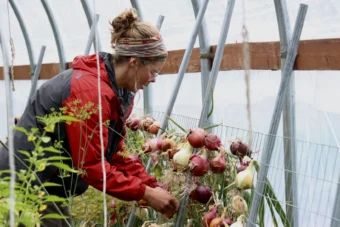
Liz Landes arranges recently harvested onions at Henderson Farm in Haines. (Avery Ellfeldt/KHNS)

Just off Main Street in Haines, a large field sits in the shadow of Mount Ripinski.

For a few years, the land sat empty. Local Liz Landes would look at it and think: “Why isn’t that full of food?”

Now it is. Or at least, it was in September, during a tour of the property at the tail end of the harvest season.

After pulling on her rubber rain gear in the high tunnel, Landes walked into a downpour and weaved through rows of kale, herbs, pumpkins and sunflowers. She pointed out black and red currants, broccoli, cauliflower, brussels sprouts, asparagus and fava beans she said were “desperately ready to harvest.”

“We’ve already surpassed 1,000 pounds for the season,” Landes said. “And honestly, we could easily have another 1,000 more with what’s still left to harvest.”

Local farmers rented the site until 2021. But then it sat unused until a new venture, known as Henderson Farm, started up before the 2024 growing season. The effort is funded by a Portland-based nonprofit called Ecotrust and fueled by the work of volunteers and local contractors, including Landes.

Liz Landes arranges recently harvested onions at Henderson Farm in Haines. (Avery Ellfeldt/KHNS)

The farm is a bright spot for the local food system and southeast Alaska, both of which rely heavily on food that’s shipped in from incredibly far away. That process results in less fresh, less nutritious produce, Landes said, and it leads to extraordinary amounts of waste.

As she sees it, nothing encourages cutting down on waste more than toiling in the soil week after week. She points to some healthy-looking purple cabbages, which she says require a lot of time – and effort – to grow.

“I’m gonna use every freaking leaf of every cabbage that I harvest,” Landes said. “And the pieces that I can’t are gonna go into compost to make my cabbages next year.”

This year was the farm’s first full season. As of early November, seeds planted on about three quarters of an acre had yielded more than 2,800 pounds of food and counting. Landes says there will be greens to glean through the first snowfall.

None of the produce is sold. It’s all shared throughout the community, either in exchange for work or for free.

A significant chunk goes to the farm’s volunteers and contractors. But it also goes to the local senior center, a food pantry in Klukwan, a food hub in Mosquito Lake, and other community groups – like volunteer firefighters.

Helping distribute the food is one of the best parts of the job, Landes said.

“Generally, I get to go around and be the little vegetable fairy and say, ‘Thank you for the time that you give to other people, here’s a bag of peas,'” she said.

Liz Landes arranges recently harvested onions at Henderson Farm in Haines. (Avery Ellfeldt/KHNS)

The operation is far from easy. But the farm is in somewhat of a sweet spot when compared to other parts of the Chilkat Valley and Southeast more broadly.

Taken together, the property’s workable soil, Alaska’s long summer days, and Haines’ relatively dry and warm climate are a big help.

“It’s not perfect,” she said. But “in many, many ways, the daylight itself here, with the right distribution of rain, does the work for you.”

Looking ahead to next year, Landes said she wants to continue recruiting more volunteers and potentially expand the growing area to a full acre. She also has a more specific, personal goal: making an all-Alaska gumbo.

That will hinge in part on how her okra – which grows well in hot, dry conditions – does next year.

Haines and Skagway collect donations for people displaced by Typhoon Halong

The tops of several canning jars, labeled with stickers showing a formline illustration of a fish and the words "Saak Eix̲í"
The Chilkoot Indian Association will ship donations to Anchorage, including these jars of saak eix̲í, or hooligan oil. (Avery Ellfeldt/KHNS)

Haines and Skagway have joined communities across Alaska that are doing what they can to support the more than one thousand people displaced by ex-Typhoon Halong last month.

Skagway’s donation drive is focused on clothing and gear, as opposed to food. Residents have until the end of the day on Wednesday to drop items from a long list at the Dahl Memorial Clinic, the local health care facility. Donations will be handled by nonprofits in Anchorage.

“The items that they’re looking for are clothes of any sort, preferably new, sleeping bags and pillows and hygiene items like toothbrushes and things of that nature,” said Albert Wall, the clinic’s executive director.

Wall emphasized that people should bring items that are either new or gently used – and clean. Other acceptable donations include air mattresses, duffle bags, cell phone chargers and crafting supplies.

“We’ve had a pretty good response so far,” Wall said.

In Haines, meanwhile, the Chilkoot Indian Association initially asked the community to drop off traditional, harvested foods. But council President James Hart says they will accept any food donations, as long as they’re shelf stable and not expired.

“The preference would be something that you harvested,” he said. “But we shouldn’t be pushing anything away.”

On Monday, at the tribe’s downtown office, there were several boxes of canned goods, including sockeye salmon, homemade applesauce, highbush cranberry juice and hooligan oil.

Soon, there will also be three cases of canned seal meat. Hart, along with locals Zack James and Nels Lynch, harvested the seal in late October to contribute to the effort.

Hart said he knows first-hand how important it is to help when communities are struck by disaster, referring to the 2020 atmospheric river event in Haines that triggered widespread destruction and a fatal landslide.

“I know how much we pulled together as a community, and how much outside help we received, so having the opportunity to give back in that way is special,” he said.

“My heart goes out to all those folks and the challenges they’re going to be going through,” Hart added. “They just went through a whole harvest season, and I’d assume all of that has been lost. That’s so hard to hear and think about and even fathom.”

Alaska opens two special hunts to aid Southwest Alaska residents affected by typhoon

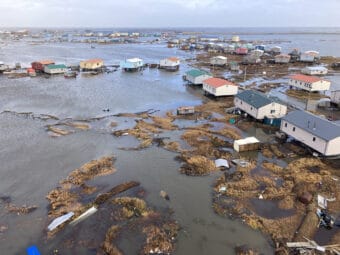
The village of Kipnuk, largely submerged by the remnants of Typhoon Halong, is seen from the air on Oct. 12, 2025. Alaska Air National Guard rescue personnel conducted search and rescue operations there, and the Alaska Division of Homeland Security and Emergency Management has worked with the Alaska Organized Militia and the U.S. Coast Guard in the response. (Photo provided by the Alaska National Guard)

On Wednesday, the Alaska Department of Fish and Game will open an emergency moose hunt in Southwest Alaska, near the town of Quinhagak, in order to help victims of ex-Typhoon Halong, which devastated communities in the Yukon-Kuskokwim delta last month.

It’s the second emergency hunt that Fish and Game has opened to help storm victims refill their freezers before winter deepens, and it’s only the latest example of how Alaska state agencies have helped in unlikely ways after last month’s disaster, which killed at least one person and displaced hundreds.

Elsewhere, officials from the Alaska Department of Education and Early Development have been coordinating new schools for evacuees who needed to move to Bethel or Anchorage.

The Alaska Department of Environmental Conservation has been helping wrangle fuel tanks set adrift in floods. Workers from the Division of Forestry and Fire Protection have been helping muck out homes, remove debris and deliver supplies to villages alongside the Alaska Department of Transportation and Public Facilities and the Alaska National Guard.

In Anchorage, hundreds of miles away from the villages hardest hit by the storm, about 20 employees of the state-owned Alaska Housing Finance Corporation worked for weeks to find long-term shelter for hundreds of Alaskans who lost their homes in the disaster.

On Monday, state and city officials in Anchorage said they had closed the last mass shelters being used by evacuees because everyone had found hotels or apartments suitable for long-term use.

“This isn’t something we normally have done,” said AHFC CEO/Executive Director Bryan Butcher on Oct. 22 of the push to help evacuees find housing. “There have been different times … that people have reached out to us and asked for assistance, and we try to help when we can.”

Butcher said AHFC employees spent time checking for available state-owned housing and tried to connect evacuees with available apartments and housing across the state.

“We’ll play whatever role we need to play,” he said in late October. “And at this point, it’s just the gathering of units and then trying to help kind of piece it together so it makes the most sense and has the least amount of disruption.”

At the Department of Fish and Game, Ryan Scott is the director of the Division of Wildlife Conservation, which oversees hunting practices and issued the emergency hunting order this week.

“Our staff has been in communication with the communities, plus people who evacuated to town. And you know, I’m very proud of them, but I’m super thankful that we could help out where we could,” he said.

Scott said the department frequently gets requests for emergency hunts, but they’re only allowed in places where the population of prey animals is large enough to support them.

While the two emergency hunts in Southwest Alaska are intended to help people affected by the disaster, any state resident can participate if they meet the guidelines.

The food generated by the hunt may even be able to help people who evacuated from the area; Alaska has a system of proxy hunting that allows someone to hunt on behalf of someone else who is elderly or disabled.

In addition, evacuees may be able to take advantage of winter hunts or small-game hunts, or other subsistence activities, Scott said.

“We get into this type of work not only for the wildlife resources, but across the board it’s about the people too, you know? And then whatever we can do to help Alaskans, that’s what we want to do.”

Juneau residents left in limbo as SNAP battle continues at national level

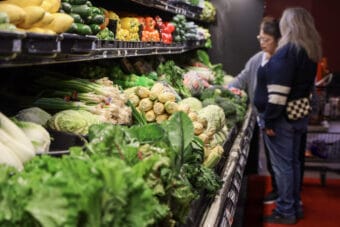
Shoppers grab produce at Foodland IGA in downtown Juneau on Tuesday, April 29, 2025. (Photo by Clarise Larson/KTOO)

Thousands of Juneau residents will be in limbo as of Saturday, when SNAP benefits officially become a victim of the political battle between Congress, the Trump administration and the federal courts. 

As the government shutdown continues, the Trump administration announced earlier this month that it would not use contingency funds to allow Supplemental Nutrition Assistance Program payments to continue. On Friday, federal judges ruled that the administration must continue the payments either partially or in full.

But benefits are unlikely to be distributed on Saturday as scheduled, and it remains unclear when and how much of the expected funds will go out to American families. That leaves as many as 2,000 SNAP recipients in Juneau without the means to buy food. 

Former Juneau Assembly Member Michelle Hale wrote an op-ed for the Juneau Independent about the SNAP cutoff last week. She told KTOO that even a week’s delay makes a difference for families. 

“People are going to start going hungry tomorrow,” she said Friday.

Hale said the federal back-and-forth takes an emotional toll on the people she knows who use food stamps. 

“What for me is really unforgivable is my elderly friends or this woman that I met yesterday, how frightening this is for them and how unnecessary it is to put them through this fear,” she said. “It’s really, really scary.”

Dan Parks leads the Southeast Alaska Food Bank. He said that even before SNAP was threatened, the demand for food support grew a lot this year. It nearly doubled. 

He said the food bank is as prepared as it can be to help meet the gap in food services, but it’s not possible to fully meet it. Feeding America, the national food bank network, says that for every meal food banks provide, SNAP provides nine. 

“We can’t increase that much, that fast,” Parks said. “Nobody can. No food bank is going to be prepared to meet that kind of gap.” 

Normally, the demand is greater at the end of the month, when people run out of SNAP benefits, and then it eases up again in the next month. But Parks said he’s expecting the need will only keep increasing until people receive their payments. 

But there are ways community members can help in the meantime. 

“In order to prepare, we are watching. We are responding,” Parks said. “We aren’t panicking, but we are trying to make it known to everybody that wants to help, that there’s lots of things that you can do. You can donate time, you can donate food, you can donate money.”

Parks said people who want to help should reach out to local groups to see what is being done and how they can help. He also said they can contact the food bank’s member organizations, like St. Vincent de Paul and several local churches, that distribute food throughout the week and often need more volunteers. 

Parks said until benefits are restored, Juneau’s food support network will keep doing whatever it can to put food on tables.

This Alaska town gets weekly barges. So why do people use Instacart to fly in groceries?

Skagway resident Katie Auer said she hasn't grocery shopped at the local store in more than a year due to concerns over store quality and prices.
Skagway resident Katie Auer said she hasn’t grocery shopped at the local store in more than a year due to concerns over store quality and prices. (Avery Ellfeldt/KHNS)

This is the second story in a four-part series from the Alaska Desk called Shelf Life, which looks at food security in Alaska.

In the very back corner of Skagway’s only grocery store, a laminated sign boasts: “LOCAL GROWN.” Above it sits a container with bundles of radishes. Next to them, a few boxes of greens.

But that’s all there is. Everything else in the store is shipped in from very far away – and it shows. While walking the aisles of the AC Fairway Market earlier this month, resident Katie Auer picked up a bag of partially wilted and bruised mini peppers.

“You’re telling me I’m going to pay 9 dollars and 29 cents for a bag of peppers, that I’d have to throw away over half of them?” she said, shrugging.

Grocery chain Alaska Commercial Company bought the store in 2021 from long-time local owners. And Auer is among those who contend that the store is expensive, the shelves aren’t well stocked and the produce rots quickly.

Greens and radishes fill the small section of Skagway’s store that carries locally grown produce, pictured above in early October. (Avery Ellfeldt/KHNS)

Locals say that’s particularly true during summer – and that things are better in Haines, Skagway’s closest neighbor.

“Why is our produce so much more expensive?” Auer asked. “Why is our food in general so much more expensive than Haines, when it’s 13 extra nautical miles to get here? Why is it so much more rotten?”

A few factors drive those challenges, including shipping costs and the drastic seasonal population swings that come with hosting cruise ships in the summer.

Both make it harder to keep the store well stocked and profitable.

In response, some residents seem to be doing what they can to avoid the store entirely – including getting same-day grocery deliveries by small planes.

A catch-22 

Skagway’s supermarket woes are not unique in Alaska, where communities across the state struggle to access affordable, fresh food.

But Skagway has some advantages other remote communities don’t. For starters, it’s connected to an international highway. And like much of Southeast, it’s on the barge route, which is perhaps the most efficient way to transport food.

“Certainly, within the data I see, as Southeast compares to the rest of the state and off-road Alaska, it’s a significantly lower quantity of food that actually spoils in transit to a store,” said Mike Jones, a food systems economist at the University of Alaska Anchorage.

But different communities face different challenges. In Skagway, they largely revolve around one main issue. The town’s wintertime population hovers around 900 people. Then, in the warmer months, it booms amid an influx of tourism workers and, on some days, more than 10,000 cruise ship passengers.

Lee McKinney has managed the local store since 2021, when it was purchased by Alaska Commercial Company. (Avery Ellfeldt/KHNS)

That sets the store up for a complicated guessing game: ordering, storing and stocking enough food to last through the week without shipping in so much that products rot in storage or on the shelves.

“In the summer, I don’t have enough space to maintain all the produce I could sell,” Lee McKinney, the Fairway manager, said. “But the other side of the coin is, if I do, a larger portion of that produce is going to go bad and have to be thrown out before I do sell it. It’s a catch-22.”

During the off-season, meanwhile, people complain that store shelves appear empty and that there are plenty of products the store doesn’t offer at all. Auer noted she prefers to drink skim milk, but that the store doesn’t carry it.

Brooke Jasky-Zuber, another local, said the store has limited organic products and few meat substitutes for her partner, who is vegetarian.

McKinney said he does what he can to meet folks’ needs, including ordering entire cases of certain products if a customer says they’ll buy all of it. But he added that he has to order specialty and more popular products based on what will actually sell.

“If I bring in that full shelf load, 90% of it’s going to date out before it sells and means I’ve got to write it off and throw it away,” he said.

“We got to make sure to make money with that space,” he added.

Skagway resident Brooke Jasky-Zuber shows off tomatoes grown at the local farm run by the Skagway Traditional Council. (Avery Ellfeldt/KHNS)

Quality and cost concerns

It’s less clear why the quality of food in Skagway would be worse than in Haines or Juneau. Jones, the food systems economist, said there could be a few factors at play.

He said stores could use different quality distributors. But they don’t. The Fairway in Skagway and the two Haines stores all use Rhode Island-based United Natural Foods Inc. for general grocery items. For produce, both the Fairway in Skagway and Olerud’s Market Center in Haines use a Seattle-based distributor called Charlie’s Produce.

Another factor could be the length of time food sits on the barge. But it doesn’t take that much longer for food to get to Skagway than it does to Haines or Juneau.

Product turnover could also help explain the problem. Consider a minimum shipment of lemons. It would likely take longer to sell those lemons in Skagway than in larger communities like Juneau or Haines.

“The big challenge is maintaining your product and not seeing everything date out on you because you don’t turn it fast enough,” McKinney said.

A container of hummus at Skagway’s AC Fairway Market rang in at $7.29 early this month. (Avery Ellfeldt/KHNS)

Then there’s the issue of prices, which fluctuate frequently and are determined by factors including freight costs, corporate pricing structures and more.

KHNS compared eight products at one store in Skagway to the same products at Howsers IGA Supermarket in Haines, including milk, various greens, and shelf-stable groceries. Everything was cheaper in Haines except spinach.

Jones, the economist, said that checks out.

“Skagway is on the high end within Southeast in terms of the prices that I can see for a couple products that happen to be right in front of me,” he said. “That’s not necessarily unreasonable, because they are farther up the barge away from Seattle.”

Grocery shopping by small plane

The challenges in Skagway underscore that even in communities with better access and infrastructure, struggles abound. And for some, the situation has reached a tipping point.

Auer, the Skagway local, said she hasn’t shopped at the Fairway in more than a year. Instead, she hits stores in Canada, Juneau and Haines when she can.

And she ships a lot of her food from out of town, including via Instacart — from Juneau.

Instacart is a service that allows people to order their groceries online and have someone pick them up at the store and deliver them to their doorstep.

In rural Alaska, it looks a little different. Customers can place their weekly orders from Skagway. Then, a driver in Juneau heads to Costco or Fred Meyer, shops, and delivers the food to the airport. From there, it’s loaded onto a flight and flown in – typically the same day.

“You can get two dozen free range organic eggs for $8 from Costco,” Auer said. “And they are $10.50 including shipping, including paying Instacart, tipping my driver and $1 per pound shipped here from Juneau.”

That day at the Fairway, there were two options for eggs: one cost $12 a dozen, the other about $9.

Brooke Jasky-Zuber walks through the Skagway Traditional Council’s farm in early October. (Avery Ellfeldt/KHNS)

Flying food around southeast Alaska is far from new. But reliance on Instacart seems to be. Data provided by the company indicates that annual Instacart deliveries to the Juneau airport have more than doubled since 2019.

Jasky-Zuber is among those who said that relying on the local store to fill her fridge and pantry just doesn’t make sense any more. For the last four years, she’s managed the local tribe’s farm, which is where the locally grown radishes and greens in the store came from.

Jasky-Zuber said she sources most of her produce from the farm in the summertime. But otherwise, she stocks up on bulk items in Whitehorse, Canada – and ships plenty in from Juneau.

“Not because I don’t want to support our grocery store. I do,” Jasky-Zuber said. But ultimately, she added, “I find mostly other ways to get the bulk of what I need.”

Site notifications
Update notification options
Subscribe to notifications