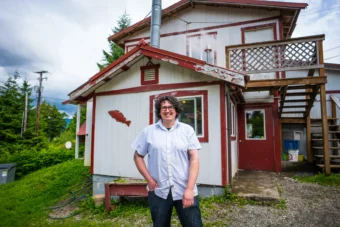
Owner Mathew Scaletta stands in front of Wildfish Cannery in the village of Klawock on Prince of Wales Island. (Bethany Sonsini Goodrich)
Wildfish Cannery was founded in Klawock, Alaska in the late 1980s by a school teacher named Phyllis Mueller. Her grandson Mathew Scaletta is at the helm these days.
Scaletta is passionate about food. He spent summers cutting fish at the cannery as a kid and then cut his teeth in the culinary world in Chicago and Portland. While working everywhere from bars to fine dining restaurants, he noticed something.
“Places were importing Spanish and Portuguese canned fish. It was kind of quietly becoming a thing,” Scaletta said. At the time, he said, canned salmon stateside was cheap – probably better for stocking a fallout shelter than a charcuterie board.
Then, Scaletta said he saw something that changed everything: an episode of Anthony Bourdain’s show “No Reservations.”
In the episode, Bourdain visits Espinaler Taverna, a tavern in the Spanish seaside town of Vilassar de Mar. The bartop is lined with dozens of bowls of oily little fish, smoked oysters, and cured seafoods.
Bourdain samples a can of razor clams that his guide tells him costs more than $150 USD.
‘Rest assured this stuff bears no resemblance to the can of smoked oysters you ate stoned and desperate back in college,’ Bourdain narrates over the din of the packed tapas bar. ‘This is the world’s best seafood and here’s what’s so mind blowing: it only gets better in the can.’
“It kind of blew my mind to see that, right? And it stuck with me,” said Scaletta.
In 2015, Scaletta’s grandmother Phyllis was diagnosed with cancer. He came home to Alaska and took over the cannery.
Scaletta said he saw a hole in the market.
“So I set out to be the first U.S.-based highend craft cannery. And we’re still there,” he said. “I’m still working on that.”
Wildfish’s garlic sumac rockfish or smoked coho go for about $10-$14 a can. The most expensive offering is a $40 can of fried king salmon cheeks. Since Scaletta started smoking salmon for the slightly spendier masses, tinned fish is officially on the map in the U.S. But he doesn’t take credit for that.
“There were other companies who came in after us, who, frankly, just had a lot more money,” he laughed.
According to Scaletta, the business – and tinned fish in general – really took off in the United States in 2020. The Wall Street Journal reported that in 2022, U.S. sales of canned seafood rose by nearly $3 billion and are still growing annually. Scaletta said he hopes to soon expand to a second cannery in Klawock. He said it’s hard to keep his more popular products in stock, nowadays, maybe partly due to some significant national attention on his company.
Marguerite Preston edits the kitchen section of Wirecutter, a product review outlet from the New York Times. As the editor, Preston doesn’t normally do the actual reviewing, but she said she really wanted to write a guide to tinned fish.
“Obviously, tinned fish has been around in all kinds of forms for centuries. In many cultures, it’s never gone out of style. But in America, it’s becoming trendy,” she said, adding that she’d been seeing sleek new brands of canned seafood everywhere. “I would say in the past maybe three years, maybe a little bit longer, we’ve just seen this growing interest, these trendy new brands, this beautiful packaging.”
Preston and her team collected over 100 different tins, jars, and cans of fish from Europe, Asia and the U.S. and laid them all out on the counter of their office in Brooklyn. They grouped the fish into categories and split up the tasting over three days.
“And then we just kind of went at it and felt really pretty ill at the end of each day to be honest,” she laughed.
Preston published her findings on Wirecutter’s website in December. The guide is like an Olympics for tinned fish, with each category crowning a world champion. Preston said when it came to sampling salmon, the unanimous favorite was Wildfish Cannery.
“I think the thing that stood out the most was the texture, it just had the most buttery, meaty, succulent texture. And then the flavor was really good too – the level of smoke. You can tell just by looking at them. They have this beautiful, kind of burnished look on top,” Preston said of Wildfish’s smoked king and sockeye salmon.
Scaletta said it was thrilling to see his small cannery getting national press. The art of canned fish isn’t a “new trend” to an Alaskan though. The state’s culture of home canning was a major inspiration for Wildfish.
“One of the most precious things an Alaskan has in your pantry is your home-pack – like your smoked and jarred salmon, right?” Scaletta said. “This is about taking what we already had, which was this culture of home-pack, and the idea of a jar of smoked salmon being elevated, and kind of bringing that to the masses.”
As tinned fish solidifies itself as a high class snack, Wildfish is going to continue to do what Alaska canneries have always done according to Scaletta – buying high-quality fish from local fishermen and canning it for the masses.
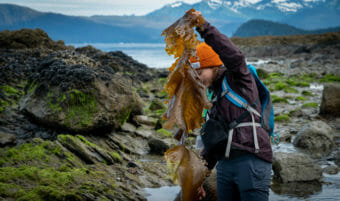
Audubon intern Mali Tamone discovers ribbon kelp at the beach near the Rainforest Trail on July 15, 2022 in Juneau. (Photo by Paige Sparks/KTOO)
The waters of Southeast Alaska are an ideal environment to grow species ranging from Pacific oysters to ribbon kelp. But growing them successfully requires in-depth knowledge of dozens of species — where they grow, when they grow, and under what conditions.
A new tool aims to make that easier.
The National Oceanic and Atmospheric Administration released a new guide earlier this month that chronicles more than 100 species of seaweed commonly found in Alaska.
“To grow it for the kelp industry, you need to know where you can find those spores, what time of year,” said Jordan Hollarsmith, a mariculture-focused research biologist with NOAA. “Or if you want to harvest it, to eat it, you need to know what you’re looking for, where you can find that species.”
The guide aims to advance the state’s budding mariculture industry at a time when global demand for kelp products is on the rise. Alaska mariculture is still tiny compared to other coastal states, like California, Oregon and Washington. But it is steadily gaining ground. All told, the state boasts more than 1,300 acres permitted for mariculture, according to a NOAA report from last year.
And more mariculture farms are coming. On average, Alaska received more than a dozen applications for new sites each year between 2019 and 2023. That’s more than double the average for the five years prior.
“A decade ago, I don’t know if there was a single farm,” Hollarsmith said. “And now we see multiple around Kodiak, some pretty small-scale ones in Kachemak Bay and in Prince William Sound, and then a few smaller, medium-sized ones and a large one as well in Southeast Alaska.”
Hollarsmith didn’t author the updated guide. But she says it will be a crucial tool as the industry develops across the state. Right now, the highest concentration of mariculture is in Southeast, with forty permitted farms, according to the 2024 report.
NOAA is also exploring where other farms might thrive. At one point that included the waters around Haines. But the agency later dropped Haines from the list because the area is near several state marine parks, which cannot overlap with farm lease applications, Alicia Bishop, a regional coordinator for NOAA Fisheries, said in an email.
Siting new farms is one of the key obstacles to growth. That’s because new sites have to meet several key criteria, including the right environmental conditions and limited overlap with other marine activities.
“You can’t set your farm where there’s already a fishery, where there’s military installations, a ferry route, those sorts of things,” Hollarsmith said.
Still, the industry is growing – and fast.
That’s largely due to a $49 million federal grant awarded in 2022 to a coalition of companies, agencies, tribes and researchers working to boost the industry. NOAA said at the time that the grant could help grow the industry to be worth nearly $2 billion within the next decade. A state task force, meanwhile, set a goal in 2016 to develop mariculture into a $100 million industry by 2040.
Driving the state’s interest in part is the industry’s potential to boost Alaska’s coastal economies. Hollarsmith thinks mariculture could offer more opportunities for people already working on Alaska’s waterfronts.
“We see a lot of people that participate in commercial fisheries also participating in the mariculture industry,” she said.
Hollarsmith says untapped opportunities for Alaskan oyster farms could also fuel growth. Kelp, meanwhile, is becoming an increasingly popular health food, and can also be used for other purposes. The industry is exploring how different species can be used as a strengthening ingredient in concrete, or in fertilizer to boost crop production.
While the new field guide doesn’t focus on the quickly growing industry, it does provide detailed information about dozens of seaweed species commonly found in Alaska. That was made possible in part by new genetic techniques, like DNA sequencing, that have allowed researchers to better classify seaweed and identify new species over the last decade.
“It’s really important that we’re all using the same name to describe a given species,” Hollarsmith said. “Especially in this time of kelp industry growth, when farmers are experimenting with new species and trying to understand what species are out there and what kind of benefits they might have.”
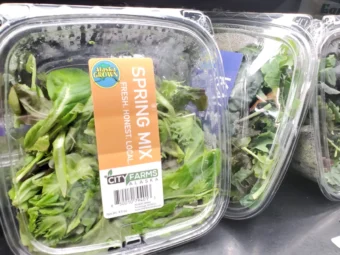
Alaska Grown-labeled salad greens are offered for sale on Jan. 14, 2025, at Natural Pantry, a health food store in Anchorage. Grocery shoppers are willing to pay a premium for locally sourced lettuce, researchers have found. (Yereth Rosen/Alaska Beacon)
How much are Alaskans willing to pay for produce that is homegrown? A newly published study has some answers: a significant premium, especially when they have information about the benefits of locally grown food.
Alaska grocery shoppers on average were willing to pay $1.90 extra for a head of lettuce if it was labeled as “Alaska Grown,” the study found. When given information about locally grown products’ benefits to health, the environment and the state economy provided by products with the “Alaska Grown” label, that premium jumped to $3.31 on average, the study found.
The study is based on surveys and interviews of shoppers at Anchorage grocery stores and farmers markets. The surveys and interviews were conducted by University of Alaska Anchorage students; the study was led by Qiujie Zheng, an associate professor of business analytics at the University of Maine. Zheng was previously at UAA.
While the surveys and interviews were conducted several years ago, in 2018, Zheng said she believes the results still stand.
The COVID-19 pandemic that came later may have changed food consumption patterns worldwide, she said by email. “However, due to Alaska’s unique geographical location, I believe that the state’s agricultural supply and consumers’ fresh produce options have remained relatively stable over the past few years,” she said.
There has been no interruption in the Alaska Division of Agriculture’s annual Alaska Grown $5 Challenge program, a summer and fall campaign that encourages residents to spend at least $5 a week on locally grown food, she noted. The information the researchers used from the state has been consistent, she added.
It was important to study consumer preferences for Alaska Grown products because the subject has gotten much less attention than consumer attitudes about local foods elsewhere, Zheng said.
And Alaska has reasons to bolster its local sources of food, she said.
“Alaska’s unique geographical location significantly influences its food supply. Since the majority of Alaska’s food is imported, Alaska’s food supply is vulnerable to supply chain disruptions and natural disasters,” she said by email. “A stronger local food system could improve the resilience of the state’s food supply. Understanding consumers’ preferences for local foods and identifying potential marketing and communication strategies are critical before promoting local food in Alaska. This helps strengthen the local food network, and, in the long run, enhances the resilience of Alaska’s food supply.”
The study also analyzed consumer preferences about lettuce labeled as organic and lettuce grown through the hydroponic method, which uses a water-based nutrient solution as a substitute for soil.
Taken in isolation, the Alaska Grown premium that consumers were willing to pay was higher than that for organic food and for hydroponic-grown lettuce. Without being given extra information about benefits, consumers were willing to spend $1.74 more for organic lettuce and 73 cents more for hydroponic-grown lettuce.
Consumer preferences were more complicated when the Alaska Grown, organic and hydroponic labels were combined and when additional information was provided, the study found.
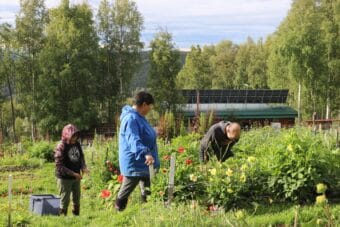
Cousins Viva Johnson (left) and Bernadette Pete harvest celery with instructor Leonardo Sugteng’aq Wassilie at Calypso Farm and Ecology Center, just outside Fairbanks, Alaska. Johnson and Pete can’t always get fresh produce in their village of Alakanuk, near the Bering Sea. In August, they participated in an Indigenous-led farmer training program at the farm. (Anna Canny/KTOO)
Growing up in rural Alaska, Eva Dawn Burk recalls hunting, trapping and going to fish camp every summer, gathering traditional foods with her family.
Burk is Alaska Native, Dene’ and Lower Tanana Athabascan. She grew up in the small villages of Nenana and Manley Hot Springs along the Tanana River in Interior Alaska, where her family and neighbors relied on the land to fill their pantries and freezers.
But that way of life is increasingly threatened. Alaska is warming faster than any other U.S. state as a result of human-caused climate change. Heat waves and other shifting weather patterns are causing chaos in ecosystems that Indigenous hunters and fishermen have long relied on, disrupting everything from the migration of caribou and reindeer to the abundance of wild-berryharvests.
“It doesn’t matter what part of the state that we look at,” says Burk, now a community food activist and a student of sustainable agriculture at the University of Alaska Fairbanks. “Climate change is wreaking havoc on the habitat and on our fish and wildlife.”
But the warmer temperatures and changing seasons have also had another impact: Climate change is making agriculture more possible in many parts of Alaska. That’s driving a new enthusiasm for farming across the state.
Few of the state’s rural villages have farms or even community gardens. So in 2020, Burk decided to start a training program to teach aspiring Alaska Native farmers how to grow their own food.
The goal, she says, is to help Alaska communities that are being most affected by climate change — and to shore up food security as traditional foods become more unpredictable.
“An Indigenous value is to be prepared for the future,” Burk says. “What our program is doing is working to prepare some of the most vulnerable communities.”
Trainers and participants with the Indigenous farmer training program at Calypso Farm and Ecology Center spent a weekend in August camping together and harvesting food for their meals. Susan Willsrud and Tom Zimmer (back row, center) founded Calypso Farm and Ecology Center with the hope of educating more beginner farmers. (Photo by Anna Canny/KTOO)
“You can’t farm in Alaska”
Alaska isn’t usually considered farm country. Much of the state has cool summers, harsh winters and a short growing season, which can make it challenging to grow anything other than hardy crops like cabbages and potatoes.
First frosts are already arriving later in some parts of the state, allowing growers to keep their crops in the field longer. Research done at the University of Alaska Fairbanks predicts the growing season could be weeks or even months longer by 2100.
Hotter summers could support larger yields, and milder winters could shift the state’s plant hardiness zones, which describe the crops most likely to thrive in a region. By 2100, the hardiness zones in Fairbanks may resemble those in modern-day Kansas or Kentucky, the UAF study found.
Even now, Alaska farmers and gardeners are experimenting with crops that have historically been extremely difficult to cultivate.
“We’re successfully able to grow things like artichokes and field-grown tomatoes, peppers and corn here in Fairbanks,” says Glenna Gannon, a professor of sustainable food systems who runs crop trials at UAF. “I don’t think 30 or even 10 years ago that would have been successful.”
The state’s tiny agriculture industry is growing fast. The number of farms in Alaska has nearly doubled over the last two decades — from just about 600 in 2002 to almost 1,200 by 2022.
But Alaska growers like Gatgyeda Haayk still encounter a lot of skepticism.
“I hear that a lot. Like, ‘You can’t farm in Alaska,’” says Haayk, an instructor at the Indigenous-led agriculture training program at Calypso Farm and Ecology Center, just outside Fairbanks. “Even when I first came here, I didn’t think of myself as a farmer.”
Haayk runs a community garden in Metlakatla, a Tsimshian village of about 1,500 people in Southeast Alaska.
She first came to Calypso as a student, learning skills like seed starting and garden planning. Now she’s eager to pass that knowledge along.
Alaska farmers will not be exempt from the downsides of agriculture in a hotter world, like increased risk of drought or pests.
But in Haayk’s eyes, farming is still one of the best ways for Alaska Native villages to adapt to climate change. Alaska Native people make up more than 20% of the state’s population. As Alaska’s agriculture industry grows, Haayk wants to see more Indigenous-led farms and gardens.
“I feel like it’s time for the Indigenous people to be the pioneers of this change,” Haayk says. “We know this land best.”
She also thinks Alaska communities need to be less dependent on the Lower 48. Alaska currently depends almost entirely on produce grown elsewhere: Almost 95% of the state’s food is imported. Most grocery supplies arrive in Anchorage on barges. From there, everything must be transported to the state’s far-flung communities, many of which are not connected to the road system. Supplies are delivered by smaller boats or planes.
Those are all issues Eva Dawn Burk hoped to combat when she founded Calypso’s Indigenous-led farmer training program a few years ago.
Eva Dawn Burk, a community food activist, visited Calypso’s farmer training program in August. Burk founded the program to grow a network of Alaska Native farmers. (Photo by Anna Canny/KTOO)
Fresh veggies for remote villages
The Calypso Farm and Ecology Center was founded in 2000, just as the current wave of interest in Alaska agriculture was starting. It’s a small farm, nestled on 3 acres of land in the boreal forest just outside Fairbanks. But it grows hundreds of varieties of fruits and vegetables, just a few hundred miles from the Arctic Circle.
Burk first visited Calypso in 2019.
“I was really in shock and awe,” Burk says. “I was like, ‘How come we haven’t ever built something like this in one of our villages?’”
By 2020, Burk had launched the Indigenous agriculture trainings, building on Calypso’s existing suite of educational programs.
Burk views growing food as a natural complement to hunting, fishing and gathering wild foods. She hopes the training program will spur more farms in rural communities, where growers will tend to crops on the same land where they smoke salmon and tan animal hides.
Burk and her partners at Calypso have already helped develop a small statewide network of Alaska Native farmers and teachers. Late last year, the nascent program received a boost with nearly $750,000 in funding from the U.S. Department of Agriculture’s Beginning Farmer and Rancher Development Program.
On a drizzly day in August, this year’s training was well underway.
Tom Zimmer, who owns Calypso Farm, dug a hole in the deep brown soil and held out a small apple sapling to a group of trainees from across the state.
“Whoever plants this, in four years you get to come back and have some apples,” Zimmer said.
Bernadette Pete raised her hand. Pete took three flights to get to Calypso Farm, traveling for 12 hours from her hometown in Western Alaska for a weekend of lessons.
She and the other trainees were learning about transplanting and seed starting, composting and soil health, and irrigation. Between lessons, they spent the weekend camping and harvesting food for meals they cooked together.
Pete stepped up, pulled the tree roots from their plastic covering, and plopped the sapling into the ground.
“Write my name on it!” she said, laughing, as she packed the soil with her heel.
Fresh apples are one food it can be hard to get back home, Pete said, along with many of the veggies she snacked on that weekend, like sugar snap peas off the vine and celery straight from the ground.
Mikkiah Goessel and Gatgyeda Haayk (right) prepare to transplant seedlings at Calypso Farm and Ecology Center. They’re instructors for the farm’s Indigenous farmer training program. (Photo by Anna Canny/KTOO)
Like almost all the students who come to Calypso, Pete has stories about how the environment around her home is changing. Her hometown, the Yup’ik village of Alakanuk, sits at the mouth of the Yukon River, near the Bering Sea.
The community of about 700 people relies on wild foods like seabird eggs, berries, moose and especially salmon, which have been hit hard by climate change.
“I notice fall flooding, a lot more rain, less fish,” Pete said.
Endless rainstorms last summer drenched the salmon on Pete’s drying rack, being preserved for winter. She had to throw much of it away.
Since salmon stocks have crashed, the region’s only commercial salmon-processing plant has started pivoting to agriculture, putting up greenhouses in Alakanuk and surrounding villages.
With the knowledge she gained at Calypso, Pete is eager to get planting.
“Everyone here is so eager to teach you. It’s like they know every plant and how it grows,” Pete said. “I want to grow lettuce, potatoes, sugar snap peas.”
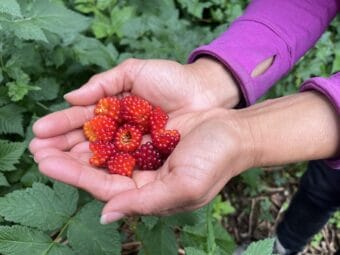
Elizabeth Lakshmi Kanter holds freshly-picked salmonberries on her land in Homer. (Rachel Cassandra/Alaska Public Media)
About 10 years ago, Genelle Winter noticed that berries in Metlakatla were much smaller than normal. So did a lot of other people in the community. Some berries were completely dried up and some bushes produced a second or even third set of flowers to try to reproduce. She said it was one of the early warning signs of what was officially deemed a regional drought in 2018.
“And then all of a sudden, all of those indicators that we had been taking note of made sense,” Winter said. “It all kind of fell into place.”
Winter, who works for the Metlakatla Indian Community in Southeast Alaska, said she’s also noticed other changes in berries since moving to Metlakatla three decades ago. She said service berries or saskatoon are thriving.
“We’re seeing more and more and more of it,” Winter said. “And I’m purely speculating that it’s because it prefers the drier conditions… It also likes more sunlight. So it’s moving into the developed areas.”
Wild Alaska berries are one of the most nutritious and antioxidant-rich foods available. But Metlakatla is just one of many Alaska communities noticing dramatic changes in berry production. In the past few years, people have reported late salmonberries in Seldovia, insects on cloudberries in Trapper Creek, oddly shaped low-bush cranberries in Anchorage and early blueberries in Fairbanks.
The changes impact berry harvests that Alaskans rely on for nutrition, culture and connection to their environment. Berries are expensive to import, so many Alaskans can’t replace them in their diet if they have a low harvest year. And any changes in berries also impact the animals that eat them, like ptarmigan, voles and bears.
Climate change is altering many different aspects of where, when and how berries grow. For the past two decades, researchers at the University of Alaska Fairbanks, or UAF, have been studying berries in Alaska.
Katie Spellman, an expert on Alaska’s wild berries and a researcher at UAF, said she hears reports on changes in berries from communities throughout the state.
“In some places it’s changing abundance or timing of the berries,” Spellman said. “And in some places, it’s increasing insect pests on their plants, or flowers frying up due to wind or drought conditions.”
Spellman and her colleagues have been collecting reports from Alaskans about berry growth and harvest. They’re also collecting data on berry size and quality, life cycle timing and impacts of snow pack to help Alaska better understand and respond to the impacts of climate change. Some of their data for blueberries dates back to 100 years ago. Their aim is to make sure Alaskans can pick both wild and cultivated berries in the decades to come.
The good news, Spellman said, is that Alaska berries are not going to disappear.
“None of them are going extinct,” Spellman said. “They might shift their regions so that we have to start using other berries as substitutes for the ones that we’ve traditionally picked.”
But she said because of climate change, Alaska now experiences more variation year-to-year in temperature, rainfall and snowfall. All of those factors impact berries in a wide variety of ways. One of the more sensitive berries, she said, is cloudberry.
“[It] used to be way more common when I was little growing up here and now, you dare not tell anybody where you found your cloudberry,” Spellman said.
Because climate change impacts are unpredictable, Spellman said the best way communities can adapt is to have a diversity of berry plants. UAF works with interested communities to gather data about how berries are growing near them and to come up with plans about how to adapt as climate change shifts berry habitats.
She said communities are getting creative to make sure they have access to berries long-term. One solution she said she loves is for blueberries in Hoonah.
“They’re actively managing the canopy in certain patches on the north side and south side of slopes,” Spellman said. “So that in hot years, the north side is more productive, and in cold years, the south side is more productive, so that they always have some sort of berry patch for their community to go to.”
In Metlakatla, Genelle Winter is part of a team working to increase community resilience and food security.
Because the community has noticed serviceberries are thriving, they’re including the species in their unfolding food forest plan. Winter said they’re planting as many fruiting and edible plants as they can throughout the community, swapping them out when ornamentals need replacing.
“We’re all really working hard to try to make sure that we’re preserving these species for future use, as well as trying to document the knowledge associated with how to use and how to preserve the various berries,” Winter said.
She and her colleagues are working with kids to plant, harvest, and gather data about berries and other fruit in Metlakatla. They hope that means people in Metlakatla can harvest berries for many generations to come.
UAF is holding a free online class on Aug. 28, from noon-1 p.m, for Alaskans who want to learn more about climate change impacts on berries and how their communities can adapt.
Shoppers come and go from Fred Meyer and Carrs stores that face each other across the Seward Highway in Midtown Anchorage on Thursday, Aug. 8, 2024. The parent companies of the competing businesses, Kroger and Albertsons, want to merge. (Matt Faubion/Alaska Public Media)
Most Alaskans live in a community where a Fred Meyer store competes directly with a Carrs or a Safeway, so the proposal for one parent company to buy the other for $24.6 billion has a lot of Alaska consumers worried.
Here’s what we know about where the proposal is now, after it was first announced in October of 2022.
What’s at stake?
If you take what the companies are saying in good faith, not much. They’ve made sweeping promises about the good things that will happen and the bad things that won’t if Kroger, which owns Fred Meyer, is allowed to buy Albertsons, which owns Safeway and Carrs. The companies say investors, customers, workers and communities are all supposed to benefit.
“We are confident our transaction with the proposed divestitures will mean lower prices and more choices for customers,” Kroger CEO Rodney McMullen said in a video about the proposed merger. “It will mean more opportunities for retail associates to grow their career while we secure the future of good paying union jobs.”
Here are some of the specific promises Kroger and Albertsons have made:
No store closures
No pharmacy closures
No front-line job losses with protection for worker pay and benefits
A $500 million investment in reducing prices
A $1 billion investment in employee benefits
A $1.3 billion investment to improve Albertsons stores
Kroger points to its 20-year track record that includes lowering its profit margins to keep prices down amid past acquisitions.
How can all of these promises be possible?
The idea is if Kroger and Albertsons merge, they’ll be in better shape to compete with even bigger retailers, like Costco and Walmart, as well as growing competitors, like dollar stores that now sell groceries and even Amazon. Bigger scale means bigger efficiencies, and that’s where the upside is supposed to come from.
Of course, most Alaskans live in communities where Fred Meyer competes with Carrs or Safeway. Specifically, that’s Anchorage, Eagle River, Palmer, Wasilla, Fairbanks, Juneau and Soldotna.
Federal regulators are wary of mergers because they can be anticompetitive, concentrating too much market power and hurting regular shoppers. To try to win regulators’ approval, Kroger and Albertsons say they’re prepared to sell off all 15 of the Carrs and Safeway stores in those Alaska communities, plus three more in Girdwood, Kenai and North Pole, to a company called C&S Wholesale Grocers based in New Hampshire.
The Safeways in Seward, Valdez, Kodiak, Ketchikan, Nome and Unalaska are not on the divestment list and would remain with the merged company.
Again, McMullen says these divested stores won’t close, because C&S is committed to running them as they are today.
Albertsons CEO Vivek Sankoran says C&S will make the landscape more competitive.
“Their deep industry knowledge and experience gives us great confidence in their ability to become even fiercer competitors moving forward,” Sankoran said in the video.
C&S CEO Eric Winn also says his company is playing the long game.
“We are confident this expanded divestiture package will provide the stores, supporting assets and expert operators needed to ensure these stores continue to successfully serve their communities for many generations to come,” Winn said in an April press release.
The United Food and Commercial Workers Local 555, which represents 30,000 grocery store workers in Oregon, Idaho and Washington, came out in support of the merger in February. However, the parent union, which represents 1.2 million workers, voted last year to oppose the merger. Other UFCW locals, including Alaska’s, also oppose the merger.
So what’s the problem? Why do people oppose the merge?
Basically, opponents just don’t believe the companies, and there isn’t anything in place to hold them to their promises.
“It’s a huge issue for Alaskans that resonates. It’s not a political issue, it’s a pocketbook issue,” said Veri di Suvero, executive director of the Alaska Public Interest Research Group, a statewide consumer advocacy nonprofit that also opposes the merger. “Whether or not it’s in good faith, about these spinoffs, we’ve seen over and over again that they don’t work.”
The seventh, at the University Center mall in Midtown Anchorage, survived and became a different grocery store, Natural Pantry, which eventually outgrew the space and built its current, standalone location off 36th Avenue.
Fast forward to 2015, and Safeway got swallowed up by Albertsons. Federal regulators approved that deal after the companies agreed to divest 168 stores. 146 went to a small Washington grocery retailer called Haggen.
Di Suvero is also concerned about how unique Alaska’s supply chain is, particularly its heavy dependence on a single port. Di Suvero and other opponents question if C&S has the expertise and wherewithal to step in and run its new grocery stores successfully.
So critics think C&S is setting itself up for failure, like Haggen?
Yes.
C&S isn’t a national player in the world of retail groceries. It owns the Piggly Wiggly brand and runs some Piggly Wiggly stores directly, but most are independently owned and operated under a franchise license. It also runs 11 Grand Union markets.
But C&S is a big deal nationally in grocery wholesaling, supplying more than 7,500 supermarkets. Forbes says it’s an industry leader in supply chain innovation, the largest wholesale grocery supply company in the country and the eighth biggest privately held company in the country. So C&S is in a totally different league from Haggen.
That said, the Federal Trade Commission says C&S doesn’t have its own store brand product lines, loyalty programs or e-commerce platforms it needs to successfully compete.
Does Alaska figure prominently into the overall merger?
No.
Kroger and Albertsons combined have 36 stores in the state. That’s 11 Fred Meyers, and 24 Carrs or Safeways plus Crow Creek Mercantile in Girdwood. Across the country, they have about 5,000.
And unlike in the Safeway-Carrs merger in 1999, the governor’s office has been hands off. Gov. Mike Dunleavy has not weighed in. The state Department of Law, which has its own consumer protection unit, says it’s monitoring the merger and the Federal Trade Commission’s legal fight to stop it.
Outside of Alaska, eight states and the District of Columbia have joined the FTC’s lawsuit in federal court in Oregon.
And the attorneys general of Colorado and Washington have their own similar lawsuits.
What happens if the merger gets shot down?
There’s a lot invested in this merger. A reporter with WCPO in Cincinnati, where Kroger is headquartered, dug through financial filings and found that through March, the two parent companies had already spent $864 million in merger-related expenses.
WCPO also found that Kroger had agreed to pay Albertsons $600 million if the merger fails.
So that’s a big incentive for Kroger to appeal if these legal fights don’t go its way.
Hearings in the FTC case at the U.S. District Court of Oregon begin Aug. 26. This case is important, but won’t necessarily make or break the merger. The judge there is supposed to rule on whether or not to pause the merger, while more substantive arguments go before an administrative law judge in Washington, D.C.
The trial in the Washington state court is scheduled to begin Sept. 16, and, separately, a Colorado state judge last month imposed his own order to pause the merger, pending a legal challenge there. That trial is scheduled to begin Sept. 30.
Close
Update notification options
Subscribe to notifications
Subscribe
Get notifications about news related to the topics you care about. You can unsubscribe anytime.