KRBD - Ketchikan

KRBD is our partner station in Ketchikan. KTOO collaborates with partners across the state to cover important news and to share stories with our audiences.
Forest Service moves forward with logging project near Ketchikan

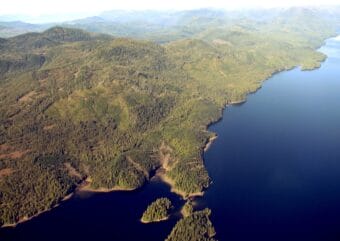
The western shores of Carroll Inlet in 2015. This region about 10 miles northeast of Ketchikan is part of the South Revilla project area, where the U.S. Forest Service proposes to offer more than 5,000 acres of old-growth Tongass National Forest to commercial loggers.
The western shores of Carroll Inlet in 2015. This region about 10 miles northeast of Ketchikan is part of the South Revilla project area, where the U.S. Forest Service proposes to offer more than 5,000 acres of old-growth Tongass National Forest to commercial loggers. (Larry Edwards/Alaska Rainforest Defenders)

The U.S. Forest Service is moving forward with a plan to harvest over 5,000 acres of trees in the Tongass National Forest, just east of Ketchikan. A majority of that will be old-growth trees, which some people worry will be devastating to the forest.
The Forest Service released the final environmental impact statement for the South Revilla project earlier this month. It would allow for the harvest of over 4,000 acres of old-growth timber, and over 1,000 acres of young growth timber. The project site, which surrounds Carroll Inlet on both sides, is around 41,000 acres in total.

Cathy Tighe, a district ranger with the Forest Service, says the cut will allow for more than logging — it will also create new recreation opportunities.

“So it’s actually it’s not just focused on timber,” she said. “It actually clears a lot of activities that help us meet our multiple-use mandate as an agency.”

The project includes construction of new trails, a cabin, boat launches and outhouses. It also includes the construction of parking spaces and 14 miles of new road.

Environmental groups have been pushing back on large-scale, old-growth logging for decades. For years, up until Trump was reelected, the Forest Service was steering away from large-scale, old-growth logging. The focus was instead on young-growth sales, which has less cultural and environmental impact.

The Ketchikan-area plans were originally introduced in 2016, under the first Trump administration, but were shelved in 2020 with the change in administrations. But with the latest administration change came a new executive order, and a new directive from the Department of Agriculture to restart and increase timber production.

“Since this project was so close to being completed previously, we had all of our resource specialists review those changes and sort of pick up where we left off.”

Part of developing the plan involves an interdisciplinary review, where resource specialists with the federal agency study the site and evaluate risks.

“It’s a long process, partly because we have all of these different resources working together,” Tighe said. “And then, in addition, there’s a lot of what we call best management practices that go into, you know, how far away from a stream you have to, like, fuel equipment to protect resources.”

But critics say that old-growth logging projects of this scale will be devastating.

Betsey Burdett is the owner of Southeast Exposure Outdoor Adventure Center, a kayaking and ziplining tour company. She says she’s seen logging projects of this size before. And she doesn’t see it as responsible development.

“It’s just a question of how many people can this land support,” she said. “What’s the breaking point, and how can we do it responsibly?”

She says she’s seen people leave the island because they didn’t like what was happening to the forests at the height of the timber industry.

Nathan Newcomer from the Southeast Alaska Conservation Council says there are better ways to go about logging.

“Our organization works with small mill operators that are just like mom-and-pop shops really, like two people that work there, and they might go grab one or two old growth trees every once in a while,” Newcomer said. “Or a tribe, for example, they might want to go chop down one old growth tree to build a canoe or carve a totem pole. There’s appropriate ways to do this.”

He says the project will harm animal populations, like those native to the Tongass, and the region’s world-class salmon runs. Old-growth projects also affect carbon sequestration and long-standing ecosystems.

Newcomer says the South Revilla project will affect Southeast Alaskans who live a subsistence lifestyle and will come at a cost to taxpayers, who will likely have to pay for a lot of the project.

“The average person in Alaska understands that that’s not our economy,” he said. “It’s not based on large scale timber production. It might have been at one point decades ago, but we’ve moved on. And so again, I ask the question, who’s asking for this? Who’s getting the benefit out of this? It certainly isn’t the majority of Alaskans in Southeast.”

Newcomer suspects this project might be a bellwether for other large scale old growth projects to come in Southeast, particularly if important conservation laws get repealed.

There is a 45-day objection period that follows the release of the final environmental impact statement. That ends on March 8. The final environmental impact statement can be found on the Forest Service website.

Congress approves reauthorization of Secure Rural Schools funding

Secure Rural Schools payments go to municipalities with large amounts of untaxed federal land — including those near the Tongass National Forest and the Chugach National Forest. (Sydney Dauphinais/KRBD)

Congress approved critical funding for rural schools Tuesday night with the Secure Rural Schools Reauthorization Act.

More than $12 million is set aside for Alaskan communities affected by the decline of the timber industry. That money goes to districts with large amounts of untaxed federal land, and is distributed in annual payments to rural boroughs and school districts — including those near the Tongass National Forest in Southeast and the Chugach near Prince William Sound.

“We had a big success,” said Rep. Jeremy Bynum (R-Ketchikan). “The legislature spoke with a unified voice that Secure Rural Schools needed to be reauthorized.”

Bynum sponsored a resolution earlier this year to renew and permanently reinstate the program. He said when the funding lapsed the past two years, those smaller rural communities felt the impact.

“We absolutely noticed that not having that funding available put an immediate pressure on, how do we backfill that funding?” he said.

In Ketchikan, the annual payments go to the borough and typically end up being between $1 million to $1.5 million. In smaller communities, like Wrangell, those payments end up being a big portion of their school budget.

The Secure Rural Schools Act initially passed in 2000 in response to the decline of the timber industry. But that funding lapsed at the end of the 2023 fiscal year. With overwhelming bipartisan support, the U.S. House of Representatives voted to reauthorize that program through September of 2026, including two years worth of back-pay.

Bynum says he knows this reauthorization isn’t a permanent fix, and that it will take work to find other ways to fill that gap and be less reliant on Secure Rural Schools funds.

“What I don’t want to have happen is I don’t want to end up in a situation where we let it lapse again, and then we’re really kind of scrambling to figure out how to effectively do the backfill for for our school funding,” he said.

Bynum says there has been discussion of filling that financial gap with longer-term logging contracts, but he doesn’t believe that will be close to enough. He says those logging contracts aren’t long enough to see forest industries revitalized.

The federal payment amounts are decided by how much money each community would have made in the height of the logging industry.

For rural municipalities that have counted on this funding for over 20 years, losing it has been a big financial blow.

In Ketchikan, Secure Rural Schools money goes directly into the Local Education Fund, a borough-managed account that funds schools and is primarily paid for with property taxes. There’s a $2 million floor for the Local Education Fund that, without a supermajority vote from the assembly, the borough’s required to stay above.

Charlanne Thomas, the finance director for the Ketchikan Gateway Borough, said that without the Secure Rural Schools money, the account went below the $2 million floor.

She says without those payments, they might have to pull from the borough’s general fund.

“So if we end up in a shortage in the Local Education Fund, it could result in property taxes being raised to make up the difference or supplementing it from the general fund, which could affect the sales tax needing to be increased,” Thomas said. “So it kind of has a domino effect. If one is shorted, it would definitely affect the other fund.”

The Secure Rural Schools Reauthorization Act now heads to the president’s desk. It is unclear when that will happen. Once it is signed into law, payments are expected to be distributed within 45 days.

Alaska Marine Lines barge continues south after taking on water off British Columbia

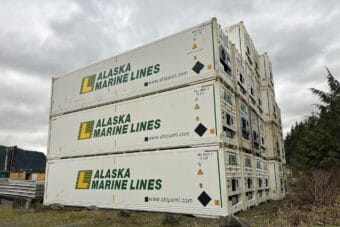
Alaska Marine Lines freight sits at a facility in Thorne Bay.
Alaska Marine Lines freight sits at a facility in Thorne Bay. (Hunter Morrison/KRBD)

An Alaska Marine Lines barge that was taking on water off the coast of British Columbia has continued its journey south to Seattle.

The barge was spotted floating lower than normal last week near Bella Bella, about 260 miles south of Ketchikan, on its way from Alaska.

According to an email from Alaska Marine Lines Director of Marketing Ryan Dixon, the barge was damaged during transit but was “secure” and “not sinking.”
Dixon said the barge was not carrying groceries or supplies for Southeast Alaska that could cause supply chain disruptions for the region. The barge also did not contain bulk cargo or petroleum products, according to the email.

On Tuesday, the company announced that a second barge was sent to offload some of its cargo. As of Sunday, both were en route to Seattle.

Heavy rains bring landslides, flooding to Ketchikan

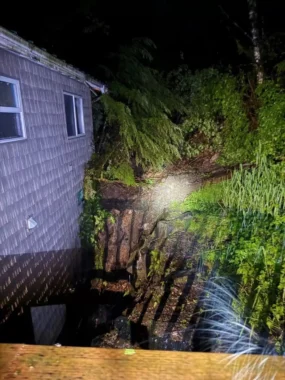
A landslide on Wednesday morning came to rest on a Ketchikan resident’s home. (photo courtesy of Ketchikan Fire Chief Rick Hines)

Heavy rains and flooding in Southeast Alaska triggered a series of small landslides in Ketchikan on Wednesday that blocked roads and damaged a home.

The most destructive slide came down just after 1 a.m. Wednesday off North Tongass Highway. The slide happened on private property north of town. Ketchikan Fire Chief Rick Hines said that the earth of one property gave way, taking a large chunk of the homeowner’s driveway with it. The slide then hit the first floor of another home below, damaging it and the residents’ car. Hines said the people in the damaged home were evacuated without injuries.

City spokeswoman Kim Simpson said in a text to KRBD that there have been no additional slides on the property. She said that Assistant Fire Chief Greg Karlik and Public Works Head Seth Brakke met with the victims Thursday morning to provide guidance but since the slide was on private property, the city and borough won’t be handling the cleanup.

Airport weather data shows Ketchikan saw nearly seven inches of rain in the couple of days before the slide. It’s one of the wettest Mays on record in the First City. The U.S. Forest Service is also reporting significant flooding in the Ward Lake campground area north of town.
Another slide came down Wednesday blocking White River Road. The Ketchikan Borough said that the slide trapped a logging crew, a construction crew, and a handful of employees of a local outdoor adventure tour company on the other side. Alaska Department of Transportation crews managed to clear a path through the slide zone after about seven hours. No injuries have been reported in any of Wednesday’s landslides or flood events.

Many Alaska families face political differences. A therapist discusses how to address them.

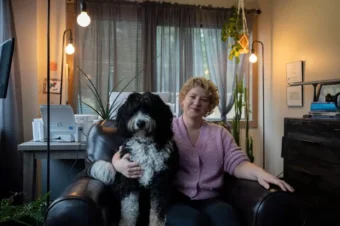
Caitlin Andrews and Guinness the therapy dog in her office at Oilean Wellbeing in Ketchikan. May 1, 2025. (Jack Darrell/KRBD)

Living in America right now can feel like you and your dad are trying to fix a car, but you can’t even agree on where the engine is. And neither one of you can fathom how the other could’ve been so wrong this whole time and still drive a car. So you’re glaring at each other, white-knuckling a wrench — and the car’s still broken.

It’s not just you. The Pew Research Center says the political and ideological divide in the U.S. is wider now than it’s been in decades. And in a small town in Alaska — especially one you can’t drive away from — it can feel like there’s no escaping the conflict.

Ketchikan has seen a lot of demonstrations lately. There have been protests and rallies against and for the federal government, the mass firings, abortion, and just Donald Trump in general.

When I talked to people at the protests and rallies, though, one thing stood out. Lots of people talked about resenting people they love because of their politics. They talked about how much it sucks, and how exhausted they feel.

Believe it or not, reporters feel that tension too. So I fired off some emails to family therapists in town. “I need your expertise on navigating pressure points,” I wrote.

I told them I wasn’t comfortable with how reactive and angry I felt, and I didn’t think I was alone. I said I wanted to know if there was a way to not feel that way.

One therapist responded immediately.

“I believe there are a few of us who would appreciate talking about this topic,” she wrote. “It’s certainly at the forefront of my life currently, both with clients and personally.”

_______

Caitlin Andrews has tea and a noise machine in her waiting room. Her enormous therapy dog, Guinness, snoozed in a big armchair next to me while we talked.

Andrews’ practice is called Oilean Wellbeing – that’s Irish for “Island.” She says that in a small island town like Ketchikan, the cavernous political divide “just feels really heavy.” And she says alienation from others in the community is something her clients have been experiencing more and more.

“This is huge. I mean, the week of the elections, that was all my clients talked about. It was affecting everyone in one way or another – whether arguments with their family, not seeing eye to eye, or feeling like their household was going to be affected,” she said. “Those are all really, real things that I think therapists across the country are faced with right now.”

Andrews is a family therapist and works with people across the political spectrum. Many of her clients are teenagers and their families. She says when it comes to religion and politics, everyone needs supportive people to talk to.

“Find the people that you can have constructive, healthy discussions with,” she said. “It’s sad that it can’t be, like, the people you’ve always had in your life — but that’s just life.”

Andrews says it’s normal to feel anger towards the people closest to you, but we should ask ourselves what’s under the surface.

“Anger is not ever by itself. It’s a secondary emotion. There’s always something causing anger,” she said.

None of this is simple. Andrews says it’s important to stand up for what you believe in, but if you care about the other person, it matters how you do it.

“The important part is being able to circle back and talk about that,” she said. “If they’re emotionally mature enough and saying ‘Hey, I want to talk about what happened with our conversation.”

Still, it’s easy for both people in a political argument to take it as a personal attack.

“Especially with family, sometimes people have a hard time separating what they’re supporting versus it being about them,” Andrews said. “Sometimes, when we are upset with another person, it’s projecting something like rejection.”

And Andrews says that sometimes, protecting yourself can mean drawing a line and taking painful topics off the table.

“Go in prepared to say, ‘This is getting ugly, and I love you too much. We’re gonna have to stop talking about this topic,’” she said. “That’s a boundary.”

Some degree of pain is often built into the foundations of family relationships, but Andrews doesn’t advocate for her clients to tear it all down.

“It’s not all or nothing,” she said “I don’t think you have to cut someone off, but you have to really protect yourself.”

She says her clients often feel powerless, like no one is listening. But she told me that I’d already done step one: acknowledging I have a problem.

“That can sometimes be the hardest part,” she said. “A lot of people don’t take that responsibility. People come to me because they want to get better.”

And Andrews believes there’s one thing everyone can control: their reactions to the headlines and the people in their lives who may read them differently. And she says that’s a good place to start.

Ketchikan band Dude Mtn on Alaska Folk Festival and the sound of Southeast Alaska

From L to R: Dude Mtn frontman Cullen McCormick, bassist Chazz Gist, Joel Forlines, and drummer Kalijah LeCornu at the Alaskan Hotel & Bar in Juneau. 2025. (Photo courtesy if Patrick Troll)

The Alaska Folk Festival wrapped up earlier this month in Juneau. The festival was celebrating its 50th anniversary. Pickers and folk fanatics flocked from all over the state and country and packed into Centennial Hall and other bars and stages around the Capital City.

Andrew Heist, the president of the festival’s board of directors, told the crowd on closing night that they’d had a record-breaking week selling Alaska Folk Festival merchandise. And they weren’t the only ones that broke records during the festival.

Ketchikan band Dude Mtn headlined shows at the Crystal Saloon and the Alaskan Bar. The shows, which also featured Juneau pop-punk band the Rain Dogs, broke both bars’ all-time records for alcohol sales.

Its been a big year so far for the psychedelic rock trio. They have a live album in the works, recorded during a show at the Mean Queen pub in Sitka, and a headlining gig lined up at Southeast Alaska State Fair in Haines this summer.

Front man Cullen McCormick, bassist Chazz Gist, and drummer Kalijah LeCornu sat down with KRBD’s Jack Darrell to talk about their run in Juneau and the ups and downs of trying to tour in Southeast Alaska.

Note: This interview has been edited for length and clarity.

Jack Darrell: So you guys are fresh off of Folk Fest. How was it?

Cullen McCormick: Well, it was the 50th Folk Fest, and it was legendary. A lot of cool people. We got to hang out with all of our music homies from around Southeast Alaska and the Interior and all converge on one city. Everybody got to do their thing, and we got to watch people do their thing, and they got to watch us do our thing. It was super cool.

Jack Darrell, KRBD: So you guys broke a couple records with beer sales. What does that look like? Was it just tearing down the house?

Cullen McCormick: One would think it’s maybe “tearing down the house,” but I think a lot of it has to do with just the vibe that’s going on in the room. Normally, the vibe that’s going on in the room when we’re playing is like –

Kalijah LeCornu: ‘Let’s drink some beer.’

Cullen McCormick: Sure, people drink beers, you know, or people drink whatever. But at the same time, we don’t put up with any weirdness. We make sure that we cultivate a specific vibe in our shows where everybody feels comfortable.

Jack Darrell, KRBD: This isn’t your first Folk Fest. Obviously, you guys have played a lot of shows, and at this point, have gotten it down to a bit of a science. Have you noticed the Alaska Folk Festival scene change over recent years?

Chazz Gist: Obviously, there’s gonna be a lot of folk music in Juneau for Folk Fest. So, us coming up there and having just a vastly different kind of sound has always been part of the draw. It was just a couple years ago when we first – we’ve been breaking records pretty consistently at The Alaskan at the very least. This is the first year that we broke both our own sales record at the Alaskan and also broke the record at the Crystal Saloon, which is usually held by another band also at Folk Fest.

We’ve just been doing very good in Juneau for a long time. And this was a bigger Folk Fest – the 50th annual. And so I think numbers are just bigger all around for everybody.

Jack Darrell, KRBD: Do you guys feel like the broader music scene in Southeast Alaska is different than when you started?

Kalijah LeCornu: People are paying more attention to it now. Everyone has been so artsy in Southeast Alaska. I feel like forever it’s been such a rich environment for people to create and everyone consumes in in Southeast Alaska. I think we just are more of a part of it now, which is a blessing. But no, I think the scene has been growing regardless of if we’re all along for the ride or not.

Chazz Gist: But interconnecting a lot more than it has in previous years.

Cullen McCormick: Oh, yeah. I think that has a lot to do with COVID. Like, back during COVID, everybody was kind of like, ‘Oh, dude, as soon as this is over, we’re gonna get out and we’re gonna do this, and we’re gonna do that.’ Then COVID ended, and everybody was like, ‘All right, yeah, we are getting out and doing this.’

That’s when this band started. During COVID, we would just lock ourselves in a garage and and literally jam for hours.

I think there’s been a big bloom of artists who have just been waiting. I know it’s 2025, now, but there’s been this bloom. You’re seeing it. The artists who are really starting to do the thing in Alaska have bloomed out of COVID and into this thing that they wanted to be. It’s phenomenal.

Dude Mtn’s Cullen McCormick (L) and Chazz Gist (R) on stage at the Alaskan Hotel & Bar during Alaska Folk Festival in 2023. (Photo courtesy of Brittany Rickard)

Jack Darrell, KRBD: So, you guys have said in the past that when you guys first started, the band was called the Dude Mountain Boys, right? And you changed that to kind of get away from the “O Brother, Where Art Thou?“-esque vibe.

Cullen McCormick: Yeah, it was a little novelty.

Jack Darrell, KRBD: Was part of that distancing at all from folk and Americana because it was outside of your sound? Obviously Alaska Folk Festival is kind of stepping back into that. Did you kind of change at all for Folk Fest?

Cullen McCormick: I think we dropped the “boys” because we wanted to take ourselves more seriously. At first, it was kind of a pet project. We’d wear overalls all the time and and then it was like, ‘Oh, let’s take it more seriously.’

And in regards to the folk thing – we don’t play folk, but we are a few folks that play music. That’s what we always say in Juneau.

Kalijah LeCornu: The first time we had to say something like that, because we really didn’t know what to expect. Its called “Folk Fest.” Well,
and we got in on a fluke too.

It was because there was that volcano that happened too, that really just kind of helped our little fan base in Juneau, mainly because there was no other bands that could make it. And it’s something I could have never imagined coming from a little COVID band, but man, it does warm my heart.

Jack Darrell, KRBD: How did your beer come about? Denali Brewing’s “Dude Mountain Hazy IPA”?

Kalijah LeCornu: It was Cullen’s fault.

Cullen McCormick: I was tweeting at Alaskan Brewing Company during our first Folk Fest because I was like, ‘Dude, name a band that has a beer. That would be sick.’ And Alaskan was like, ‘Haha.’ And they retweeted it, and they were toying with the idea but they were just fooling about.

And then the Denali rep, Tommy Vrabec, was at the show and heard about it, and was on Twitter and he hit us up, and asked if they can make us a beer and we said absolutely. It’s been this cool partnership.

Chazz Gist: Up north, we’re still pretty unknown. Southeast Alaska is like a totally different country to people up north.

Jack Darrell, KRBD: Touring in Southeast Alaska must be an incredibly, uniquely difficult thing to do. How do you schedule a show when you can barely schedule a flight half the time?

Cullen McCormick: So, that’s the pain of it all. First of all, you gotta get that figured out on time. Then, you have gear, right? You want to travel with your gear. You know how it sounds and how it operates. A lot of times, if you borrow somebody else’s gear, it sounds wonky, you know, it’s like driving somebody else’s car for a week. You get used to it, but it’s still not your car. So, we’re traveling around with gear, and it can be a pain because a lot of it is overweight, and we have a lot of gear and a lot of road cases. And so Alaska Airlines is charging $100 for each overweight item, and it’s like, ‘Oh my god, we have all these bags.’

So that can be a hard part, especially for other bands who are just starting out, if they want to travel and play.

Chazz Gist: I was born and raised here. I’ve never known any other way. But if you’re on the road system, it’s just nothing to pack up your gear in the van. So, it’s about trying to factor in those costs into our pricing.

Cullen McCormick: As a collective, we are not good at planning at all, and but we’re all figuring it out. My wife Stasha is helping us out, even our good friend, Austin Otos. If you’re gonna travel as a band, I would highly recommend bringing friends along, because it just makes everything so much easier with extra hands around and extra vibes.

Kalijah LeCornu: That is the key right there. Bring your friends on tour. Bring your homies on tour. That’s my advice. [Alaska Folk Festival] is the best thing in Alaska that they put on every year. I will stand by that.

Jack Darrell, KRBD: And are you guys writing music at all?

Cullen McCormick: Always trying. We actually did write a song about the milk run while we were at Folk Fest, because everybody hates the milk run. Hoping to record an album in the fall and put it out by next spring.

Chazz Gist: We got a live album in the works from our Dec. 7 show in Sitka, which is Cullen’s birthday.

Jack Darrell, KRBD: Do you guys have any favorite stages or audiences that you have played or play consistently?

Kalijah LeCornu: Personally, I think it’s the Alaskan. That one has my heart. The sound is – I can’t hear a thing up there, but it sounds like everyone else can. So it’s all right with me.

Cullen McCormick: Yeah, I think the Alaskan is probably my favorite too. But, you know what? Aside from travel gigs, throw me into the Arctic Bar in the corner with the boys and let us rip for three or four hours.

Chazz Gist: I really like the Crystal Saloon up there. I like the tight ship. I like being able to hear everything. They just keep adding more lights. Now, they had lasers on top. So, between the fog and lasers, you have these sheets of light going above. And they just get tighter with the sound and tighter with the lights every show.

The Alaskan is can be very chaotic, and though there’s a lot to enjoy there, I have to give up on being able to hear everything. I have to give up on being able to control certain aspects of it. But the Crystal? I just like the tight ship.

Like we said, we broke sales records when we were the headliner. But in each of those shows, we had a few bands before us. Every time we go Juneau, we have our friends, the Rain Dogs.

Jack Darrell, KRBD: You guys brought the Rain Dogs to Ketchikan for the first time this summer, right?

Cullen McCormick: Yeah, I loved it. That was so much fun.

Jack Darrell, KRBD: That was a great time. It shut the electricity off.

Kalijah LeCornu: Rocking too hard!

Jack Darrell, KRBD: Any parting advice for a young band coming up in Southeast Alaska?

Cullen McCormick: Practice hard. Love your homies.

Kalijah LeCornu: Kiss your homies. They need it. They’ll definitely be kissing you back later, and it’s nice.

Cullen McCormick: Can we start that one over?

Chazz Gist: Meet other bands. Whenever bands are coming through, try and hang out a little bit. See their show and talk about what you’re doing. Just make those connections.

Kalijah LeCornu: And pack light.

Cullen McCormick: Says the drummer.

Jack Darrell, KRBD: Okay, last question. Where do you feel like Dude Mtn is going to go from here?

Kalijah LeCornu: Hopefully stay together.

Cullen McCormick: I see Dude Mtn taking over the state of Alaska, and after that, taking over the rest of the U.S., and after that, travel all around. But my end goal for the band, and I think these boys too, is to literally just be able to travel and play music comfortably. If I can make music with my friends and make some money while doing it, that is a dream I could have never imagined.

Site notifications
Update notification options
Subscribe to notifications