Timber

Forest Service moves forward with logging project near Ketchikan

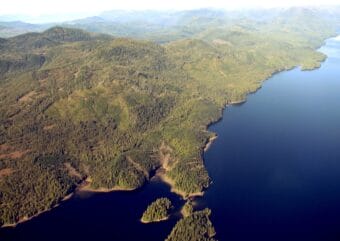
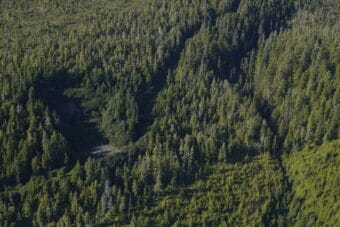
The western shores of Carroll Inlet in 2015. This region about 10 miles northeast of Ketchikan is part of the South Revilla project area, where the U.S. Forest Service proposes to offer more than 5,000 acres of old-growth Tongass National Forest to commercial loggers.
The western shores of Carroll Inlet in 2015. This region about 10 miles northeast of Ketchikan is part of the South Revilla project area, where the U.S. Forest Service proposes to offer more than 5,000 acres of old-growth Tongass National Forest to commercial loggers. (Larry Edwards/Alaska Rainforest Defenders)

The U.S. Forest Service is moving forward with a plan to harvest over 5,000 acres of trees in the Tongass National Forest, just east of Ketchikan. A majority of that will be old-growth trees, which some people worry will be devastating to the forest.

The Forest Service released the final environmental impact statement for the South Revilla project earlier this month. It would allow for the harvest of over 4,000 acres of old-growth timber, and over 1,000 acres of young growth timber. The project site, which surrounds Carroll Inlet on both sides, is around 41,000 acres in total.

Cathy Tighe, a district ranger with the Forest Service, says the cut will allow for more than logging — it will also create new recreation opportunities.

“So it’s actually it’s not just focused on timber,” she said. “It actually clears a lot of activities that help us meet our multiple-use mandate as an agency.”

The project includes construction of new trails, a cabin, boat launches and outhouses. It also includes the construction of parking spaces and 14 miles of new road.

Environmental groups have been pushing back on large-scale, old-growth logging for decades. For years, up until Trump was reelected, the Forest Service was steering away from large-scale, old-growth logging. The focus was instead on young-growth sales, which has less cultural and environmental impact.

The Ketchikan-area plans were originally introduced in 2016, under the first Trump administration, but were shelved in 2020 with the change in administrations. But with the latest administration change came a new executive order, and a new directive from the Department of Agriculture to restart and increase timber production.

“Since this project was so close to being completed previously, we had all of our resource specialists review those changes and sort of pick up where we left off.”

Part of developing the plan involves an interdisciplinary review, where resource specialists with the federal agency study the site and evaluate risks.

“It’s a long process, partly because we have all of these different resources working together,” Tighe said. “And then, in addition, there’s a lot of what we call best management practices that go into, you know, how far away from a stream you have to, like, fuel equipment to protect resources.”

But critics say that old-growth logging projects of this scale will be devastating.

Betsey Burdett is the owner of Southeast Exposure Outdoor Adventure Center, a kayaking and ziplining tour company. She says she’s seen logging projects of this size before. And she doesn’t see it as responsible development.

“It’s just a question of how many people can this land support,” she said. “What’s the breaking point, and how can we do it responsibly?”

She says she’s seen people leave the island because they didn’t like what was happening to the forests at the height of the timber industry.

Nathan Newcomer from the Southeast Alaska Conservation Council says there are better ways to go about logging.

“Our organization works with small mill operators that are just like mom-and-pop shops really, like two people that work there, and they might go grab one or two old growth trees every once in a while,” Newcomer said. “Or a tribe, for example, they might want to go chop down one old growth tree to build a canoe or carve a totem pole. There’s appropriate ways to do this.”

He says the project will harm animal populations, like those native to the Tongass, and the region’s world-class salmon runs. Old-growth projects also affect carbon sequestration and long-standing ecosystems.

Newcomer says the South Revilla project will affect Southeast Alaskans who live a subsistence lifestyle and will come at a cost to taxpayers, who will likely have to pay for a lot of the project.

“The average person in Alaska understands that that’s not our economy,” he said. “It’s not based on large scale timber production. It might have been at one point decades ago, but we’ve moved on. And so again, I ask the question, who’s asking for this? Who’s getting the benefit out of this? It certainly isn’t the majority of Alaskans in Southeast.”

Newcomer suspects this project might be a bellwether for other large scale old growth projects to come in Southeast, particularly if important conservation laws get repealed.

There is a 45-day objection period that follows the release of the final environmental impact statement. That ends on March 8. The final environmental impact statement can be found on the Forest Service website.

State seeks input for plan to boost logging in Haines

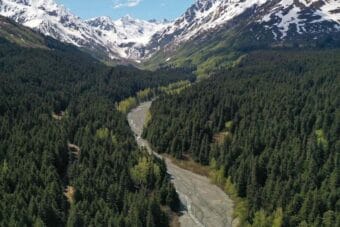
The Baby Brown and Glacier Side timber areas, left, are south of Glacier Creek, a main tributary to the Klehini River.
The Baby Brown and Glacier Side timber areas, left, are south of Glacier Creek, a main tributary to the Klehini River. (Courtesy of Derek Poinsette)

The state Department of Natural Resources is moving forward with its effort to overhaul the longstanding plan that dictates how it manages one of Alaska’s three state forests.

Agency staff are in Haines this week to meet with a range of local groups to solicit input for the new roadmap, which would open the entire Haines State Forest to logging — a major departure from the plan that’s been in place since 2002.

The effort began in 2024 after Gov. Mike Dunleavy directed the state Division of Forestry to boost the timber industry in Southeast Alaska – particularly in the Haines State Forest. The new version of the plan would also need to accommodate another Dunleavy policy: the sale of carbon credits.

But the major change is that the new management plan would allow for timber harvest in the entire forest, as opposed to about half of it.

“Prior to that it was 42,000 acres” available for harvest,” State Forester Greg Palmieri said in an interview earlier this week. “Well, now there’s 74,360 acres available for access for that type of resource management.”

A draft plan is in the works, but it hasn’t been released to the public yet. First, the agency will meet with local groups – including tribes, the Haines Borough and various advisory committees.

State Forester Greg Palmieri said those meetings will inform the draft, which should be released for public comment this spring.

“If we’re going to do this here, what do you think is the most appropriate way to do it, to protect the interest that you represent?” Palmieri said. “That’s the meaningful contribution that we’re trying to acquire at this time.”

Take the state forest land around Chilkoot Lake, which previously was not available for timber harvest. Palmieri said that the new plan could specify, for instance, that even though some timber harvest in that area may be on the table, clear cutting is not.

But at two local meetings this week that addressed the plan, participants focused more on the state’s process and its goal to boost logging than they did on any specific forestry recommendations.

One of those meetings happened Wednesday morning. Forestry officials met with a group that advises the state on how to manage the Alaska Chilkat Bald Eagle Preserve. Some, including Bill Thomas, seemed supportive of the effort.

“People forget, if it wasn’t for the logging industry, you wouldn’t have access out here anywhere,” he said.

Others, including Haines Mayor Tom Morphet, questioned the intent of the plan revision and potential outcome for local people.

“The state I think is going to have to make a lot better job explaining why it wants to start logging on recreation lands,” he said. “What’s the benefit to the community?”

People also voiced confusion over the process – and how they were supposed to weigh in on the issue without seeing the current draft or specific questions from the state.

That sentiment also arose on Monday, during a meeting of the area Fish and Game Advisory Committee. The group had yet to meet with DNR about the plan, but members spent the bulk of its regular meeting discussing it.

“They want us to comment when we have absolutely no idea of what their specific intentions are in any of these areas,” said committee member Kip Kermoian. “We have more meetings, but I think we need to insist on, if they want us to make informed decisions, we need more information.”

The group had yet to schedule a meeting with the state agency, but it voted to send a letter noting that the state is required by law to consult with them on such matters – and that the group’s members don’t think that what’s happened so far amounts to good-faith consultation.

Both committees indicated they planned to provide more specific, forestry-related feedback in the coming weeks.

Lingít elders, Tongass advocates in Juneau gather in favor of keeping Roadless Rule

Seikoonie Fran Houston, spokesperson for the Áak’w Ḵwáan, speaks out against the potential rescinding of the Roadless Rule on Sept. 13, 2025. (Photo by Yvonne Krumrey/KTOO)

The U.S. Department of Agriculture announced this summer it was moving to rescind the Roadless Rule, a 2001 law that protects large swaths of National Forest land from development. 
That includes more than half of the Tongass National Forest, where Juneau is located. On Saturday, more than 100 people gathered in the state capital to protest the move. 

It’s not the first time protections for the Tongass have been in question. The first Trump administration repealed protections for the Tongass National Forest specifically, which were reinstated by the Biden administration.

The USDA’s announcement called the Roadless Rule “burdensome, and outdated.” It said the rule threatens livelihoods and stifles economic growth. 

Alaska’s Congressional delegation unanimously supports the rollback of the Roadless Rule. U.S. Sen. Lisa Murkowski has said that most of the Tongass would still be protected without it — the parts of the forest that are already designated as wilderness. U.S. Sen. Dan Sullivan said rescinding the rule would open the door for economic growth in rural Alaska, and U.S. Rep. Nick Begch said the rule inhibits local management of forests. 

But protesters say Alaskans have more to lose in risks to the land and waterways than what they have to gain through further development. Lingít elders and fishing and tourism industry experts took the mic Saturday to deliver a message: the Roadless Rule should be left alone.

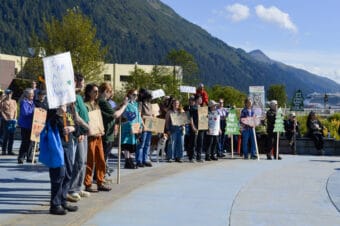
Protestors gathered at Overstreet Park on Sept. 13, 2025 to advocate against the potential rescinding of the Roadless Rule. (Photo by Yvonne Krumrey/KTOO)

Kaatssaawaa Della Cheney told the crowd her mother had protested clear cutting on Haida Gwaii in Canada in the 1980s. She said when young people stepped up to form a blockade, their parents and grandparents came too. 

“The elders showed up with their regalia and put the young people aside and said, ‘We are going to form the line to keep machines away from our lands, our trees, are ways of life,’” Cheney said. “And that’s what they did.”

Now Cheney said, as an elder herself, she is speaking up in favor of keeping the Roadless Rule. 

Seikoonie Fran Houston is Áak’w Ḵwáan, who originally lived in Juneau. She said development threatens sacred salmon runs and Lingít burial sites.

“This was our territory, and it was taken away from us,” she said. “And now hundreds of hundreds of years later, here I am standing on the grounds of my ancestors fighting to try and protect what they had.” 

Houston said the damage to sacred land isn’t worth the potential financial gain.

And others said the financial math doesn’t actually add up in favor of rescinding the rule. 

Kate Troll has worked in fisheries and climate management in Southeast Alaska for more than 30 years. She says old growth logging, which the rule limits, is a very small piece of Alaska’s economy. And the rule protects resources the tourism and fishing industries rely on, which make up a far greater piece. 

“If doing right by the numbers — right by our economy — was the real objective, we wouldn’t be having this debate,” she said. “If facts really mattered, the Trump administration would realize there’s absolutely no overall economic benefit to be gained by tossing the Roadless Rule out.”

Activist Xaawk’w Tláa Yolanda Fulmer and her granddaughters read words prepared in Lingít and English in support of the Roadless Rule on Sept. 13, 2025. (Photo by Yvonne Krumrey/KTOO)

She said the forests serve as irreplaceable carbon sinks, which combat the effects of climate change.  

Xaawk’w Tláa Yolanda Fulmer advocated for the codification of the Roadless Rule, which is being considered by Congress. She said she wants the future of the Tongass to be guaranteed for her grandchildren. 

“So we don’t keep going back and forth with this whiplash politics that keeps happening to us, where one day we’re feeling safer and we’re feeling protected,” she said. “And the next it’s being ripped from us, just like our trees are being threatened.” 

Fulmer referenced a comment Rep. Begich made last month, saying that he’s heard Southeast Alaskans asking for the timber industry to be revived.

“You’re not listening to the people I’ve been talking to from Kichx̱áan all the way to Yaakwdáat that says, ‘Stay out of our lands. Leave our trees alone. Find another way,’” she said, using the traditional names for Ketchikan and Yakutat. 

The public can comment on the proposed rescission of the Roadless Rule through Friday, Sept. 19 at federalregister.gov

The Roadless Rule is on the chopping block, and the public has less than a month to comment on it

Logging roads crisscross the Tongass National Forest near Excursion Inlet. (Photo by Alix Soliman/KTOO)

Listen to this story:

The Roadless Rule protects more than half of the Tongass National Forest from road development, and it’s on the chopping block again. Tribes and environmental groups are strategizing to keep it in place. 

A host of Alaska Native communities in Southeast Alaska, which rely on the Tongass National Forest for their food and culture, say they want to make the Roadless Rule permanent. 

Tlingit advocate Xaawk’w Tláa Yolanda Fulmer presented one tactic at the Southeast Tribal Environmental Forum in Juneau this week. She explained how a bill that was reintroduced to the U.S. House of Representatives this summer called the Roadless Area Conservation Act, or RACA, could codify the Roadless Rule once and for all.

“The current situation is a political struggle between the proposed repeal of the Roadless Rule and the introduction of RACA,” Fulmer said. “The outcome of RACA will determine the future protection of vital national forest lands, including the Tongass.”

She said that if the bill passes into law, it could end the political ping pong between promoting extractive industries and preserving traditional foods and practices in National Forests. 

“Road construction often leads to logging, mining, forest fires and development — development which fragments ecosystems,” she said. “The Roadless Rule helps maintain intact forests, streams and shorelines where traditional foods thrive.”

The Roadless Rule has flip-flopped multiple times since it was established to protect undeveloped lands in 2001. It was rolled back during President Donald Trump’s first term before being reinstated in 2023 by former President Joe Biden. 

The proposed rollback aligns with Trump’s executive order earlier this year to end a ban on constructing roads in undeveloped areas of the forest. The USDA’s announcement comes on the heels of Representative Nick Begich’s visit to Juneau, where he said that he supports the expansion of logging in the Tongass National Forest. 

“This is something I hear from folks from Ketchikan all the way up to Yakutat on a regular basis,” he said. “How do we bring timber back?”

Tribal leaders at the forum in Juneau spoke to the value of keeping the forest ecosystem intact. Joel Jackson is President of the Organized Village of Kake, an Alaska Native tribe based on Kupreanof Island. He said it’s vital to keep the forest healthy, in part because the salmon that feed his tribe rely on it. Old growth trees shade the streams, making the water cold enough for salmon to swim up.

“If the stream isn’t cool enough, those fish aren’t going to be able to spawn,” Jackson said.

After the fish spawn and die, their decaying bodies feed the forest with nutrients they gathered at sea — and the cycle continues.

The U.S. Department of Agriculture announced Wednesday that the public can comment on the proposed rollback from Friday through Sept. 19. 

“This administration is dedicated to removing burdensome, outdated, one-size-fits-all regulations,” said U.S. Secretary of Agriculture Brooke L. Rollins in a press release. 

Nathan Newcomer advocates for the Tongass with the Southeast Alaska Conservation Council. He worries that the USDA won’t listen to the public’s wishes to keep the rule in place. 

“We know what they’re going to do,” Newcomer said of the department. “They’re not going to listen to anybody, but we still need to get on the record and make it sure and clear that people in Southeast Alaska and across the nation want to see the Roadless Rule kept in place.”

When the first Trump administration rolled back the Roadless Rule in 2020, people had about 90 days to comment and nearly all of the public comments were in favor of keeping the rule.

Newcomer said that he’s organizing quickly since the federal government has expedited the public process to allow for less than a month of public comment. 

Kate Glover is an attorney at Earthjustice, an environmental law firm that has challenged past rescissions of the Roadless Rule on behalf of tribes, conservation nonprofits, tourism and fishing groups. She said a few weeks is not enough time for a meaningful public process.

“It doesn’t allow time for the agency to meet its obligation to consult with tribes on a government-to-government basis,” she said. “Typically, at least 120 days is needed for that.” 

Glover said she had not seen such short comment periods before this administration.

US House Natural Resources Committee members tour Alaska to survey mining, timber resources

Alaska’s U.S. House Rep. Nick Begich speaks at a Juneau Chamber of Commerce luncheon on Thursday, Feb. 20, 2025. (Photo by Clarise Larson/KTOO)

The U.S. House Natural Resources Committee is touring Alaska this week to take a closer look at the land they spend so much time talking about in Congress. 

Rep. Celeste Maloy, R-Utah, was in Juneau with 10 other members of Congress on Monday.

“We set natural resources policy, and obviously, Alaska is a big natural resources state, so we’re here seeing things on the ground so that when we’re talking about it in Washington, D.C., it’s not just an academic exercise for us,” she said.

They toured the Hecla Greens Creek Mine on Admiralty Island and flew over parts of the Tongass National Forest.

The visit comes after the Trump administration’s tax and spending bill, known as the One Big Beautiful Bill, was signed into law July 4. It boosted oil and gas leasing in Alaska, mandated the expansion of timber harvest on public lands, and allocated more than $7 billion dollars to grow the U.S. military’s mineral stockpile. 

Rep. Bruce Westerman, R-Arkansas, is chairman of the committee. At a press briefing at Ward Air in Juneau, he said there is a growing demand for metals like silver that are used in AI data centers and military weapons.  

“It’s imperative that Congress work with everyone who’s in the business to help figure out how to get more mining done here in the U.S., and not just mining, but also the refining of the metals, which is a huge issue,” he said.

Westerman says the committee could help Hecla further extend the lifetime of Greens Creek Mine, the most productive silver mine in the nation. Its mine life was recently extended by more than a decade. 

Alaska’s Rep. Nick Begich said forestry is another big focus for the committee.

“In the One, Big, Beautiful Bill Act, there are provisions to unlock additional forestry resources for timber, particularly in the Tongass, but across the nation as well,” he said. “This is something I hear from folks from Ketchikan all the way up to Yakutat on a regular basis. How do we bring timber back?”

The U.S. Forest Service is currently revising the Tongass Management Plan, which is set to take effect in 2028 and will determine how logging is done. 

The committee heads to the Kenai Peninsula tomorrow and will attend the Alaska Oil and Gas Association conference in Anchorage on Wednesday.

Losses mount for timber companies in Alaska amid China’s import ban

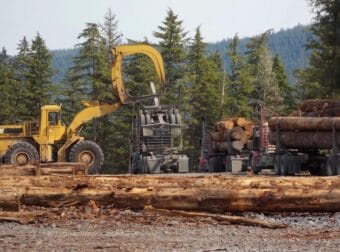
Logs being moved from the road system to water on Kupreanof Island near Petersburg in 2013.
Logs being moved from the road system to water on Kupreanof Island near Petersburg in 2013. (Joe Viechnicki/KFSK)

The Trump administration’s tumultuous relationship with China is proving to be a major issue for some companies in Alaska’s forest products industry. That includes in Haines, where a timber sale that was supposed to kick off this spring has stalled amid China’s ban on U.S. log imports.

China announced the ban in March, citing concerns over pests like bark and longhorn beetles in U.S. shipments. The move came the same day that China imposed retaliatory tariffs on certain U.S. agricultural products amid President Donald Trump’s global trade war.

The decision has had sweeping effects on companies that harvest logs in Alaska and ship them overseas.

“We’re severely impacted by it. There’s no doubt about that,” said Eric Nichols of Alcan Timber, a Ketchikan-based company. Nichols also serves as vice president of the Alaska Forest Association, a Southeast nonprofit.

Nichols said about half of his company’s volume typically would go to China. As a result of the halt on imports, he said, the company has had to shut down at least one of its operations and make a range of other changes.

Those include shipping to other markets, including Washington, South Korea and Vancouver, British Columbia. Alcan has also shifted its focus away from harvesting areas that are best suited for the Chinese market.

Those changes have come at a steep cost.

“We’re at pretty big losses on going to other markets, just because of the transportation differential from what we’re used to,” Nichols said.

In Haines, meanwhile, Oregon-based company NWFP Inc. had been planning to move forward with a sale in May that’s been under contract since 2021. The so-called Baby Brown sale would be the area’s first major timber sale since the 1970’s.

But the company could not move forward with the sale this spring due to the loss of the Chinese market, Haines State Forester Greg Palmieri said in an email. He added that the company is seeking other markets for the sale, both within the U.S. and overseas.

“I expect that as soon as they have the ability to market the timber, operations will move forward with the sale currently remaining under contract,” Palmieri wrote Tuesday afternoon. “They are continuing the processes to obtain the required permits from State and Federal agencies to move the logs to markets as originally planned.”

The trade disputes have also hit Canadian lumber company Transpac Group. The company in March largely shut down its site on Afognak Island, just north of Kodiak, citing the ban and failed efforts to divert its product to other markets.

“We’ve been trying very hard since the announcement,” Transpac CEO Charles Kim said in an interview at the time. “And it has all failed.”

A spokesperson confirmed this week that the situation hasn’t shifted in the time since.

Nichols, of Alcan, says his company will have to weigh similar decisions if nothing changes.

“We have to make decisions, you know, a little bit like Afognak, whether we’re going to stay in business or not,” Nichols said. “The question is how long can we hold these logs before we have to sell them and generate the losses they’re going to generate here.”

Site notifications
Update notification options
Subscribe to notifications