Timber

Hotter climate means a never-ending fire season for the National Guard

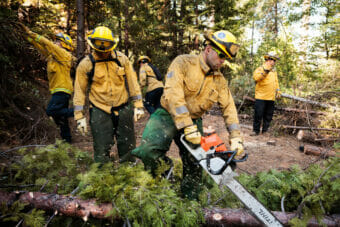
Members of the California National Guard’s Task Force Rattlesnake clear brush and small trees to reduce the likelihood of a high-intensity wildfire. (Max Whittaker for NPR)

NEVADA CITY, Calif. — Jaleel Brown had only been on the job a few weeks, chainsawing for California’s Task Force Rattlesnake, when he raised his hand to fight the Jones Bar Road fire.

“I didn’t know I was getting myself into. And that’s probably the craziest fire we’ve ever had here. And I had to ask the captain like, ‘Hey, this is how every fire is?’ ” he says.

A Guardsman for almost a decade, Brown had been considering leaving the military when he learned of the Task Force — and a different kind of soldiering.

That wildfire burned 705 acres west of Nevada City, Calif., in August of 2020, one of 8,648 fires in the state that year. What made it crazy for Brown was the terrain.

“We had to hike into the fire. We ended up at the bottom of the [river] drainage. We had to cut uphill and uphill — it went like forever cutting uphill,” Brown said, looking exhausted just from the memory.

Endless fire season

Recent images from Maui have shocked Americans with the worst death toll from a wildfire in over a century. But they’re familiar to communities of Western states, where a warming climate has made fire an existential threat. After California lost over 4 million acres to fire in 2020, the state funded Task Force Rattlesnake, to assist the California Department of Forestry and Fire Protection (Cal Fire).

“Fire season is almost a thing of the past. It’s year round,” says Carl Trujillo, a Sgt. 1st Class in the California Army National Guard.

“Even if there’s not fire, it’s prepping for fire and it’s treating the landscape to try and mitigate the impact that the fire has when it does come because it is going to come,” he says.

Cal Fire used to rely on prison inmates for firelines, which involved a lot more supervision. With the Task Force Rattlesnake guardsmen, it’s a military operation, with a practiced chain of command. After setting up the program as an emergency response in 2019, it’s now grown to 14 crews of National Guardsman who are salaried year round.

Members of the California National Guard’s Task Force Rattlesnake gather in Nevada City, Calif., to begin their day. (Max Whittaker for NPR)
Members of the National Guard’s Task Force Rattlesnake clear brush and small trees to create a fireline, to deprive any fast-moving fire of fuel. (Max Whittaker for NPR)

“In the past, [Cal Fire] could depend on the National Guard to step up when they were called on and help fill any gaps. But as climate change has taken hold and changed fire behavior, there’s been a need to lean forward more proactively, and that’s a big role that Task Force Rattlesnake plays,” says Trujillo.

With the strain of COVID emergencies, civil unrest around the country, and the Guard’s regular overseas duties, the creation — and funding — of the task force has actually helped provide a degree of structure and reliability.

Nonetheless, climate change disasters are straining Guard troops nationwide, not just in California.

California National Guard Sgt. Jaleel Brown tosses a small tree aside as Task Force Rattlesnake work on fire prevention. (Max Whittaker for NPR)
California National Guard Sgt. Tyler Bingham pauses for lunch while brush clearing with Task Force Rattlesnake. (Max Whittaker for NPR)

“In 2021, the National Guard spent 172,000 personnel days fighting fires, and that’s compared to about 18,000 personnel days in 2019. So it’s gone up significantly,” says Erin Sikorsky with the Center for Climate and Security. She tracks how climate is engaging military forces worldwide, including the U.S. Army National Guard. The strain on the Guard makes her wonder what would happen if the U.S. were at war.

“Many of those same troops are the ones that would be called upon in case of a conflict,” she says. “There would be a challenge there if they were being deployed at the levels they have been in recent years domestically and needed on the front lines.”

Fighting fires before they happen

In California it’s been a mercifully quiet year so far, which means more days for Task Force Rattlesnake to work on prevention.

Just outside Nevada City, a crew walks up an abandoned logging road that smells of red cedar and damp earth. They’ve been reopening the road for weeks, for access and also as a potential fire-break to protect the houses further up the hill. With chainsaws axes and chippers they remove deadwood that could fuel a fire, and cut down “ladder trees” the short 10 or 20 footers, that could help a fire climb up to the giant cedars and ponderosa pines that seem to touch the sky.

California National Guard Specialist John McMahan working on fire prevention as part of Task Force Rattlesnake. (Max Whittaker for NPR)
Cal Fire Captain Eric Ayers briefs members of the California National Guard’s Task Force Rattlesnake before they spend the day clearing brush and small trees, all part of fire prevention tactics. (Max Whittaker for NPR)

Capt. Eric Ayers has worked 34 years with Cal Fire, and he’s supervising the Task Force on this summer’s day.

“If we were to have fire in here today, without this fuel reduction being done, the fire would be too intense, and it’s going to ladder up these trees and all the timber in here is going to be fully consumed,” he says.

Ayers is a third generation woodsman. His grandfather logged these woods. Centuries before that, Native Americans did controlled burns to keep the forest healthy. But now after decades without either, and with houses built further and further into the woods, Ayers says the job is urgent — and endless — across California.

“It’s kind of like painting the Golden Gate Bridge. You do the initial paint, you get to one end and you gotta go back and redo it,” he says.

But it’s work these guardsmen say they enjoy. Brett Carl joined Task Force Rattlesnake in 2020, after two years of doing COVID response for the National Guard. Sawing trees and lugging brush until he’s dog tired is more what he had in mind when he joined.

“It’s manly right? Can’t get more manly than that!” he says with a laugh. “I feel better about myself mentally, physically every day once we get out here running the chainsaw.”

Carl says the Task Force is an attractive transition from the military as well, setting up a possible career in fire fighting, which appears to be a growth industry as North America keeps posting record high temperatures.

California National Guard Specialist Brett Carl cuts down a small tree while working on fire prevention with Task Force Rattlesnake. (Max Whittaker for NPR)
Copyright 2023 NPR. To see more, visit https://www.npr.org.

Southeast Alaska’s budworm infestation is declining, Forest Service says

“Budworms are wasteful feeders, often clipping loose needles that are not completely consumed,” says the official US Forest Service web page devoted to blackheaded budworm. Although defoliation is not necessarily fatal to the trees, the thinning of the canopy affects the ecosystem in many ways that are not fully understood. (Gordy Williams photo)

An insect infestation responsible for defoliating thousands of acres of the Tongass National Forest is abating.

Scientists with the Forest Service believe that the blackheaded budworm, whose numbers surged over the past three years, is now in decline.

And while it’s not clear how much lasting damage was done by the insect, there’s a good chance that some parts of the forest may emerge from the infestation better off.

KCAW caught up with Gordy Williams by cell phone while he was riding the state ferry LeConte from his home on Killisnoo Island in Angoon to Juneau in mid-July. It was a perfect day for a cruise up the Inside Passage, and a perfect day to see the widespread damage caused by the blackheaded budworm.

“You know, I’m looking at Chichagof and Baranof,” Williams said. “There are some pretty big impacts on the east side of these islands.”

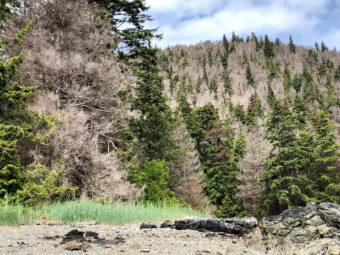
That damage is acre upon acre of defoliated hemlock trees — wide swaths of brown striping the otherwise endless green of Southeast Alaska. The trees’ needles were consumed by tiny, voracious caterpillars fueling their transformation into budworm moths.

Williams worked for years in the Alaska Department of Fish & Game. He understands that budworms and their partner-in-crime, the hemlock sawfly, have a role in the forest. But this latest event he considers extreme. The Forest Service estimates 685,000 acres were defoliated by insects in the last three years.
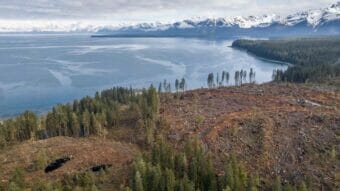
“It’s a natural cycle, but when it does get ramped up like this, it does have a pretty, pretty significant effect on the ecosystem,” said Williams. “So what our curiosity is at this point, and our concern is: What are the impacts of this radically thinned-out forest canopy in so many areas? You know, that’s what provides winter cover for deer and other animals and is it going to impact stream temperatures, and that kind of thing?”

This part of Chatham Strait is notorious for winter storms – huge sou’easters that blow right up the channel between Admiralty and Baranof islands, and can make this ordinarily pleasant ferry ride a bit of a stomach-churner. Hemlock sawfly stressed these trees in 2018 and 2019. The blackheaded budworm infestation followed in 2020.

Forest Service entomologist Liz Graham described it as a one-two punch to the forest, putting it on the ropes. The weather may have finished the job.

“It definitely seems to be on some more extreme sites, too,” Graham said, “the ones that are really heavily exposed. And so I do think that it’s a little bit more like a compounding impact where there was heavy defoliation, and then maybe on top of that a big windstorm or ice storm, and that really kind of stripped the last of it. And so I do think that that’s why we have seen some of those areas with really more dense mortality — that there’s been more than one event there.”

Graham said that, depending on the area, up to half of the hemlock trees may have died. Although this sounds like a high toll, Graham’s colleague, silviculturist Molly Simonson, says on a forest-wide scale, the damage is limited. Most areas are unaffected. And some forest die-off is not necessarily a bad thing.

“Trees do die,” Simonson said, “whether it’s clusters of them during a particular event, or whether it’s just individually over the course of that forest’s development. But you know, it contributes to nutrient cycling within the ecosystem. And there’s always going to be other trees in the understory waiting to take over that space. There’s regeneration underneath those dominant trees that are just waiting to take over. And will capitalize on that.”

The last major blackheaded budworm infestation in the Tongass was in the 1950s, and good data is hard to come by. Liz Graham says tree ring studies could help her identify the timing of the budworm cycle, but humans are throwing new variables in the mix. Climate change — or specifically, the number of frost-free days — could play a role in outbreaks. But warmer weather can also disadvantage budworms.

“The budworm population actually extends all throughout the Pacific Northwest,” Graham said. “And so the outbreaks that we’ve been experiencing here have really just been happening in Southeast Alaska and haven’t extended to British Columbia. And so, based on some of the research we’ve been looking at, it might be actually too warm down there. So it could be that we’re in this perfect little climate window right now for budworm outbreaks.”

Although the outbreak in Southeast Alaska is subsiding, there are some areas where budworms are peaking – notably Juneau and Haines. Picture a slow-moving budworm tsunami that began on Prince of Wales Island, and traveled north. Defoliation is not certain death, however; trees that were stripped near Gordy Williams’ home on Killisnoo Island are sending out new buds this year, as are many along the route of the LeConte as it steams up Chatham Strait.

“And we’ll just have to see how many of those trees can come back and how long it takes,” said Williams.

Yak Timber files for bankruptcy after its parent company, the village corporation, is sued for $13M

This Yak Timber logging at Humpback Creek is controversial because the site is culturally and historically significant, according to the Yakutat Tlingit Tribe, Central Council of Tlingit and Haida Indian Tribes of Alaska, and Sealaska Corporation. (Photo/Defend Yakutat)

A timber company owned by Yakutat’s village corporation has filed for bankruptcy this month after a bank sued the corporation over $13 million in outstanding debts. It’s the latest chapter in the story of a contentious logging operation that many of the corporation’s shareholders didn’t support.
Yak Timber filed for bankruptcy on May 11. In a letter to shareholders the next day, the village corporation, Yak-Tat Kwaan, said they filed “only after exhausting all efforts to negotiate a resolution” with the bank.

Yakutat’s tribal government, Yakutat Tlingit Tribe, says the lawsuit is further dividing a town that was already stressed — many residents didn’t agree with the logging operation in the first place. Andrew Gildersleeve is the Tribe’s executive director. He says above all, there is grief.

“The matter itself is almost like a broken piece of glass, with so many edges it’s impossible to pick up without getting cut,” Gildersleeve said. “There’s a shock of what’s happened to tribal lands and disbelief that there could be a claim of the size against an organization that is ultimately run by our friends, family and neighbors.”

Washington bank vs. Yak-Tat Kwaan

The lawsuit, brought by AgWestFarm Credit, alleges that Yak Timber owes the Washington-based bank about $13.3 million in unpaid loans. The suit was filed in U.S. District Court in Seattle on March 31.

“Where did all that money that they borrowed go?” asks shareholder Cindy Bremner. She’s also the former CEO of the corporation and Yakutat’s current mayor. She says shareholders have a lot of questions the corporation won’t answer. It’s straining relationships in the small town of 600.

“We live in a small town — we’re all related,” she said, “and it’s caused quite a divide between those on that board, and then pretty much the rest of the shareholders.”

The suit says the corporation hasn’t made payments since the middle of 2022. The bank is seeking repayment, interest, and attorney’s fees. It lists equipment along with timber, proceeds, and property as collateral.

In a letter to shareholders on April 7, corporation leadership said their board “is united in every possible effort to address the allegations.”

Shari Jensen, the corporation’s CEO said in a written statement that they had no comment for this story. But as recently as October, Jensen told CoastAlaska that paying back the loans wouldn’t be a problem after they sell Yak Timber’s logging equipment.

“Banks don’t lend money to broke companies, they just don’t,” Jensen said. “And, you know, we had a business plan. And they bought into it.”

A large barge is one of the assets the bank AgWestFarm Credit is seeking in its lawsuit against Yak Timber. (Photo/Defend Yakutat)

A controversial project

The Yak-Tat Kwaan corporation was formed in the early 70s after the Alaska Native Claims Settlement Act took effect. The federal law exchanged Indigenous land rights for money, divvying up the remaining land among a few hundred village corporations. Those corporations are charged with making a profit for their shareholders.

The Kwaan created its timber subsidiary in 2018 to harvest 21 million board feet of timber on its land. It logged about three-quarters of that, shipping nearly 4,000 log trucks worth of wood to China.

As Yak Timber pursued different logging projects, opposition grew among shareholders. Some wanted the corporation to seek other resource revenue, such as carbon credits. Eventually, Yak Timber announced last fall that it would sell off its assets.

But the company continued to harvest timber at a place called Humpback Creek, which the local and regional tribal governments say is culturally and historically significant.

They, along with the regional corporation Sealaska, have requested Yak Timber stop logging there.

Shareholders take action in court

The corporation faces a lawsuit from shareholders as well. Some are worried that their land could be lost as collateral for their debt. Amanda Bremner is a cousin to the mayor.

“I am incredibly concerned not just for the risk to existing land, but for what this means for the future of our company and all of our shareholders,” she said.

Yak Timber logging at Humpback Creek. The creek is outside of Yakutat in Southeast Alaska. (Photo by Cindy Bremner)

Amanda Bremner and another shareholder, Jay Stevens, co-chair the Yaakwdáat Latínx’i Coalition that is seeking a change. Their lawsuit, filed on May 9 in Anchorage Superior Court, asks the court step in and force the corporation to hold an election for all nine seats on the board. Yak-Tat Kwaan hasn’t held an election in a couple of years, which led to a state fine.

Amanda Bremner says taking the corporation to court was a difficult decision, but many shareholders share her goals.

“To see our corporation flourish and thrive and be successful and ethical and rooted in Indigenous value and to have business practices reflect that,” she said.

Seattle-based law firm Cairncross and Hempelmann is representing the bank. In an email, they said their client did not want to comment.

In a separate court filing, April 7, the bank seeks to repossess a tug and barge they loaned Yak Timber for $3.3 million in January of 2022. Later, on May 5, they asked the court to ban the corporation from moving the barge, saying it was uninsured. The corporation has disputed this and filed its own motions.

Yak Timber has its own lawsuit playing out. It filed a suit November 18 accusing Bethel Environmental Solutions, an Alaska Native-owned environmental consulting firm, of owing them $443,912 for charter services.

New lumber-grading bill could open markets for Alaska sawmills

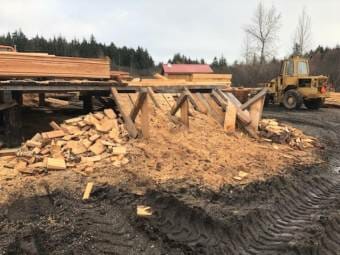
Sawdust and wood scraps at Mud Bay Lumber Company in Haines. (Photo provided by Clay Good/REAP)

A recently passed state bill would allow small sawmill operators to grade their own lumber. This could open some new markets to Alaskan operators.

Senate Bill 87 would allow Alaska sawmill operators to become certified to grade and sell certain types of dimensional lumber they produce for residential construction. As it stands now, Alaskans have to ship in graded lumber from the outside, which is expensive. The grading is required to sell lumber in places that enforce building codes, like Juneau and Anchorage.
The bill passed the House on May 1, 38-1. It passed the Senate unanimously last month, with a vote of 16-0.

Sage Thomas operates a sawmill in the Chilkat Valley.

“In our town of Haines, there is no building codes and there is no inspectors, so you can build with whatever you want, so our local sawmills have been selling lumber here for years,” he said. “But in Juneau or Anchorage or places like that, you can’t.”

Thomas says he doesn’t plan on selling lumber outside the Haines area but would be interested in taking the training to learn about grading lumber.

The state’s Department of Natural Resources would oversee the certification program and provide free training for sawmill operators. Greg Palmieri is the state forester in Haines. He describes what grading lumber means.

“What you are doing is identifying the quality of the stick of wood,” he said. “So you are looking for things that are going to impact the structural integrity of the piece, so in other words the distribution of knots, the size of knots, those all have factors in the quality of the lumber and therefore the grades of the lumber will reflect that.”

Palmieri says there are three training locations being planned, one near Fairbanks, one on the Kenai Peninsula and one in Southern Southeast. He says the program could be a boost to local sawyers.

“The grading certification allows them to produce that product and enter into that market, which is a significant opportunity for the local rough cut and full dimension lumber,” he said.

The bill is now waiting for Gov. Mike Dunleavy’s signature.

Forest Service asks Southeast Alaskans to help make 10-year plan for the Tongass

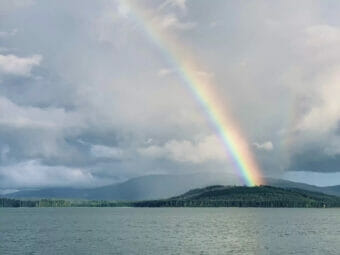
Rainbow near the Wrangell Narrows. (Photo by Angela Denning/CoastAlaska)

The U.S. Forest Service is asking the public to get involved in creating a 10-year forest management plan for the Tongass National Forest in Southeast Alaska.

The federal agency will be holding in-person workshops, virtual webinars and community gatherings through June.
The project is called the Southeast Alaska Sustainability Strategy, Forest Management — SASS-FM, for short.

Paul Robbins Jr. is a spokesperson for the Forest Service. He talked with CoastAlaska’s Angela Denning about the public engagement effort. He says the federal agency is working from the ground up.

Listen:

Here is a link to the project’s comment box.

Paul Robbins Jr.: In the past, the way the Forest Service worked, right, is we would come out with a 10-plan. And we would be open to public comment. But it would be public comment on a 10-year plan that the Forest Service created. In this case, there is no plan. We’re asking, instead of commenting on a plan we made, that the public help us make the plan. The overall goal is for us to work with our tribes, partners and communities to put together the full range of forest management activities, and complete them in a way that meets the greatest diversity of public needs. That would be the goal of SASS-FM. And we’re excited to get started. And we hope as many people as possible, come out and talk to us and take part in this process.

Angela Denning: What would you ideally like to see with this public engagement process?

Paul Robbins Jr.: Well, we have a couple of different things that we’re trying to get out of it, right. So we want all the organizations that I mentioned to tell us what they want to see from forest management on the Tongass. What are the outcomes that they want to see for themselves and their communities and, and their organizations. And then we also have a separate ask in there of identifying specific projects and locations where we can work collaboratively to get things done. SASS-FM, Southeast Alaska Sustainability Strategy Forest Management, that’s a big term, right? That is all about integration, integrated work, multiple resource activities down to one effort to reach ecological, economic and cultural benefit. So we want them to talk about what the overall outcomes they want to see. We also want to know specifically where and what they want us to do as far as forest management. And we also are taking comments and put on our what we call our assessment tool, which is a list of drafted criteria of what would move a project potentially to the top of our priority list for that 10-year plan.

Angela Denning: Can you give me some examples of projects that might be included in this?

Paul Robbins Jr.: Well, under forest management, you’re talking everything from thinning, which is, you know, harvesting of trees and a stand for the overall health of the ecosystem and the health of the trees that are supposed to be there to watershed restoration, wildlife habitat enhancement, road building, there’s so many factors that go into what we do for forest management on the Tongass because we’re a multiple use forest. On the second ask, we’re actually asking for specific projects. What work do you want us to do? And where? And how can we do it to where we’re getting multiple resource activities done at once, and the most beneficial way possible?

Angela Denning: So you’re taking public input in these kind of live public meetings, but also people can contribute just by themselves online?

Paul Robbins Jr.: You know, the public meetings, like the first 10 minutes or so is going to be us giving a presentation on what this effort is because not everybody, you know, will see the press release or the stories or we’re hearing so we definitely got to break it down. And then the majority of the meeting is just us answering questions and helping them work through this story map tool for submission, where we’re trying to keep it all focused in it’s very easy to use an effective tool to take in all this information.

Angela Denning: Okay, how long do you think this process is going to last? Like, how far out are you scheduling?

Paul Robbins Jr.: Right now, we’re looking to do this all the way through the end of June and could go longer than that because I mentioned the tribal consultations, which are a legal requirement and we’re going keep doing this until all of those are done. But we’re hoping around June 30 is when we can be wrapping up most of this.

Whale Pass timber sale moves forward, leaving residents with questions about town’s future

Members of the Friends of Whale Pass. (Photo courtesy of Maranda Hamme)

Despite an outcry from residents in the small Prince of Wales Island town, a nearly 300-acre timber sale in and around the city of Whale Pass is poised to go forward. After months of advocating for changes to the plan, residents are now worried about what their town will look like once cutting begins.

Whale Pass is a quiet town, tucked out of the way on the northern tip of Prince of Wales Island. It’s a good place to escape the hustle and bustle of larger communities. James Greeley lives in town.

“People are coming to Whale Pass to get away from all that, for fishing adventures and such,” Greeley said.

The city’s 100-some residents hunt and fish and rely on natural resources.

But Greeley expects an upcoming 292-acre timber sale to change a lot about his town. Greeley said he’s concerned log trucks will clog up the only road in and out of town and bring this quiet community a steady stream of mechanical noise. He explained he’s concerned the planned clearcut on a hillside overlooking town could also hurt the town’s status as a destination for fishermen and other tourists.

And he’s also worried about what it will do to residents’ way of life. There are concerns about how the clearcut might affect fish and deer habitat — even though the state’s best interest finding dismissed those concerns.

The sale could become final on April 26. And residents who live on the hillside worry that their houses will face landslides, floods and strong winds.

Greeley lives in one of those houses, and he can see the orange tape marking the clearcut boundary from his kitchen window.

“Will I be able to walk my dog again?” Greeley asked. “I don’t know.”

The state’s Division of Forestry is conducting the sale. Southeast Area Forester Greg Staunton said he expects the hillside to recover quickly.

“It’s been quite a while since they’d seen a cleared hillside in their viewshed, but it was — it will be similar to what they’re already looking at, probably five to 10 years’ time,” he said.

Staunton said his division listened to the outpouring of opposition for the sale — specifically, how close the boundary comes to some homes — but he explained it just wasn’t feasible to push it back.

“We approached the design of the sale with a perspective that we wanted to maximize that footprint for the intended purpose of the land base, which is for forest management,” he said.

But Staunton said the plan does incorporate wildlife corridors to minimize the impact on deer and fish.

Katie Rooks is a policy analyst for the Southeast Alaska Conservation Council. She thinks the most surprising thing about the sale is that, despite how much criticism it received, it’s still moving forward. The Division of Forestry published its land use plan last week.

“After the, you know, moving appeals by the people of the town, I think we were just shocked at the lack of empathy,” she said. “This is public land, and the public overwhelmingly responded in opposition to this sale.”

Rep. Dan Ortiz, I-Ketchikan, and former Rep. Jonathan Kriess-Tomkins, D-Sitka, both opposed the sale.

The recent forest land use plan included comments from both representatives.

“I respectfully request that you modify the Draft Forest Land Use Plan for the Whale Pass timber sale and return to the drawing board with the City of Whale Pass to reach a reasonable compromise that will benefit both the State of Alaska and residents of Whale Pass,” Kriess-Tomkins wrote.

“Whale Pass is Alaska’s newest established city as of 2017 and does not yet have the infrastructure needed to provide utilities such as water and sewer,” Ortiz wrote. “Residents rely on naturally occurring resources. However, clearcutting the land above their homes would negatively impact the watersheds those households primarily rely on.”

Greeley heads the group Friends of Whale Pass, which has led local opposition to the sale. He submitted several written comments and proposals to the division, and participated in the hearing process.

“It’s just very frustrating, very disappointing,” he said.

Greeley feels like the state ignored Whale Pass.

“From my first comment was basically just saying, shut up and take it,” Greeley said. “So I guess that’s what we have to do. So that’s great to know.”

If a request for reconsideration is not filed, the sale will be made final on April 26.

Site notifications
Update notification options
Subscribe to notifications