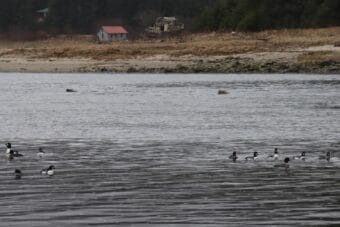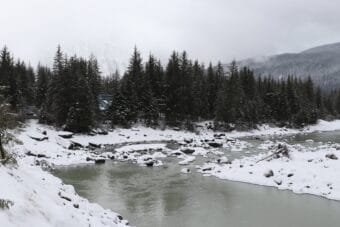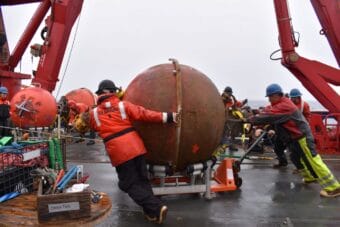
Sea ice floats in the Bering Strait off Cape Prince of Wales. (Gay Sheffield/University of Alaska Fairbanks)
Alaska saw its eighth hottest year on record in 2025 according to a new report, with temperatures coming in at 1.5 degrees Fahrenheit warmer than the last three decades on average.
“This last year was a confirmation that, unfortunately, we are warming our planet faster than we hope,” said State Climatologist Martin Stuefer, who authored the 2025 annual report by the Alaska Climate Research Center.
“That has implications,” Stuefer added. “Ice melting, permafrost thawing, wildfires, changing of our environment.”
The report highlights dwindling sea ice as a top line issue. Alaska’s sea ice peaked in March at more than 5.5 million square miles – an area more than 1.5 times the entire United States — but that’s the lowest sea ice peak recorded in the last 47 years.
“It’s a big area. But still, it was smaller than in any year observed before,” Stuefer said. “We are heading towards an ice-free Arctic later this century.”
The northern parts of the state are warming most rapidly, with the Interior and North Slope showing the largest increases from normal temperatures. Utqiaġvik recorded the highest relative temperatures – about 2.7 degrees above average.
Southeast Alaska, meanwhile, had a near average annual temperature last year, but the region had far less snow than is typical. Juneau specifically saw a warmer year and received near-normal levels of precipitation. But the area also saw just half its average snowfall due to frequent mid-winter rain, the report said.
Steufer emphasized that, while Alaska in general saw warmer temperatures, it also endured extreme weather events like wildfire activity, ex-typhoon Halong and an intense, widespread December cold snap.
“I had one person asking me, Are we heading into an ice age now?” he said. “Of course not. We are heading into a warmer phase on the global scale.”
That extreme variability across the state, he added, is becoming more common as temperatures rise with climate change.
The deadly landslide that crashed through the outskirts of Wrangell on the night of Nov. 20, 2023, is seen from the air on the following day. The landslide killed six people and blocked a major road, the Zimovia Highway. (Photo provided by Alaska Department of Transportation and Public Facilities)
Listen to this story:
Landslides have killed at least a dozen people in Southeast in recent years.
That prompted Aaron Jacobs, a hydrologist at the National Weather Service in Juneau, and his colleague to answer a major question people in the region have been asking: “Are we seeing more landslides across Southeast Alaska?”
A couple of years ago, scientists weren’t sure. Now, Jacobs says the answer is yes.
According to the study, published in the journal Landslides in November, news outlets reported 281 destructive landslides between 1883 and 2025 in Alaska. Jacobs said they decided to use news reports as the data source because if a landslide affected people or infrastructure, it probably made the news.
They found the number of reported landslides started to increase in the 1980s and has skyrocketed in recent decades.
Fewer than 10 damaging landslides were reported per decade before 1980. From the 1980s to the 2010s, they found a 295% increase in impactful landslides across the state. In the 2010s, 84 damaging landslides were reported. In just the first half of the 2020s, 76 landslides have made the news.
“A big thing that stuck out was the precipitation-driven or triggering events that were increasing within the last 20 years,” Jacobs said.
Images of the last four fatal landslides in Alaska, included in the paper: (a) Sitka; (b) Haines (c) Wrangell; and (d) Ketchikan. (Photos courtesy of (a) U.S. Coast Guard; (b) and (c) M. Darrow; and (d) NWS Juneau)
The four fatal landslides that hit Southeast in recent years — Sitka in 2015, Haines in 2020, Wrangell in 2023 and Ketchikan in 2024 — were all triggered by heavy rain or rapid snowmelt.
In the paper, the scientists drew a connection between rising average annual air temperatures — between 1.2 and 3.4 degrees Celsius — and a 3% to 27% increase in precipitation across Alaska over the past half-century.
“It’s all connected,” Jacobs said.
It’s a result of climate change. As the globe heats up, more intense atmospheric rivers are slamming Southeast because warmer air can hold more moisture. These downpours cause steep slopes to crumble.
Climate change is also expected to raise the frequency and intensity of storms that dump rain on top of snow. When the rain melts the snow, it rapidly saturates hillsides and can make landslides more likely. Additional research published Wednesday by Jacobs and others found that this phenomenon triggered the 2023 Wrangell landslide.
Earlier this month, Jacobs and his colleagues posted a manuscript of a scientific paper addressing these rain-on-snow events that hasn’t been peer-reviewed yet. They used a high-precision weather forecasting model to assess atmospheric rivers in Southeast within the last handful of decades and project how they could change in the near future.
The researchers found that rain-on-snow events coincided with 8% of landslides assessed between 1981 and 2019, including some that were large and widespread. They predict that rain-on-snow events will happen more often and involve an increase in extreme rainfall and snowmelt between 2031 and 2060 as the atmosphere continues to heat up.
Landslide debris scars Mount Roberts near the Strasbaugh Apartments on Gastineau Avenue in Juneau on Thursday, Sept. 18, 2025. (Photo by Clarise Larson/KTOO)
How people use the land also plays a role in where landslides occur and how they affect people. On Prince of Wales Island, scientists have mapped nearly 800 landslides. The island is crisscrossed by hundreds of miles of logging roads.
“The writing is on the mountain,” said Quinn Aboudara, natural resources manager for the Shaan Seet tribal corporation in Craig.
He said he’s noticed that landslides are more prevalent in logged patches and where roads cut across steep slopes. When he was growing up in Port St. Nicholas Bay, he said landslides weren’t as frequent and more snow fell in the winter. In recent years, it mostly rains.
“Now we treat the rainy seasons as landslide season,” he said.
Shaan Seet is piecing together a road and culvert inventory to identify problematic areas. During a deluge, Aboudara said some old culverts meant to funnel water under roads clog or just aren’t big enough to handle the runoff. He said that causes water pressure to build up in the hillside and can lead to landslides.
“We’re looking to replace those with actual bridge works instead of culverts,” he said.
At the Sitka Sound Science Center, Luka Silva is working on other measures to reduce risk. He manages the Ḵutí Geohazards Project, which works with Southeast communities to address gaps in landslide science and public safety.
“Because no one wants to lose their neighbor or their home or their friends or loved ones in a landslide, and we have steps that we can take to make that less of a possibility,” Silva said.
The center developed an early warning system for Sitka that Silva said other communities are using as a model. Scientists are studying soil thresholds to someday forecast landslides. Many communities are working on or already have landslide hazard maps.
But some municipalities have struggled to take action. After residents in Juneau pushed back against updated landslide hazard maps, the Juneau Assembly declined to adopt them and rolled back development restrictions in landslide paths. Nearly identical stories played out in Sitka and Haines. It’s because homeowners don’t want to see their property values tank and insurance premiums rise.
Silva urges people to keep the bigger picture in sight.
“We know what we know about how our landscape is going to change even further, and how our landslides are going to be more and more impactful and frequent,” he said. “What are we going to do about that? And what are we going to do to make people safer?”
This story has been updated with information about an additional study published Wednesday.
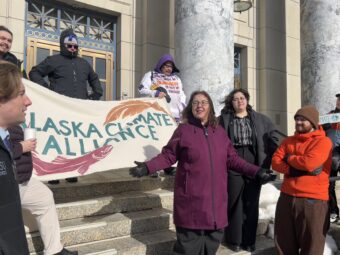
Members of the Alaska Youth for Environmental Action hold signs at the steps of the Alaska State Capitol in downtown Juneau on Saturday, Jan. 24, 2026. (Photo by Clarise Larson/KTOO)
Juneau teens and residents are calling on the Alaska Legislature and Gov. Mike Dunleavy to call off the state’s longtime push for a natural gas pipeline in Alaska.
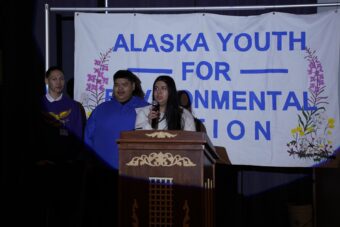
On Saturday, more than 40 people gathered at the steps of the Alaska State Capitol in downtown Juneau to protest the long-sought Alaska LNG project. The protest was led by Alaska Youth for Environmental Action, a youth-led environmental advocacy group with chapters across the state.
Paige Kirsch is a senior at Juneau-Douglas High School: Yadaa.at Kalé and a member of the group’s Juneau chapter.
“I think it’s really important to be cognizant of the future of Alaska, especially because I do want to live here when I grow up, and I don’t want to live somewhere that’s purely for economic profit,” she said. “I just don’t think it’s really that fiscally responsible to keep investing in non-renewable resources.”
Alaska officials have been pushing for the proposed pipeline for decades and the state has already poured more than half a billion dollars into the project. If it’s built, the project would move natural gas from the North Slope to Southcentral for export overseas. A portion of the gas would be reserved for in-state use. The project has already been federally permitted. Last year, the Texas-based Glenfarne Group assumed majority ownership of the project from the state.
Members of the Alaska Youth for Environmental Action write messages in chalk in front of the Alaska State Capitol in downtown Juneau on Saturday, Jan. 24, 2026. (Photo by Clarise Larson/KTOO)
Since then, it has announced a handful of nonbinding gas purchase and supply agreements. Last week, the company announced several more agreements it says moves the project’s first phase into an early development stage.
Proponents for the project say it would tap into an underdeveloped natural resource and provide energy security to a region facing shortfalls. But others remain skeptical about whether the project will actually be built, citing high costs and competing global energy projects.
At the protest on Saturday, multiple teens took to a microphone to share some of the negative impacts they believe the pipeline would bring, including bisecting land, disrupting habitat and emitting carbon dioxide. Atagan Hood, a junior at JDHS, says Alaska’s dollars would be better spent on renewable energy to mitigate human-caused climate change.
“We are told that the 800-mile Alaska liquid natural gas pipeline is a bridge to a cleaner future, but you cannot build a bridge to a stable climate out of fossil fuel infrastructure,” he said.
Last year, an Anchorage Superior Court Judge dismissed a youth-led lawsuit challenging the pipeline.
There was one counter-protester at the event on Saturday. Kevin Nye, a retired engineer, stood on his own holding a sign that read “Build the Pipeline.” He said he wanted to represent those in Alaska who support the economic benefits the pipeline would bring to the state.
Kevin Nye, a retired engineer, stands with a sign outside the Alaska State Capitol on Saturday, Jan. 24, 2025. (Photo by Clarise Larson/KTOO)
Glenfarne told reporters last week it expects to begin laying pipe later this year. But project skeptics say that the timeline is unrealistic. The company also initially said it planned to make a development decision by the end of 2025. That decision is now expected to come in February at the earliest.
Researchers used air and water temperature from sites around the Copper River Delta to gauge climate impacts on wetlands. (Amaryllis Adey)
Before juvenile salmon make their way to the sea, they grow and feed in freshwater, including wetlands, for anywhere between a few months and several years.
But new research finds that as air temperatures rise with climate change, the water that flows through coastal Alaska’s ponds and marshes is warming rapidly, too. That could spell trouble for Pacific salmon, which can’t grow – or live – in waters above certain temperatures.
“I’ve never really hoped so much that I might be wrong,” said Amaryllis Adey, a researcher at Virginia Tech.
Adey is a co-author of the report, which was published in December in the journal Nature. The researchers compared nine years of water and air temperature data from 20 ponds near Yakutat and Cordova. They found that the water was keeping pace with increases in air temperatures.
That’s notable because it marks a departure from what’s happening with other freshwater ecosystems as temperatures rise, Adey said.
Past research shows that rivers and streams are warming more slowly than the air due to a range of factors, including that they move quickly and benefit from glacial runoff. Wetlands, meanwhile, are typically shallow, still, and more spread out across the landscape – leaving them more exposed to the air.
“It was really stark,” she said. If “one degree of air temperature results in one-degree increases in water temperature, that could be really concerning in the future.”
Report co-author Amaryllis Adey and a fellow researcher download temperature data in the field. (Elliot Deins)
The researchers’ next step was using the historical data to model what might happen in the decades to come.
The researchers looked at two possible scenarios. One was a future in which humans continue producing greenhouse gases at the current rate. Adey called that the “business as usual scenario” and said it resulted in a “drastic increase” in water temperatures.
“It was like up to 22 degrees Celsius by the end of the century,” Adey said.
That’s about 71 degrees Fahrenheit, which is really warm – and dangerous – for these wetland ecosystems. Coho salmon, for instance, stop growing at around 68 F. And death becomes likely once temperatures surpass about 73 F.
Adey says it’s certainly possible that salmon would adapt. But if they can’t shift the timing of their migrations or habitat use, she said, “they won’t be able to continue to grow and survive in these systems that are very economically and culturally dependent on them.”
The second scenario was less grim. If humans continue emitting at current rates for another decade and then begin reducing carbon emissions, water temperatures would still rise. But they would be less likely to reach dangerous levels.
The study looked specifically at two areas – the Yakutat Forelands and the Copper River Delta. But the results have far-reaching implications, including in Southeast Alaska.
“We’d expect that there’s going to be kind of similar responses across that coastal region,” she said.
Other organisms, including algae and bottom-dwelling invertebrates, are also temperature sensitive, the study said. That means warmer water could be felt by the entire food chain, ranging from different fish species to migratory birds.
A fish camp in the Nome area, seen on Sept. 24, 2022, shows damages wreaked by the remnants of Typhoon Merbok. The day before, then-President Biden declared a major disaster for a vast stretch of western Alaska that had been slammed with high winds and floods caused by the remnants of that typhoon. The storm is among several recent disasters in Alaska that scientists link to climate change. (Photo by Jeremy Edwards/Federal Emergency Management Agency)
Landslides, storm-driven floods, infrastructure-damaging permafrost thaw and intensifying wildfires are among the expensive disasters that scientists link to Alaska’s rapidly changing climate.
Now a state legislator is proposing to levy a 20-cent surcharge on every barrel of Alaska-produced oil to fund programs that respond to and prepare for disasters related to climate change.
Rep. Andy Josephson, D-Anchorage, introduced the measure, House Bill 247, in advance of the legislative session scheduled to start on Jan. 20.
To explain why the state needs such a fund, Josephson ticked off a list of recent disasters in Alaska that imposed heavy costs — and, in some cases, killed people. Those events, which include deadly landslides in Southeast Alaska, landslides that have blocked roads, severe flooding in Western Alaska last October from the remnants of Typhoon Halong and similar damage in 2022 from the remnants of Typhoon Merbok, all had some links to climate change that is caused by greenhouse gas emissions from fossil fuel burning, he said.
“It’s a true statement that a lot of the disaster dollars we need right now are related to climate change. That, in my opinion, is sort of inarguable,” he said.
Disasters like those that have occurred in recent years are expected to continue in the future, he said: “We’re in a new normal.”
The bill is logical from a fiscal standpoint, Josephson said.
As of now, the state’s disaster relief fund is “basically a sub-fund of the general fund,” and it gets whatever lawmakers are able to appropriate, he said. But if there is a new stream of money as proposed by his bill, “we would free up those dollars we’re otherwise spending in the disaster relief fund.”
At 20 cents per barrel, the proposed surcharge would raise about $30 million a year, he said.
In comparison, Gov. Mike Dunleavy in December proposed that lawmakers approve a $40 million appropriation for the state’s existing disaster relief fund. The need could increase from that total if the Trump administration fails to reimburse 100% of the costs for Typhoon Halong relief rather than the normal 75%. The Biden administration in 2022 approved 100% reimbursement for Merbok-related costs.
As introduced by Josephson, the bill would give the Alaska Department of Environmental Conservation oversight over the money generated by the surcharge. It would distribute fund money in the form of grants to local governments and other entities for purposes like disaster response, disaster preparation and upgrades that make infrastructure better protected against climate change.
The surcharge idea has precedent in Alaska. The Department of Environmental Conservation already administers another fund with money coming from a per-barrel fee on oil produced in the state.
Debris dovering the Zimovia Highway in Wrangell is seen in the aftermath of the deadly landslide that struck on Nov. 20, 2023. (Photo provided by Alaska Department of Transportation and Public Facilities)
After the 1989 Exxon Valdez oil spill, the state began levying a 5-cent-per-barrel surcharge on oil that goes into the state’s Oil and Hazardous Substance Release Prevention and Response Fund. The fund itself was created by the legislature in 1986, with the surcharge established after the disastrous Prince William Sound spill.
That surcharge and rules concerning the fund’s operations have been modified over the years, broadening the purposes for which the fund can be used and boosting DEC’s reporting requirements, according to the department.
In its current configuration, each 5-cent-per-barrel surcharge sends 1 cent into a spill response account, to be used for spills that have been officially declared disasters. The other 4 cents goes into a spill prevention account, which can be used to address spills that have not been declared disasters, among other functions.
In 2015, refined petroleum products were added to the program. The state added a small surcharge, 0.95 cents per gallon, on refined fuel projects sold, transferred or used at the wholesale level, according to the DEC.
The idea of a similar levy to raise money for climate change preparedness and response is not new.
Rick Steiner, a retired University of Alaska marine conservation professor who founded and leads an environmental organization called Oasis Earth, has been advocating for the approach for several years.
“The legislature has so far seemed unable or unwilling to connect the dots between the many climate-related disasters we are experiencing — typhoon Merbok, wildfires, landslides, floods, coastal erosion, permafrost thaw, storm damage, infrastructure damage, subsistence impacts, commercial fishing impacts, etc..– to see the larger picture of the threat and costs these interrelated climate disasters pose,” he said in a letter to lawmakers sent last September. “The money to address these issues will have to come from government.”
In advocating for what he called an Alaska Climate Resilience Fund, Steiner said funding issues have become more pressing because of federal cutbacks.
The climate-response surcharge idea is not unique to Alaska, either.
Hawaii has put its version of a climate surcharge into law, a measure that seeks to raise money for responses to future disasters like the deadly 2023 Lahaina wildfire on the island of Maui.
In May, Hawaii Gov. Josh Green, a Democrat, signed a bill that increases the state’s hotel and lodging tax by less than a percentage point. The increase is applied to the state’s Transient Accommodations Tax, known at TAT. The governor said the increase would amount to an additional charge of about $3 on a $400-a-night hotel room fee. It is expected to generate about $100 million a year, according to state officials.
The center of Mendenhall Glacier’s terminus on November 23, 2025. Scientists confirm the glacier is no longer interfacing with Mendenhall Lake. (Photo by Alix Soliman/KTOO)
Listen to this story:
For the first time, Juneau’s famous Mendenhall Glacier is not touching Mendenhall Lake, which was hidden beneath a thick sheet of glacial ice only a couple of hundred years ago. Scientists say this means the glacier has entered a new phase of its retreat.
Jason Amundson, a glaciologist at the University of Alaska Southeast who’s been studying the Mendenhall Glacier for years, said the glacier is the symbol of Juneau.
“There’s several glaciers around, but when someone says ‘the glacier,’ they’re definitely talking about Mendenhall,” Amundson said.
The inside of Juneau’s City Hall features a panoramic image of the glacier. It’s the most striking part of the landscape that travelers see when they fly into Juneau International Airport. It’s the capital city’s top tourist attraction, with more than 700,000 visitors each year.
For generations, the glacier fanned out across the lake that it carved out. But it’s been rapidly retreating out of the lake over the past two decades. Now, scientists say it’s separated from the water completely.
Amundson flew over the scene in a helicopter about two weeks ago.
“That was the first time I had really thought, ‘Oh, it doesn’t look like it’s touching the lake anymore,’” he said, adding that photos posted on Facebook by local photographers confirmed it.
But he said glacial ice and water will probably touch again for brief periods over the coming seasons. Rainfall and snowmelt could cause the lake level to rise enough to meet the ice. Also, the glacier still pushes toward the lake a fraction in the winter, when gravity pulls on the added mass of the snowpack.
Eran Hood, an environmental scientist at the University of Alaska Southeast, said that despite these expected seasonal meet-ups, the Mendenhall is “functionally” no longer a lake-terminating glacier.
“It’s clear there’s a lot of shallow sediments through there that it’s kind of sitting on, or even perched up above,” Hood said. “There’s just not much chance at this point that it would really have meaningful interactions with the lake anymore.”
The northern end of the Mendenhall Glacier’s terminus, where it’s perched on lake sediments, on November 23, 2025. (Photo by Alix Soliman/KTOO)
Climate change has accelerated the glacier’s retreat. Between 1941 and 2020, the local mean temperature rose by 2.5 degrees Fahrenheit.
In recent years, Amundson said that glacial ice on the lake has quickly disappeared.
“There was pretty rapid retreat that occurred because there was this shallow, pretty thin area of the glacier that was in the lake and that broke apart— like where the ice caves used to be,” he said.
According to a previously unpublished report shared with KTOO and written by Hood, Amundson and their colleagues, the Mendenhall Glacier retreated fastest between 2007 and 2011 — losing roughly a football field per year — because icebergs were calving off at a high rate as the glacier’s terminus moved through the deepest part of Mendenhall Lake.
Amundson said that’s because of the way that ice interacts with water.
“When you have a glacier that’s in deep water, there’s a lot of pressure at the bottom, so the glacier tends to flow faster,” he said. “Then, if it’s flowing faster, it can break apart.”
The deep blue ice after calving at Mendenhall Glacier in 2014. (Photo courtesy Laurie Craig/USFS)
Now that the ice isn’t touching the water, Amundson said the Mendenhall’s retreat could slow down. In the report, the researchers found parts of the glacier that terminated on rock retreated substantially slower than parts that terminated on the lake. Between 1998 and 2020, the ice attached to bedrock receded about 56 feet per year, while ice on the lake vanished at more than two-and-a-half times that speed, at roughly 148 feet per year.
“So once you get out of the lake, it’s harder for the glacier to retreat as quickly as it has over the last 5, 10, 15 years,” Amundson said.
But the glacier is still receding. Using ice-penetrating radar, the research team is currently trying to predict when it will pull into another lake of unknown size, shape and location that’s currently hidden beneath the ice. That could speed up the glacier’s retreat again.
Losing a scenic view
One day in the not-so-distant future, scientists say Juneau’s symbol will disappear from the vantage point of the U.S Forest Service visitor center that was built to feature its scenic vista.
Hood said he thinks that will happen sometime around 2050.
(Infographic courtesy of Hood et al.)
Alix Pierce, the visitor industry director for the City and Borough of Juneau, said that losing sight of Juneau’s most accessible glacier could change how the city markets itself as a tourist destination. Although, she suspects many cruise ship passengers will probably still come to see the Mendenhall.
“But we’re going to need to be creative about how it changes, what it looks like, how we adapt,” Pierce said.
A few years ago, the Forest Service looked at several different options for how to address that foreseeable future.
“Some of those options were things like boating people across the lake to a satellite visitor center where they’d be able to see the glacier for longer,” Pierce said. “Those things weren’t ultimately selected in their final plan.”
Hood said the visitor center at Portage Glacier in Chugach National Forest could be a cautionary tale. In the 1990s, hundreds of thousands of people traveled there. But since that glacier pulled out of view, visitation has plummeted.
The terminus of Mendenhall Glacier, seen from the rock peninsula on November 23, 2025. (Photo by Alix Soliman/KTOO)
Paul Robbins, a spokesperson for Tongass National Forest, did not comment on how the agency might try to maintain scenic access once the current view of the glacier is lost.
“Our current plans are focused on improving access and increasing visitor capacity, safety and enjoyment through the Mendenhall Glacier Visitor Facilities Improvement project,” Robbins wrote in an email to KTOO. “The project adds a Welcome Center, an outdoor plaza, enlargement of parking areas, additional restroom facilities, three new trailhead parking lots, and improvements to the existing facility.”
But Pierce said those improvements don’t address the decline of the glacier.
“Things like that, that are vital and necessary for managing the traffic flow that we have out there today, but aren’t necessarily looking into the future for how we adapt to climate-related changes to how people use the area,” she said.
Close
Update notification options
Subscribe to notifications
Subscribe
Get notifications about news related to the topics you care about. You can unsubscribe anytime.