Climate Change

As the Arctic heats up, the U.S. Coast Guard’s icebreaker fleet is preparing for boom times

The U.S. Coast Guard icebreakers Polar Star (at background), Healy (at left) and Storis (at foreground) are seen together at Coast Guard Base Seattle on Oct. 26, 2025, marking the first time since 2006 that the Coast Guard had three active polar icebreakers in the same place at the same time.
The U.S. Coast Guard icebreakers Polar Star (at background), Healy (at left) and Storis (at foreground) are seen together at Coast Guard Base Seattle on Oct. 26, 2025, marking the first time since 2006 that the Coast Guard had three active polar icebreakers in the same place at the same time. (Lt. Christopher Butters/U.S. Coast Guard)

On a dreary November day in Seattle, the U.S. Coast Guard put its past and future on display.

Within sight of the Space Needle, three eye-catching red icebreakers towered over Pier 36. It was the first time since 2006 that the Coast Guard has had three active icebreakers in the same place at the same time.

In the coming years, that scene will become more common, and not just in Seattle. After years of underfunding, the Coast Guard’s icebreaker fleet is undergoing a massive expansion, with almost $9 billion for new ships.

On Tuesday, the U.S. government signed the Icebreaker Collaboration Effort — or ICE Pact — a three-nation agreement with Finland and Canada that will see some of those ships built in Finland, whose shipyards will train Americans to build more.

“It’s an exciting time to be a polar icebreaker sailor,” said Capt. Jeff Rasnake, commanding officer of the Polar Star, America’s only heavy icebreaker.

So many ships are about to join the Coast Guard’s fleet that the agency isn’t yet sure where it will put them all. The Coast Guard has earmarked millions for a port expansion in Seattle to accommodate three heavy icebreakers, plus another $300 million for Juneau to serve as a port for a medium icebreaker.

More space will be needed on top of that, and Sen. Dan Sullivan, R-Alaska, said his intent is to have as many of the new ships based in Alaska as possible.

“We want home port decisions on these icebreakers sometime in early 2026,” he said. “That is my goal.”

Eric Boget, a research engineer aboard the U.S. Coast Guard Cutter Healy (WAGB 20), prepares to throw a grappling hook to recover an Arctic Mobile Observing System (AMOS) mooring while Healy operating in the Arctic Ocean, July 21, 2025. Boget is a member of the scientific research team recovering data from the AMOS moorings. (Petty Officer 3rd Class Chris Sappey/U.S. Coast Guard Pacific Area)

The need for new icebreakers is clear: As the Earth warms amid climate change, no place is warming faster than the Arctic. Melting ice is opening new routes for shipping, places to mine and drill, and seas to fish or view from the deck of a cruise ship.

In many cases, control of those new routes is being disputed among nations.

“Right now, things are heating up in the Arctic, and not just on the ice,” said Capt. Kristen Serumgard of the icebreaker Healy.

Russia is expanding its military presence in the Arctic, including with icebreakers, and as NATO confronts Russian aggression in Europe, there’s been international concern that the United States and NATO should be prepared to match Russia in the Arctic as well.

China is operating significant numbers of icebreakers in the Arctic, as are European nations, each interested in maintaining their right to access the area.

“It’s a geopolitical hotbed up there,” Serumgard said.

Rasnake, who typically works in the comparatively calm Antarctic, said that “with lines being drawn and a lot of different contested (seafloor) land claims, it’s — I wouldn’t say the wild, wild West, but maybe the wild, wild North.”

Shipping traffic through the Arctic Ocean is on the rise, with more ships traveling Russia’s Northern Sea Route and the Canadian-American Northwest Passage each summer.

As yet, the Northwest Passage isn’t regularly used by commercial shipping, said Steve White, executive director of the Marine Exchange of Alaska, which monitors the area for safety risks.

While that’s the case, “we are seeing a trend of more and more traffic, though, going through the Bering Straits, both on the US side and on the Russian side,” he said.

With more ships comes more risk. On Sept. 6, the Dutch cargo ship Thamesborg ran aground in Franklin Strait, part of the Northwest Passage. The accident didn’t release any pollution and no one was injured, but it took 33 days for the ship to be freed and sent on its way.

The Northwest Passage and the Northern Sea Route each funnel through the Bering Strait, which is split between American and Russian control.

“The reason this is so important for people to understand is that the Bering Strait — you’ve only got about (51) miles between the US and Russia, and you have the biodiversity, the wildlife that’s there,” White said. “This comes at a time where we’re getting more storms, the communities are struggling up there with food security and the top priority, the salmon returns … the fabric of our Alaskan communities up there is under threat, and it’s under threat from what’s going on with the weather changing and increased traffic.”

The U.S. Coast Guard is the federal government’s nautical Swiss Army knife — it performs rescue operations, enforces fishing laws, stops drug smugglers, runs border patrols, performs safety inspections, anti-pollution patrols, counter-piracy patrols, and enforces America’s maritime laws.

The U.S. Navy runs submarines under the Arctic ice, but it doesn’t operate icebreakers. It leaves the Coast Guard to do that — on the Great Lakes, on American rivers, and in the Arctic and Antarctic.

But for years, the national icebreaker fleet has been underfunded.

When Nome, home to the endpoint of the Iditarod Trail Sled Dog Race, ran short of fuel in 2012, the U.S. Coast Guard struggled to muster a single icebreaker, the Healy, to escort a Russian icebreaking tanker to the town.

At the time, the Healy was the Coast Guard’s lone operating icebreaker. Soon afterward, it reactivated the Polar Star, which had been mothballed because it was old and needed maintenance.

While both ships continue to operate, they’re less capable than modern ships and have suffered mechanical breakdowns, some significant.

Last year, the Healy caught fire and had to abbreviate its summer patrol. While it returned to service in the fall and went on to discover a volcano-like mountain on the Arctic seafloor, it’s now due for an extended period of maintenance.

“She’s 25 years old and been breaking ice for 25 years, right? That is hard on a ship,” Serumgard said.

The U.S. Coast Guard Cutter Storis uses dynamic positioning to maintain its position near the Johns Hopkins Glacier in Glacier Bay National Park and Preserve, Alaska, Aug. 5, 2025. The Storis is equipped with Dynamic Positioning Class 2 capabilities which provide redundancy and ensure station-keeping even with the failure of a critical component, such as a generator or thruster. (Petty Officer 3rd Class Ashly Murphy/U.S. Coast Guard Arctic)

Two American icebreakers in the Arctic Ocean in 2025

If America’s icebreaking fleet is near a low ebb, this summer saw the first steps toward the planned resurgence.

As a stopgap until new ships arrive, Congress last year ordered the purchase of the Aiviq, an oilfield services ship designed to work in the Arctic Ocean.

Eight years ago, following a disaster that saw the Aiviq lose control of a drilling rig during a storm, the Coast Guard deemed the ship “not suitable for military service without substantial refit.”

Since then, the ship has been overhauled and the Coast Guard’s opinion has changed.

After Congress appropriated the money, the Coast Guard purchased the Aiviq, quickly converted it, and in August this year, commissioned it as the icebreaker Storis.

At the time of that commissioning, commanding officer Capt. Corey Kerns said the ship and its crew would “need to learn to crawl” before they could get fully up and running.

In addition, there were unanswered questions about how well the Storis would handle the kinds of storms that troubled the Aiviq.

In October, Kerns sat down for another interview after returning from the Arctic.

“One of the things that kind of surprised me was that it went smoother than maybe I would have expected,” he said.

“She was able to perform, get through the whole thing without any major issues,” Kerns said of the ship’s first patrol.

As a result, Kerns felt confident enough to guide the Storis into the Arctic Ocean, where it worked with the icebreaker Healy to shadow two Chinese research ships in parts of the ocean that the United States claims.

The presence of those Chinese ships and others that have operated in conjunction with Russian shipshas alarmed some American officials.

If China and Russia are present in the region, it behooves the United States to be there too, Kerns said in August.

“The ability to be present guarantees your ability to to maintain sovereignty. And that’s what we’re trying to get at here in the Arctic. We need more icebreakers to be present in our waters and be clear what is our waters,” he said.

The Coast Guard cutter Waesche, a “thin-hulled” ship, also monitored the Chinese ships. Both it and the Storis participated in Arctic Edge 2025, a military training operation near the Russian border that also included Canadian forces.

There’s still work to be done with the Storis, Kerns said. It hasn’t been certified to host Coast Guard helicopters yet, and it hasn’t done a full icebreaking test.

“We got into the ice and we showed that she could break flat ice to some extent, at certain speeds, but … probably not a fully worthy test of capability in the ice, so we’re discussing that now,” he said.

Coast Guard Chief Petty Officer Kevin Rambo gives a demo of a machine gun aboard the Coast Guard icebreaker Storis on Nov. 12, 2025, in Seattle. Four were mounted on the new Coast Guard icebreaker after its acquisition from a private offshore oilfield services company. (Tom Banse for the Alaska Beacon)

Thirteen years ago, the Aiviq lost control of the drilling rig Kulluk, causing it to run aground on Kodiak Island. That disaster took place after rough seas flooded the Aiviq’s fuel tanks and caused it to lose power.

This summer, as the Storis sailed across the Gulf of Alaska, it again encountered rough seas.

“There were a few nights where you didn’t sleep as well, but it was perfectly safe,” Kerns said.

He said his crew are already overhauling equipment and preparing for next summer in the Arctic, working in conjunction with the Healy.

That ship spent 129 days at sea this summer, primarily focusing on science, according to an official Coast Guard description of the patrol.

“We know more about the surface of the moon than we know about the seafloors, so it’s kind of a really amazing area of exploration,” Serumgard said.

En route back to Seattle, the Healy was diverted to help search and rescue efforts in Southwest Alaska following Typhoon Halong, which devastated the region and left hundreds of people homeless.

In Seattle, the Polar Star was preparing to leave on a five-month roundtrip to Antarctica, where it will help supply research outposts across that continent.

Rasnake said he believes the Polar Star is in the best shape it’s been since being reactivated in 2013, and he looks forward to it possibly breaking the record of the most Antarctic missions by any Coast Guard icebreaker. That would come — if all goes well — in December 2026 or January 2027.

The U.S. Coast Guard icebreaker Polar Star is seen in Seattle on Nov. 12, 2025. (Tom Banse for the Alaska Beacon)

A huge expansion of the fleet is on the horizon

If the Polar Star does break that record, it may not have many opportunities to expand on it. The Coast Guard’s first new heavy icebreaker since the Polar Star is now under construction in Mississippi.

Named the Polar Sentinel, it’s expected to be complete by 2030. The Republican-backed budget plan that President Donald Trump nicknamed the “Big Beautiful Bill” includes funding for two other heavy icebreakers after the Sentinel.

Thirteen other icebreakers were funded in that bill, said Sullivan, the Alaska senator.

“There’s funding for three to four Arctic Security mediums. Those are the target ones for our state. And then there’s 10 light icebreakers. Those are smaller. Those do work in the Great Lakes and other things like that,” he said.

The medium icebreakers, known as “Arctic Security Cutters,” are among 11 planned ships being built by two separate industry groups. Canada’s Davie Shipbuilding is planning to build five ships — two in Finland, and then three at a to-be-expanded Texas shipyard.

The second group, which includes American, Canadian and Finnish firms, will build two ships in Finland and a third simultaneously in the United States, then build three others in the United States.

The first five ships are expected to be delivered to the Coast Guard within 36 months of a contract being signed, meaning they could be patrolling the Arctic Ocean before the end of the decade.

The newly commissioned Storis will also need upgrades to complete its conversion from a civilian ship. First on the docket may be additional military communications gear, but Kerns said the Coast Guard is also considering how to fit more crew aboard.

In the longer term, Kerns — who has a nautical engineering background — is working with his crew on plans for a deeper refit that could allow the Storis to serve as a kind of “logistics ship.”

As currently built, it carries several large holds originally intended for drilling mud and other materials needed for oil wells at sea. Those could be repurposed, he said this month, and his crew is coming up with ideas for the ship’s first major refit, expected sometime after summer 2026.

The new ships and the changes to the Storis are only part of the Coast Guard’s plan in the coming years. Each ship will also need people and equipment ashore for maintenance and support. The Coast Guard is involved in an ongoing struggle to acquire acreage to expand its Seattle base, which the port authority is reluctant to cede.

Pier space at the Coast Guard’s Alameda base, in California, is also constrained.

“We’re looking for space in all possible areas,” said Capt. Brian Krautler, chief of operations for the Coast Guard’s Pacific Area.

The Big Beautiful Bill included $300 million to build a base in Juneau to host the Storis. Other places in Alaska — Seward, Kodiak, Nome, or Dutch Harbor — might also accommodate one or more of the new Arctic Security Cutters. Kodiak is home to the largest Coast Guard base in the country.

Speaking this week at the signing of the so-called ICE Pact, Secretary of Homeland Security Kristi Noem said that the Trump administration sees the expansion of the icebreaker fleet as a top priority.

“Today is a major milestone in the race to secure the Arctic for all of our countries,” she said. “The Arctic is the world’s last, most wild frontier, and our adversaries are racing to claim its strategic position and its rich natural resources for their own. If we give up that high ground, then we will condemn future generations to permanent insecurity, and we’re not going to let that happen on our watch.”

After a landslide closure, Auke Lake Trail to reopen soon

Mark Krumwiede saws through a tree along the edge a landslide that washed out Auke Lake Trail in September 2025. (Photo by Alix Soliman/KTOO)
Mark Krumwiede saws through a tree along the edge of a landslide that washed out Auke Lake Trail in September 2025. (Photo by Alix Soliman/KTOO)

Listen to this story:

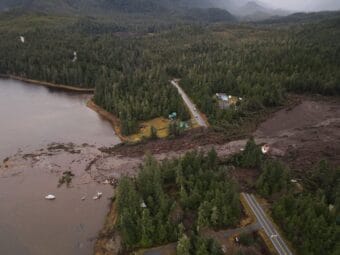
Two landslides took out Juneau’s popular Auke Lake Trail in September, causing the City and Borough of Juneau to close it to the public. Now, as trail workers repair it, they say it’s an example of climate impacts on local trails they’ve been seeing more frequently in recent years. 

On Monday, a trail coordinator used a chainsaw to rip through a fallen tree blocking the path along Auke Lake where landslides washed it out. The trail is flat and follows the contour of the lake next to the University of Alaska Southeast’s Juneau campus. The landslides occurred during an atmospheric river in late September and the trail has been closed since.

Two landslides washed out roughly 150 feet of Auke Lake Trail, which is just over a mile long, in September. The debris can be seen from the boat launch across the lake. (Photo by Alix Soliman/KTOO)
In September, two landslides washed out roughly 150 feet of Auke Lake Trail, which is just over a mile long in total. The debris can be seen from the boat launch across the lake. (Photo by Alix Soliman/KTOO)

“We saw footsteps as we were going,” said Meghan Tabacek, the executive director of Trail Mix Inc. “People are already still using this trail.”

Trail Mix is a local nonprofit that maintains more than 200 miles of trails in Juneau, including those owned by the city. 

“So our goal is now to make it, one: fully reopen so we can get the trail closed signs down; and two: at least passable,” Tabacek said. “Our first step to passability is using these chainsaws right here to clear all the logs.”

Later, they’ll push those logs into the lake, where much of the debris fell naturally.

Mark Krumwiede saws through a branch along the edge a landslide that washed out Auke Lake Trail in September 2025. (Photo by Alix Soliman/KTOO)

Nick Marinelli is a trail coordinator for Trail Mix. He paced the length of both landslides, which are about 50 feet apart at the trail level, and estimates that about 150 feet of the trail washed out altogether. The slides appear to reach up the slope roughly 400 feet, where they’ve scoured the soil down to bedrock.

He said he has noticed landslides affecting popular Juneau trails more frequently in recent years, including on Perseverance Trail and Montana Creek Trail. 

“It seems like with those heavier storm events that happen in September and October, there’s more material coming down,” Marinelli said. 

Tabacek said that has factored into how Trail Mix plans maintenance. 

“Especially over the past five years, as climate-related disturbances to trails become a little more frequent, we’ve just started having to budget our time a little bit different,” she said.

She said that Trail Mix now sets aside five to eight weeks each year to handle this extra work. That work has included things like restabilizing a bridge on Black Bear Trail where Montana Creek widened sooner than expected, redirecting water and clearing landslide debris.

Once the workers clear away the logs, Tabacek said they’ll rebuild damaged sections of Auke Lake Trail this week. 

“A lot of that is just going to be pushing dirt around,” she said. 

Then they’ll layer some gravel on top and build retaining walls. In the spring, she said they’ll probably come back and add moss to the bare soil on the lake-side of the trail. They might also plant blueberry and devil’s club starts on the upward slope.

“But honestly, Southeast kind of takes care of the re-veg(etation) pretty, pretty fast every year,” Tabacek said. 

Although the slide chutes seem stable now, she said some trees are loosely attached and a storm could cause further slides. 

“Especially on days where you’re getting more than half an inch or a full inch of rain,” she said.

Marc Wheeler peers up at one of the landslides that washed out Auke Lake Trail. (Photo by Alix Soliman/KTOO)

Marc Wheeler, the city’s director of parks and recreation, said residents should always consider the hazards when heading outdoors. 

“Like with all of our trails, we just have people use their best judgment,” Wheeler said. “You’re kind of using our trails at your own risk.”

Juneau recreators can fill out a damage report on the Trail Mix website if they encounter fallen trees or slides blocking trails. 

The city hopes to reopen Auke Lake Trail at the end of this week.

Clarification: A previous version of this story said Trail Mix hopes to reopen the trail. The City and Borough of Juneau owns Auke Lake Trail.

Alaska crab fishery shows signs of recovery after massive crash

Fish and Game says survey results show increases in all sex and size groups of snow crab compared to last year. Large males remain at historic lows, but the population is showing signs of stabilization and recovery after the recent collapse.
Fish and Game says survey results show increases in all sex and size groups of snow crab compared to last year. Large males remain at historic lows, but the population is showing signs of stabilization and recovery after the recent collapse. (Laura Kraegel/KUCB)

Bering Sea crabbers will see a boost in catch limits this season, after years of cancellations and small harvests due to low snow and king crab stocks.

The Alaska Department of Fish and Game announced Monday that it’s nearly doubling the harvest for the upcoming Bering Sea snow crab commercial fishing season from last year’s totals.

Fish and Game set the cap at 9.3 million pounds. That’s a low number compared to historic levels. In 1991, crabbers harvested more than 320 million pounds of snow crab.

The catch limit was set at 45 million pounds back in 2020, the year before the snow crab stock crashed. And the next year, the fishery closed for two seasons after more than 10 billion snow crabs disappeared from the region.

Researchers blamed warming waters from climate change for the crash.

Fish and Game now says survey results show increases in all sex and size groups compared to last year. Large males remain at historic lows, but the population is showing signs of stabilization and recovery after the recent collapse.

Officials said a return to colder ocean conditions and increased numbers, especially in juvenile crab, are reasons to be optimistic.

And for the first time, a portion of the harvest will be reserved for a hybrid snow-tanner crab. Those are crabs that share some characteristics of both snow and tanner crabs, like eye color and tooth shape.

Regulators said recent surveys show an “unprecedented” amount of the hybrid crab. To incentivize harvest of them, Fish and Game designated about 11% of the total snow crab catch to the snow-tanner mix. According to officials, the fleet will be encouraged to harvest about a million pounds of the hybrids from the “hybrid grounds.”

Meanwhile, Fish and Game also boosted the Bristol Bay red king crab catch limit by about 16% from last year, with a total harvest of about 2.7 million pounds. Tanner crab harvests more than doubled for the western district of the Bering Sea but dropped by almost 40% for the eastern area.

All of those fisheries open Oct. 15. The lucrative Bristol Bay red king crab has the highest priority harvest, as that fishery closes shortly after the new year. Snow and tanner crab both close in the spring.

Alaska’s Climate Adaptation Science Center will stay open amid closures elsewhere

The Mendenhall Glacier dams water in Suicide Basin. As the glacier calves, it could be creating more storage space for water. That could cause bigger glacial outburst floods in the future. (Photo by Anna Canny/KTOO)

The Alaska Climate Adaptation Science Center, or AK CASC, is so far spared from closures coming to a third of such climate science centers across the country, as first reported by The Washington Post

In other regions of the U.S., some centers are expected to run out of money soon because the federal government has stalled funding and essential agreements with universities that the U.S. Geological Survey needs to manage the centers.

But Alaska’s center is safe for now.

Kristin Timm, AK CASC’s university co-director at the University of Alaska Fairbanks, said the center’s funding through next summer has already been disbursed. 

“But of course, we’re worried about how long our funding will continue to last,” she said.

The center’s budget is roughly $2.2 million dollars per year. AK CASC signed an agreement with the University of Alaska in 2023 that maintains their partnership through July of 2028, which should ensure the center’s existence until then.

Timm said that about 25 university employees receive a significant portion of their salary through the CASC.

But she said that two grants through the USGS are on hold. One would have funded communications interns and the other would have funded a study on how climate change could affect a caribou herd that’s important to subsistence hunters. 

She said the center does projects that Alaskan communities and decision makers have asked for. 

“If we don’t get funded, you know, one of the major projects that would really affect Alaskans is the work around the glacier outburst flood and Suicide Basin,” Timm said.

The center funded the interactive website that helped inform Juneau’s Mendenhall Valley residents about the threat to their homes during August’s flood. The center has also funded research around improving wildfire forecasts and how climate change is affecting salmon in the Yukon River Basin.

Brief tuna bounty in Southeast Alaska spurs excitement about new fishing opportunity

Jared Nelson, left, and Adam Olson, right, show off their haul of albacore tuna caught off the Sitka coast on Sept. 7. Waters near Sitka were warm enough to draw tuna from the south, and residents took advantage of the rare opportunity to hook a type of fish not normally seen in Alaska. (Photo by Rebecca Olson/Used By Permission)

In Alaska, a state famous for abundant salmon and huge, cold-water-loving crab, another type of fish is making a splash: tuna.

Incursion of warm waters into Southeast Alaska coastal areas off Sitka and Baranof Island created a brief tuna jackpot earlier this month for sport fishers.

One of the first of those anglers was Troy Tydingco, who happens to be the Sitka sportfish area management biologist for the Alaska Department of Fish and Game.

He took a day off from work when conditions were just right to search for tuna, a type of fish suited to more southern latitudes: beautiful weather, with calm waters and water temperatures that reach 60 degrees.

About 30 miles offshore, the search was successful. Tydingco and his six companions caught 44 albacore tuna in all. Other fishers followed.

“I think this is probably the first time sport anglers have really successfully targeted them and harvested them out of Sitka,” he said.

Another successful Sitka tuna angler was Adam Olson, operations manager at the Northern Southeast Regional Aquaculture Association.

What makes it fun, he said, is that it is “incredibly unique and unusual.” It is a big change for Sitka, he said. “We’re very salmon-centric here in Southeast Alaska,” he said.

Steve Ramp, Troy Tydingco, Isabel Platten, and Alex McCarre pose on Sept. 4, 2025, with some of the albacore tuna they caught that day about 30 miles offshore from Sitka. (Photo provided by Troy Tydingco)

Olson enjoyed eating the tuna as well as catching it, grilling it with a little salt and pepper. “It was phenomenal,” he said.

Tydingco said there is no precise count for the tuna haul. Based on anecdotal reports, social media posts and general talk around town, he estimates that there were 200 caught out of Sitka.

Anyone with a sportfishing license is allowed to harvest tuna in Alaska, as long as they use legal means. Most anglers use rod-and-reel gear that would typically be used to catch salmon. It is also legal to use a spear gun, which one man employed successfully to get a skipjack tuna in the Sitka harbor.

Commercial opportunity?

The Sitka tuna flurry generated enough interest to prompt the Department of Fish and Game to issue an advisory on Friday laying out the rules for a commercial harvest.

There is no federal fishery for tuna in Alaska, so it is up to the state to regulate catches if they occur, said Rhea Ehresmann, a Sitka-based groundfish project leader for the Department of Fish and Game.

Though no one may have tried it yet, commercial tuna fishing is legal in Alaska. There are requirements for permits, gear types and record-keeping. Trolling and jigging gear, which uses hooks to catch fish, is allowable for tuna, but nets are not.

So far, the department has issued a couple of permits to interested fishers, Ehresmann said.

Any commercial catch of tuna – whether deliberate or accidental bycatch during a harvest targeting another species —  is required to be reported to the state. There had been no such reports as of Monday, said Grant Hagerman, a Sitka-based troll management biologist for the Department of Fish and Game.

The Sitka tuna bounty may be new. But the occasional presence of tuna in Alaska waters is not.

Sea surface temperature departures from normal across the oceans as of Sept.14, 2025. (Map provided by the National Oceanic and Atmospheric Administration)

Up to now, Prince of Wales Island, at the far southern tip of Southeast Alaska, has been the site of most of the state’s tuna fishing, Tydingco said.

There are also isolated cases of tuna catches farther north, such as a skipjack tuna fished off Yakutat in 2015.

History indicates that the presence of tuna in Alaska waters is ephemeral. They might linger for a few weeks if waters are warm enough, then swim south.

Excitement over tuna in Alaska and rumors of their appearances date back to the 1920s, according to a 1949 report by the U.S. Fish and Wildlife Service. There was a Ketchikan-based commercial harvest in 1948, though that tuna appears to have been caught off British Columbia’s Queen Charlotte Island, according to the report.

Whether tuna fishing will become a trend in Alaska is yet to be determined.

Tydingco said this year’s successes are likely to encourage more fishers to look for tuna, but that people should not count on having tuna-friendly conditions every year.

“That warm water temperature doesn’t even always make it up this far,” he said.

There are signs that Alaska will be more hospitable to tuna in the future, due to warming waters caused by climate change and other factors.

While sea surface temperatures have increased in almost all of the world’s marine areas, temperatures in the North Pacific Ocean are rising faster, according to National Oceanic and Atmospheric Administration scientists. That includes the Gulf of Alaska, which has had recent marine heat waves.

albacore hooked on a bait pole
An albacore tuna is hooked on a bait pole on Oct. 9, 2012, in waters off Oregon. Tuna are normally found along the U.S. West Coast but occasionally stray into Alaska waters if tempertures are high enough. Sport anglers catch them with gear similar to that used to hook salmon. (Photo provided by the National Oceanic and Atmospheric Administration/West Coast Fisheries Management and Marine Life Protection)
Offshore in Oregon

Drone photos suggest a 2014 marine heat wave is still stunting orca growth, reproduction in Alaska

An aerial photo of seven killer whales, including young ones, swimming through greenish water.
Killer whales, including calves and juveniles, travel in their family group in the Gulf of Alaska in June 2025. (New England Aquarium in collaboration with North Gulf Oceanic Society under NMFS Research Permit 26614)

It’s well documented by now that the marine heatwave that hit the Pacific Ocean in 2014 had devastating effects on Alaska’s marine ecosystem and commercial fisheries.

Now, scientists are uncovering long-term impacts on Alaskan killer whales specifically – a harbinger as marine heat waves become more frequent and severe with climate change.

“We’ve learned that females that were growing during those heat wave years grew to smaller sizes,” said John Durban, a senior scientist with the New England Aquarium in Boston who has been studying killer whales in the Gulf of Alaska for two decades.

“If you’re smaller as a whale, it means you don’t have as much fasting endurance, you can’t store as much blubber,” Durban added. “So if you go through lean times, you’re less likely to bring a successful pregnancy to term.”

Durban has been partnering with the Alaska-based nonprofit North Gulf Oceanic Society to monitor several hundred resident, salmon-eating killer whales in the Gulf of Alaska. He flies drones over the water, which capture images of the whales from more than 100 feet in the air.

Those images allow researchers to measure how individual whales are developing over time.

The North Gulf Oceanic Society has been monitoring killer whales in the Gulf for more than four decades. Durban said that work became particularly important in the aftermath of the Exxon Valdez oil spill, which correlated with an “unprecedented” number of whale deaths among two pods that were exposed to the spill, according to NOAA.

The resident killer whales gradually recovered over the years. Or at least they were recovering, before the 2014 heatwave known by many as “The Blob” hit the area, according to Durban’s research.

“We started seeing that this recovery that had happened over the previous three decades basically getting wiped out in the course of a couple of years,” Durban said.

The technology has delivered some good news. This summer, researchers observed three new calves, plus some slightly older ones that appeared to be healthy and growing as expected.

That could mean the population is on a path to recovery. But it doesn’t mean the Gulf’s resident killer whales are in the clear. The females impacted by the heat wave may be less resilient in the face of future events, such as heat waves or dips in the salmon population.

“We’re cautiously optimistic, but I think it does mean that there’s some vulnerable whales out there,” Durban said.

His latest scientific findings haven’t yet been published. But he said he’s working on several scientific papers that lay out evidence that the so-called blob is still impeding Alaskan killer whales’ growth and reproductive success today, a full decade later.

As he sees it, the findings underscore the importance of studying apex predators. They rely on species down the food chain, which means they can serve as early indicators of trouble in the broader ecosystem.

Durban emphasized that the findings also highlight something else: the threat of climate change.

“These marine heat waves that we’re starting to see in increasing duration and intensity around the world are having really important effects on marine food webs.”

Site notifications
Update notification options
Subscribe to notifications