Tongass Voices

Tongass Voices: Svitlana Bell on quilting for Ukrainian pride and independence

Svitlana Bell at her quilting station in Juneau on Oct. 23, 2025. (Photo by Yvonne Krumrey/KTOO)

This is Tongass Voices, a series from KTOO sharing weekly perspectives from the homelands of the Áak’w Kwáan and beyond.

Svitlana Bell moved to Juneau from Ukraine after a few years of seasonal work to marry her husband and send more money back to her family. 

Bell cleans houses during the day, but in the evenings, she spends hours quilting. Her quilts are intricate and full of color, with soft, curved lines. She sells her quilts — which are based on works by Ukrainian artist Lyubov Panchenko  — to raise money for supplies for her brother Serhii Matviichuk who’s fighting on the front lines in Ukraine. 

Bell will be showing her quilts at Changing Tides this Friday from 4 p.m. to 7 p.m. during Gallery Walk.

Listen:

The following transcript has been lightly edited for clarity.

Svitlana Bell: 

I do these numbers for myself to make a plan – what is first piece to another, and how connection. It’s like “eat elephant in small pieces,” you know? Make all together and that is it. It’s just like a Lego, yes.

I’m Svitlana Bell. This design, (by) Lyubov Panchenko, Ukrainian artist and she wasn’t so famous, because in Soviet Union you cannot be different. It was a different time. But she made a lot of beautiful pieces, and right now they are in museum in Kyiv. 

She died in 2022 in Bucha when it was occupied by Russians and she was starving because she cannot leave house. It was very difficult time.  

And when I find here these designs, I contact with that museum, I ask, “Can I try?” because I’m just learning to do quilt – I do only three years. I clean houses, I see a lot of blankets or stuff, and think, “I should try it!”

And Lyubov Panchenko’s design, I asked permission. They approved it and said, “Please try it, do it.” And so I was so happy. So I’m very excited. I hope someday when war finish there, and I will bring some of the best pieces to that museum. 

Svitlana Bell’s quilt made from a design by Ukrainian artist Lyubov Panchenko. (Courtesy of Svitlana Bell)

You know, I have to rush, because I know if I sell, I can send money. If you have somebody who you love, you will do anything.

And, of course, how I can help brother here. He is in — like all Ukraine — in difficult time now, and he do what he has to do. But you always in risk.

I can show you some pictures they make. Here they look very tired. And you see they just came back from front line for couple days to rest.

Drones, mines, shootings that can just with one shot, can destroy all car and everybody in (it). Yeah, it’s very scary. Sometimes, like, we don’t breathe. 

And waiting when he will be back and he say, “I’m safe now.” Because, yeah, war is war.

I think every immigrant – even before war from another countries – made such a huge decision – especially a woman who has kids – this, they are so brave. You need be so brave to be immigrant.

It’s America. It’s a lot of cultures here. It’s make this America beautiful and big and strong.

Tongass Voices: S’eiltin Jamiann Hasselquist on the power of traditional foods

S’eitlin Jamiann Hasselquist serves chili made with beef, deer, and mountain goat meat in the Traditional Foods and Medicine Kitchen on Nov. 19, 2025. (Photo by Yvonne Krumrey/KTOO)

This is Tongass Voices, a series from KTOO sharing weekly perspectives from the homelands of the Áak’w Kwáan and beyond.

S’eitlin Jamiann Hasselquist has been hosting weekly community soup nights this month in the Traditional Foods and Medicine Kitchen inside Sealaska Heritage Institute’s new Indigenous Science Building in Downtown Juneau. 

She and her team use traditional Lingít foods to make soup for anyone who wants to try some — and maybe bring home the recipe to make themselves.

Last week, the group prepared chili with beef, deer and mountain goat meat. The last soup night is Wednesday from 6 to 7 p.m. 

Listen:

The following transcript has been lightly edited for clarity.

S’eiltin Jamiann Hasselquist: Can you hear it sizzling? We have so many good things in here. We have g̱uwakaan, deer; jánwu, mountain goat and wasóos, cow.  

And then cow, you know, wasóos. Most of us know cow. But we don’t know that it’s called wasóos in Lingít, and so to share that part is kind of fun. 

Lingít x̱’éináxS’eiltin yoo x̱at duwasáakw. Yéilx̱ x̱at sitee. Deisheetaan áyá x̱at. Yéil S’aag̱i Hít dáx̱. My people come from Angoon and the Raven’s bones house and my Lingít name is S’eitlin. Most people know me by Jamiann. 

I think it’s a really beautiful way to bring community together, especially in a time of need, when SNAP benefits have been delayed or whatever it is, it’s putting our families and members of our community into very stressful positions where they’re having to make choices between food and whatever else is important.

And so being able to provide a night where we can gather together and share a meal and just enjoy each other’s company and show each other like we’re not alone, that we’re here to support each other. I think that’s really important. 

There was a child who was in here, I think last week. They had never tried deer meat before, so it was their first time. They were probably 10 years old, and others. I never tried mountain goat before. You know, I’ve been cooking with it now. It cooks a lot like deer, and it tastes pretty similar to deer, but a little bit different. 

And then cow, you know, wasóos. Most of us know cow. But we don’t know that it’s called wasóos in Lingít, and so to share that part is kind of fun. 

I think it’s really nice to be able to share these out with people in the community, because it should be a part of our regular diet, and because of, you know, harms that have happened, distances between relations of the Earth and us as people, and what we ate in our diets, what we use for plant medicines, there’s  been a huge disruption in that. 

And so to be able to bring it into a dish like chili, to share it with everyone and have them try it, I hear things like, “Oh, I remember tasting this when I was a kid,” or “I’ve never had this in my entire life.” So there’s a wide range of emotions that go along with feeding this traditional food to our people. 

That animal, they had a life going on, and they give that life to be here. And so um I will thank it for its life and its spirit still being with us through this process, and tell it the healing that it’s bringing to the people.

That some people have never tried you before. They don’t know the taste. Some people, it’s going to transport them back to when they were children, 30 years ago. Maybe, you know, some people think that they never were going to try this again. 

It makes me emotional when I’m talking to them, but I also feel it’s very appropriate, and it’s something that has to be done to be able to respect the spirit of whatever that is that’s here, to help us learn, to help us return, to re-remember.

Tongass Voices: Ldaan.aat Laurie Cropley and Yuxgitsiy George Holly on making space for tribal values

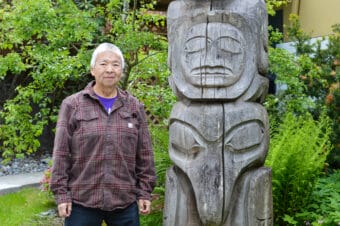
Elder Ldaan.aat Laurie Cropley and elder-in-training Yuxgitsiy George Holly will lead dawn prayers at the annual Elders and Youth conference in Anchorage this year. Oct. 8, 2025. (Photo by Yvonne Krumrey/KTOO)

This is Tongass Voices, a series from KTOO sharing weekly perspectives from the homelands of the Áak’w Kwáan and beyond.

Lingít elder Ldaan.aat Laurie Cropley and elder-in-training Yuxgitsiy George Holly are leading dawn  prayers at the annual Elders and Youth conference in Anchorage next week. 

The prayers are from 8 a.m. to 9 a.m. Monday through Wednesday, and they involve singing, dancing, sharing thoughts. This year, they plan to lead a talking circle about tribal values across Alaska Native nations afterwards.

Listen: 

The following transcript has been lightly edited for clarity.

Yuxgitsiy George Holly:  These are the words of Seigeige’i Emma Marks, when   she shared about an old way of greeting the morning, greeting each other in the morning. And she expressed that she said, though all those old peoples would say that “Again upon us, a day has broken.”

Maybe I can share with you the Dena’ina word for dawn prayers: Yetałqun duch’idatqeni. 

Dawn is for everybody. The whole earth turns itself towards the sun each morning, and you can hear the animals waking singing, and it is a time for everyone to enjoy. So dawn prayers is for everybody. It’s time for singing, it’s time for language. It’s time for making connections and really centering ourselves in a healing story.

Ldaan.aat Laurie Cropley: We all live by some values. We all have values that we live by. And in this particular case, we’re going to follow dawn prayers with tribal values circle, and we’re going to talk about how much we love holding each other up, how important it is to show reverence and respect for elders and others, and we’re going to spend some time just remembering and renewing our commitment to that way of life.

Yuxgitsiy George Holly: I don’t at all feel like an elder. I’m learning, you know, I’m learning. We all are learning. I mean, that, of course, is the truth. Lori is one of our elders.

Ldaan.aat Laurie Cropley: How old are you? 

Yuxgitsiy George Holly: 55. 

Ldaan.aat Laurie Cropley: He’s a cusp. I’m 80. So I’m claiming, I’m just recently claiming it. Really, it’s hard to be an elder. There’s pressure, there’s expectations, sometimes unrealistic. You maybe haven’t been able to practice your language or your lifestyle — like he mentioned — early in your childhood, and now here we are, you know, just trying to encourage and hold up others who are really focusing now on language and tribal values. And so, yeah, I’m an elder.

But that’s why this elders and youth conference is so important, working together with the young people who are really coming up in the language and the culture and elders who have some history and stories to share. 

What I found so interesting is that our values are such a way of life that when you ask a group of adults or youth, what are the values that they live by, they can’t mention them. They can’t verbalize them.

And so I found that talking circles about tribal values, it’s just like these lights go on, like, “Ah! we hold each other up, we’re reverent, we’re respectful.” It’s just our way of life. We’re all just relatives, we’re all family. We’re all beginning to realize that we have the same needs and wants. Want to be seen and heard and respected and held up and loved so all that kind of disappears in a talking circle because you’re sitting shoulder to shoulder. 

Yuxgitsiy George Holly: That’s so beautiful, Laurie. Gosh, yeah, it’s true. It’s all true. 

Tongass Voices: Student debaters on what the U.S. Constitution means to them on stage

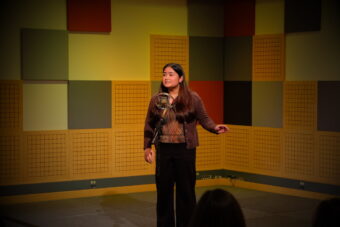
Maddie Bass (left), Ariel Estrada (center), and Alivia Gomez (right) in What the Constitution Means to Me at Perseverance Theatre in Juneau. (Photos courtesy of Perseverance Theatre)

This is Tongass Voices, a series from KTOO sharing weekly perspectives from the homelands of the Áak’w Kwáan and beyond.

Juneau high school students Alivia Gomez and Maddie Bass are playing student debaters in Perseverance Theatre’s new play, “What the Constitution Means to Me.” 

The play reflects playwright Heidi Schreck’s experience as a teenager participating in constitutional debates in 1989, and how it influenced her understanding of the founding document of our government as an adult.

During the play’s run in Juneau, Gomez and Bass step into Schreck’s shoes and draw on their own experience in high school debate. 

Listen:

The following transcript has been lightly edited for clarity.

Alivia Gomez: I’m Alivia Gomez. I’m a senior at Juneau Douglas High School. I play debater in the performance, “What the Constitution Means to Me.” Aside from that, I’m also the debate captain of Juneau Douglas’s drama, debate and forensics team. I’m very proud to be. 

Maddie Bass: Hi, my name is Maddie Bass. I’m a sophomore at Juneau Douglas High School. I’m Alivia’s understudy for the role of debater, in “What the Constitution Means to Me.” I’ve also been debating for one year. 

Alivia Gomez:  I will say for I think debate, particularly, because a lot of the topics are politically focused, it really gives you a more open minded perspective going into things. Like, you’re kind of forced to hear these resolutions and you have your preliminary ideas about it. 

Like, for example, the topic for nationals last year was, “On balance, the benefits of executive orders outweigh their harms.” 

And of course, everyone kind of has their bias on it, but you’re kind of forced to consider both aspects of it and really consider, ‘Okay, I have to weigh these, these really hard factors.’ 

And I think that’s really helpful, not especially for younger minds, because I really believe that we need more young people politically involved.

Maddie Bass: Our world has drastically changed since Heidi Schreck was a teenager. And so it’s a really interesting way for the audience to see how, even though you know, Heidi was talking about the Constitution — what was it? 30 years ago — and it’s still just as relevant to us today.

I’ve learned the most about the laws of this country and how my own life has been shaped by the Constitution, from these past couple weeks working on this play.

You know, it’s the baseline for all the protections and all the harms for people in this country, which is something so fascinating and so scary at the same time. Yeah, yeah.

Alivia Gomez: Obviously, this script was written a while ago. But I really, truly think that what makes this play so special is that its importance is timeless. It will always be relevant in how we can better shape our democracy, the question of how we can get better as a country, which is really what the place centers around, and how we can fight for better, positive human rights for all of us, is really the theme that it shows. 

Maddie Bass: There are two different versions of the debate. So if you, if you go and watch this play, you’re going to see a coin flip. That coin flip is real. We don’t know which side we’re taking when we go into this performance. So there is that, that little bit of improvisation in there too.

Alivia Gomez: There’s also, yeah, a little room for mystery as to be arguing, which is going to be really cool, because we’re also going to be keeping tally of which way the audience votes, because the audience will be our judges.

Tongass Voices: Tara Thornton on the joy and heartbreak of fostering kittens

Tara Thornton holds her foster kittens Salish and Sedona on August 28, 2025. (Photo by Yvonne Krumrey/KTOO)

This is Tongass Voices, a series from KTOO sharing weekly perspectives from the homelands of the Áak’w Kwáan and beyond.

Juneau’s cat population has been growing out of control for the last few years. Juneau Animal Rescue relies on fosters to help with litters of kittens that people find around town, under buildings and porches.

Tara Thornton is one of JAR’s fosters — she regularly has one or two litters of kittens with or without a nursing mom. Thornton has a passion for caring for these cats, but she says, sometimes it’s a bit hard to give them back.

Listen:

The following transcript has been lightly edited for clarity.

Tara Thornton: My goal is to never cry at JAR. It’s okay to cry once you get in the car after you give them back. That’s my rule for myself. No crying in JAR, no crying before you drop them off. You always give them forehead kisses and snuggles before you drop them off. 

And realize like you’re doing an amazing service for their lives and you’re contributing to their success, and then finding loving homes and letting yourself then cry it out that evening and maybe get some pizza and ice cream, you know?

I’m Tara Thornton. I foster kittens for Juneau Animal Rescue, and it’s an amazing thing to contribute to the community, and also just so fun to interact with kittens and watch them grow and develop into cats. 

My history of fostering kittens – my mom went to school for zoology, and all I can remember is she always had rescues, like I grew up with rescues in the house. She was always taking in injured animals, specifically cats. Like, she’s definitely a cat lover. So I have lots of memories of being in a Walmart parking lot in the bushes, trying to capture kittens as a little kid. 

Something that’s so important to me is contributing to the community and protecting the cats, as many as I can without letting it overtake my life. Like this is the try to focus on. Like this is the part I can contribute to, is the fostering. I can’t fix all the problems that go [on] out there and spay, neuter everyone’s cats for them, but I can focus on keeping the babies alive and getting them to the point where they can be adopted by the public.

Juneau Animal Rescue is amazing to partner with. I love fostering for them. I feel so supported. I can text or call with any questions. They provide food and litter, wet food, dry food and litter, and just – they’re [an] amazing group of people that are just so compassionate anytime I go in there for checkups and they’re excited to see the babies as they get older and less spicy. And so it really feels like it’s a good team. 

If anyone has been thinking about adopting or fostering, now is the time to act on that, because jar has so many cats within their care, and all their regular cat fosters have multiple litters that they’re taking care of right now. So there’s only so many of us, so we really do need help. For anybody who’s even been curious and thinking about it, to volunteer time, resources, money, whatever you can do. Your home, if you can.

You can let JAR know your level of experience and comfortability and that you’re new, and get into it that way, and maybe take a senior cat – a little bit lower responsibility, or, like less time responsibility, but still really needed. Because I can’t take on three adult cats that need medication every day along with my two litters, and I’m sure the other kitten fosters are in the same boat. 

So we would really need a house that could take one cat that needs medication every day, or one house that could take a bonded senior pair of cats until they could be adopted. So any help is needed, and very much so appreciated.

Tongass Voices: Juneau’s mobile crisis responders on meeting patients where they’re at

Two women stand smiling by a car marked "Capital City Fire/Rescue." Meghan DeSloover and Sarah Zaglifa respond to mental health emergencies in Juneau as part of a new mobile crisis team. July 1, 2025. (Photo by Yvonne Krumrey/KTOO)
Meghan DeSloover and Sarah Zaglifa respond to mental health emergencies in Juneau as part of a new mobile crisis team. July 1, 2025. (Photo by Yvonne Krumrey/KTOO)

This is Tongass Voices, a series from KTOO sharing weekly perspectives from the homelands of the Áak’w Kwáan and beyond.

A new mobile crisis team has been operating in Juneau since November. Each team is comprised of a clinician from Bartlett Regional Hospital and an EMT from Capital City Fire/Rescue.

Meghan DeSloover and Sarah Zaglifa reflected on their role in filling some of the gaps in behavioral health care in Juneau. The first responders broke down how their unit helps get patients care on their own terms. 

The following transcript has been lightly edited for clarity.

Sarah Zaglifa: So this is what goes in the crisis bag. We have a resource binder with everything you can imagine, treatment applications, resource lists, different assessment tools. Is in there, clean socks for someone who’s walking around in wet socks. That’s never a healthy thing, so I always keep a stash. I’m Sarah Zaglifa, and I’m a licensed clinical social worker on the mobile crisis team.

Meghan DeSloover: My name is Megan de Slover, and I am a community health specialist with Capital City Fire/Rescue and an EMT, and I work on the mobile crisis team.

I’ve been working with the fire department since 2018 just naturally, being a part of the mobile integrated health team, I have become a part of the mobile crisis team. We’ve done a number of trainings to prepare us for this, and so that’s how I’m here.

Sarah Zaglifa: So I got involved in mobile crisis way back in the 90s, believe it or not, I got my master’s degree way back then. I was living in San Francisco and part of the domestic violence task force there, and really immersed into crisis work at that point, and was married to the military. We relocated. Were stationed in Alaska, decided to settle here and wanted to commit to the community. I was working at Bartlett in the emergency department for four years. Then I worked in behavioral health and a little bit in oncology, and then when this program started getting up and running, I really wanted to get back to my crisis roots, because it’s the best job. Love it. 

Meghan DeSloover: I learned that we have a huge need in this community for assistance, and that there isn’t always money and there aren’t always avenues, and there aren’t always people to fill those roles. So I’ve just, I’ve been really thankful to be a part of this, because I feel like our role has been very helpful.

Sarah Zaglifa: I feel really inspired by Bartlett and other community partners like CCFR being very invested in the safety net of the community, and being part of the fiber of that safety net is really important. 

I think the best part about this position and where I’ve learned the most is how important it is to meet the patient – literally and figuratively – where they’re at. Your assessment is so much more rich and respectful when you’re on their turf and you are their guest versus the natural change in dynamics when you’re in an emergency department or in more clinical setting, 

I feel really proud of how our team as co-responders can just sit with someone and just be with them and whatever It is they’re in with no agenda, with no pressure.

Meghan DeSloover: We don’t fix everything for everybody. Certainly that’s not even the goal, because it would be impossible. But just people feeling like, oh, I have someone else to reach out to. 

Sarah Zaglifa: I feel like crisis is an invisible illness. Behavioral health is an invisible illness. It’s not outward. So a lot of people, I think, can easily hide some of these things and not identify it as a crisis. And we come judgment-free to just see where we can go with what we have. 

There’s plenty of times we go on a call thinking it’s about one thing, finding out the root is actually something very different, and we can work on that root. Or maybe the person’s not ready to open up to complete strangers, and so we can offer other types of support, and then maybe follow up with them. Or now, now they know us, and when they call, we’re not starting from square one. 

Site notifications
Update notification options
Subscribe to notifications