This is Tongass Voices, a series from KTOO sharing weekly perspectives from the homelands of the Áak’w Kwáan and beyond.
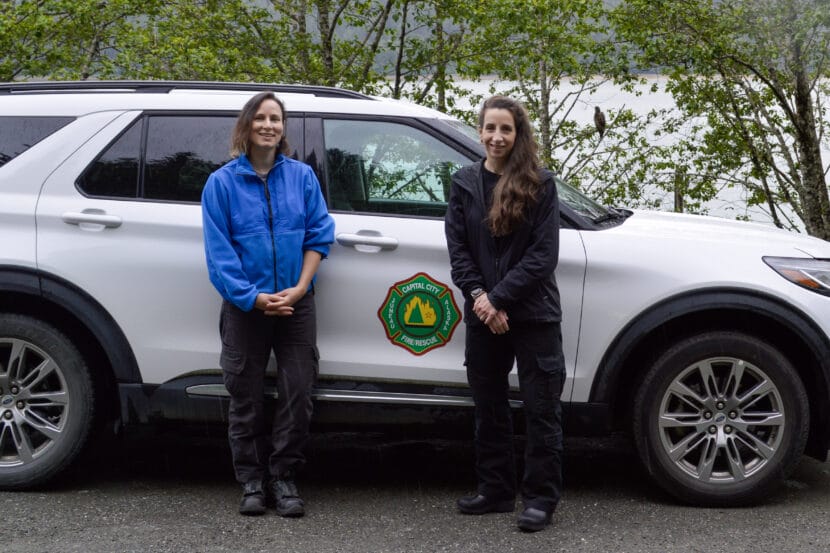
A new mobile crisis team has been operating in Juneau since November. Each team is comprised of a clinician from Bartlett Regional Hospital and an EMT from Capital City Fire/Rescue.
Meghan DeSloover and Sarah Zaglifa reflected on their role in filling some of the gaps in behavioral health care in Juneau. The first responders broke down how their unit helps get patients care on their own terms.
The following transcript has been lightly edited for clarity.
Sarah Zaglifa: So this is what goes in the crisis bag. We have a resource binder with everything you can imagine, treatment applications, resource lists, different assessment tools. Is in there, clean socks for someone who’s walking around in wet socks. That’s never a healthy thing, so I always keep a stash. I’m Sarah Zaglifa, and I’m a licensed clinical social worker on the mobile crisis team.
Meghan DeSloover: My name is Megan de Slover, and I am a community health specialist with Capital City Fire/Rescue and an EMT, and I work on the mobile crisis team.
I’ve been working with the fire department since 2018 just naturally, being a part of the mobile integrated health team, I have become a part of the mobile crisis team. We’ve done a number of trainings to prepare us for this, and so that’s how I’m here.
Sarah Zaglifa: So I got involved in mobile crisis way back in the 90s, believe it or not, I got my master’s degree way back then. I was living in San Francisco and part of the domestic violence task force there, and really immersed into crisis work at that point, and was married to the military. We relocated. Were stationed in Alaska, decided to settle here and wanted to commit to the community. I was working at Bartlett in the emergency department for four years. Then I worked in behavioral health and a little bit in oncology, and then when this program started getting up and running, I really wanted to get back to my crisis roots, because it’s the best job. Love it.
Meghan DeSloover: I learned that we have a huge need in this community for assistance, and that there isn’t always money and there aren’t always avenues, and there aren’t always people to fill those roles. So I’ve just, I’ve been really thankful to be a part of this, because I feel like our role has been very helpful.
Sarah Zaglifa: I feel really inspired by Bartlett and other community partners like CCFR being very invested in the safety net of the community, and being part of the fiber of that safety net is really important.
I think the best part about this position and where I’ve learned the most is how important it is to meet the patient – literally and figuratively – where they’re at. Your assessment is so much more rich and respectful when you’re on their turf and you are their guest versus the natural change in dynamics when you’re in an emergency department or in more clinical setting,
I feel really proud of how our team as co-responders can just sit with someone and just be with them and whatever It is they’re in with no agenda, with no pressure.
Meghan DeSloover: We don’t fix everything for everybody. Certainly that’s not even the goal, because it would be impossible. But just people feeling like, oh, I have someone else to reach out to.
Sarah Zaglifa: I feel like crisis is an invisible illness. Behavioral health is an invisible illness. It’s not outward. So a lot of people, I think, can easily hide some of these things and not identify it as a crisis. And we come judgment-free to just see where we can go with what we have.
There’s plenty of times we go on a call thinking it’s about one thing, finding out the root is actually something very different, and we can work on that root. Or maybe the person’s not ready to open up to complete strangers, and so we can offer other types of support, and then maybe follow up with them. Or now, now they know us, and when they call, we’re not starting from square one.