Outdoors

Alaska’s ‘Superbowl’ of dog mushing, the Iditarod, set to run its normal northern route

A woman on a sled in heavy winter clothing with bib number 37 being pulled by dogs down a road as viewed from above.
Musher Calvin Daugherty leaves downtown Anchorage at the Iditarod ceremonial start on Saturday, March 2, 2024. (Adam Nicely/Alaska Public Media)

The Iditarod Trail Sled Dog Race is less than a month away and set to run on its normal northern route this year.

Race officials said that’s a relief, after low snow conditions last year forced the race to start in Fairbanks, over 200 miles north, for the fourth time in history.

Snow conditions are generally much better than they were last year, said race director Mark Nordman, although there were concerns about the trail until just recently.

“It wasn’t that long ago that I was still concerned about going over the Alaska Range, because there wasn’t a lot of snow up by Rainy Pass Lodge, one of our checkpoints,” Nordman said. “But we’ve got plenty of snow now, and so I think we’ll be good.”

In 2025, race officials said a portion of the trail outside of Nikolai was impassable because of the lack of snow. Nordman said that section, called the Farewell Burn, is notoriously challenging for its ice and windblown ground. But it currently has some snow coverage and “looks doable,” he said.

The 1,000-mile race typically alternates routes each year, running the northern route on even years and the southern route on odd years. The trail is the same for the first 350 miles before splitting at the ghost town of Ophir, then rejoining at the Yukon River village of Kaltag before heading to Unalakleet and continuing up the Bering Sea Coast.

Clearing brush off the trail takes more work now than it used to, Nordman said.

“Where we might have only brushed the trail every four or five years in certain areas, it seems like it’s every other year now,” he said.

One section in particular required extra effort.

The remnants of Typhoon Halong last fall decimated the trail between Kaltag and Unalakleet, Nordman said. The Iditarod hired a crew to clean up blown-down trees along that 85-mile stretch, and it’s now ready for mushers, he said.

“They spent a full month out there, cutting, opening it up, grooming,” Nordman said. “Otherwise nobody would be going over that trail this year.”

This year’s Iditarod starts March 7, with its parade-like ceremonial start through Anchorage. The race will officially start March 8 in Willow.

US Forest Service cancels plan to build Herbert Glacier cabin in Juneau

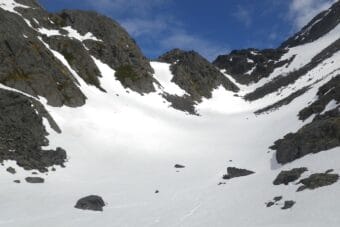
Herbert Glacier on Nov. 27, 2025. (Photo by Alix Soliman/KTOO)

After proposing to build a new cabin near Juneau’s Herbert Glacier, the U.S. Forest Service released a draft decision last month abandoning it. 

The cabin site was initially selected due to public interest. It would have been built within a mining claim block across the river from the proposed New Amalga gold mine owned by Grande Portage Resources, Ltd. The Forest Service approved exploratory drilling at New Amalga in April. 

But Paul Robbins, a public affairs officer for Tongass National Forest, said the agency’s decision to cancel the cabin is unrelated to mining interests and is instead due to the challenging location and limited staff capacity. This comes after the agency lost a third of its staff in Alaska last year. 

“The proposed cabin site’s elevation, distance from the trail, design requirements and the need to move materials through difficult terrain all add to the complexity of that cabin project,” Robbins said.

He said the agency’s landscape architects and engineers could be overwhelmed with work if they moved forward with building the cabin.  

But some residents in Juneau submitted public comments saying they don’t believe those reasons are genuine. 

“Cancelling the project seems to be influenced by mining interest across the river which would inherently be hard to make compatible,” wrote Riley Moser, a Juneau resident. “It appears that the Forest Service is bending to corporate interests instead of listening to the needs and concerns of the public.”

Staff from the Alaska Miners Association and Grande Portage submitted comments to the agency before the draft decision, saying that building a cabin near the proposed mine could lead to disputes over how the land is used.

“Selection of a site to be used for recreational lodging, which can be easily placed anywhere, within an area of active mineral exploration could unnecessarily invite land use conflicts that do not and should not exist, and could incite litigation and appeals for years,” wrote Deantha Skibinksi, executive director of the Alaska Miners Association.

Kyle Mehalek, a technical specialist at Grande Portage, wrote that “it would be incredibly challenging, likely impossible, to protect the proposed cabin from potential visual and noise impacts with the same effectiveness as the existing trail.”

The cabin would have been part of the Alaska Cabins Project, the Forest Service’s biggest public-use cabin expansion plan in 50 years, which plans to bring around 25 new cabins to the Chugach and Tongass National Forests, including four in Juneau at Mendenhall Campground, Montana Meadows, Treadwell Ditch Trail and Dupont Beach.

Robbins said cancelling this cabin won’t affect the other proposed cabins. He said the Forest Service plans to reroute part of Herbert Glacier Trail and build a scenic overlook there instead. 

Although there is a lot of public support for building a cabin near Herbert Glacier, Robbins said the agency is unlikely to change course.

“Only because our decision was based on the complexity and capacity, not on whether or not the site was popular,” he said. “We know the site is popular, that’s why we wanted to initially build a cabin there.”

A public comment period to object to the cancellation closes March 9.

Alaska House passes bill tightening residency requirements for hunting and fishing licenses

Sitka independent Rep. Rebecca Himschoot speaks in support of House Bill 93 on the House floor on Jan. 30, 2026.
Sitka independent Rep. Rebecca Himschoot speaks in support of House Bill 93 on the House floor on Jan. 30, 2026. (Eric Stone/Alaska Public Media)

The Alaska House of Representatives passed a bill Friday that would tighten residency requirements for Alaskans buying hunting or fishing licenses.

House Bill 93 aims to ensure that only people who spend enough time each year in Alaska to qualify for a Permanent Fund dividend can buy resident hunting and fishing licenses, which tend to cost less and offer higher bag limits than nonresident licenses.

State law currently limits resident licenses to people who are physically present in Alaska with no plans to leave, do not claim residency in another state and have maintained a home in the state for 12 consecutive months. But it does not require that resident hunters and fishermen actually live in the state for a full year.

Rep. Rebecca Himschoot, a Sitka independent who sponsored the bill, said that definition leaves a big loophole.

“The last point means that we allow someone who rents a room in a home from friends, or someone who has a liveaboard boat that’s on a trailer but actually is in the state for less than a month — less than two months, potentially less than a week — to hunt and fish and enjoy the higher bag limits that are reserved for residents who are here year-round, shoveling snow, volunteering in their communities and putting their kids in our schools,” Himschoot said.

Himschoot’s bill seeks to close that loophole. If the bill becomes law, Alaskans would have to be physically present in the state for at least 180 days each year to get resident licenses, though there would still be numerous exemptions, including for military servicemembers, students and others allowed to be outside the state while remaining eligible for Permanent Fund dividends.

In some cases, people ineligible for dividends would still be eligible for resident hunting and fishing licenses. For example, new Alaskans moving to the state would be eligible for resident licenses 12 months after they arrive. Permanent Fund dividend eligibility rules generally require new residents to live for an entire calendar year in the state, from Jan. 1 to Dec. 31, before applying for a dividend.

People who do not qualify for a resident license would have the option to buy a nonresident license instead.

The deputy director of the Alaska Wildlife Troopers, who enforce fish and game laws, told a House committee in 2024 that the current definition makes it difficult to prosecute people who violate the residency requirements. By contrast, state prosecutors often bring charges against people who fraudulently apply for Permanent Fund dividends.

“The problem is that our enforcement officers don’t have the right tools,” said Rep. Donna Mears, an Anchorage Democrat.

A wide range of local governments, tribes and fish and game advisory committees spread across the state backed the bill.

Twelve House Republicans opposed the bill, including Big Lake Rep. Kevin McCabe, who said he was concerned the bill would exclude some Alaskans from the benefits of a resident license.

“What about those pilots that have vacation homes elsewhere, that would like to go spend two months in Hawaii, say, and then they have to fly out of state for 15 days a month?” McCabe said.

The bill, however, had broad support and passed with a bipartisan two-thirds majority in favor.

A board shows the final vote on House Bill 93 on Jan. 30, 2026.
A board shows the final vote on House Bill 93 on Jan. 30, 2026. (Eric Stone | Alaska Public Media)

“Is there a problem? I think that we all acknowledge there is,” said Rep. Dan Saddler, an Eagle River Republican. “Is this a solution? I think it is. Is it the perfect solution? No, it’s not. But we don’t deal in perfect and ideal. We do what’s best and what we can do.”

The bill now heads to the Senate, which passed a similar bill in 2024.

“An Alaskan is and always will be an Alaskan,” Himschoot said. “But if you live outside Alaska, and you enjoy those lower prices at the grocery store and other costs of living that are much reduced compared to what we experience here in Alaska — if that is you, we ask you to please hunt, fish and trap as a nonresident.”

Juneau Assembly stalls on whether to disempower Eaglecrest Ski Area’s board

Juneau Assembly member and Eaglecrest Ski Area board liaison Neil Steininger speaks during a meeting at City Hall on Monday, Jan. 26, 2025. (Photo by Clarise Larson/KTOO)

The Juneau Assembly has stalled on deciding whether to disempower the Eaglecrest Ski Area’s board of directors until a joint meeting in March. 

Earlier this month, Mayor Beth Weldon proposed an ordinance to reduce the status of the city-owned ski area’s board from an empowered board to an advisory board. She cited the recent leadership turnover at the mountain and ongoing financial challenges.

At a committee of the whole meeting Monday night, Weldon further explained her reasoning for the proposed ordinance to the Juneau Assembly and the roughly 20 members of the public in the audience. 

“I’m literally trying to save Eaglecrest, and I think with the empowered board making the decisions, I don’t see the status quo changing,” she said.

Right now, as an empowered board, Eaglecrest has its own set of laws, rules and responsibilities. But, if it became an advisory board, members could only make recommendations to the Assembly. It would lose the authority to establish policies or make decisions without Assembly approval. 

At the meeting, Weldon argued the ski area needs more oversight, given the high amount of funding the city has funneled toward it in recent years, specifically on a new gondola project.

“If we are investing large amounts of money on things such as the chair lifts or maybe even the gondola, we want to have more of a say in how that money is spent, and currently, we don’t,” she said. 

In the coming years, the ski area is slated to run into a multimillion-dollar deficit. The deficit is a part of a plan to repair some broken and aging infrastructure while boosting pay to employees and preparing to operate year-round. 

Its expansion into summer operations relies heavily on the success of the gondola, which the ski area hopes to get up and running by the summer of 2028. However, many city leaders are worried the timeline — and cost — of the project will run far over what the board projected. 

The Assembly agreed to hold off on any decision-making until it holds a joint meeting with the Eaglecrest board on March 4. Assembly member and Eaglecrest Ski Area board liaison Neil Steininger said he thinks that’s the best option. 

“I think we owe it to everybody in the community to have a joint meeting with the Eaglecrest board to actually hash this out,” he said. 

The Assembly will then vote on whether to move the ordinance forward during a committee meeting on March 16.

Eaglecrest board pushes back against Juneau mayor’s plan to diminish its power

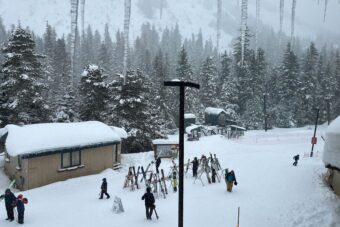
Snow covers the Eaglecrest Ski Area’s Fish Creek lodge on Dec. 10, 2023. (Photo by Clarise Larson/KTOO)

Eaglecrest Ski Area’s board of directors is pushing back against the mayor’s proposal to remove most of the board’s decision-making authority. This comes after recent leadership turnover at the mountain and ongoing financial challenges.

Last week, Mayor Beth Weldon told the Juneau Assembly she asked the city’s attorney to draft an ordinance to reduce the status of the board from an empowered board to an advisory board. The Juneau Assembly will discuss the draft ordinance at its committee of the whole meeting on Monday evening. 

As an empowered board, Eaglecrest has its own set of laws, rules and responsibilities and makes decisions without direct Assembly oversight. If it became an advisory board, members could only give advice or make recommendations to the Assembly. It would lose the authority to establish policies or make decisions without Assembly approval. 

“As we know, they’re having major financial issues, and I just think the city needs to have more oversight over what’s happening to Eaglecrest,” she said. “I think the government is standing in its way right now, and it needs to be changed.”

But, at a special meeting on Thursday evening, Eaglecrest’s board moved to draft a letter to the mayor and Assembly asking to remain an empowered board. The board intends to finish the letter this weekend, in time for the Assembly discussion during its committee of the whole meeting on Monday. 

Board member Jim Calvin said remaining an empowered board is in the community’s best interest. 

“The board is deeply engaged in gondola planning work, and we’re deeply engaged in recruiting a new GM (general manager),” he said. “We’re initiating some business planning work, and all of that is at risk of completely derailing if we’re not an empowered board.”

The tension between the Eaglecrest board and the mayor comes after the ski area’s general manager resigned and the board chair stepped down earlier this month. Eaglecrest has also had several issues with its facilities that sullied the beginning of its season, including a broken water line and issues keeping Ptarmigan lift open. 

Eaglecrest is expected to run into a multimillion-dollar deficit in the coming years to repair some broken and aging infrastructure, while boosting pay to employees and preparing to operate year-round. Its plan toward financial stability relies heavily on revenue from the gondola, which the ski area hopes to get up and running by the summer of 2028.

According to the board, the city plans to post the general manager position online next week, which will remain open until it’s filled. 

Eaglecrest Ski Area’s general manager resigns, board chair steps down

Craig Cimmons interviews for the Eaglecrest Ski Area general manager position during a meeting at City Hall on Friday, Aug. 2, 2024. (Clarise Larson/KTOO)

The general manager of Juneau’s Eaglecrest Ski Area has resigned and the chair of its board of directors has stepped down. Both departures were announced Thursday night during the ski area’s board of directors meeting.

Hannah Shively served as the board chair for less than six months. At the meeting, she said she was leaving the role due to health reasons. The board elected Brandon Cullum as its new chair. 

Craig Cimmons, Eaglecrest’s general manager, was absent from the meeting Thursday night and did not immediately respond to a request for comment on his resignation. He has not publicly offered a reason as of Friday morning. 

“We’re not sure why the manager is not here tonight, totally honestly, we’re still trying to figure that out,” Cullum said during the meeting. “I’m sure it’s not out of disrespect to anyone, but we’re going to do the best we can to present the information that he’s provided and answer questions.”

Cimmons’ resignation comes after serving in the role for less than two years. He was hired as general manager in the fall of 2024 after the former manager, Dave Scanlan, was abruptly asked to resign by the board.

Both departures also come as the city-owned ski area faces a tough start to its 50th season, including a broken water line and a delayed opening of the Ptarmigan lift. And, that’s all while Juneau has been facing back-to-back snowstorms, prompting city officials and tribal leaders to issue a joint disaster declaration. The capital city is currently bracing for heavy rain and potential flooding from an atmospheric river on Friday.

“This month has been terrible,” Shively said at the meeting. “Pretty much anything that could have gone wrong went wrong.”

Eaglecrest staff originally announced in mid-December that there was a large break in its main water line that supplies its lodges. And, while that has since been repaired, staff say there are still other repairs that need to be done before the water is restored. In the meantime, skiers and staff have been using portable toilets outside of the lodge. 

Another issue is the delayed opening of its Ptarmigan lift due to unexpected repairs. The chairlift serves the middle of the mountain. According to Shively, the ski area hopes to open it soon. 

“All our required state certifications have been received, and we’re currently waiting for that final inspection from our insurance provider,” she said at the meeting.

Cimmons agreed to stay in his role for another month to help facilitate finding his replacement. Meanwhile, the ski area’s Director of Snowsports School, Rental, Retail & Repair Erin Lupro will take over the role of acting general manager.

The ski area is slated to celebrate its 50th year as a ski area next weekend.

Site notifications
Update notification options
Subscribe to notifications