Outdoors

What to know before harvesting your Christmas tree in Juneau

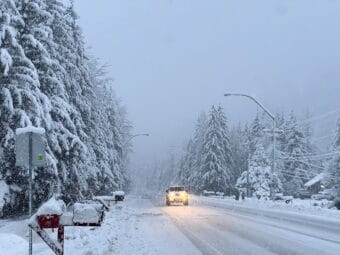
Trees on Douglas Island on Tuesday, Nov. 25, 2025. (Photo by Clarise Larson/KTOO)

Some Southeast residents put up Christmas decorations over Thanksgiving weekend. The centerpiece, of course, is the tree.

The U.S. Forest Service allows each household to cut down one Christmas tree from the Tongass National Forest per year. Julia Spofford is the assistant director at the Mendenhall Glacier Visitor Center. No permit is required, but she said residents should follow a few key guidelines to protect ecosystems.

“We don’t want to do any trees within, you know, 330 feet of bald eagle nests, or 100 feet of salmon streams or 100 feet of roads or trails,” she said.

She said to only take a tree that’s seven inches in diameter or smaller, and to cut as low to the ground as possible.

“We ask that you avoid muskeg as well, just because the regeneration in those areas is difficult for trees to establish,” Spofford said.

Some helpful things to bring are a hand saw, sled, cord to wrap the tree and a tape measure.

Tree harvesters will see a lot of western hemlock and Sitka spruce. Spofford explains the difference in terms of Christmas-tree quality.

“Hemlocks are really soft, but they also have kind of very flexible branches,” she said. “So if you’ve got a lot of heavy ornaments — might not be a good choice — but if you’re likely to brush into your tree a lot or have small kids, it might be a nicer option, since it’s softer versus the Sitka spruce. Spruce has those spikier needles, but often have a little more conical of (a) shape.”

Spofford said it’s important to check Forest Service maps.

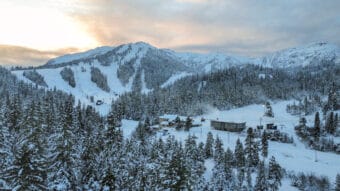
People can find Christmas trees by hiking out on the trails, but there are also a couple of accessible spots just off of Juneau’s road system. The first is along Glacier Highway between mile post 29 and 33. The second is up Fish Creek Road toward Eaglecrest Ski Area.

The Mendenhall Glacier Recreation Area, Auke Recreation Area and Lena Beach are off-limits.

The City and Borough of Juneau also allows Christmas tree harvest on designated areas of city-owned land, including off of North Douglas Highway near Fritz Cove and False Outer Point, and off of Glacier Highway near Bridget Cove.

The city’s regulations differ slightly from the Forest Service policy. Harvesters must still avoid muskeg and cut the tree at its base. But discarded branches must be scattered and trees must be cut more than 50 feet from a hiking trail and more than 25 feet from any body of water.

After a landslide closure, Auke Lake Trail to reopen soon

Mark Krumwiede saws through a tree along the edge a landslide that washed out Auke Lake Trail in September 2025. (Photo by Alix Soliman/KTOO)
Mark Krumwiede saws through a tree along the edge of a landslide that washed out Auke Lake Trail in September 2025. (Photo by Alix Soliman/KTOO)

Listen to this story:

Two landslides took out Juneau’s popular Auke Lake Trail in September, causing the City and Borough of Juneau to close it to the public. Now, as trail workers repair it, they say it’s an example of climate impacts on local trails they’ve been seeing more frequently in recent years. 

On Monday, a trail coordinator used a chainsaw to rip through a fallen tree blocking the path along Auke Lake where landslides washed it out. The trail is flat and follows the contour of the lake next to the University of Alaska Southeast’s Juneau campus. The landslides occurred during an atmospheric river in late September and the trail has been closed since.

Two landslides washed out roughly 150 feet of Auke Lake Trail, which is just over a mile long, in September. The debris can be seen from the boat launch across the lake. (Photo by Alix Soliman/KTOO)
In September, two landslides washed out roughly 150 feet of Auke Lake Trail, which is just over a mile long in total. The debris can be seen from the boat launch across the lake. (Photo by Alix Soliman/KTOO)

“We saw footsteps as we were going,” said Meghan Tabacek, the executive director of Trail Mix Inc. “People are already still using this trail.”

Trail Mix is a local nonprofit that maintains more than 200 miles of trails in Juneau, including those owned by the city. 

“So our goal is now to make it, one: fully reopen so we can get the trail closed signs down; and two: at least passable,” Tabacek said. “Our first step to passability is using these chainsaws right here to clear all the logs.”

Later, they’ll push those logs into the lake, where much of the debris fell naturally.

Mark Krumwiede saws through a branch along the edge a landslide that washed out Auke Lake Trail in September 2025. (Photo by Alix Soliman/KTOO)

Nick Marinelli is a trail coordinator for Trail Mix. He paced the length of both landslides, which are about 50 feet apart at the trail level, and estimates that about 150 feet of the trail washed out altogether. The slides appear to reach up the slope roughly 400 feet, where they’ve scoured the soil down to bedrock.

He said he has noticed landslides affecting popular Juneau trails more frequently in recent years, including on Perseverance Trail and Montana Creek Trail. 

“It seems like with those heavier storm events that happen in September and October, there’s more material coming down,” Marinelli said. 

Tabacek said that has factored into how Trail Mix plans maintenance. 

“Especially over the past five years, as climate-related disturbances to trails become a little more frequent, we’ve just started having to budget our time a little bit different,” she said.

She said that Trail Mix now sets aside five to eight weeks each year to handle this extra work. That work has included things like restabilizing a bridge on Black Bear Trail where Montana Creek widened sooner than expected, redirecting water and clearing landslide debris.

Once the workers clear away the logs, Tabacek said they’ll rebuild damaged sections of Auke Lake Trail this week. 

“A lot of that is just going to be pushing dirt around,” she said. 

Then they’ll layer some gravel on top and build retaining walls. In the spring, she said they’ll probably come back and add moss to the bare soil on the lake-side of the trail. They might also plant blueberry and devil’s club starts on the upward slope.

“But honestly, Southeast kind of takes care of the re-veg(etation) pretty, pretty fast every year,” Tabacek said. 

Although the slide chutes seem stable now, she said some trees are loosely attached and a storm could cause further slides. 

“Especially on days where you’re getting more than half an inch or a full inch of rain,” she said.

Marc Wheeler peers up at one of the landslides that washed out Auke Lake Trail. (Photo by Alix Soliman/KTOO)

Marc Wheeler, the city’s director of parks and recreation, said residents should always consider the hazards when heading outdoors. 

“Like with all of our trails, we just have people use their best judgment,” Wheeler said. “You’re kind of using our trails at your own risk.”

Juneau recreators can fill out a damage report on the Trail Mix website if they encounter fallen trees or slides blocking trails. 

The city hopes to reopen Auke Lake Trail at the end of this week.

Clarification: A previous version of this story said Trail Mix hopes to reopen the trail. The City and Borough of Juneau owns Auke Lake Trail.

After three years, Eaglecrest plans to finally get its gondola project off the ground

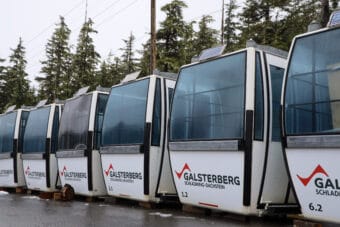
Parts of the city-owned gondola sit outside at Eaglecrest Ski Area on Wednesday, Aug. 6, 2025. (Photo by Clarise Larson/KTOO)

Construction to get Eaglecrest Ski Area’s controversial gondola up and running is finally underway. 

The ski area announced Wednesday that work has begun to develop the access road to one of the gondola’s stations on Douglas Island. That means that the mountain will be closed off to the public beyond the main lodges for the foreseeable future. 

The road construction comes more than three years after the city bought the used gondola from Austria. 

And now, the ski area’s future is riding on it. 

In the coming years, the ski area is slated to run into a multimillion-dollar deficit. That is intentional – it’s part of a plan to repair some broken and aging infrastructure while boosting pay to employees and preparing to operate year-round. The plan to dig out of the deficit relies heavily on revenue from the gondola.

Eaglecrest General Manager Craig Cimmons said the road construction marks a major step for the ski area.

“It’s really exciting,” he said. “Like I’ve been saying all along, the summer revenue is going to change the course of Eaglecrest forever, and having these crews here working on this really solidifies that this is happening. It’s really going to be a big deal.”

Cimmons said the goal is to have the gondola up and running by the summer of 2028. This January, the ski area will celebrate 50 years of operation. 

A local Alaska Native corporation, Goldbelt Incorporated, invested $10 million in the gondola in 2022 in exchange for a revenue-sharing agreement. Goldbelt announced last fall that it plans to develop a cruise ship port a few miles north of Eaglecrest on Douglas. 

Cimmons said the ski area will provide updates regularly about the status of the closure. 

Too much of a good thing? Helping your garden deal with all the rain.

On this episode of Garden Talk, host Bostin Christopher talks with Darren Snyder about how to help your garden deal with too much rainfall.

Ed Buyarski holds up seaweed he added to a garden bed, which is still covered with plastic to help warm the soil and protect it from snow and rain (photo by Sheli DeLaney, KTOO)

On this episode of Garden Talk, host Bostin Christopher talks with UAF Cooperative Extension Agent Darren Snyder about how to help your garden deal with too much rainfall.

The conversation examines how excessive rain and strong winds, particularly in Juneau, affect gardens nearing the end of the growing season. Snyder offers practical advice for dealing with the current conditions, such as covering ground crops like potatoes with plastic to prevent cracking, and suggests harvesting crowded annuals to improve airflow and reduce rot. He also shares long-term strategies for future seasons, emphasizing the importance of good soil drainage and utilizing techniques such as mulching, hoop houses, and high tunnels to manage moisture effectively.

Find further resources and more information at https://www.uaf.edu/ces/garden/index.php.

Making the most of your precious harvest

On this episode of Garden Talk, host Bostin Christopher talks with Darren Snyder about maximizing your precious harvest and preparing for successful storage.

Photo courtesy of UAF Cooperative Extension

This episode of Garden Talk with Bostin Christopher features UAF Cooperative Extension Service agent and Associate Professor Darren Snyder, who discusses making the most of your precious harvest.

As the growing season comes to a close, many gardeners wonder what to do with their bounty. Darren shares insights into proper preparation for successful storage, emphasizing that a bit of planning now can make all the difference.

Discover how to preserve your harvest into fresh, crisp and nutritious food that lasts for weeks or even months by replicating a refrigerator’s environment. Learn about the three main concepts for successful cool storage: managing temperature (ideally just above freezing, 32-40°F for many root crops), controlling humidity (often over 90% for most vegetables), and ensuring adequate airflow.

Darren also discusses starting with the best quality produce, strategies like “skinning up” potatoes, and various root cellar options—from modifying a dry crawl space in your home to separate structures or even buried barrels.

Eaglecrest Ski Area celebrates 50 years of snow sports as future remains uncertain

People celebrate Eaglecrest Ski Area’s 50th year of operation on Saturday, Sept. 13, 2025. (Photo by Clarise Larson/KTOO)

Eaglecrest Ski Area celebrated 50 years of downhill skiing and outdoor adventures in Alaska’s capital city on Saturday. But, the celebration comes amid questions about the financial viability of the city-owned ski area in the years ahead. 

A live band played under the sun outside the lodge. Athena Morris was in the crowd with her family. She has been skiing most of her young life. She and her friend said their favorite thing about the local ski area isn’t the skiing.  

“It’s the chairlift,” she said. “You get to sit on it and you get to go really high.”

Her dad, Ammon Morris, said his favorite part is the easy access to the sport and being able to share it with his daughter. 

“I just love it,” he said. “I feel so privileged that we have this thing — and right in town. It’s just like, 20 minutes from my house. I get here every weekend, and we’re totally doing that this year.” 

The Morrises were among the hundreds of residents who flocked to the ski area on Douglas Island on Saturday to celebrate its 50th year of operation. There was live music, food and auctions. 

For five decades, Eaglecrest has drawn generations of local outdoor enthusiasts and travelers seeking Alaska snow adventures. It’s the only ski area in town. 

Jim Calvin is the board chair for the Eaglecrest Foundation, a nonprofit dedicated to generating community support for the ski area.

“I think it’s hard to understate the value of Eaglecrest,” he said. “It’s hard to measure the value of Eaglecrest to the community, but it really is one of the things that makes Juneau a special place to live.”

Over the years, Eaglecrest has faced criticism for its growing reliance on city funding to build and maintain infrastructure and pay its staff. Now, management is looking to the future. The ski area is attempting to expand its services to operate year-round and become financially self-sustaining. 

Calvin said Eaglecrest is at a turning point in its history. 

“I think many of us see that summer development opportunities are part of the equation, part of the solution as we move to the next generation of Eaglecrest and we’re working hard to make that happen,”  he said. 

In the coming years, the ski area is slated to run into a multimillion-dollar deficit. It’s a part of a plan to repair some broken and aging infrastructure while boosting pay to employees and preparing to operate year-round. 

Its expansion into summer operations relies heavily on the success of a gondola that the city bought for about $2 million three years ago. Its parts haven’t left the ground since arriving in  Juneau, and it’s unclear how much it will cost to get it up and running. But once it’s operating, leaders say it will allow the ski area to stay open year-round and eventually make enough money for Eaglecrest to be self-sustaining. 

Hannah Shively, Eaglecrest’s new board chair, said that’s critical to the next 50 years of operation. Eaglecrest’s former longtime board chair Mike Satre resigned earlier this month, saying he didn’t have enough time to dedicate to the position. 

Shively said, despite the uncertainty, she thinks Eaglecrest’s future is bright. 

“There’s a lot of opportunity to becoming more self-sustainable and maybe even subsidize winter recreation in the future,” she said. “I think it’s all potential, and it’s whether or not we can grab onto it.”

The ski area plans to host another anniversary celebration in January, which is when Eaglecrest officially opened in 1976.

Site notifications
Update notification options
Subscribe to notifications