Outdoors

Search called off after man falls through a hole on Mendenhall Glacier

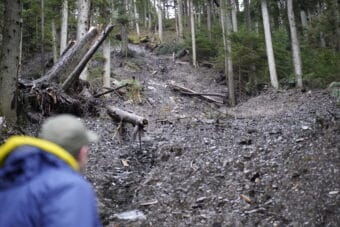
The Mendenhall Glacier on Friday, Feb. 21, 2025. (Photo by Clarise Larson/KTOO)

An Italian man is missing after falling into a hole in the ice on the Mendenhall Glacier on Tuesday. Juneau search and rescue responders have called off the search.

The Alaska State Troopers have not named the man and are working to connect with his family. 

According to troopers, the man was on the glacier Tuesday afternoon with two travel companions. Troopers did not say where on the glacier they were, but a dispatch says the man initially fell into a stream and was pushed by the rushing water into the hole in the ice. The people with him said they couldn’t see him after that. 

Juneau Mountain Rescue attempted to locate him, but found the hole was filled with rushing water. They decided it would be too dangerous to try to locate the man.

At least three people have died in the backcountry around Juneau this summer. On Saturday, an Arizona resident was reported missing and his body was discovered on Monday near the Mendenhall Glacier. He is believed to have died from injuries suffered during a fall.  

This story has been updated to reflect that officials did not say why the man was on the glacier. 

Gathering, processing, and applying seaweed in your fertile garden

On this episode of Garden Talk, host Bostin Christopher talks with Darren Snyder about the various ways to gather, process, and apply seaweed to your fertile garden.

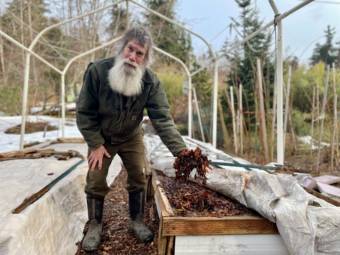
Seaweed and other beach gatherings serve as a mulch in this garden bed featuring recently planted garlic. For empty garden beds, it's preferable to mix the seaweed into the soil so that it decomposes faster.
Seaweed and other beach gatherings serve as a mulch in this garden bed featuring recently planted garlic. For empty garden beds, it’s preferable to mix the seaweed into the soil so that it decomposes faster. (Photo by Matt Miller/KTOO)

On this episode of Garden Talk, UAF Cooperative Extension Agent and Associate Professor Darren Snyder discusses the benefits of using seaweed to create a fertile, living garden soil. Snyder shares that seaweed provides essential micronutrients and macronutrients like potassium, which are crucial for plant growth. He offers practical advice on ethically gathering seaweed from shorelines, emphasizing the importance of collecting only detached seaweed. The episode also covers methods for processing and applying seaweed, such as “seaweed tea” or directly incorporating it into the soil as a fall amendment or a protective mulch to enrich the soil and suppress weeds.

For more episodes, visit the Garden Talk page on KTOO, or subscribe in your podcast catcher of choice.

Garden Talk is a production of KTOO.
This episode aired first as a live segment on Juneau Afternoon with Bostin Christopher.

Public land sales in Alaska, western US removed from federal reconciliation bill again

A view of the Tongass National Forest near the U.S. Forest Service’s Raven’s Roost Cabin on Mitkof Island. (Angela Denning/CoastAlaska)

Proposed public land sales in Alaska are no longer included in the GOP budget bill that is making its way through the Senate this week. 

A mandate to sell somewhere between 2 and 3 million acres across the western U.S. was first struck down by the Senate Parliamentarian last week because it was irrelevant to the budget. U.S. Senator Mike Lee, the Utah Republican who introduced the provision, then tried to write about 1.2 million acres back in

But on Saturday, Lee withdrew the land sale provision completely, announcing on X that it was because he was unable to prevent the land from being sold to foreign interests or BlackRock.

Republicans, including U.S. Senator Lisa Murkowski, initially said selling the land would allow it to be developed into affordable housing. But much of the identified public lands, which could have included areas of the Tongass and Chugach National Forests and remote parts of the Interior, are not suited for housing development. 

The idea sparked public outrage among outdoor recreation enthusiasts from across the political spectrum. Some Republican representatives from Colorado, Idaho and Montana even spoke out against the sell-off. U.S. Senator Dan Sullivan indicated support for the land sales before they were stripped from the bill. 

Senate Republicans aim to pass the bill by July 4.

Annual cross-border race draws fewer cyclists – and some Canadians who won’t enter the U.S.

A solo rider crests the summit during a previous Kluane Chilkat International Bike Relay. (Jillian Rogers/KHNS)

More than 900 cyclists are set to participate this weekend in an annual 150-mile cross-border race that starts in Canada and ends in Haines. But this year’s competition could look a little different amid ongoing political tensions between the neighboring countries.

The Kluane Chilkat International Bike Relay has been happening for decades — and it has a particular legacy.

“It’s all about the goodwill between Americans and Canadians,” said Richard Clement, the relay race board’s vice president.

Clement said the race is capped at 1,200 people, and that most years, it sells out in about two weeks. This time around, that didn’t happen. Roughly 930 people registered.

“We suspect it was Canadians who just didn’t want to come to the US,” he said. “But you know, there’s other factors too, like the exchange rate. It’s unbelievably bad for Canadians to come down and change to American dollars these days.”

Still, the vast majority of this year’s registered participants — around 85% — are Canadian, according to race organizers.

The race has been around since 1993 and has only been cancelled a few times — once for snow, and three times during the Covid-19 pandemic. Teams and solo cyclists start in Haines Junction, about an hour drive north of the Canadian border, and ride on the highway from there to Haines.

Clement says race organizers also heard from a small number of Canadian teams — about a dozen — who did register and plan to race. But they’re choosing not to finish because they don’t want to cross the border into the U.S.

It’s the latest example of the increasingly fraught relationship between Canada and the U.S. amid President Donald Trump’s global trade war and repeated comments about making the neighboring country the 51st state. In response, some Canadians have boycotted visiting or spending money in Alaska border towns.

In response to teams that won’t cross the border, race organizers posted a new policy posted to the race website on June 13. It says cyclists must travel southbound only, and that those who do not plan to cross the border into Alaska must withdraw from the race no later than Checkpoint 6.

At that point, or sooner, cyclists must get into their team vehicles and drive home rather than ride back toward Haines Junction.

“For safety considerations, we tried to explain to them, don’t turn around and try to ride your bike home. Because we cover people going to Haines. We don’t cover people going the other way.”

The policy adds that teams who withdraw early will be marked as DNF — or “Did Not Finish.”

Severe thunderstorm soaks Juneau, loosens cruise ship mooring

Downtown Juneau at 3:10 p.m. on Monday, June 16, 2025. (Photo courtesy of SnowCloud Services)

The National Weather Service issued Juneau’s first recorded severe thunderstorm warning on Monday after conditions escalated and a cruise ship partially broke free from its moorings. 

It was a sunny afternoon until the sky abruptly darkened, heavy rain came down and winds gusted up to 60 mph. 

Brian Bezenek, lead meteorologist at the Juneau NWS office, said the office was aware that the storm was traveling north through the panhandle early Monday morning. But by the time it reached Juneau, the storm’s force surprised him. 

“We were issuing marine statements for thunderstorms in the inner channel, so we were tracking those,” he said. “The intensity was not something we had any larger indications that they were that strong.”

Bezenek said Juneau typically has a thunderstorm once every two years. They’re uncommon in the area because thunderstorms need heat to fuel them and space to grow in the atmosphere. Juneau’s high latitude and nearby icefield prevent storm clouds from growing tall and heating up.

A cruise ship docked downtown broke free of its mooring and drifted into the Gastineau Channel at the height of the storm. Residents shared videos of the Celebrity Edge’s escape on social media.

Matt Creswell, the city’s harbormaster, responded to the incident. He said the wind speed was too much for the lines that tied the ship to the dock and some broke free. He said cruise ship staff then fully untied the vessel to prevent damage to the dock. 

“This was the perfect, literally, the perfect storm,” he said. “With the direction of the wind hitting the ship broadside at its moorings and exceeding the capacity that the lines were made to handle.”

He said the ship was able to dock again once the winds died down and there was no damage to the infrastructure. 

Residents reported downed trees and hail from Douglas to the Mendenhall Valley. There were no reported injuries from the event. 


Eaglecrest Ski Area permanently closes its Black Bear lift

The sun sets at Eaglecrest Ski Area in November 2023. (Photo by Clarise Larson/KTOO)

One of Eaglecrest Ski Area’s four chairlifts is permanently closed. That’s according to a decision announced on Thursday by Eaglecrest leadership. 

Eaglecrest’s general manager Craig Cimmons said it would cost too much to fix the ailing Black Bear chairlift. 

“It’s just become more clear that the investment in time and money would be far more than we have right now,” he said. 

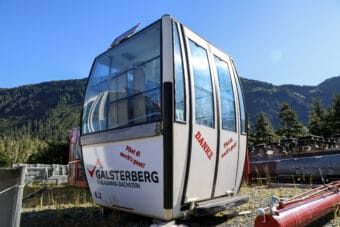
The announcement comes as the ski area projects it will run a deficit for the foreseeable future. That’s in order to repair some broken and aging infrastructure, boost pay to employees and prepare to operate year-round with a new gondola. 

The Black Bear chairlift is more than 50 years old. It serviced the east side of the mountain, including the East Bowl Chutes and the Drifter, Marmot and Vertigo runs. It was out of service this past season after a maintenance team discovered a broken bearing that impacts its entire system. 

Cimmons said further inspection showed additional problems with the lift, which would require more investment than the ski area felt the lift was worth.

Eaglecrest’s three other lifts are Ptarmigan, Hooter and Porcupine. Cimmons said the ski area wants to focus on investing more in those lifts as they also continue to age. That could include expanding those lift’s capacities to carry more people. 

“We have to devote our energy to Ptarmigan, Hooter and Porky to make sure that they are 100% so we don’t have the same issues with them coming up,” he said.

Cimmons said the Black Bear lift will remain at Eaglecrest until leadership comes up with a plan to break down its infrastructure.

Site notifications
Update notification options
Subscribe to notifications