Outdoors

Juneau’s Forest Service trails may be without maintenance this year

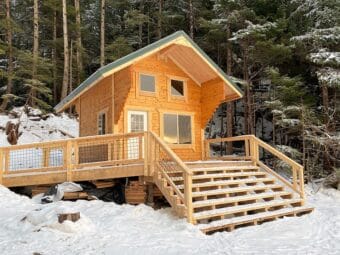
John Muir Cabin near Auke Bay on Sept. 16, 2022. (Photo by Yvonne Krumrey/KTOO)

Juneau’s trail maintenance nonprofit won’t be maintaining Forest Service trails this season, unless it can crowd-source funding for a new trail crew. 

That includes maintenance on access trails to heavily-used cabins at Peterson Lake, Dan Moller and Windfall Lake. 

Leaders of Trail Mix, Inc. made the decision to reallocate their Forest Service crews to other work, because they say they may lose the federal funding that pays them.

Half of the organization’s summer trail crews are funded by Forest Service grants. With instability at the federal level, Executive Director Meghan Tabacek said she doesn’t want to risk not being able to pay those workers. 

“I don’t ever want to be in a situation where we can’t pay our employees,” she said. “That’s just not how we do business here.”

Trail Mix usually gets about $420,000 annually in federal funding. Usually, the Forest Service pays Trail Mix during or after the season.

Tabacek says the funding comes from two sources: the Great American Outdoors Act, a 2020 act that funds improvements to recreation areas on federal land, and Alaska Forest Service fees from the Mendenhall Glacier Visitor Center and cabin use that get deposited back into trail work.

The city has long partnered with Trail Mix for trail upkeep. George Schaaf leads the City and Borough of Juneau’s Parks and Recreation department and said they are one of Juneau’s greatest assets. 

“The trails make Juneau, Juneau,” he said. “It’s a huge reason I think a lot of us chose to come here, chose to stay and a lot of why people who grew up here also stay or come back.”

And, he said, the federal funding cuts could mean Juneau has to spend a lot more money in the future to maintain certain trails.

“If you keep up on the periodic maintenance, your cost over the lifetime is going to be a lot lower,” he said. “But if you don’t maintain what you have, you’re going to end up spending a lot of money all at once to try to get it back.”

Trail Mix, Inc. staff member Laib Allensworth and volunteers Dave Haas and Dan Parks working on Lemon Creek Trail. June 4 2022. Photo by Yvonne Krumrey/KTOO

Trail Mix’s Tabacek said the federal funding agreements haven’t been canceled yet. But she fears they could be because federal funding across the U.S. has been slashed, leaving many nonprofits without previously-guaranteed money to operate.  

“We’re just incredibly nervous to have the federal government as a business partner right now,” Tabacek said. “Agreements and grants that people thought were set in stone are being lost, left and right.”

Trail Mix has already hired its crews. Tabacek said Trail Mix now has to find other ways to pay for about half of its staff, and hopes to secure funding from the city. But she said those funding sources would pay only for work on city trails, not Forest Service trails.

That’s why the nonprofit is raising funds to hire a new crew made up of fired Forest Service staff. That crew could be tasked with maintaining Forest Service trails – roughly 40% of Juneau’s trails, she said. 

“It’s the people who use trails that are going to feel this, you know,” Tabacek said. “And obviously our staff are feeling it, and the staff of the Juneau Ranger District are feeling it as well. But this really has eliminated a lot of ways we work on Forest Service trails and to maintain these trails that we love.”

The fundraiser’s goal is $170,000, and Tabacek said the organization has about a month to raise that amount before trail work begins. And she said this year is a good year to volunteer. 

Fired Forest Service staffers in Juneau are uncertain about their futures — and the safety of visitors at the glacier

Maria Diaz, Hillary Hunter and Mason Hearn all worked as rangers at Mendenhall Glacier Visitor Center, until they were fired in the mass Forest Service terminations earlier this month. (Photo by Clarise Larson/KTOO)

On Valentine’s Day Maria Diaz was delivering flowers — her winter job — when she got a call from the District Ranger’s office. The call was short. She was told she was “laid off” from her seasonal job with the U.S. Forest Service effective immediately. She got her termination letter later, over email. 

“And then I had to go continue delivering flowers, and it looked like I just got broken up with on Valentine’s Day,” she said. “But it was just the Forest Service breaking up with me instead.”

Diaz worked at the glacier for two seasons — one as an intern and one as a ranger. She said the job was her future, and it made Juneau her home. 

“This isn’t a summer job,” she said. “It was supposed to be a career for me. I was expecting, fully expecting, to stay in Juneau for years and continue moving my way up. And they didn’t give us a choice to do that.”

The roughly one million visitors coming to the Mendenhall Glacier Visitor Center in Juneau this summer will have less staff monitoring their experience – including their safety. That’s after the U.S. Forest Service fired nearly all the visitor center staff, mostly rangers. Instead of a dozen employees, only two public-facing staff are left ahead of this tourist season.

Officials with the Trump administration say the workers were laid off to increase government efficiency and reduce spending. But a Forest Service official confirmed that the recreation area’s revenue in visitor fees and permits exceeds its operating costs by more than a million dollars – in other words, the park earns enough to pay employees and more.  

Diaz is one of more than a dozen employees recently terminated from the visitor center, leaving only two public-facing staff and a few maintenance staff. 

She and other fired staff expect the people left behind will have to do multiple jobs to keep things running. They’re worried about what this will mean for the future of the glacier — and the people who love to go there.  

Diaz said boots-on-the-ground roles like hers are essential. Rangers enforce safety on the trails near the glacier. That’s critical at the Mendenhall Glacier where visitors from across the country may see bears for the first time. Visitors often don’t know how to react when they encounter a bear — sometimes crowding it instead of moving away.

“And there’s been plenty of times throughout the past two years that I have seen people really put themselves in dangerous situations,” she said. “And the only reason why something bad didn’t happen was because there was somebody there. There was a ranger there.”

Visitors walk back from viewing the Mendenhall Glacier on Friday, Feb. 21, 2025. (Photo by Clarise Larson/KTOO)

The visitor center recently added new positions: cultural ambassadors who are tribal citizens. The roles are part of a 2023 co-stewardship agreement between the Central Council of the Tlingit and Haida Indian Tribes of Alaska and the Forest Service. These ambassadors educate tourists on the connection between the landscape and Lingít history and culture. At this point, these jobs, which are funded by the tribe, haven’t been included in the firings. 

When asked about the firings, the tribe responded with a statement that said it remains committed to co-stewardship with the Forest Service. It said they are actively recruiting cultural ambassador positions for the summer season.

Mason Hearn worked at the glacier as a ranger, too. He was also fired. He said he thinks that even if the Forest Service can keep the visitor center open with volunteers and reallocated staff, the visitors will feel the effects of the cut jobs. 

“They’re going to have to make a sacrifice somewhere, and I think it’s going to mainly be the user experience,” he said.

Hearn said he hopes the Forest Service can continue to provide safety precautions, even if there won’t be Forest Service staff out speaking with tourists about the landscape, local flora and fauna. 

Hillary Hunter said rangers frequently use their first responder training to treat patients on the trail while they wait for an emergency medical team, which could take as long as an hour. Hunter is another Forest Service ranger at the visitor center who’s been terminated. 

“There have been heart attacks at the visitor center before, and we have people go into diabetic shock,” she said.

Like the others, Hunter’s termination letter cited poor performance as the reason for being fired. But, she said, there was no performance review to inform that.

“And the person who the email is signed from is someone in Washington who has not met us,” she said. 

Hunter grew up in Petersburg. Her dad worked on trails there, and she learned about the natural world around her and how to safely enjoy it from an early age. 

“I didn’t realize what a privilege that was as a child until I got older, and then that made it more important to me to increase access to others,” she said. 

Isabel Dziak has been working at the Mendenhall Glacier since her summer internship in 2019. She was fired, too, but she’s going to do whatever she can to get her job back. 

“I am not going anywhere,” she said. “I’m not gonna be quiet.”

Dziak plans to appeal her firing, arguing that the basis — her alleged poor performance — isn’t valid. 

She said she’s known since she started that this job isn’t about the money. 

“When I was an intern, I was talking to a wiser, older ranger, and they said, ‘If you’re in this field, you get paid in sunsets,’” Dziak said. “You’re here because you love your national forests, you love your national parks, and to serve your community and your nation.”

Forest Service officials have not released a plan to staff the visitor center. 

Juneau’s tourism sector unsure what will happen at Mendenhall Glacier as summer season approaches

Visitors view Mendenhall Glacier on Friday, Feb. 21, 2025. (Photo by Clarise Larson/KTOO)

Most of the staff at the Mendenhall Glacier Visitor Center were fired earlier this month, leaving city tourism leaders worried that one of Juneau’s most popular visitor destinations may reduce services, or even close for the cruise season.

Listen:

Last week, Juneau’s Visitor Industry Director Alix Pierce said she’s been fielding calls from tour operators who want to know what the lack of staff at the glacier means for their businesses. 

“Everybody has a lot of questions about what the next steps are,” she said. “I think the Forest Service staff that remain from what I understand are kind of in triage mode trying to figure out how to best allocate resources.”

The visitor center at the glacier sees about a million visitors per year. It’s run by the U.S. Forest Service, which saw about 2,000 job cuts nationwide in the last two weeks under a Trump administration plan to reduce the federal workforce.

The Tongass National Forest’s spokesperson is directing media requests to the U.S. Department of Agriculture, which says it doesn’t have location-specific information about staffing. 

As it stands now, Pierce said the city isn’t getting information about how the glacier recreation area will operate. The dramatic staff reductions come after the city and the visitor center have spent a decade planning improvements to the visitor center. Pierce says there isn’t information about that either.

“We have no idea,” she said. “We have no idea whether those types of improvements will be funded. We have no idea about anything.”

Travel Juneau is the city’s destination marketing organization. Liz Perry is the director, and she said these firings come at an especially bad time as visitors are finalizing their plans for the summer. City leaders expect more than 1.6 million people will come to Juneau on cruise ships this summer. 

“Knowing whether or not the Mendenhall Glacier Visitor Center is going to be able to operate, or how it’s going to operate, is going to be a key piece to a lot of those plans,” Perry said. “Because it’s one of the number one things for people to do when they get in town.”

Perry works with 260 businesses, many of which are permitted by the Forest Service to run tours at the glacier. She’s heard from tourism operators who say they’re worried about their business investments if the glacier is off-limits for the season. 

Snow surrounds the Mendenhall Glacier Visitor Center on Friday, Feb. 21, 2025. (Photo by Clarise Larson/KTOO)

Other small business owners are worried as well. Shawn Eisele is the executive director of Discovery Southeast, a nonprofit that offers natural education programs for kids in Juneau and operates the bookstore in the visitor center. It stocks items from local artists and authors, and funds half of Discovery Southeast’s budget. 

“It is, in my mind, one of the best success stories of local tourism in Southeast and in Juneau,” he said.

Eisele said the partnership between his organization and the Forest Service allows for locals to have a hand in educating tourists, and benefit from the high numbers of visitors who come to see the glacier. 

Now, he’s not sure what the firings mean for the bookstore this summer and he’s worried about the broader implications too. 

“It’s a scary and dire situation,” Eisele said. “That’s true for the individuals who are fired. It’s true for the individuals who remain. It’s true for Discovery Southeast, and I think it’s probably true for our community too.”

But some businesses aren’t as worried. Juneau Tours buses run to Mendenhall Glacier five to 10 times each day during cruise season. Serene Hutchinson said her company has the second largest tourism operations permit for the glacier.  

“It is a foundation of our business, to bring people to the Mendenhall Glacier,” she said. 

But Hutchinson has seen government shutdowns and other obstacles to the visitor center’s operations before, and she’s optimistic the Forest Service will have a plan for the season.

“This is not completely unfamiliar territory for us as an operator, and every other time it’s been figured out,” she said. 

If the visitor center shuts down, she at least wants her customers to see the glacier from viewpoints near the parking lot. 

“Obviously, we want full service, but if they have to, I hope that at the very least we can keep the views open,” she said. “And the bathrooms, because they’re just as important as the views.”

Juneau’s first cruise ship of the season is scheduled to arrive April 14. 

Forest Service warns Juneau residents to stay away from Mendenhall Glacier amid calving concerns

The U.S. Forest Service warned residents on Tuesday, Feb. 11, 2025 of a large crack in the Mendenhall Glacier that may cause significant calving. (Courtesy of U.S. Forest Service)

Update, Thursday 1 p.m.:

The Forest Service posted an update on Facebook saying part of the glacier had calved into the lake and warning that the ice remains unstable.

“More calving is possible and we urge all visitors to the Mendenhall Glacier Recreation Area to stay far away from the face of the glacier,” the post reads.

Original story:

The U.S. Forest Service is warning Juneau residents to stay away from the face of the Mendenhall Glacier, where a large piece of ice may fall off at any moment. 

Paul Robbins Jr, a spokesperson for the Forest Service, said in an interview Tuesday afternoon that it’s difficult to predict how dangerous the calving may be, but it’s best to steer clear. 

“There’s really no way for us to predict when it’s going to fall and we really don’t know what the scale is going to be either,” he said. 

This comes as hundreds of Juneau residents have flocked to recreate on the frozen lake in recent weeks. The Juneau Nordic Ski Club grooms cross-country skiing trails on it and walking paths in the snow lead toward the face of the glacier.

Every winter the Forest Service advises residents that venturing out onto the frozen lake can be dangerous. In December when the ice first froze over, several reports of people falling through the ice and self-rescuing circulated on social media. 

Capital City Fire/Rescue Chief Rich Etheridge said the department is aware of the warning and is advising residents to stay off the lake entirely. He said a rescue mission would be extremely difficult to pull off and could put rescuers at risk. 

“Our recommendation is stay off the ice until this large chunk gives way,” he said. “It’s beautiful, and everybody wants to be out there. But is it really worth the risk of being stuck out there in that freezing water, which could very well be a fatal event?”

Robbins said the glacier has had significant calving activity in recent weeks, with multiple sections already falling onto the frozen lake. 

“The major dangers are in the immediate vicinity of the glacial face, from large chunks of ice falling, and the possibility of crushing individuals that could be nearby,” he said. “When those large chunks of ice hit the iced over lake below, it could cause cracks and make the ice unstable for people who would be skiing or skating across it.”

A video shared on social media in December showed Juneau residents running across the ice away from the face of the glacier after a large chunk of ice calved, causing the lake ice to flex and crack.

(Note: this video contains unedited language)

The National Weather Service typically advises that people keep a distance of at least 300 yards from the face of the glacier.

As snow returns, Juneau skiers hit the slopes to make up for lost time

Skiers and snowboarders on the Ptarmigan chairlift at Eaglecrest on Jan. 30, 2025. (Photo by Yvonne Krumrey/KTOO).

Juneau is finally seeing some snow this week after a winter that hasn’t gotten nearly as much as usual.

Up at Eaglecrest Ski Area Thursday morning, Holly Harris was glad to squeeze some runs in on a long-awaited heavy snow day.

“It’s filling in fresh so you get fresh tracks every run wherever you go,” she said.

She moved to Juneau from New Zealand in November, and she said she couldn’t pass up coming out today, even if for just a bit.

“I just took a couple of laps,” Harris said. “I’m meant to go to work now.”

But she said she’ll be back bright and early Friday.

The ski area opened the Ptarmigan lift Wednesday, which takes skiers and boarders up to the top of the mountain. There they can access greens, blues and even some double black runs.

Due to a lack of snow so far this winter, Eaglecrest Ski Area has only been able to open one lift until this week — the short Porcupine chairlift that only services the bunny hill.

A recent city meeting outlined some big costs Eaglecrest is facing in the coming years, so selling some lift tickets this week is a welcome relief for the city-run ski area.

Jeff Garmon is a forescastor with the National Weather Service Juneau office. He said January 2025 has seen about a foot less snow than the average Juneau January, according to measurements at the Juneau International Airport.

“And there’s some spots, like Eaglecrest, that maybe significantly more below normal, because they’ve had a lot more rain on the mountain than we’ve had,” Garmon said.

This week’s snowfall will help close the gap, he said. Then, this weekend is slated to be sunny and cold. It should make for some good views from the slopes.

Today, the snowfall meant there wasn’t a lot of visibility on the mountain. But, that didn’t stop Nelson Merrell.

“It is awesome, everyone should come up and enjoy the snow,” he said.

Merrell wasn’t dwelling too much on the late season opening.

“Today is great,” he said with a laugh.

Financial report paints hopeful picture for gondola to make Eaglecrest Ski Area self-sustaining

Parts of the city-owned gondola sit outside at Eaglecrest Ski Area on Dec. 10, 2023. (Clarise Larson/KTOO)

As Eaglecrest Ski Area faces ongoing financial hardship, city officials continue to hope the gondola will one day make it self-sustaining — once it’s up and running. 

In the meantime, Eaglecrest may need to borrow more money from the city to fix a broken chairlift and increase wages. On top of that, low snowfall means it still hasn’t fully opened for the season. 

Kirk Duncan, a former Eaglecrest general manager, wrote a financial review of the city-owned ski area for the Juneau Assembly. He presented it at an Assembly Committee of the Whole meeting Monday. 

“I’ve made many assumptions and it’s up to the board to determine whether they’re going to modify those, accept them, not accept them, whatever,” Duncan said.

The report is part of a broader analysis to provide a timeline for how Eaglecrest could become self-sufficient, instead of relying on the city for financial support.

Duncan said the ski area has seen similar hardship before. Last year’s sudden change in leadership and the potential financial loss this winter are reminiscent of a rough few years Eaglecrest faced when he was manager 20 years ago. 

“That gives me a really good feeling of optimism, that there’s good potential for turning things around,” he said. “One of the questions is, how can we quit doing this, needing to turn things around?”

His report did suggest that, with a few different ticket price options — ranging from $45, $65 or $85 per ride — the gondola could eventually create year-round revenue the ski area could then reinvest in winter operations. 

Duncan’s report offered a myriad of recommendations for how to both cut costs and fund upcoming maintenance and operations. This season, the Black Bear lift is down and needs to be fixed or replaced. Along with other maintenance fees and services, Duncan estimates that the ski area could see an additional $750,000 added to this year’s budget.

He warned against raising user fees without knowing if that would drive down the number of people buying lift tickets and season passes. He said the ski area could instead add to their negative fund balance for now and hope to pay off the deficit later, which is a strategy that has worked in the past.

Eaglecrest Board Chair Mike Satre said he’s pleased that Duncan’s report matches many of the board’s earlier projections about the potential future revenue of the gondola. 

“It’s just great that the report justifies everything that we’ve done to purchase the gondola, get into a partnership with Goldbelt to install it, and make this happen,” Satre said.

While the costs may seem like a lot, Satre thinks it will pay off in the future.

“In a sense, this is like any business,” he said. “This is our startup expenses before revenue can be booked.”

The city spent about $3 million to purchase and import the used gondola in 2022. Since then, a $10 million investment from Goldbelt Inc. has paid for expenses — so far $5.8 million — but City Manager Katie Koester says $2.5 million in city funding is earmarked for the project. 

Satre said the board plans to start offering biweekly reports to the Assembly on the state of Eaglecrest’s finances. That’s after Duncan’s report said that many of the ski area’s issues can be traced back to a lack of oversight and communication.

Satre said the board will present their funding needs to the Assembly for consideration. Construction is still a moving target as Eaglecrest continues to secure the necessary permits. According to the city’s agreement with Goldbelt, the gondola must open by the end of May 2028.

Eaglecrest announced Tuesday that additional snow will allow it to open more of the ski area Wednesday and this weekend. 

Site notifications
Update notification options
Subscribe to notifications