On Valentine’s Day Maria Diaz was delivering flowers — her winter job — when she got a call from the District Ranger’s office. The call was short. She was told she was “laid off” from her seasonal job with the U.S. Forest Service effective immediately. She got her termination letter later, over email.
“And then I had to go continue delivering flowers, and it looked like I just got broken up with on Valentine’s Day,” she said. “But it was just the Forest Service breaking up with me instead.”
Diaz worked at the glacier for two seasons — one as an intern and one as a ranger. She said the job was her future, and it made Juneau her home.
“This isn’t a summer job,” she said. “It was supposed to be a career for me. I was expecting, fully expecting, to stay in Juneau for years and continue moving my way up. And they didn’t give us a choice to do that.”
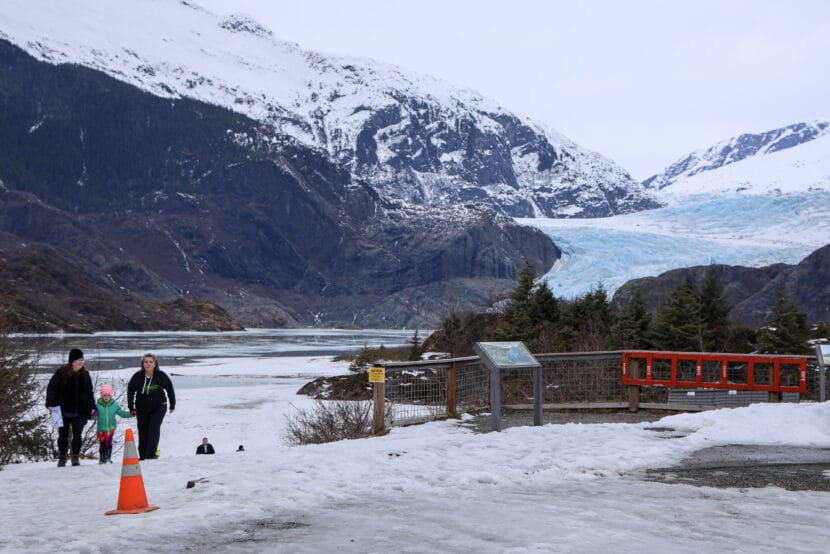
The roughly one million visitors coming to the Mendenhall Glacier Visitor Center in Juneau this summer will have less staff monitoring their experience – including their safety. That’s after the U.S. Forest Service fired nearly all the visitor center staff, mostly rangers. Instead of a dozen employees, only two public-facing staff are left ahead of this tourist season.
Officials with the Trump administration say the workers were laid off to increase government efficiency and reduce spending. But a Forest Service official confirmed that the recreation area’s revenue in visitor fees and permits exceeds its operating costs by more than a million dollars – in other words, the park earns enough to pay employees and more.
Diaz is one of more than a dozen employees recently terminated from the visitor center, leaving only two public-facing staff and a few maintenance staff.
She and other fired staff expect the people left behind will have to do multiple jobs to keep things running. They’re worried about what this will mean for the future of the glacier — and the people who love to go there.
Diaz said boots-on-the-ground roles like hers are essential. Rangers enforce safety on the trails near the glacier. That’s critical at the Mendenhall Glacier where visitors from across the country may see bears for the first time. Visitors often don’t know how to react when they encounter a bear — sometimes crowding it instead of moving away.
“And there’s been plenty of times throughout the past two years that I have seen people really put themselves in dangerous situations,” she said. “And the only reason why something bad didn’t happen was because there was somebody there. There was a ranger there.”
The visitor center recently added new positions: cultural ambassadors who are tribal citizens. The roles are part of a 2023 co-stewardship agreement between the Central Council of the Tlingit and Haida Indian Tribes of Alaska and the Forest Service. These ambassadors educate tourists on the connection between the landscape and Lingít history and culture. At this point, these jobs, which are funded by the tribe, haven’t been included in the firings.
When asked about the firings, the tribe responded with a statement that said it remains committed to co-stewardship with the Forest Service. It said they are actively recruiting cultural ambassador positions for the summer season.
Mason Hearn worked at the glacier as a ranger, too. He was also fired. He said he thinks that even if the Forest Service can keep the visitor center open with volunteers and reallocated staff, the visitors will feel the effects of the cut jobs.
“They’re going to have to make a sacrifice somewhere, and I think it’s going to mainly be the user experience,” he said.
Hearn said he hopes the Forest Service can continue to provide safety precautions, even if there won’t be Forest Service staff out speaking with tourists about the landscape, local flora and fauna.
Hillary Hunter said rangers frequently use their first responder training to treat patients on the trail while they wait for an emergency medical team, which could take as long as an hour. Hunter is another Forest Service ranger at the visitor center who’s been terminated.
“There have been heart attacks at the visitor center before, and we have people go into diabetic shock,” she said.
Like the others, Hunter’s termination letter cited poor performance as the reason for being fired. But, she said, there was no performance review to inform that.
“And the person who the email is signed from is someone in Washington who has not met us,” she said.
Hunter grew up in Petersburg. Her dad worked on trails there, and she learned about the natural world around her and how to safely enjoy it from an early age.
“I didn’t realize what a privilege that was as a child until I got older, and then that made it more important to me to increase access to others,” she said.
Isabel Dziak has been working at the Mendenhall Glacier since her summer internship in 2019. She was fired, too, but she’s going to do whatever she can to get her job back.
“I am not going anywhere,” she said. “I’m not gonna be quiet.”
Dziak plans to appeal her firing, arguing that the basis — her alleged poor performance — isn’t valid.
She said she’s known since she started that this job isn’t about the money.
“When I was an intern, I was talking to a wiser, older ranger, and they said, ‘If you’re in this field, you get paid in sunsets,’” Dziak said. “You’re here because you love your national forests, you love your national parks, and to serve your community and your nation.”
Forest Service officials have not released a plan to staff the visitor center.