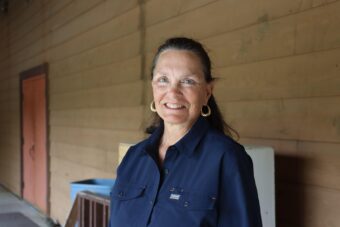
Skagway residents attended a local screening of a new documentary about how the community fared during the pandemic. (Avery Ellfeldt/KHNS)
The smell of buttered popcorn wafted through the Skagway School as dozens of people streamed inside. They were there to watch a new documentary — one about their own community during one of its darkest periods in recent history.
The film depicts life in Skagway between 2020 and 2022, when the cruise industry shut down amid the COVID-19 pandemic. It’s named “Last Call in the North.”
Andrew Cremata was Skagway’s mayor at the time. He said the ordeal forced what may have been the community’s first serious reckoning over its complete dependence on the industry.
“I don’t think there’s ever been any real meaningful conversations about it as a community, either on a governmental level or on a social level,” he said.
That conversation was the film’s throughline, said Stan Bush, who wrote and directed the film.
“What happens when your main economic driver is completely shut off?” Bush said in an interview last week.
Former Skagway resident Stan Bush wrote and directed the film, “Last Call in the North.” (Avery Ellfeldt/KHNS)
In many ways, COVID-19 was Skagway’s worst nightmare. With the town’s tourism-based economy shuttered for one full season and much of a second one, families and businesses went without income for an excruciating 22 months.
Bush went to middle and high school in town, but he hasn’t lived here since then. He said he was developing a project idea in Skagway before the pandemic, focused on the struggling local newspaper.
But Bush pivoted when COVID-19 hit the community in earnest, and the industry that had fueled the town for decades disappeared overnight.
“We’ve seen that when things are going great, they’re going really great. And when things go bad, here, they go really bad,” Bush said. “I think that’s a conversation for the community to have. Can you survive another crisis like this?”
The film follows a few key characters, including Cremata, the former mayor. In an interview after the screening, he raised questions about the long-term sustainability of the town’s economy.
“My fear was that when things got back to normal, people would kind of just go back to normal, right? Go back to the way things were before the pandemic,” Cremata told KHNS. “That’s really exactly what’s happened.”
The film also focuses on struggling small businesses — a jeweler who had to leave town, the owner of an outdoor guiding company who eventually shut his doors, and the former co-owners of the Skagway News. That includes Melinda Munson, the current KHNS news director.
Another key voice was Jaime Bricker, Skagway’s tourism director and the president of the Skagway Traditional Council, a local tribe.
After the premiere, Bricker said she was impressed by the videography and storytelling. She added that she could imagine how difficult it would be to tell the full story in just 90 minutes.
“I think I’ve heard different observations from just about everybody I’ve talked to, and rightfully so,” Bricker said. “We’re all a bunch of individuals in this community, and there were so many pertinent stories of that period of time that, you know, weren’t showcased.”
Bricker added that she thinks the film presents an opportunity for renewed reflection.
“Are there opportunities to plan as we look towards the future, given this particular COVID experience?” Bricker said. “Are there things that we can be doing differently in the future, to better prepare for an economic stop?”
Bush said prompting conversation was one of his main goals – not only locally but in similar communities across the state, country and world. As he sees it, what happened in Skagway could happen anywhere where the presence of one industry is the difference between economic survival and economic collapse.
Disclosure: This film features KHNS News Director Melinda Munson and her family, when Munson was co-owner of the Skagway News. Munson did not review this story before publication.
Mt. Edgecumbe High School, the state’s sole public boarding school, is seen in Sitka on Oct. 6, 2025. (Corinne Smith/Alaska Beacon)
Lawmakers held a series of hearings with officials from Mt. Edgecumbe High School, the largest state-run boarding school in Alaska, following a tumultuous year of budget and staff cuts, administration changes and a wave of student disenrollments.
Sen. Bert Stedman, R-Sitka, opened his remarks at a Feb. 12 Senate Finance Committee hearing saying lawmakers need to air the school’s “dirty laundry” so they can help fix the school’s finances and make needed repairs.
“The goal here is to improve Mt. Edgecumbe High School, and we can’t do that without accurate information,” he said.
Stedman was among a delegation of legislators that made an impromptu visit to the school on Feb. 6, after the news of a mass student disenrollment after this winter break. Lawmakers reported they found leaking roofs, classrooms and buildings in disrepair, rodents, and outdated dormitories. They also met with students to hear about their concerns.
Buckets catch water from a leaky roof in the attic of a Mt. Edgecumbe High School girls dormitory, seen by legislators on a legislators’ visit on Feb. 6, 2026. (Courtesy of the Senate Finance Committee)
After the visit, Sen. Lyman Hoffman, D-Bethel, reported at a Senate news conference the conditions of the facilities were “deplorable.”
Hoffman, who also serves as the finance co–chair, did not mince words to school officials at the hearing. “I could say that if I were a parent, I wouldn’t let my child go to school there,” he said. “The condition of that school speaks for itself. ”
Mt. Edgecumbe High School is based in Sitka, which typically enrolls around 400 students, the majority of whom are Alaska Native from rural communities without local high schools. As of February, enrollment dropped to 311 students, officials said.
Superintendent David Langford, newly hired in July, told lawmakers that administrators were concerned that roughly 25% of students had disenrolled, but said they could not identify a common reason to explain why.
“So far, all the data of all the 100 students that have left this year, we can’t find any trends,” he said. “Like we didn’t have any majority of the students saying ‘it was the food’ or ‘it was the dorm,’ or was this or the other thing. But all those were issues that we’re working to rectify.”
Lawmakers put questions to Deena Bishop, commissioner of the Alaska Department of Education and Early Development, which administers the school, along with the governor-appointed Alaska State Board of Education.
Mt. Edgecumbe Superintendent David Langford (left) and Deena Bishop, commissioner of the Alaska Department of Education and Early Development, are seen on Feb. 11, 2026. They testified before several committees of lawmakers on the conditions at the boarding school, after over 100 students disenrolled to date this school year. (Corinne Smith/Alaska Beacon)
To explain recent events at the school, Bishop painted a picture for lawmakers of a “right-sizing” effort led by DEED after COVID pandemic relief funding ran out in 2024. She said Mt. Edgecumbe had a $1.6 million budget shortfall that forced a series of cost-cutting measures throughout 2025. The state sold off a parcel of land on the campus property for $900,000 to help fill that gap.
But Bishop said last year, the DEED and the administration cut four teachers, one administrator and two support staff positions. They also made cuts to student activities, travel and maintenance funding — plus a change in the superintendent and contractors running the student dorms and food service this year.
Mt. Edgecumbe High School student housing in Sitka on Oct. 6, 2025. (Corinne Smith/Alaska Beacon)
Langford testified that when he arrived in August, he wasn’t sure the school would open. But DEED and administrators made a series of emergency repairs and deep cleaned the kitchen facilities and dorms, replacing years-old mattresses, dorm furniture and upgrading the kitchen including all cookware.
Legislators asked how school facilities had been left to deteriorate so badly, who was responsible for advocating for the school repairs, and how officials planned to make improvements.
Hoffman said it was obvious from legislators’ visit that there is more work to do.
“It seems every time we go down the path, there are more and more and more issues that aren’t being addressed,” Hoffman said. “I’m glad we’re addressing the immediate needs, but there’s long term needs that need to be addressed that aren’t being addressed by the Department of Education.”
Bishop acknowledged that the effort is ongoing. “So in right-sizing the ship, it’s moving forward. I absolutely agree with you. Is Mount Edgecumbe where we want it to be? Absolutely not. I believe, with the leadership that is there and support for this school, that we can get there.”
Hoffman pointed out the school lost Americorps support staff after the Trump administration gutted the program last year. Mt. Edgecumbe lost three staff who served in major support roles for students for after-school activities and outings into town.
“The primary role of these people was to do nothing but be with students in the evening,” said Langford. He added that he tried to hire staff back this year, but it was too late. “So in terms of students going home, I would point to that as one of the biggest impacts that could have been prevented.”
In a state Board of Education meeting in December, parents, alumni and current and former staff from Mt. Edgecumbe testified that because of changes in the dorms, loss of staff and teachers and reduced activities, students’ quality of life suffered, and morale plummeted last fall. A local healthcare provider testified to members of the board that in the previous month, eight students were hospitalized for suicidal ideation — an unprecedented number, she said.
Ilana Kalke, a junior, was one of two Mt. Edgecumbe students that testified to lawmakers last week. She said there is a disconnect between the new contractor running the dorms, the NANA Corporation, and staff and students.
“It seems like they have trouble communicating, which impacts us, this leads to inconsistent application of rules,” Kalke said. “There’s been trouble communicating, getting rides, and just like less collaboration, which affects rec activities.”
Mt. Edgecumbe sophomore Kadyn Cross (left) and junior Ilana Kalke (right) testify before legislators on Feb. 11, 2026. (Corinne Smith/Alaska Beacon)
Kadyn Cross, a sophomore, testified in support of the school and told lawmakers that supporting the school supports students like him, who are coming from small villages like his community of Koyuk, on the coast of Norton Sound.
“MEHS is already producing future educators, leaders and contributors to Alaska’s communities. But we can’t do that without stable funding for staff, updated facilities, student activities, and real maintenance, especially maintenance, which is stretched thin right now,” he said. “I’m not here with data charts. I’m here as one student who moved from a small village to a school that changed my trajectory fast. And I’m one of hundreds. MEHS isn’t just a school, it’s a place that grows people who go back to their communities and strengthen them.”
Lawmakers slam Gov. Dunleavy for years of vetoing funds for repairs
Lawmakers criticized Gov. Mike Dunleavy for vetoing funding for Mt. Edgecumbe year after year — most recently last year vetoing $2.7 million for a new roof and windows on the girls’ dorm.
Since the start of Dunleavy’s term in 2019, the governor has vetoed funding allocated for Mt. Edgecumbe, including maintenance of the aquatic center and student services. He vetoed funds to replace the dorm windows for three years in a row. Over six years his vetoes totaled over $22.4 million, according to state data.
Storage containers and suitcases are stacked in a stairwell of the Mt. Edgecumbe girls dormitory as the attic is leaking, seen on a legislators’ visit on Feb. 6, 2026 (Courtesy of the Senate Finance Committee)
Sen. Löki Tobin, D-Anchorage and chair of the Senate Finance Committee, expressed her frustration at a Senate news conference last week, reading out a list of the vetoes. “We continue to advocate for school repairs and to address school infrastructure across the state,” she added. “And it seems that we do not have a governor who wishes to lead. It is incredibly frustrating.”
A spokesperson for the governor’s office responded to questions about lawmakers’ criticisms by email on Tuesday, noting the governor had approved $15.3 million for repairs and maintenance for Mt. Edgecumbe since 2019, including for bathroom and kitchen upgrades, asbestos and lead abatement and some funding toward replacing dorm roofs.
“The challenges Mt. Edgecumbe is currently addressing stem from years of low prioritization of needs. With the new leadership of Superintendent David Langford, under Commissioner Deena Bishop, emphasis has been placed on realigning the budget to remedy maintenance issues,” said Jeff Turner, Dunleavy’s director of communications.
Turner said that even with the governor’s vetoes, Mt. Edgecumbe maintenance and repairs are underway.
“Without the vetoed funding, Mt. Edgecumbe has reprioritized and has updated culinary equipment, furniture, and scheduled three buildings to be re-rooved this summer — with more to come. Budget management has now been placed at the forefront, allowing existing funding to begin remedying what was thought to be unattainable without further allocation,” he said. “This is a textbook example of results obtainable when accountability is highlighted.”
Legislative action for Mt. Edgecumbe repairs
On Wednesday, the Senate passed a new bill, Senate Bill 146, that would add Mt. Edgecumbe to the state’s school major maintenance list to be eligible for state grants for construction and maintenance projects. Currently Mt. Edgecumbe is maintained using funds through the Alaska Department of Transportation and Public Services, as a state-run facility.
The bill would also do away with the $70 million cap on the Regional Education Attendance Area school fund — for schools that rely solely on state funding as they’re located in rural areas without municipal funding — and allow those funds to be used for Mt. Edgecumbe projects, including teacher housing.
A similar bill was passed last year, but Dunleavy vetoed it. Senators said they are hopeful there will be more support this year, and the bill now advances to the House.
“I’m hoping that there’ll be broad support in the legislature like there was last year, and we’ll put it back on the governor’s desk, and hopefully the governor will reconsider,” Stedman said.
Sen. Bert Stedman, R-Sitka, is seen meeting with Mt. Edgecumbe students on a legislative visit on Feb. 6, 2026. (Courtesy of Senate Finance Committee)
Moving forward, Stedman said the Finance Committee is gathering information on critical repairs and maintenance needed, projects in progress and items to be added into next year’s budget, including funds immediately available to replace items like washing machines and mattresses.
“We’ll be monitoring it,” Stedman said Tuesday. “There’s a good percentage of the (Capitol) building here that got its attention, because it’s embarrassing for everybody.”
Lawmakers questioned Langford, the superintendent, last week on his role currently running two school districts this year — both the Mt. Edgecumbe high school and the Chatham School District, which serves approximately 175 students across rural schools in Angoon, Gustavus, Tenakee Springs and Klukwan.
Langford and Bishop testified that a former Wasilla Republican Senator, Mike Shower, approached Langford to run both districts. Langford said he considered only with the permission of the Chatham School board, and then accepted both roles.
Bishop said at first she was skeptical of the arrangement, but changed her mind. “I initially said, ‘Yeah, no, thanks. This is, we’ve got big, big issues to solve.’ Then they started talking to me, and I said I would not go and poach someone else’s superintendent.”
She said she was convinced by Langford’s experience in education consulting, and his history with Mt. Edgecumbe, starting as a teacher in 1985. She said he has valuable leadership experience as a superintendent and running district finances.
Langford said the board of the Chatham School District is conducting quarterly reviews of his performance, and the State Board of Education conducts annual reviews on his tenure at Mt. Edgecumbe. He said while there are disadvantages of not being on the ground in the Chatham School District, he has access to DEED officials to the benefit of both districts.
He said so far, the arrangement is going well. “I think it’s very exciting to work with you and all the staff at Mount Edgecumbe,” he told lawmakers. “To try to remake Mt. Edgecumbe and bring it back to the greatness that I think it once was.”
The forest on Douglas Island dusted with snow on Nov. 25, 2025. (Photo by Clarise Larson/KTOO)
The U.S. Forest Service officially kicked off its public process for the Tongass National Forest Plan Revision on Wednesday, with an initial 30-day public comment period intended to guide a draft plan and environmental review.
The Tongass National Forest is the largest national forest in the U.S., with more than 16 million acres covering 80% of Southeast Alaska, including more than a thousand islands.
Forest-wide decisions made at the federal level shape the environment and the lives of Southeast residents — from industrial uses like mining and timber, to tourism and recreation, to the health of ecosystems and quality of subsistence harvests.
The last forest management plan was completed in 2016. That plan phased down the amount of old-growth available for logging over several years. The revised plan will set the stage for how the agency intends to manage the forest over the next 10 to 15 years.
In its public notice released Tuesday, the agency outlined six proposed goals for the updated plan that address land use designations; economic uses of the forest; the rise in cruise ship visitors, collaboration between different groups; subsistence hunting, fishing and gathering needs; and Indigenous knowledge.
The public notice said the agency will ensure the plan is consistent with two of President Trump’s executive orders aimed at maximizing mineral extraction and logging in the Tongass.
The agency also noted that a long-term timber demand analysis underway at the Pacific Northwest Research Station will inform projected timber sale quantities. The last analysis, published in 2016, estimated demand for Tongass forest products would range from roughly 41 to 76 million board feet per year between 2015 and 2030.
The public comment period for the scoping phase ends March 19 at 11:59 p.m. The agency expects to publish a draft revised plan and draft environmental impact statement this fall, followed by a 90-day public comment period. The final plan is expected next May.
James Beck of Oklahoma began his role as Hoonah’s new chief of police and director of public safety in January. Hoonah, a community of less than a thousand people, is located on the northeastern side of Chichagof Island, west of Juneau.
Beck has served in multiple law enforcement roles for more than two decades, holding positions including tribal police officer, tribal chief of police and sheriff at different agencies in the Lower 48.
In an interview, Beck said he took the job because he was looking for a change and was drawn to Hoonah’s Indigenous culture. Beck is an enrolled tribal member of the Cherokee Nation in Oklahoma. He said his goal is to build trust between the community and the police department.
“If you’re always truthful, you’re going to remember what you told somebody,” he said. “If you go to trying to tell fibs and little white lies and just being dishonest, it’s going to come back on you eventually, because you’re going to spin a web of lies, and it always collapses.”
Beck’s hiring comes after Hoonah’s former chief, Carlos Frias, alleged he was fired from his role after two years because he began investigating domestic violence and sexual assault complaints made against some city leaders. However, city leaders rebuffed his claims, saying he was fired for a series of violations, including excessive use of force. Frias has since moved away from Hoonah and is now a police officer in Tucson, Arizona.
Beck said one of his goals as chief is to increase transparency and accountability.
On Thursday, the City of Hoonah is hosting a community meeting at 6:30 p.m. at City Hall for residents to ask questions or make suggestions to him about the police department. Community members can participate in person or online.
“I think these community meetings is for me to put myself in front of the community so that I could increase that transparency, because I do believe in transparency and law enforcement,” he said.
Beck said he would also like to increase staffing levels at the four-person department and upgrade the station.
Bill Miller, Hoonah’s mayor, said Beck has been a great addition to the community so far.
“His community involvement is really good. He’s been attending all of our meetings because he’s wanting to know the community,” he said. “He fits well for it. He’s got a really good attitude, very knowledgeable.”
Benjamin Botts, formerly with the Ketchikan Police Department, served as interim chief after Frias was fired. According to the city’s website, Botts now serves as a multi-service officer for the department alongside two other officers.
The Columbia, a mainliner in the Alaska Marine Highway System, docked in Skagway in early March, 2025. (Avery Ellfeldt/KHNS)
Travelers can now schedule ferry rides with the Alaska Marine Highway System for May through September. That’s after the summer schedule opened for booking Feb. 12.
The schedule looks a lot like recent years, with six of the state’s nine vessels sailing. There is not enough funding or staffing to run them all, said Shannon McCarthy, spokesperson for the state Department of Transportation.
“Our crew is relatively stable right now, but, you know, it’s not expanding rapidly,” McCarthy said. “Our budget is also a concern this year, so we will only be running one of the mainliners at any given time.”
Only one mainliner – the Columbia – is scheduled to travel weekly through Southeast to Bellingham, Washington. That means a round trip every two weeks for most residents.
A map of the Alaska Marine Highway System’s routes in Southeast Alaska. (Alaska Dept. of Transportation and Public Facilities)
McCarthy said the Kennicott will be on standby in case the Columbia needs repairs.
“The nice thing is, it is much better to have two vessels — main liners — that are able to be sailed at any point,” she said. “It puts the state in a much better position.”
The Tustumena will sail the southwest region between Homer and the Aleutians. That’s roughly two round trips per week from Homer to Kodiak, and one full Aleutian Chain run per month.
The day boat, Leconte will sail Prince William Sound. And Lynn Canal will be similar to last year, with the Hubbard doing nearly daily runs between Juneau, Haines, and Skagway.
U.S. Senator Lisa Murkowski helped secure hundreds of millions in federal ferry funds over the last five years. But the state is now waiting on a key federal grant for this year. DOT Commissioner Ryan Anderson is scheduled to be in DC this week to talk to the Alaska Delegation about it.
“Because this money is still available — it was written into the law,” McCarthy said. “So, we’re just trying to figure that out, to see if there is some relief there.”
With ongoing funding issues, the state is considering selling the Matanuska, a 63-year-old mainliner that’s been tied up in Ketchikan and used for housing new ferry workers. McCarthy says they’ll still be able to offer housing in the mainliner that’s not currently sailing.
Thousands of young Pacific oysters grow in bins within the floating upweller system, or FLUPSY. (Photo by Alix Soliman/KTOO)
Listen to this story:
At the end of a dock in Auke Bay, an oyster farmer lifted a creaky hatch door on an unassuming floating platform. Inside were bins holding thousands of young oysters, called spat.
The platform is called a floating upweller system, or FLUPSY, and it’s one way oyster farms can keep more stock.
“This is just a cheaper way to buy spat in a smaller size, much bigger quantity,” said Maranda Hamme, owner of Shinaku Shellfish Company, a small, family-run Pacific oyster farm in Klawock. Hamme was part of a small group that visited Juneau for a day-long mariculture workshop organized by Alaska Sea Grant and the Central Council of the Tlingit & Haida Indian Tribes of Alaska last week.
Nutrient-rich water flushes through the FLUPSY, so the tiny oysters can quickly grow big enough to fit into mesh bags out on a farm. The oysters in the FLUPSY are around the size of a penny — they’ve been growing here for roughly 9 months.
An oyster farmer opens a hatch on the FLUPSY in Auke Bay, where thousands of small oysters are growing. (Photo by Alix Soliman/KTOO)
The FLUPSY in Auke Bay belongs to Salty Lady Seafood Company, the only oyster farm in Juneau. Hamme said she’s planning to stock her own FLUPSY in Klawock because it can help her scale up, even when there are bottlenecks in the supply chain.
“Currently, there’s only so many FLUPSYs in the state, and as a farmer, we’ve already not had seed needs met,” she said.
Most oyster farmers in Alaska, including Hamme, have to ship in spat from out-of-state hatcheries in Hawaii, Washington, Oregon or California. Sometimes there are shortages at those hatcheries.
Spencer Lunda manages the University of Alaska Fairbanks’ mariculture research hatchery at Lena Point. He said developing in-state hatcheries can help solve that problem.
The facility pumps in seawater that gets heated and flows into troughs filled with oysters, where Lunda and his team are studying ways to produce spat locally for farms across Alaska.
“It would be nice to have spat production in the state, and be able to produce oysters that perform better in the conditions of Alaska, because the water is very cold here compared to where oysters are typically grown,” he said.
Lunda said the ultimate goal is to breed oysters that grow relatively quickly in cold water and form a deep cup with a lot of meat — traits desirable for both farmers trying to turn a profit and consumers slurping them from the half-shell.
Spencer Lunda holds a scallop shell covered in dozens of tiny oysters, called spat, in the oyster research hatchery at Lena Point. (Photo by Alix Soliman/KTOO)
Back on the dock, Hamme said the lease process to enter the industry is another issue that could be improved.
“I’m here sharing about being a farmer and the struggles and challenges that we face firsthand so other Indigenous farmers can get into the industry,” said Hamme.
She said it took two years to get an aquatic farm lease through the state. She also said the process doesn’t include tribal consultation to see whether proposed farm sites would overlap with subsistence seafood harvest sites.
“I think it’s crucial that the state of Alaska incorporates tribal consultation, rather than just city government,” Hamme said.
But developing mariculture operations could become a boon for Native communities, too.
Frank Nix, the cultural foods manager for the Organized Village of Kasaan, attended the workshop to see how mariculture could bolster economic development and food security in his small village.
Parent oysters, or broodstock, sit in a trough in the oyster research hatchery. (Photo by Alix Soliman/KTOO)
“Most of us are already working three or four jobs, and all of our facilities are running three or four programs,” Nix said after touring the small Auke Bay oyster hatchery. “So when it comes to looking at opportunities like, well, maybe we don’t have the manpower to run a farm — but, you know, it seemed like one or two people could manage a space of the size that we were just in.”
He said he’s grateful to attend the workshop on a travel scholarship, and the recent availability of funding and training in Alaska mariculture makes the industry attractive.
“I think one of the most valuable things that I’ve seen so far is that this seems perfectly doable,” he said.
Close
Update notification options
Subscribe to notifications
Subscribe
Get notifications about news related to the topics you care about. You can unsubscribe anytime.