Angela Denning is CoastAlaska's regional news director, based in Petersburg. CoastAlaska is our partner in Southeast Alaska. KTOO collaborates with partners across the state to cover important news and to share stories with our audiences.
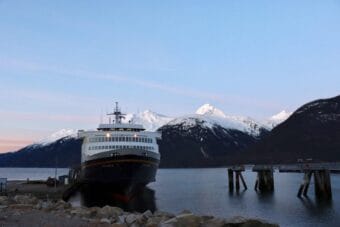
The Columbia, a mainliner in the Alaska Marine Highway System, docked in Skagway in early March, 2025. (Avery Ellfeldt/KHNS)
Travelers can now schedule ferry rides with the Alaska Marine Highway System for May through September. That’s after the summer schedule opened for booking Feb. 12.
The schedule looks a lot like recent years, with six of the state’s nine vessels sailing. There is not enough funding or staffing to run them all, said Shannon McCarthy, spokesperson for the state Department of Transportation.
“Our crew is relatively stable right now, but, you know, it’s not expanding rapidly,” McCarthy said. “Our budget is also a concern this year, so we will only be running one of the mainliners at any given time.”
Only one mainliner – the Columbia – is scheduled to travel weekly through Southeast to Bellingham, Washington. That means a round trip every two weeks for most residents.
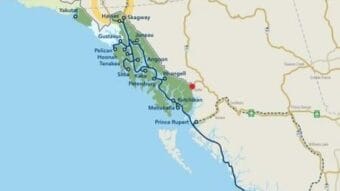
A map of the Alaska Marine Highway System’s routes in Southeast Alaska. (Alaska Dept. of Transportation and Public Facilities)
McCarthy said the Kennicott will be on standby in case the Columbia needs repairs.
“The nice thing is, it is much better to have two vessels — main liners — that are able to be sailed at any point,” she said. “It puts the state in a much better position.”
The Tustumena will sail the southwest region between Homer and the Aleutians. That’s roughly two round trips per week from Homer to Kodiak, and one full Aleutian Chain run per month.
The day boat, Leconte will sail Prince William Sound. And Lynn Canal will be similar to last year, with the Hubbard doing nearly daily runs between Juneau, Haines, and Skagway.
U.S. Senator Lisa Murkowski helped secure hundreds of millions in federal ferry funds over the last five years. But the state is now waiting on a key federal grant for this year. DOT Commissioner Ryan Anderson is scheduled to be in DC this week to talk to the Alaska Delegation about it.
“Because this money is still available — it was written into the law,” McCarthy said. “So, we’re just trying to figure that out, to see if there is some relief there.”
With ongoing funding issues, the state is considering selling the Matanuska, a 63-year-old mainliner that’s been tied up in Ketchikan and used for housing new ferry workers. McCarthy says they’ll still be able to offer housing in the mainliner that’s not currently sailing.
The Alaska Marine Highway System ferry Lituya provides regular service between Metlakatla Indian Community and Ketchikan. (KRBD file photo by Leila Kheiry)
The state ferry Lituya went aground on Tuesday at about 2:50 p.m. near Annette Bay in Southeast Alaska. The small ferry runs a daily shuttle service between Ketchikan and Metlakatla.
The brief grounding happened when the ferry left Annette Bay dock. It lasted less than a minute, according to Shannon McCarthy, a spokesperson with the Alaska Department of Transportation. She says the grounding is “a rare event” in Alaska’s fleet.
But the Lituya was out of service until Friday while inspections were conducted. Officials found damage to the ship’s hull, but not enough to keep it tied up. It is sailing on a limited schedule in daylight hours until it can be dry-docked in early February.
The U.S. Coast Guard led the investigation into the grounding.
Hyder is marked in red, located about 70 miles up the Portland Canal.
The state of Alaska is considering opening up a new ferry terminal in Southeast Alaska, connecting Alaska’s ferries to the Lower 48 road system without going through Canada.
The idea comes as Alaska continues to struggle with the closure of the ferry terminal at Prince Rupert, British Columbia. Now, the state is conducting a $250,000 study to see if a terminal on Alaska’s side of the border would be a good replacement.
For decades, the Alaska Marine Highway System relied on a terminal at Prince Rupert as its southern road connection. The state has leased the terminal from Canada since 2013, but it’s been closed for most of the past six years. There are numerous complications, like infrastructure challenges and disagreements with Canada over border control responsibilities. The dock needs over $20 million in repairs, and Alaska’s aging fleet isn’t certified for international travel anymore.
Jim Clark spoke about it at a regional development meeting in Ketchikan last year. He’s the former chief of staff for Governor Frank Murkowski, who worked on the ferry system for decades.
“If we can put a man on the moon, we ought to be able to solve the problem between here and 90 miles away at Prince Rupert,” Clark said.
Prince Rupert’s closed terminal has been a hot topic in many southern Southeast meetings. Some, like Robert Venables of the Southeast Conference, say they’re not ready to give up on Prince Rupert.
“It’s going to take everyone to lean into this thing,” Venables said. “It is problematic at the highest levels of bureaucracies to try to get back to Prince Rupert. But we’re going to give it our best, best push, and we’re going to keep pushing until it happens.”
The Prince Rupert connection isn’t completely off the table. But Alaska would need a federal waiver to bypass a requirement that steel materials for repairs be American-made. The state has requested this waiver in recent years without success. Canadian officials have opposed the requirement because the terminal is on Canadian soil.
And so, the state’s Department of Transportation has considered Hyder, Alaska — about 90 miles from Ketchikan — as an alternative.
“Fortunately, we have a lot of data for this site,” said Kirk Miller, an engineer with the state’s Department of Transportation, last year. “We’ve done engineering up and down this whole Causeway, the island, I’ve been working on their harbor and all these projects there for years. So, we have data, but not quite enough.”
This October, a new feasibility study began and is expected to be completed in mid-2026. The study is looking at all the details, like where a dock would go, the water depths, dredging, and environmental concerns.
It’s estimated the new terminal would cost about $30 million. It’s located about the same distance to Seattle as Prince Rupert – about 1,000 road miles. Prince Rupert is much larger than Hyder and has more amenities, but Hyder would be under Alaska’s control.
“I just want to really voice my support for Hyder,” said Bob Horchover, speaking in July as a member of the Alaska Marine Highway Operations Board, which makes recommendations to the state.
“In Hyder, we own the land, and most of the work is already done,” he said. “It’s a very adaptable situation. So, for me, there isn’t even a discussion.”
The state approved a 20-year ferry plan this year, based, in part, on a survey of over 2,500 Alaskans. Many respondents said restoring a road connection in Southeast was a priority.
Local governments agree. The Ketchikan Gateway Borough passed a resolution supporting a Hyder terminal if Prince Rupert doesn’t work out. Nearby Metlakatla feels the same. Mayor Albert Smith said that the lack of a Prince Rupert connection has hurt his town’s economy.
“With fishing, the rail system is real close to Rupert, so we could use the ferry to transport fish, and then it’s connected right to the 48s,” Smith said. “It’s a more efficient way than other ways of shipping.”
At least one Alaska lawmaker is on board: Republican Representative Jeremy Bynum of Ketchikan.
“I’m going to be a fierce fighter here on the legislative side and make sure we can get the funding in place that we need,” he said.
Whether Alaska rebuilds the Prince Rupert connection or builds a new terminal at Hyder, officials say either option would take five to eight years to complete the necessary infrastructure work.
The National Weather Service in Juneau shared this map of the expected windstorm. (Courtesy of National Weather Service)
Hurricane-force winds are expected to hit central and southern Southeast Alaska late Thursday into Friday with gusts up to 80 miles per hour. Seas along the outer coast in the Gulf of Alaska could reach 35 feet.
Jeff Garmon is a meteorologist with the National Weather Service in Juneau. He said residents in the region should prepare.
“These winds, making landfall, they will do damage, they will push trees over, and we could see some damage to structures,” Garmon said. “Especially for folks from Sitka South, really ought to be paying very close attention to this.”
The storm is supposed to make landfall along southern Baranof Island and Prince of Wales Island Thursday night and then get stronger early Friday. Garmon said residents in other areas should also stay alert.
“Those winds extend well out to the east, well to the north, well to the south and west of where that center of circulation comes in,” he said. “So, this is not just an immediate coastal threat for wind. Those winds will eventually move inland and the Inside Passage needs to be watching.”
The windstorm is supposed to dissipate over the weekend, and Monday could see a few peeks of sun.
“Sunday, Monday looks a lot more benign, but we’re still going to have some weather around. We may get some breaks on Monday in the weather. So, let’s say the glass is half full for Monday.”
The National Weather Service in Juneau is posting weather updates to their social media accounts, and public radio stations in the region are also giving forecast updates on their airwaves.
Editor’s note: This story has been updated to include the increased winds and seas predicted by the National Weather Service.
An Alaska State Troopers vehicle. (Alaska Department of Public Safety)
A woman accused of stabbing her husband to death in the Southeast Alaska community of Metlakatla was arrested early Saturday morning.
Court records show that Jade Jordan, 33, charged with one count of criminally negligent homicide in the death of Kevin Jordan, 36.
In a charging document against Jordan, police said when they arrived at the Jordans’ residence Saturday, they saw Jade Jordan standing in the driveway with dried blood on her. Her husband was lying face down in the driveway with stab wounds. Medics took him to the local medical clinic, where he was later pronounced dead.
The couple’s two children were home at the time.
Alaska State Troopers from nearby Ketchikan assisted in the investigation Sunday. They said Jordan told them that she and her husband had been drinking and were arguing and pushing each other that night. That’s when troopers said she stabbed him near the left clavicle with a kitchen paring knife.
The public defender’s office in Ketchikan is representing Jordan. Staff did not immediately return a request for comment.
A preliminary hearing is set for Friday in the Ketchikan Courthouse.
The Matanuska waits at Ketchikan’s state ferry terminal on June 20, 2022, the day of the Alaska Marine Highway System’s first voyage to Prince Rupert, B.C. since 2019. (Photo by Eric Stone/KRBD)
Alaska’s oldest ferry is too expensive to repair, according to officials with the Alaska Marine Highway System, who say it would cost millions to fix the 62-year-old Matanuska.
Craig Tornga, the marine director, said seeking that funding would compete with other future projects.
“Funding is tight, and will those dollars stay there in the rural ferry program? You know, with the new administration? We just don’t want to be competing against our new build plan that’s in the long-range plan,” he said.
Tornga was speaking to the Alaska Marine Highway Operations Board during an April 25 meeting. The nine-member board makes recommendations to the state’s Department of Transportation, which controls the ferry system. The board made a formal recommendation that the Matanuska be officially retired from the fleet.
At the bare minimum, the ferry would require at least $45 million to return to service and around $130 million if it’s certified for international travel.
The ferry’s problems surfaced during an overhaul two years ago and then multiplied. Surveys of the ship showed asbestos in the crew quarters and deteriorating steel throughout. The Matanuska would need about 125,000 pounds of steel in repairs.
Operations Board Chair Wanetta Ayers said fixing it would be too challenging.
“It’s regrettable,” she said. “It will be a sad day when the Matanuska is no longer in the fleet.”
The Matanuska is a large ferry, carrying up to 450 passengers and dozens of vehicles. It used to be one of Southeast Alaska’s mainliners sailing the route from Lynn Canal north of Juneau all the way south to Prince Rupert, British Columbia. However, for more than two years, the Matanuska has been used as a hotel ship for ferry workers in Ketchikan. Tornga said it’s very useful right now, but it’s still too expensive to operate long-term, even as a hotel.
Board member Captain Keith Hillard said the Matanuska is a prime example of what happens when you defer maintenance.
“The report you just got here is a poster child of exactly where we do not want to be 10 years from now,” he said, “with the Tazlina, the Hubbard, the Kennicott, Columbia.”
He said it’s also a warning for the six new ferries the system plans to bring on in the next decade or so. He said it’s like the old adage: paying a little now can save a lot later.
Close
Update notification options
Subscribe to notifications
Subscribe
Get notifications about news related to the topics you care about. You can unsubscribe anytime.