Angela Denning is CoastAlaska's regional news director, based in Petersburg. CoastAlaska is our partner in Southeast Alaska. KTOO collaborates with partners across the state to cover important news and to share stories with our audiences.

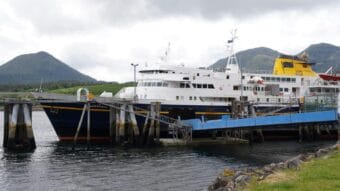
The M/V Columbia travels the Inside Passage in October 2023. (Jack Darrell/KRBD)
A draft of the 20-year plan for Alaska’s state ferry system is open for public comment. Officials with the Alaska Department of Transportation are asking residents to weigh in on the plan that will guide the Alaska Marine Highway System through the year 2045.
In an online public meeting March 19, AMHS Director Craig Tornga said the system is planning for more reliable service – not increasing it much but bringing it back to pre-pandemic levels.
“We’re really looking at trying to increase the port calls at our current communities and to make sure that we have some reliable service on a regular basis that can be planned,” said Tornga. “And then keeping it as efficient as we can from a cost perspective for the state, so it can be maintainable going forward.”
The state plans to build new hybrid ferries to replace the aging fleet, hire more workers to run them, and improve infrastructure at the ports.
That, plus regular maintenance, will cost about $3 billion. The plan to pay for it includes a combination of state and federal money along with increasing profits from ridership.
In creating the plan, the state hired engineering and research groups to crunch data and gather information from dozens of coastal communities. Economist Katie Berry said the ferry plan anticipates the state to appropriate roughly $120 million a year in operating costs. The 20-year plan also calculates that federal funding remains intact.
“The expectation is that the federal funding sources that have pre-dated the Federal Infrastructure Act will be stable over this time period,” Berry said.
The Infrastructure Law brought in about $700 million in federal funds to the ferry system in the last three years. Meanwhile, Gov. Mike Dunleavy has vetoed millions in state ferry funding that the Alaska Legislature approved.
Efforts for a long-range plan began in 2022 after the Legislature created the Alaska Marine Highway Operations Board to help guide the state’s DOT. The nine-member board is made up of state workers and coastal residents with ferry knowledge.
The public comment period on the long-range plan ends March 30. The operations board will consider the plan in April before it heads to the Legislature. According to state law, the plan will be updated every five years.
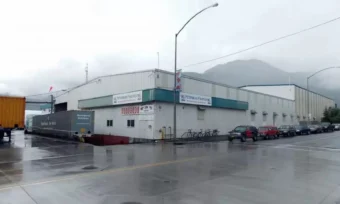
The Petersburg Fisheries seafood processing plant (shown) has changed hands multiple times in recent years, from Icicle to OBI to Silver Bay. (KFSK file photo)
Sitka-based Silver Bay Seafoods is buying out the international seafood processing giant OBI.
Silver Bay announced the acquisition on Tuesday, stating that it is partnering with the Bristol Bay Economic Development Corp.
In a press release, Silver Bay says it plans to manage all OBI facilities and operations, including processing plants in Petersburg, Seward, Kodiak, Larsen Bay, Egegik, Wood River, Cordova, and Naknek, as well as a warehouse and labeling facility in Kent, Wash.
The processing plants produce salmon, whitefish and crab products.
The takeover has long been rumored, with visits by Silver Bay officials to some of the plant sites.
Silver Bay is a fishermen-owned company that operates 13 plants in Alaska and on the West Coast.
OBI was created in 2020 when two large seafood companies merged – Icicle Seafoods and Ocean Beauty Seafoods. Silver Bay is acquiring Icicle’s stakes in OBI. Bristol Bay Economic Development Corporation acquired half the stakes in Ocean Beauty Seafoods back in 2007 before it became OBI.
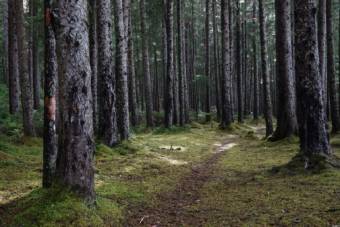
The Tongass National Forest is the largest temperate rainforest in the country. With exceptions, the Clinton-era Roadless Rule restricted road building and industrial activity in around 55% of the national forest. Advocates for its repeal said it posed unnecessary hurdles to development projects, like logging, mining, and renewable energy (Erin McKinstry/KCAW)
The U.S. Forest Service has completed assessment reports on over 20 topics that will inform how the Tongass National Forest will be managed in decades to come.
The last comprehensive plan for the Tongass was done in 1997. There have been a few amendments since then, but the plan is still missing a lot about the way the forest is today.
Barb Miranda is a spokesperson for the U.S. Forest Service.
“Our economic fabric has shifted from timber to tourism,” she said. “The reason why we are doing a plan is not just because we’re required to, but everything’s changed in the last 25 years.”
The assessments are a comprehensive look at what the federal agency knows about the Tongass now and will help inform the new plan. They cover timber, energy and minerals to subsistence and the status and uses of the land. Nearly all assessments mention climate change as a future challenge. For example, the assessment on subsistence cites salmon as an “integral part” of both salt and freshwater ecosystems, but their population can be affected by numerous climate-related factors.
Another new topic in the plan is carbon stocks. It’s the measurement of how much the trees and soil can store carbon dioxide, which is a greenhouse gas that contributes to climate change. Human activities produce a lot, but the 17-million-acre Tongass can store a lot.
“It’s not going to be easy, there’s a lot of competing interests on the Tongass,” Mirada said. “It’s a vast forest and, of course, a lot of people have, you know, really particular interests in a particular area, because it’s our backyard, and we’re so fortunate to have it as our backyard. But you know, we’re looking for those sweet spots where we can all agree.”
Another area that the old plan didn’t detail was Indigenous knowledge. The Forest Service wants the new one to have more input from the Tlingit, Haida and Tsimshian, who have been living in the region for thousands of years. The new assessment says every part of the Tongass is associated with Native Alaskan tribes.
To prepare the new plan, the Forest Service met with a few dozen communities in the region, sharing their latest reports on the status of the Tongass. Altseen Esther Reese is the tribal administrator for Wrangell. She said the Forest Service has done “a wonderful job” with outreach this past year.
“They brought a tribal liaison to town and just really went into depth on what the tribal priorities are for our specific community and the lands of the Shtax’heen Kwaan [Stikine River People] and what we want to see included in that 25-year plan because as the original stewards of this land, it’s very important that our voice be heard,” Reese said.
She said there are many issues the tribe wants to collaborate with the federal government on, including addressing climate change and transboundary mining.
Wrangell suffered a landslide that killed six people in 2023. Reese said they’d like to create an early warning system for landslides and other natural disasters.They’re also concerned about upriver mining across the border in Canada.
“So we talked about transboundary mining issues,” Reese said. “We talked about fisheries restoration. We talked about stream monitoring, we talked about mapping plans. So it’s been a good collaborative relationship.”
The Forest Service expects the overall comprehensive plan revision to take three to five years. This spring, they plan to revisit Southeast communities to hear the details of what the new plan should include.
They want feedback on the new batch of assessments, which can be found on the Forest Service’s website. Comments on those are due Feb. 24.
Kootink Heather Douville of Craig teaches workshop participants how to skin a sea otter at the Elders and Youth Conference in Anchorage, Oct. 15. The workshop was hosted by the Central Council of Tlingit and Haida Indian Tribes of Alaska. (Photo by Angela Denning/CoastAlaska)
For years, the regulations about who could hunt sea otters in Alaska were confusing. Many thought hunters must be at least one-quarter Alaska Native and belong to a coastal tribe. But a recent opinion from the U.S. Fish & Wildlife Service confirms that any coastal tribal member can hunt sea otters, no matter their blood quantum.
The Central Council of Tlingit & Haida Indian Tribes of Alaska, the regional tribe of Southeast, led a workshop on processing sea otters at the Elders and Youth Conference in Anchorage in October.
The Central Council of Tlingit and Haida Indian Tribes of Alaska host a sea otter workshop at the Elders and Youth Conference in Anchorage, Oct. 15. The workshop was led by Kootink Heather Douville, who hunts sea otters out of Craig. (Photo by Angela Denning/CoastAlaska)
At the event, dozens of people gathered around long tables covered in plastic in the Dena’ina Convention Center. Most are youth, but there are elders, too. They’re here to learn how to clean and process sea otter pelts, a fur traditionally prized for its warmth.
“Sea otters have up to a million hairs per square inch,” said Kootink Heather Douville. “They’re the most densely furred mammal on the planet.”
Douville hunts sea otters from her home in Craig on Prince of Wales Island. She sews all kinds of things with the pelts like hats, scarves, purses, and blankets. Several people are waiting at her table, eager to learn how to skin an otter with a knife.
“The word for knife in Lingít is lítaa,” Douville said.
Sea otters are protected under the federal Marine Mammal Protection Act. Who can hunt them has long been questioned by the Central Council of Tlingit and Haida Indian Tribes of Alaska. About a year ago, the Tlingit & Haida asked the federal government for another legal opinion of the law language, focused on one word in the statute.
“There’s actually an ‘or’ in the regulation,” said Gooch Xaay Ralph Wolfe, Tlingit & Haida’s director of Indigenous Stewardship.
He said the law actually allows sea otter hunting by people who live on the coast and are a quarter Native — or are an enrolled member of a coastal tribe.
“There’s people who cannot hunt and haven’t been able to hunt because they don’t have a quarter-blood quantum,” Wolfe said. “And our argument for that is there’s no other people in the world who are justified by blood quantum. There’s horses and dogs, and we are neither.”
Scientists agree that Southeast Alaska’s sea otter population has increased, with the region hosting more than 22,000 of the voracious shellfish eaters. Wolfe said the population has dramatically increased in recent years, in part, due to lack of hunting.
“The otters have been devastating populations of resources that we rely on for so long now; in the management that it’s been under is kind of a management of terror, right?” said Wolfe. “Like there’s fear that’s put out there to go out and hunt these things.”
At the sea otter workshop, attendees were from all over the state.
Ten-year-old Leona Richardson is Inupiaq and took a turn with the knife. Her family is from Ambler in northwest Alaska but she lives in Anchorage.
“I just want to know what it feels like cutting an animal,” Richardson said. “And some Native people that I’m friends with, they said, just touching the animal just makes you feel more Indigenous to your culture, and I really liked it.”
Twelve-year-old Alissa Levit also had a go. She’s from Venetie, north of Fairbanks.
“I think it was pretty fun; it was very interesting,” Levit said. “I’ve done skinning with moose and caribou legs before, but this one was more fun than that.”
Kootink Heather Douville of Craig teaches youth how to salt sea otter skins at the Elders and Youth Conference in Anchorage, Oct. 15. The workshop was hosted by the Central Council of Tlingit and Haida Indian Tribes of Alaska. (Photo by Angela Denning/CoastAlaska)
Although she didn’t go into the implications of the new ruling in her workshop, leader Kootink Heather Douville clearly sees a benefit in sharing sea otter processing with kids from outside her tribe.
“I think youth are sacred, and I’m so glad that so many showed up,” she said.
Douville said youth are the link between past generations and those to come.
“In our culture, and I believe, that our youth are the insurance that we have a bright, healthy future,” Douville said. “And we should invest in our youth, teach them what we know, have them here beside us, watching and working on our traditional foods and materials with us, and it gives them purpose.”
Now, these youth can take their newly learned skills home with them. And maybe one day, they’ll be able to hunt sea otters themselves.
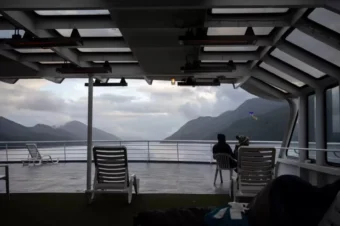
A seating area on the Tazlina ferry on March 9, 2023. (Katie Anastas/KTOO)
The Alaska Marine Highway System’s plan for the next 20 years includes building six new hybrid ferries, increasing port calls, and recruiting Alaskans for jobs. New details of the plan were discussed at a day-long meeting in Anchorage on Oct. 23.
The plan stems from over a year of data crunching through engineering and research groups and gathering information from regional ferry groups and the public. The plan still needs to be approved by Governor Mike Dunleavy and the Alaska Legislature following a month-long public comment period.
“It’s a new day,” said board member Wanneta Ayers. “This is a watershed moment to have this plan. And so, I’m hopeful.”
Hope is what many coastal Alaskans have been hanging on to in recent years as ferry services diminished. Some communities that used to get weekly service, are down to once a month or none in the winter.
“They’ll just be more efficient vessels,” said AMHS Marine Director Craig Tornga. “And they’ll be purposely designed for their intended routes
Tornga said the hybrid fleet will be more reliable because of their backup battery systems.
“All of our boats will be hybrid because we always want redundancy in the system,” he said.
How the new fleet will be paid for isn’t clear. For certain, it won’t be from fares alone and the ferry system will continue to rely on federal grants. Recent federal awards come from the Bipartisan Infrastructure Law, which has designated $700 million to Alaska’s ferry projects.
Still, that only goes so far. Ferries are expensive – a new large one costs over $300 million. Governor Mike Dunleavy has vetoed millions in state funding for the marine highway system nearly every year he’s been in office. ( $5 million in 2019, $13 million in 2020, $8.5 million in 2021, $10 million in 2023, and another $10 million this year.)
The long-range plan is looking at new ways to raise revenue such as adding gift shops in terminals. Board Chair Shirley Marquardt said the plan will hopefully bring more stable revenue.
“This is never going to be a business, because it’s a function of the state,” she said. “However, the more it can operate as a business, the more it can operate with autonomy, the better chance the system has of avoiding so many snares and pitfalls we’ve had in the past that have done nothing, nothing good for the system.”
Who will run the future ferries is another story. Higher-level maritime workers need special certifications. But the system has long suffered from a shortage of those workers. The shortage even led to some vessels being tied up. Tornga said the long-range plan seeks to recruit Alaskans because they turn over less often than workers from out of state.
“We’re going to have a pathway as we start hiring Alaskans working in the high schools, introducing them to the maritime industry, and then having the system in place where they can see their pathway,” Tornga said.
AMHS also wants to digitize its system for scheduling, timesheets, work-rest logs, and crew certifications. Tornga said that’s still all on paper.
“We’ve been, I think I could say, in a 20-year time warp in this category, where we still have paper systems for payroll and everything else,” Tornga said.
The long-range plan includes infrastructure improvement projects for the system’s terminals and docks. They’re considering a new floating dock in Yakutat, a road built across Baranof Island to Sitka, and a new connection to the Lower 48.
One terminal still in question is at Prince Rupert, British Columbia. It closed five years ago, eliminating road access for many Southeast residents.
Ketchikan resident Lynne Dahl told the board to look at a new Alaska-based site.
“I’m suggesting that the board seriously consider building a dock and terminal in Hyder for residents of Southeast Alaska to get that road access through British Columbia, because Hyder is less than two miles from the Canadian border,” Dahl said.
But when will these long-range improvements be felt by communities?
“The ‘when’ question keeps coming up,” Rep. Rebecca Himschoot of Sitka told the board. She represents a few dozen Southeast island communities in the Alaska Legislature. “What can I tell my constituents as a timeline — when can we start to see some things changing?”
Years, in some cases. Bringing new ferries online can take longer than expected. For example, the replacement vessel for the Tustumena keeps getting bumped further back. Now, it might not be done for another five years, according to the new plan.
There are still a few months before the long-range plan is made public. AMHS must get the final draft to the Commissioner of the Department of Transportation Ryan Anderson by the end of the year.
Then there will be a month-long public comment period before it heads to the governor and state Legislature for final approval.
The view from the solarium deck of the M/V Columbia near Klemtu, British Columbia. The M/V Columbia’s route often begins in Bellingham, Washington and travels up the Inside Passage to serve Southeast Alaska communities such as Ketchikan, Wrangell, Petersburg, Juneau, Haines, Sitka, and Skagway. (Jack Darrell/KRBD)
The Alaska Marine Highway System expects to roll out its long-range plan early next year, setting the course for the next 20 years.
It was recently discussed at the annual Southeast Conference. The final details are still being figured out.
“Our vision is for the 2045 long-range plan to chart a path forward to a thriving system,” said Craig Tornga, director of the Alaska Marine Highway System or AMHS. “It really defines our vision, sets our goals and develops our strategies for the future, and it also provides the framework for decision making and our resource allocation and then ensures that the future actions we take align with our vision.”
Tornga addressed the future of the state’s ferry system to hundreds who had gathered in Ketchikan last month for the Southeast Conference, which is a regional nonprofit that advocates for economic development.
AMHS convened a team to plan for the future – it included members of the conference, contractors, and the Alaska Marine Highway Operations Board, which advises the state on the ferry system.
The team held meetings with regional ferry groups across the state. And over the past year, they conducted a system-wide survey that received over 2,600 responses. It was compiled by the Anchorage-based McKinley Research Group led by Katie Berry. She said the number one concern was being able to rely on sailings.
“Reliability, Reliability, Reliability is what the communities and residents most impacted by the marine highway system want,” said Berry.
Like any other boat, it’s normal for things to break down on ferries especially when the state’s fleet is aging. Of the nine AMHS ferries, one is 60 years old, two are 50 years old and one is 47. The Tustumena is 60 years old, the Columbia and Leconte are both 50, and the Aurora is 47. There also aren’t enough replacement ferries in Alaska’s fleet for when things go wrong – meaning vessels get docked and sailings get canceled.
As for what ferries are used for, most of the McKinley survey’s respondents said that they use the ferry service to connect to the Lower 48, to the road system, for medical care, and for shopping. Other forms of transportation are most limited due to the cost and weather. Survey results have been broken down by community and are available online at DOT’s website.
The planning team came up with eight possible long-range service scenarios and paired them down to four. Now, Berry said, they’re figuring out which will be the best one.
“I want to be really clear that a plan like this is not something that you publish, and next year, Craig can snap his fingers and say, ‘Great, here’s your increase in service for all of these communities,’” Berry said. “It really will take this dedicated work in each of these focus areas to move on a 20-year path.”
One certainty in the long-term plan is replacing the 60-year-old Tustumena that serves the Kodiak and Homer areas and the Aleutians. The Tustumena Replacement Vessel, or TRV as it’s called, will have a backup battery system, making it the first hybrid vessel in the fleet. Siemens Energy is the engineering group working on those elements. Engineer Ed Schwarz said hybrid and battery-powered vessels are the future.
“When I first started, seven-eight years ago, working in this kind of systems hybrid business, you would have to go to Scandinavia to actually see one of these vessels running,” he said. “You’d have to go to Norway, you have to go to Germany, or Denmark or something like that to actually get on one of these vessels.”
Now, he said, hybrid ferries are in New York, Texas, and Washington. He said the newer systems require new safety measures – especially because the service life of ferries ends up being a lot longer than planned.
“When you’re integrating new technology, you’re changing the safety requirements on board the vessel,” Schwarz said. “So, training of people is really important, making sure that we’re conforming with the Coast Guard requirements for this new technology.”
Meanwhile, AMHS plans to have its final long-range plan report done by the end of the year and release the plan to the public at the start of next year.
The public still has time to give input – the Alaska Marine Highway Operations Board will take comments at its meeting on Oct. 23.
Tornga said they’ll revisit the plan annually in the years to come to keep it relevant.
Close
Update notification options
Subscribe to notifications
Subscribe
Get notifications about news related to the topics you care about. You can unsubscribe anytime.