Angela Denning, CoastAlaska

Angela Denning is CoastAlaska's regional news director, based in Petersburg. CoastAlaska is our partner in Southeast Alaska. KTOO collaborates with partners across the state to cover important news and to share stories with our audiences.
Feds pinch Southeast Alaska skippers for illegally transporting crab

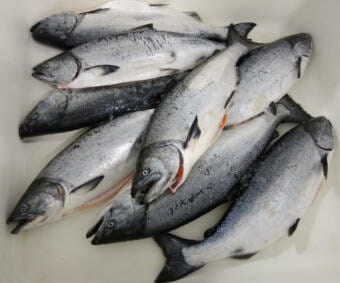
Commercial Tanner crab in Petersburg, Alaska in 2023. (Photo by Andy Wright)

Three men are charged in federal court for illegally transporting Alaska crab to sell in Washington. The U.S. Attorney’s office in Alaska says Kyle Potter and Justin Welch caught crab in Southeast Alaska this spring and moved them to Seattle at the direction of Potter’s dad, Corey.

The federal indictment says Corey Potter owns the two fishing vessels involved, which were run by his son, Kyle, and Welch. One of the boats is the 97-foot Arctic Dawn, which has been docked in Petersburg this spring but is registered to a Kodiak residence.

The two captains participated in the Southeast Tanner and golden king crab fisheries in February and March, harvesting over 7,000 pounds. Corey Potter allegedly directed the two captains to transport the crab to Seattle to fetch a higher price. By the time they arrived, a lot of the king crab was already dead and about 4,000 pounds of Tanner had to be thrown out because of bitter crab syndrome. Bitter crab is a common parasite and is sorted out at Alaska ports when fishermen sell their catch. It causes the crab to taste bad but isn’t harmful.

The federal indictment says Kyle Potter and Welch never recorded their harvests at an Alaskan port, which is required by state law. And they took the undocumented crab through Canadian and Washington waters, which is against a federal law called the Lacey Act.

Corey Potter is being charged in federal court with two counts of unlawfully transporting fish or wildlife. Kyle Potter and Justin Welch are being charged with one count each of the same thing. Their first court appearance is set for May 2 before U.S. Magistrate Judge Matthew M. Scoble in U.S. District Court in Anchorage.

In February, Justin Welch was fined $1,000 in Petersburg court for using king crab pots that don’t allow smaller crabs to escape. He was put on probation for one year. Back in 2016, Corey Potter and his family, including Kyle, were rescued from their 74-foot tender boat “The Ambition” when it sank near False Pass in the Aleutian Islands.

Attorneys for the men are not listed in the federal indictment. The U.S. Attorney’s office would not make further comments.

Offshore magnitude 5.9 earthquake rattles Southeast Alaska

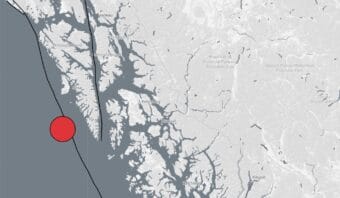
(Alaska Earthquake Center)

A magnitude 5.9 earthquake shook Southeast Alaska late Thursday night. According to the Alaska Earthquake Center the quake happened at 10:46 p.m. and was centered offshore, about 50 miles southwest of Sitka and 140 miles southwest of Juneau, at a depth of about 12 miles.

Houses shook briefly in Sitka, Petersburg and Wrangell. People from Ketchikan to Juneau reported to the USGS that they felt the quake, though most felt it lightly.
The quake happened near the Fairweather-Queen Charlotte Fault, which runs along Southeast Alaska.

There were no immediate reports of any damage.

State identifies those killed or missing in Wrangell landslide

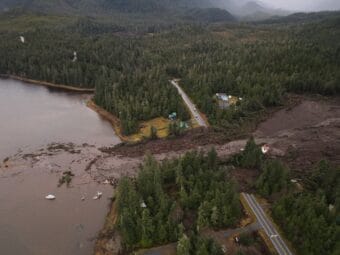
A Nov. 21, 2023 view of the Wrangell landslide looking north. (Courtesy Calib Purviance via State of Alaska)

Update, Nov. 26, 2023:

Searchers recovered the body of of 11-year-old Kara Heller from the landslide debris at 6:35 p.m. on Nov. 25. Two people remain missing:
  • 65-year-old Otto Florschutz
  • 12-year-old Derek Heller

Original story:

The state Department of Public Safety has released the names of those killed in Monday night’s landslide near Wrangell.

The body of 16-year-old Mara Heller was recovered that night.  Her parents, 44-year-old Timothy Heller and 36-year-old Beth Heller, were recovered Tuesday.

Three Wrangell residents remain missing, including two more Heller siblings: 12-year-old Derek Heller and 11-year-old Kara Heller.

Otto Florschutz, 65, is also missing. Florschutz’s wife Christina Florschutz survived the slide and is recovering at the local hospital.

Next of kin have been notified.

Workers with the state Department of Transportation started to clear the landslide debris 11 miles south of town on Thursday. The slide, which is about 450 feet wide, came down across Zimovia Highway before it reached the water, destroying three homes and leaving about 75 without power. Many of the affected homes also lack phone and internet service.

DOT Spokesperson Shannon McCarthy says crews are removing debris from both sides of the slide.

“We’re working to restore the roadway,” she said. “That will allow people on the south side to get power again, and then also allow them to have emergency access.”

Search efforts have been ongoing since Monday night, with drones, helicopters, planes, K-9 teams and sonar.

State officials announced yesterday that teams have searched every place they can without the use of heavy machinery. The strategy is now moving from “an active search to a reactive one.”

“We have to move pretty deliberately because it is still a search and rescue situation,” McCarthy said. “We have a search dog team with their handler standing by so that we can stop should we, you know, need to resume rescue activities.”

McCarthy says the state is collaborating with local contractors to remove mud and downed trees from the roadway with heavy equipment. She says it’s a matter of days – not weeks – before they get a single lane of access across. And if they find evidence that anyone missing is in a specific area, an active search may be restarted.

State brings 55 more charges against Petersburg fishing lodge

Rocky Point Resort is located on the Wrangell Narrows, 11 miles south of Petersburg. It is locally owned and operated by the Payne family. (Photo by Angela Denning/CoastAlaska)

A father and son who are part-owners of a Petersburg fishing lodge were charged Tuesday by the State of Alaska with over 50 violations of state fishing laws.

Walter Payne, 74, and Mikel Payne, 50, are also the operators of Rocky Point Resort, along with other family and staff.

Mikel is facing 42 charges and Walter is facing 13 charges for violations in the June, July, and August of 2020.

All of the charges are misdemeanors involving illegal fishing for halibut. Halibut is strictly regulated with a limited quota for commercial and sports fishermen, and the harvests must be documented. State and federal officers were involved in the investigations. The officers say the two men helped their clients take too many halibut and did not accurately document the halibut that was caught.

Many of the charges stem from guided angler fish halibut. That’s halibut quota sold by commercial fishermen to guided sports fishermen through a federal catch-sharing program.

The charges follow over 50 similar counts charged in May against four fishing guides at the lodge.

Summons for both Paynes were issued on Wednesday. Their arraignment is set for Dec. 4 at the Petersburg Courthouse. Mikel Payne, when reached by phone Thursday, said he hadn’t seen the charges yet. Walter Payne could not be reached.

The state’s prosecuting attorney is Ronald Dupuis with the Office of Special Prosecutions in Anchorage.

Pink salmon are thriving in warmer waters, affecting other species, scientists say

Pink salmon returning to Prince William Sound, Alaska, hatcheries contributed to record-setting abundances in recent years and to impacts on other marine species. (Photo by Preston and Teresa Cole)

A new scientific paper published this fall shows that the pink salmon population is booming in the North Pacific Ocean, and global warming is helping it happen. The new evidence suggests that pinks are not just outcompeting other salmon species but they’re affecting the whole ecosystem — from the microscopic to large marine whales.

“Pink salmon are one of the winners in terms of climate change,” said Greg Ruggerone, a salmon researcher and lead author of the new 40-page paper published Sept. 21 in the scientific journal, Marine Ecology Progress Series.

But for every winner, there is a loser — or in this case, several. The new research shows that the spike in pink salmon in recent decades is affecting the ocean’s fragile food chain. Pink salmon run on an every-other-year cycle. The population in the odd number years is 25% greater than even number years. And when pink numbers are up, other species are down.

“From phytoplankton, zooplankton, forage fishes, all five species of Pacific salmon, and so forth and marine birds. It all points to pink salmon,” Ruggerone said.

Scientists don’t know all the reasons that pink salmon are doing better in warmer waters. But they do know that pinks are better than other salmon species at finding prey and growing from their nutrients. In fact, they’re the fastest-growing salmon, ready to spawn in just two years, three times faster than kings.

Plus, hatcheries are bolstering their population — pumping roughly 5 billion salmon annually into the Pacific Ocean, mostly pink and chum.

The general assumption is that the ocean has sufficient capacity to support them all. But Ruggerone said his new paper proves that’s not the case.

“I think the evidence that we provided leads to the observation that the ocean has a limited carrying capacity to support both wild salmon plus massive numbers of hatchery, chum and pink salmon released into the North Pacific,” he said.

His new research shows that when pink salmon are especially abundant, that’s when other species suffer. Pinks eat a ton of prey from zooplankton to small fish. In turn, this creates:

  • Smaller and fewer other salmon species as well as steelhead trout
  • Less growth in Alaska’s herring population
  • A 33% lower birth rate in humpback whales in Southeast Alaska
  • And higher mortality and lower birth rates in endangered orcas in Puget Sound.

The study also connects the pink salmon cycle to nearly a dozen species of seabirds.

“They laid more eggs on even years, good years than they did on odd years, bad years,” said Alan Springer, co-author of the study and a seabird researcher with the University of Alaska Fairbanks.

Springer said they got data from scientists all over the world who had found biennial patterns.

“A variety of associated reproductive kinds of parameters all varied in lockstep with that even-odd year pattern in pink salmon,” he said.

Things like emaciated and starving shearwater birds on an every-other-year cycle.

The scientists say there is no evidence for other explanations for the biennial patterns that have been recorded.

“You know, sea surface temperature or wind speeds or these atmospheric indexes of, whatever, failed to show any kind of similar patterns,” said Springer. “So that’s kind of what for us is the bottom line.”

The Alaska Department of Fish and Game is skeptical of the paper’s findings. Commissioner Doug Vicent-Lang, in a written response, called the paper a “hypothesis” and said it’s “the subject of an ongoing debate among scientists.”

“The conclusions put forth are stated as more definitive than the strength of the evidence that backs them up,” he wrote.

The researchers agree that it’s a hypothesis — but a strong one. The data shows connections but doesn’t answer all the reasons why.

“More research is certainly needed,” Ruggerone said. “But again, with the synthesis paper, an important part of it is just the consistency in the relationships across all these different taxa.”

Taxa meaning a biological group.

The authors hope that other scientists take their findings and dig deeper into all the ways the large pink salmon population could be affecting other species in the North Pacific. And timing is of the essence as ocean temperatures are expected to rise.

Whale Pass wants carbon credits instead of state timber sale: ‘A clear-cut right in the town’

A tree trunk with orange flagging tape tied around it
A ribbon marks a tree in the Prince of Wales Island town of Whale Pass. (Photo courtesy of Maranda Hamme).

The Southeast island community of Whale Pass is asking the state to pursue carbon credits instead of a nearby timber sale. But the state says it’s going ahead with the logging project.

Whale Pass has long opposed a nearby timber sale on state land. The state approved the project this spring to clear-cut nearly 300 acres of old growth on a steep slope behind the town. Residents say it’s just too close.

“A clear-cut right in the town. You know, directly in the backyard, ” said resident, James Greeley.

Greeley says the project site is just 100 feet away from his property line. He is also a city assembly member and says residents are concerned about many things: more exposure to wind, messing with the watershed used for homes, affecting salmon streams, and the community’s growing tourist industry – the logging traffic and “visual eyesore” on the landscape.

“No one’s really anti-logging out of this whole group,” said Greeley. “We’re just kind of saying, you know, maybe not this timber sale.”

This DNR map depicts the state’s land near Whale Pass in dark green, the timber sale in yellow, and roads for the project in red dashes.

Residents have asked the state to adjust the boundaries but were rejected. Now, the community is asking the state to reconsider the project – and seek carbon-offset credits instead.

This follows a new state law that allows the Department of Natural Resources to develop a system to use the state’s forested land to sell carbon-offset credits. Companies would basically pay the state to keep its trees intact.

Governor Mike Dunleavy, who introduced the bill said it “will generate new revenue for the state.”

Whale Pass’s city assembly approved a resolution supporting carbon-credits. And Greeley sent a letter to the commissioner of the Department of Natural Resources  explaining their stance – that carbon credits would be much more profitable than the timber sale.

“The difference is like, insane, really,” Greeley said.

He says the city worked with the Nature Conservancy of Alaska to come up with the profit estimates. It shows carbon credits, over time, could bring in anywhere from about one to nearly seven million dollars, according to various market prices.

The state’s DNR says they do not have an estimate yet on how much the timber sale at Whale Pass will make. The project went out to auction on, Oct. 14.

Nature Conservancy spokesperson, Amy Miller, says carbon credit projects are a win-win.

“They create the opportunity for a community to preserve a resource that’s important to them, and also earn some money in the process,” she said.

Pink harvest boundary tape hangs from a tree near Whale Pass. (Photo by James Greeley)

The Whale Pass harvest requires four miles of new logging roads to be built, which is expensive. Greeley says the state can make more money without all of that required development.

“They’re telling me that they can’t give me a bigger buffer on my property, because they won’t be able to cover the cost of building the road, to even have the timber sale,” Greeley. “Versus if they don’t even have to do anything, they’re gonna make 10 times as much.”

Despite the ongoing opposition, the state is moving forward with the project. No one from the DNR office would agree to an interview for this story. But in a written statement, Commissioner John Boyle repeated what the department has said before – that the state’s constitution mandates that the department uses natural resources on public lands.

Boyle wrote that while carbon offsets present new opportunities, “Regular timber harvests in our Southeast State Forest ensures DNR meets that mandate.”

The two main logging companies in Southeast — ALCAN in Ketchikan and Viking Lumber on Prince of Wales Island — have been asking the state for timber sales. The state’s DNR blames the federal government for not supplying logging opportunities on federal land because of the Roadless Rule.

In February, Greg Staunton, the state’s area forester, told CoastAlaska that they have to provide old-growth logging near communities in some cases.

“A lot of the land base that we’ve been charged with managing here is in proximity to where communities are,” Staunton said.

But Katie Rooks says seeking a timber sale instead of carbon credits doesn’t make sense. She’s with the Southeast Alaska Conservation Council. She’s seen the numbers and says it doesn’t add up.

“What Whale Pass sent the state definitively proves that this timber is worth more economically to the state itself if left on the stump,” Rooks said.

Rooks says there is also the value of leaving the landscape for the town, which is a subsistence community. Something that Whale Pass residents were asking the state to consider.

“The state’s response to this proposal – it reads angrily,” said Rooks. “It reads as if the state is penalizing its own town, the town of Whale Pass, for the federal government’s lack of supply of timber. And that’s unfortunate.”

Other communities and tribal governments on Prince of Wales island have also voiced opposition to the project. The state says logging could start early next year, depending on the harvester’s needs.

Site notifications
Update notification options
Subscribe to notifications