Angela Denning, CoastAlaska

Angela Denning is CoastAlaska's regional news director, based in Petersburg. CoastAlaska is our partner in Southeast Alaska. KTOO collaborates with partners across the state to cover important news and to share stories with our audiences.
Hatchery chums are returning strong in Southeast Alaska

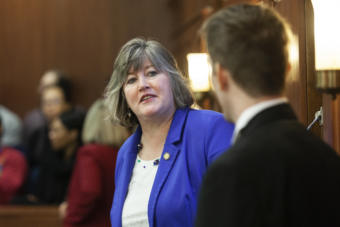
Troll caught chum salmon (Photo courtesy of Matt Lichtenstein)

While chum salmon runs in the western part of the state are crashing, hatchery chum salmon returns in Southeast are strong. The runs this year are promising to either meet or exceed expected numbers.

Southeast’s main hatchery operators are private non-profits that rear and release salmon to supplement commercial fisheries. Hatchery chums in the region are genetically indigenous fish but they’re raised in captivity and the fry are released into the ocean by the tens of millions. A small percent return three to five years later, nearly all of them caught by seiners, gillnetters, and trollers.

Hatchery chums are worth millions of dollars every year. The top season was in 2012, when they were valued at nearly $63 million.

Last year’s haul was worth about $25 million. This year will probably be better.

“This has been a great chum return and it’s still ongoing,” said Susan Doherty, who runs Ketchikan-based Southern Southeast Regional Aquaculture Association.

Every year, SSRAA releases millions of chum fry at sites throughout the southern half of the region. Doherty says they’ve had good returns since the beginning of the season and they’ve been on time. All but one of the sites are coming in over their forecast numbers.

“It’s a very strong run,” Doherty said. “We’re very pleased after the last couple of years, where that has not been the case.”

She says in recent years, SSRAA had to take out additional loans because there weren’t enough fish to cover their operating costs. She says this year, that shouldn’t be a problem.

“This is more like days of old,” she said.

Further north, the Northern Southeast Regional Aquaculture Association operates hatcheries in the central part of the region. There, the chum run showed up late.

“It was the latest, slowest start ever, for all of our sites,” said Scott Wagner, NSRAA’s general manager.

Although the run was late, it’s turning out to be a good one.

“I think we might actually hit forecast,” Wagner said. “But that’s saying something; we haven’t hit forecast in three or four years.”

A sign of success is the Hidden Falls hatchery on Baranof Island. It opened for seine fishing this season after having been closed the last few years.

Like NSRAA, another northern hatcheries operator is also seeing a late return of chums.

“We were very nervous in early July,” said Katie Harms, the executive director of Douglas Island Pink and Chum, Inc. DIPAC releases chum fry every year in the Juneau and Haines area and sees an average return of around three million fish, which are mostly caught by gillnetters.

Harms says this year’s return was late but it’s turning out substantially better than the last two years. 2021 saw a return of just 1.4 million and 2020’s return was less than a million.

“Any movement in the right direction, out of the hole that we were seeing in 2020 and 2021 is a good sign,” Harms said. “It’s nice to see fish around so I think that everybody’s pretty happy.”

There have been many guesses as to why the hatchery chum returns the last few years were down — everything from hot, dry weather to residuals of the warm-water blob in the Gulf of Alaska in 2015-16. However, like indigenous runs, hatchery salmon cannot be tracked in the ocean so there is always lot of mystery surrounding them.

Housing identified as top problem for Southeast Alaska businesses

Co-owner of Sitka Construction Solutions, Derek James, points out the future bathroom in an unfinished “mini home.” (KCAW/Erin McKinstry)
Derek James, co-owner of Sitka Construction Solutions, points out the future bathroom in an unfinished “mini home.” (Photo by Erin McKinstry/KCAW)

Most businesses in Southeast Alaska say a lack of workforce housing is hurting their economic outlook. For some, it’s a major barrier to success. That’s according to a recent survey of 440 businesses in the region.
The annual survey looks at how businesses are faring in the region. And while they’re generally optimistic after two pandemic years, the region still faces economic headwinds. In this year’s survey, 72% of respondents indicated that housing is one of their top problems.

“We’ve just been struggling,” said Jaylene Owen, human resources and payroll director for the Hames Corporation in Sitka, where a region-high 88% of businesses say a lack of workforce housing is weighing on profits. The family-owned company has several stores from groceries to gas and employs 150 people. Many are renters, and that’s a big challenge.

“There’s just no place to rent,” Owen said. “My employees were leaving me and telling me things like, ‘I can’t afford to live here.’”

At the worst point last year, Hames had 40 open jobs it couldn’t fill. Owen says the corporation has tried to sweeten the deal for workers. They’ve given three raises in the last year and half, and they might offer a fourth. They’ve also beefed up the employee discount, taking a hit on their own profits. But they are still stretched thin.

“I have employees that are pulling 120 hours a payroll because they put in 40 hours of overtime on top of their 80 because there are no workers here,” Owen said.

“I don’t see a solution in the short term,” said Scott Wagner, manager of the Northern Southeast Regional Aquaculture Association. It’s a Sitka-based nonprofit that runs salmon hatcheries that supplement stocks in Southeast.

“We have two different housing issues I guess,” he said. “One is, we have this peak need in the summer, which is hard to find short-term housing in the summertime in Sitka. It’s really hard. But then the long term housing issue is employees, especially entry level employees, being able to find affordable housing for the year.”

A bar graph showing responses to a question about whether housing poses a barrier to one's business. Results show large majorities saying it was either a significant or moderate barrier.
This graph is part of annual business climate study commissioned by the SoutheastConference.

NSRAA employs 30 to 55 people depending on the season, and they provide bunk housing for some of them. Wagner says he’s running into the same issue as a lot of regional employers.

“I’m trying to think how many times we’ve had a position come open and offer [it to] somebody, and then they tell us a week later, ‘You know what, I just looked into it, I can’t afford to move there,’” Wagner said.

Housing isn’t the only economic problem affecting the workforce. Affordable childcare is another one. The pandemic and inflation have also been a big hit to economic prospects.

But housing should be a solvable problem, says Robert Venables. He’s the executive director for the regional economic development organization Southeast Conference, which commissioned the survey.

“The housing shortage and challenges is so pervasive that it’s impacting almost every single economic sector,” Venables said. “It doesn’t matter if you’re in tourism or construction, or healthcare, or retail, everybody is struggling, not only for the workers but for a place to put them if you can find them.”

It’s a complicated issue. Most towns in Southeast are on rocky, mountainous islands with limited road systems. There are only so many places to build. The region also relies heavily on summer tourism, which means more housing is needed for seasonal workers — but short-term rentals also get taken up by tourists themselves.

Still, an answer to the housing problem is needed, says Venables.

“That is definitely a challenge that has to be addressed if we’re going to thrive as a region,” he said.

But so far, solutions are elusive.

Forest Service seeks to restore logged area on Admiralty Island

A view of a hilly landscape with clearcut slopes
This aerial photo shows past logging upstream of Kathleen Lake in the Cube Cove area of Admiralty Island in Southeast Alaska. (USFS photo)

The U.S. Forest Service is proposing to restore land on an island in the Tongass National Forest that has been logged in past decades. The federal agency wants this 23,000 acres of developed land to match the wilderness area that surrounds it.

Cube Cove is on the northwest side of Admiralty Island. The area was heavily logged – mostly by clear cut – in the 1980s and 90s by Shee Atiká, Sitka’s Native Corporation. The U.S. Forest Service bought the land for just over $18 million, completing the deal in 2020. Shee Atiká had done some reclamation work after the logging, but the Forest Service wants to finish it up.

“Admiralty Island is a special and unique place, every inch of it anyways,” said Marci Johnson, a wildlife and fisheries biologist with the U.S. Forest Service. “Certainly some unique characteristics with the concentration of brown bears, eagle nests and a lot of intact, old growth forests throughout the island.”

Before the federal purchase, it was the largest privately owned land surrounded by a federal wilderness area. It’s now joined that protected area, known as Kootznoowoo Wilderness, which makes up most of Admiralty Island.

Shee Atiká did not immediately respond to a request for comment.

A map of Admiralty Island showing the project area
The Cube Cove region was logged in the 1980s and 90s by Shee Atiká, Sitka’s Native Corporation. On the map it appears as three fingers on Admiralty Island. The U.S. Forest Service is proposing to restore the land. (USFS)

Because of past logging, there are many remaining roads, bridges and culverts. The Forest Service proposes removing three large steel bridges and culverts that would affect fish passage. They also want to remove or modify some of the road beds that might affect water flow. Johnson says there is a coho salmon run and trout in the streams.

“So eventually this type of infrastructure does fail, and it could become a fish passage issue and water quality issue,” Johnson said.

The federal agency is also proposing to thin some of the new growth trees to allow space for larger ones to grow, especially around waterways.

“When you don’t have these large trees growing around these streams, you don’t have that temperature control and you also don’t have this large wood material that ends up in the creeks is good fish habitat,” Johnson said.

There are two federally managed recreational cabins on site that see visitors. Johnson says that the driving force behind the restoration project is preserving the wild character of the land now and in the future.

“Providing that wilderness experience in say a visitor in 300 years is still important too,” she said.

A few years ago, a pilot project removed a large culvert on a fish bearing stream near a lake in the area. It was run by the Southeast Alaska Watershed Coalition with help from an Angoon youth program.

An exposed culvert with logs lying across it
This culvert in the Cube Cove area of Admiralty Island was removed in a pilot project run by the Southeast Alaska Watershed Coalition with help from an Angoon youth program. (USFS photo)

The village of Angoon is south of Cube Cove on the western shore. Its residents have lived on Admiralty Island for as long as anyone knows and subsistence fish and hunt there.

“We put up fish to last us the winter,” said Tribal Administrator Charles James. “We can our fish; we smoke it,”

James doesn’t know if any residents go near the logged areas now but he says restoring the land makes sense.

“I think it would be nice to have those trees and stuff growing back and get all that stuff out of there,” he said.

The Forest Service plans to do more field work this summer to fine tune the details of the project, such as what tools and equipment will be needed. They are taking public comment on the proposal through July 22. They expect all the work to be completed within five years.

It’s unknown how much the restoration will cost and what partnerships might help fund it. But it’s been identified as a priority project by the Tongass National Forest.

Here is the U.S. Forest Service scoping proposal.

Gov. Dunleavy’s budget vetoes include $5M cut for seafood marketing institute

""
A tendering vessel brings kelp back to Kodiak for processing. Kelp farming is taking off in Kodiak and making waves on the Kenai Peninsula, too, where there are several permitted kelp farmers on Kachemak Bay. (Courtesy of Chris Sannito)

Gov. Mike Dunleavy in June announced budget vetoes that equals $763,329,800. That included a $5 million cut for the Alaska Seafood Marketing Institute.

ASMI is a state agency with a mission to increase the economic value of Alaska seafood and create a demand for it.

Jeff Turner, a spokesperson for the governor, said in an email that ASMI received $7 million in federal COVID relief funds and has “a substantial amount of program revenue available to carry into the next fiscal year.”

That leftover amount is $3.1 million.

ASMI’s funding went through several versions leading up to the veto. The governor had included $28.5 million for the institute in his initial budget proposal last December. The House Finance Committee cut that by $7 million. Then the Senate Finance Committee put back $5 million, which was ultimately approved by the conference committee made up of both bodies. The governor ended up vetoing that amount.

“After a thorough review of the agency’s funding, it was determined that the $5 million wasn’t needed this fiscal year for ASMI to promote and advertise Alaska seafood,” Turner wrote. “All the funds that were vetoed from the FY23 budget will be deposited in the state’s rainy day fund, the Constitutional Budget Reserve account.”

ASMI staff did not want to comment on the funding.

The Alaska Legislature could override the governor’s vetoes, but it would take 45 votes. Since Dunleavy has been in office, there has not been enough support for overrides.

Southeast’s Dungeness crab fishery to close early after slow start

One woman measuring a crab while another takes notes
Vera Goudima and Hilary Wood sample Dungeness Crab for the Alaska Department of Fish and Game in Petersburg. (Photo courtesy of ADFG)

The commercial Dungeness crab fishery in Southeast Alaska will close two weeks early this summer because the start of the season has been so slow.

In recent years, Dungeness crabbing has been pretty great for commercial fishermen in Southeast. The harvests and prices have been above average, sometimes way above. Last year saw the second highest harvest on record and the highest price ever paid. The summer season was worth $13 million.

But this year looks different. The season opened on June 15.  About 200 fishermen registered in the region, and they’ve reported poor fishing.

“I’ve heard generally it’s slow,” said Joe Stratman with the Alaska Department of Fish and Game. “I’ve heard generally it’s slow throughout the region.”

Stratman is the lead biologist for shellfish in the region. He says the estimate for this summer season is just about 2 million pounds, which is less than the 2.25 million pounds that’s needed for a full length season.

It doesn’t come close to recent years.

“The poundage landed in the first week of the fishery was about 433,000 pounds, which was half, actually, not quite half of what was landed in the first week the last summer season, 2021,” Stratman said.

Because of the slow start, it was announced on June 29 that the season would close two weeks early, at the end of July.

The state manages the fishery according to harvests and sampling in-season only. There is no other data gathered throughout the year. Managers look at what the first week of the fishery was like and predict the overall season harvest estimate and decide how long the season should be.

It’s only the third time in the last 20 years that the season has been shortened — 2013 and 2017 saw early closures, too.

Stratman says this downturn could be part of a natural cycle.

“Those kind of fluctuations in harvest are pretty common in Alaska and in other places,” Stratman said. “It’s possible that this year, that the below-average catch rates are due to smaller than usual cohort of crab recruiting into the fishery. But it could be environmental factors as well.”

Those factors could be a couple of things. Fishermen started the season off with huge daily tides, moving 24 feet twice a day. Also, crabs molt or regrow their shells once a year as adults. Stratman says water temperature was colder than normal, which could have affected that.

“That may be playing a part in the molt timing or maybe making crab less active. These are all possibilities,” Stratman said.

Prices have plummeted this year, with processors are paying around $2.79/pound, compared to last year’s $4.21/pound. Still, the current price is around the 10-year average.

The first week’s catch also means that, as of now, the fall season will be cut in half for most of the region, lasting only one month. That could change if the state department determines that a lot of soft-shelled crab contributed to the low numbers.

In the low year of 2013, the department decided soft-shelled crab contributed to the numbers at the start of the summer season and held a full fall season anyway. In 2017, there was a shortened fall season.

Stratman says they’ll make the decision on this fall season in mid-August. That fishery starts Oct. 1.

Blood quantum requirement dropped for Sealaska Corporation enrollment

A Sealaska corporate logo adorns the roof of the Southeast Alaska Native corportation's headquarters in Juneau on May 2, 2018.
A Sealaska corporate logo adorns the roof of the Southeast Alaska Native corporation’s headquarters in Juneau on May 2, 2018. (Photo by Jeremy Hsieh/KTOO)

Sealaska Corporation shareholders have voted to get rid of the blood quantum requirement for enrollment. The vote was tallied at the annual shareholders meeting in Juneau on June 25.

The change means descendants of original shareholders no longer need to prove they have onequarter Native blood to become a shareholder, which was a requirement set by the Alaska Native Claims Settlement Act in 1971.

“It was super exciting to see the vote,” said Angela Michaud.

Michaud is a corporation board member and was the first person to enroll after the vote. Previously, she had just one share gifted from her grandmother. This new enrollment gives her 100 more shares, which will last her lifetime.

But she was most excited for her four children, who can also enroll when they come of age.

“When my kids get 18 they’ll also be a part of this,” Michaud said. “It means that you’re able to be part of it and that you’re Native enough. It didn’t matter that your parents or grandparents married somebody who wasn’t Native. You’re still Native.”

ANCSA limited shares to those enrollees born by 1971. After that, descendants had to be gifted original shares or, starting in 2007, get a different class of shares known as descendant shares. But they still had to prove a quarter Native blood.

Board President Joe Nelson says it’s an issue he’s heard a lot about from shareholders, which he understands personally as well. While he was an original shareholder, his sister, born a few years later, wasn’t. He calls the 1971 ANCSA cut-off date arbitrary and the blood-quantum requirement archaic.

“The blood quantum issue itself continues to literally divide families pretty quickly and within a few generations the pool of eligible descendants would be dwindling,” Nelson said.

Now, people just need to prove they are descended from an original shareholder through a birth certificate.

Sealaska Corporation has 23,000 shareholders who are Lingít, Haida, and Tsimshian people with roots in Southeast Alaska. Many now live elsewhere.

Not all of them agree with the change. 40% of shareholders did not support dropping the blood quantum requirement.

Vikki Mata was one of them. She’s a former Sealaska communications vice president. She says the change devalues shareholders’ dividends and voting power.

“If you add more shareholders, then the voting strength of the current shareholders is diluted,” Mata said.

Mata is an administrator of the social media group, Shareholders of Sealaska, that includes 6,000 members. She says many dissenters agreed that the blood quantum issue needed to be talked about. But she says the vote was rushed — shareholders had 6 weeks to consider the question — and the timing was bad.

“Food prices, gas prices, everything is hitting all at once, so every dollar counts when it comes to making ends meet, especially those on fixed income and our elders,” she said.

Sealaska shareholders are paid dividends twice a year. Original shares pay more than those allocated to descendants. That’s due to a formula sharing natural resource earnings among regional Native corporations.

The corporation predicts that approximately 15,000 shareholders over a 20-year period would be eligible to enroll with the loosened requirements.

Sealaska Corporation is the third of Alaska’s 12 regional Native corporations to eliminate the blood quantum requirement.

Site notifications
Update notification options
Subscribe to notifications