Angela Denning is CoastAlaska's regional news director, based in Petersburg. CoastAlaska is our partner in Southeast Alaska. KTOO collaborates with partners across the state to cover important news and to share stories with our audiences.
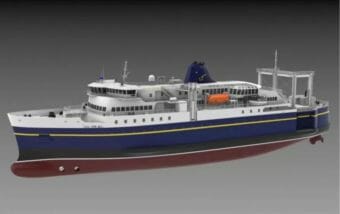
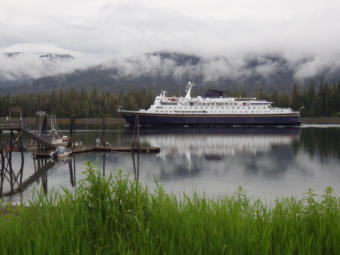
The Alaska Marine Highway System ferry Columbia passes through Wrangell Narrows headed south from Petersburg in Southeast Alaska, June 15. 2012. (Photo by Skip Gray/KTOO)
One of Alaska’s main ferries won’t be running this winter after all. The Columbia was going to be used on the mainline route running through the inner channels of Southeast from Bellingham, Washington and Prince Rupert, B.C. up to Yakutat. But the State Department of Transportation has decided to keep the 418-foot ferry sidelined.
“Columbia has been out of service for a few years and we’ve got it just about ready to bring back into service, but we feel it would be a better backup ship than being the primary vessel out there at this time,” said DOT spokesman Sam Dapcevich.
Now, the state plans to use the Kennicott and Matanuska throughout the winter and use the Columbia as a backup ship. The Kennicott will run through mid-January and the Matanuska from late January on. There will be a two-week gap of no service in between.
This also means the Kennicott won’t run cross-Gulf of Alaska service in the winter months, Dapcevich says, but it should return in May.
Some other changes to the winter ferry schedule include adjusting the Tustumena dates out of Kodiak, filling the two-month gap that was in the draft schedule. It now provides trips to Prince William Sound between Cordova and Valdez, which connects Cordova to the road system during the two-month stretch when the Aurora is in overhaul.
But Dapcevich says it’s not set in stone.
“Those trips are dependent on weather because the Tustumena will have to cross the Gulf of Alaska between Homer and Prince Williams Sound to make those trips,” he said.
The state also decided to go back to flat rates for now, after two years of dynamic pricing. Dapcevich says customers didn’t like the ferry prices changing. And dynamic pricing didn’t work well with short staffing, which is an international problem.
“Right now, with our crewing situation, we’re not always able to live up to our schedule,” Dapcevich said. “And when that happens we end up having to cancel people’s plans, potentially they have to make last minute changes. And because of dynamic pricing, they may end up paying more and we don’t feel that’s right.”
Dapcevich says there is a recruitment program in place that should be filling vacant positions soon.
The Matanuska docked on Friday, February 7, 2020 at the Auke Bay ferry terminal in Juneau, Alaska. The ship is headed to Ketchikan for repairs. (Photo by Rashah McChesney/KTOO)
The Alaska Department of Transportation and Public Facilities announced Sept. 9 that it would stop dynamic pricing this winter. Dynamic pricing means that as seats fill up, they get more expensive. It’s a common practice with airlines — the closer you book to departure, the higher the price. The pricing formula has been in place in the Alaska Marine Highway Service for the last two years.
But DOT says the ferry service will move back to flat rates this winter.
DOT was unavailable for comment on Monday.
Pausing dynamic pricing is part of a new program called “Reimagining AMHS Program,” which the state announced in a press release.
The state says the program will bring more transparency, flat rates, and increased communication about the marine highway service.
The program looks to improve service over time in three phases. The first phase, “stabilization,” looks to provide reliable service by increasing crew and vessel maintenance. The phase will include weekly updates to the public.
The second phase, “recovery,” looks to add services while monitoring reliability.
The third phase, “full steam ahead,” expects services to be restored and growth to happen.
Last year, the Alaska Legislature created a statewide ferry advisory board. The Alaska Marine Highway Operations Board has been meeting every two weeks since February.
Wanetta Ayers is the vice chair of the board. She says the board wasn’t aware of the state’s new program but she supports it.
“I welcome this because I think it is a move towards a more customer-centric service,” Ayers said, “that will take into account the needs of customers as well as well as how decisions and service interruptions and other unanticipated things may fall on the customer.”
She says the board needs to identify exactly where they want the Alaska Marine Highway Service to be in the years to come and will continue advising the state’s DOT.
As for going to flat rate ferry rates this winter, Ayers supports it.
“I think dynamic pricing has not been a very effective tool for the system on a year round basis,” she said. “I think pausing dynamic pricing is a good thing. And I think an overall pricing strategy needs to be revisited.”
The Tulsequah Chief Mine is on the banks of its namesake river, which flows into the Taku River, which enters an ocean inlet about 25 miles northeast of Juneau. (Photo by Joe Hitselberger/ADF&G)
A two-year process that was stalling cleanup efforts at a mine upstream of Southeast Alaska has come to a close, which could speed up remediation of the Tulsequah Chief Mine.
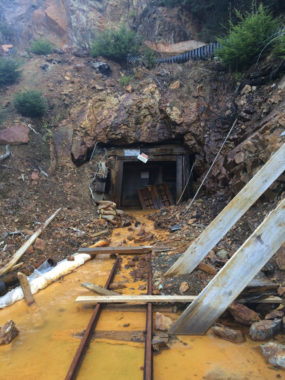
The Tulsequah Chief mine is in Canada, about 20 miles from the Alaska border near Juneau. It extracted zinc, copper and lead in the 1950s. And ever since, rusty, acidic runoff from the mine’s tunnels and leftover waste rock has been flowing into a tributary of the Taku River, a major salmon-producing waterway.
“For 65 years it’s been leaking acid mine drainage pretty much unabated into the watershed,” said Guy Archibald, executive director of the Southeast Alaska Indigenous Transboundary Commission. The group represents 15 tribes in the region concerned with toxic waste from Canada’s mines.
The British Columbia government has said it’s committed to cleanup efforts. But in recent years, the process has been held up in court. In 2016, a company that had hoped to get the mine going again, Chieftain Metals, filed for bankruptcy and was put into receivership. That means a third-party firm — West Face Capital — was managing the mine’s assets, hoping to recoup nearly $50 million of investments in the project.
Eventually, a Canadian court gave the investors a two-year deadline to ask for an extension on the receivership. That ended August 11.
Acidic runoff from the Tulsequah Chief Mine mine’s tunnels and leftover waste rock has been flowing into a tributary of the Taku River for years. This image was taken in 2017. (Photo courtesy of Rivers Without Borders)
Archibald says it’s a big step towards getting the mine cleaned up.
“This is a long time coming and I’m glad to see it,” he said.
West Face Capital did not return a request for comment.
Though British Columbia’s mining ministry released a 113-page remediation plan and says it’s performed some interim reclamation work the last three summers, environmental groups say the end of receivership will allow the provincial government to take responsibility for the site and start a more substantial cleanup process.
“I think B.C. sees this as a black mark and they definitely want to get rid of it and prove they can do the job right here,” said Chris Zimmer, with Rivers Without Borders, an environmental watchdog group in Juneau that follows transboundary mining activity. He says British Columbia can now move forward with cleanup.
“The B.C. government for a couple years has been saying that this bankruptcy has hindered them, has tied their hands, has limited their abilities to actually get in there and physically cleanup up the mine and shut it down,” Zimmer said.
Zimmer says there is a long road ahead for remediation.
“It’s going to take a bit of time, certainly, to get the clean up together and deal with the engineering challenges,” he said. “So, we’re hoping to see B.C. right away firming up its plans, creating budgets, and hopefully becoming a bit more transparent with us here in Alaska so we know what’s going on.”
The Ministry of Mines did not respond to requests for comment.
Although Tulsequah Chief Mine is small compared to other transboundary mines in Southeast — and many that are proposed for development — Archibald says all eyes are on it.
“It’s kind of the poster child for bad Canadian mining practices,” he said.
He says it could set a precedent for how the British Columbia government deals with the industry.
The Alaska Marine Highway System ferry Columbia passes through Wrangell Narrows headed south from Petersburg in Southeast Alaska, June 15. 2012. (Photo by Skip Gray/KTOO)
This winter’s Alaska Marine Highway schedule has ferries running for more weeks than last year but still leaves some communities with large service gaps. The draft schedule for October through April, released by the state Department of Transportation on Aug. 16, is up for comment through Aug. 26.
The Southwest region will see more sailings than last year but no service in January and February. Prince William Sound will be without service in October and November but will see calls from the Aurora between December and April.
Small communities in the northern panhandle, including Hoonah, Gustavus, Tenakee and Pelican may also spend most of January and February without ferry service. The Tazlina is scheduled to take over those routes for the first two months of the year while the LeConte is out for maintenance, but that’s only if the Transportation Department has enough crew available to run the vessel.
But they’re hopeful, says ferry system spokesman Sam Dapcevich.
“It says crew pending on our operating plan, but you know, we have a very heavy recruitment effort going on,” he said. “We’re going to shuffle things around so that we can run the Tazlina in place of the LeConte during that two month time period where Leconte is in overhaul.”
Two of the state’s largest ferries will be out of service for most of the winter for overhauls.
The Matanuska, serving the mainline route through Southeast, won’t run at all. But the 418-foot flagship Columbia will be back online in November for the first time since it was sidelined to save money in 2019. That means there won’t be a gap in mainline service for the region, which hasn’t been the case the last three years.
“The Columbia is going to be ready to go in November, and it will run the entire winter schedule all the way through April 30,” said Dapcevich.
This image shows the Alaska Marine Highway routes through Southeast. (AK DOT)
The Kennicott is slated to fill in for the Matanuska in October, running from the Lower 48 to Prince Rupert through Southeast. Then it’ll go in for service for nearly six months.
“It goes into overhaul Nov. 1, and it doesn’t come back out until April 20,” Dapcevich said. “So that’s longer than usual for not having cross-Gulf service.”
There are no port calls to Prince Rupert after October on the draft schedule.
Another of the fleet’s largest vessels, the Tustumena, will sail in the Southwest region except during a two-month overhaul in January and February.
The newer ferry Hubbard will be out all winter getting crew quarters built. It was previously scheduled to start service this year, but officials say the project is being held up by supply chain issues.
The only ferry expected to run the full seven-month winter season is the Lituya. The smallest ferry in the fleet, it runs between Ketchikan and Metlakatla.
Rep. Sara Hannan, D-Juneau, talks to a page in January, 2020. Hannan got over 80% of the vote in her primary on Aug. 16, 2022. (Photo by Rashah McChesney/KTOO)
Across Alaska, just one candidate — Kieran Brown of Fairbanks — was not expected to advance after Tuesday’s primary elections for the Legislature. The new system allows the top four primary candidates to move on, and nearly all races had four or fewer candidates.
That means all of Southeast Alaska’s primary candidates will advance to the ranked choice general election. But the primary results do give an early preview of how voters are feeling about the candidates.
In Juneau, Democratic Rep. Sara Hannan took 83% of the vote in the House District 4 primary compared to 17% for challenger Darrell Harmon. Rep. Andi Story and Sen. Jesse Kiehl, both Democrats, are running unopposed.
Sitka Republican Sen. Bert Stedman has a big lead over Petersburg Republican Mike Sheldon in the primary race for Senate Seat A with just a few precincts left to be counted. Stedman received nearly 68% of the votes to Sheldon’s 32%.
In the House District 1 race, which includes Ketchikan and Wrangell, incumbent Independent Dan Ortiz took 51% of the vote. Republican Jeremy Bynum had 45%, and non-partisan Shevaun Meggitt got just 4% after ending her campaign and endorsing Bynum.
For House District 2, which includes Petersburg, Sitka and most of Prince of Wales Island, independent Rebecca Himschootof Sitka got 54% of the vote, with Republican Kenny Karl Skaflestadbringing in 46%.
The House District 2 seat was long held by Sitka Democrat Jonathan Kreiss-Tomkins, who announced earlier this year he wouldn’t seek a sixth term.
The primary election results won’t be certified until early next month.
This post has been updated to include that Rep. Andi Story, D-Juneau, is also running unopposed.
Mark Hofstad sits on his boat, F/V Norsemen, in the Petersburg harbor. (Photo courtesy of Mark Hofstad, cropped by CoastAlaska)
Reality TV stars from the long-running Discovery series “Alaskan Bush People” made a brief stop in the Southeast community of Petersburg earlier this month.
The famous Brown family tried to buy land after living in Washington the last three years. But locals, including Mark Hofstad, did not welcome them as neighbors.
Hofstad said he first noticed a boat belonging to the “Alaskan Bush People” at Petersburg’s South Harbor in early July. The harbor is home to many large commercial fishing boats, including Hofstad’s boat called the Norseman.
Hofstad said when he saw staff from the “Alaskan Bush People” walking around, he started bugging the harbor master to move them someplace else.
“Just cause I don’t want to look at ‘em,” Hofstad said.
On one of Hofstad’s visits to the harbor office, a Brown family member also showed up.
“That one kid, I think they call him Gabe, introduced himself and stuck out his hand,” Hofstad said. “I looked at him, ‘I aint’ shaking your hand.’ He just looked at me and walked away.”
“I mean, look what the show is,” he said. “It’s non-residents portraying themselves as Alaskans that basically make us all look like a bunch of frickin’ morons.”
Emily Fehrenbacher knows not all Alaskans like the series. She herself had been an avid follower. For five years, she wrote a column for the Anchorage Daily News about reality TV in the state. She said “Alaskan Bush People” draws a following down south. It had five million viewers in 2015, according to Discovery.
“Really, it’s like a lot of Alaska reality TV shows, where they’re playing up the remoteness and kind of building drama around the typical Alaskan lifestyle,” Fehrenbacher said.
But the Browns push it a little bit further. Further from… reality. And Fehrenbacher understands why it rubs some Alaskans the wrong way.
“It just seemed like a lot of it was pretty staged for television,” she said.
The show’s production company, Park Slope Productions, nor the Discovery Channel responded to requests for comment for this story.
Disgust for the Browns and their show is a popular sentiment among Petersburg residents. Local realtor George Doyle was contacted by the production company but says he didn’t engage.
“We were approached but I didn’t respond to them because again we weren’t interested in having that type of activity,” said Doyle.
Doyle said “again” because this wasn’t the first time. About a decade ago, the show was looking for a plot across Frederick Sound on the mainland in a place called Point Agassiz.
“The folks at Agassiz weren’t necessarily excited in seeing the camera crew and everybody move in there,” Doyle said.
The Brown family has lived in different communities in Alaska over the years and has burned some bridges along the way. About a decade ago they were at Mosquito Lake 30 miles north of Haines on the highway.
Jim Stanford was a neighbor and said “they seemed like conmen.”
“They certainly weren’t living off the land, building their own cabin and stuff like that,” Stanford said. “You could tell they were more users than givers, not really the kind of people that you would want as a direct neighbor.”
He said he doesn’t wish the Brown family ill will but they didn’t fit in with his community where folks helped each other.
“Depending on the neighbors for support and everybody pitching in, the Browns weren’t cut of that cloth,” he said.
Hofstad, Doyle and others in Petersburg say they’re not against all Alaska reality TV. For example, the National Geographic show “Port Protection,” which is based out of Prince of Wales Island is a local favorite. Hofstad said it’s not fake.
“You know, I know some of the people in the show and it depicts… life,” he said.
The “Alaskan Bush People” show was unsuccessful in buying land near Petersburg. Another local realtor did show them a piece of property near town but they didn’t want it.
So, when their boat left Petersburg’s harbor July 15, Hofstad was relieved.
“Keep going, man. Just keep going,” Hofstad said.
Where they’re headed and whether or not there will be a 14th season in Alaska is unknown.
Close
Update notification options
Subscribe to notifications
Subscribe
Get notifications about news related to the topics you care about. You can unsubscribe anytime.