Angela Denning, CoastAlaska

Angela Denning is CoastAlaska's regional news director, based in Petersburg. CoastAlaska is our partner in Southeast Alaska. KTOO collaborates with partners across the state to cover important news and to share stories with our audiences.

Alaska Marine Highway sees leadership changes

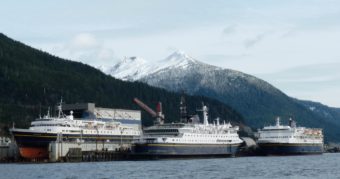
Three ferries dock at the Ketchikan Shipyard in 2012. Four ships are slated to be tied up for the 2016 season. (Photo by Ed Schoenfeld/CoastAlaska News)
Three ferries dock at the Ketchikan Shipyard in 2012. (Photo by Ed Schoenfeld/CoastAlaska News)

The Alaska Department of Transportation is changing the leadership running the Alaska Marine Highway System. The manager of the ferry system is leaving after almost 20 years, and there’s a new deputy commissioner.
The Alaska Marine Highway Operations Board addressed the staffing changes at a meeting, Jan. 6.

“The system is in a really vulnerable place, right now,” said Shirley Marquardt, board president. In terms of talking about planning for succession and transition, how does that work?”

DOT Commissioner Ryan Anderson attended the meeting.

“I really recognize there’s a lot of change going on right now. And that’s a serious thing,” Anderson said.

The marine highway system’s general manager of nearly 20 years, Capt. John Falvey, announced his retirement. His last day will be Jan. 17.

Capt. John Falvey, General Manager of the Alaska Marine Highway System (middle) sitting with Doug Ward of the Ketchikan shipyard (left) and Troy Tacker of the shipyard (right) in 2014. (KRBD photo)

Anderson said they will be “aggressively” looking for Falvey’s replacement over the next month through a national search. They did not have a job description ready at the time of the board meeting.

“It’s something we have to put the energy into,” said Anderson. “Make sure we’re all working together that we have good lines of communication and we’re all just solid on we have a purpose here. And that’s, you know, keeping the system moving, keeping Alaska moving.”

The state named Capt. Tony Karvelas interim manager – he’s currently the ferry system’s operations manager.

Retiring Capt. Falvey served through five administrations. He was appointed as AMHS general manager in 2004 by Gov. Frank Murkowski. Before that, Falvey worked for 27 years in commercial shipbuilding, and in ocean-class vessel and fast ferry operations, including crew management. He graduated from the Maine Maritime Academy in 1976.

No one from the state would comment on Falvey ’s tenure when asked several times by CoastAlaska. But Anderson spoke about him briefly at the board meeting.

“I want to thank Captain Falvey for his service,” Anderson said. “He is a vast, you know, knowledgeable man that I respect.”

Board Vice President Wanetta Ayers said Falvey would be remembered.

“He really has done a yeoman’s job for Alaska and for Alaskans, and for the Alaska Marine Highway,” Ayers said.

“He worked through quite a bit of financial and political chaos, which is normal, everyone has to do it, but he did that for 20 years,” Marquardt said. “Your time at AMHS is greatly appreciated by thousands and thousands of Alaskans.”

Falvey did not return emails and calls requesting comment. But at the ferry board meeting, he thanked all of the marine highway workers.

“It takes a team to keep this operation moving. It is very, very complex,” he said. “And it’s something that the person in this office – they can’t do that by themselves. And that is the ships’ crews, folks here in KCO [Ketchikan Central Office], the folks out in the terminals, it takes a real team pulling together to make it all go.”

The Department of Transportation, which oversees the marine highway, also has a new deputy commissioner. Rob Carpenter resigned at the end of the year and was replaced by Katherine Keith, January 5. She previously served as the liaison for the ferry board.

Keith told the board she’s optimistic about the future.

“I think we’re at a time where we just want to look forward,” Keith said. “And the situation that we’re in is dynamic and things are happening in real time pretty quickly.”

Robert Venables, director of the regional civic and business organization Southeast Conference, has worked with Falvey for 18 years. He said in an email, “he will be a very tough act to follow”.

Board member Ayers said she hopes Falvey would share suggestions on managing the marine highway system and the specific skills needed for his replacement before he leaves for good, Jan. 17.

An 8-bridge fish passage project near Gustavus has been finished

""
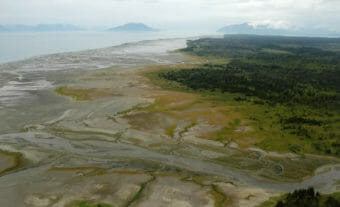
With beginnings in Glacier Bay National Park and an end in Icy Strait, the Good River is like many Southeast Alaska rivers — a nursery for fish, cold, and relatively short (for Alaska standards). According to the U.S. Fish and Wildlife Service, it’s groundwater fed and makes a lazy traverse across a relatively recent outwash plane. (Photo courtesy of USFWS)

An eight-bridge project over the Good River near Gustavus has finally drawn to a close. It’s part of a national fish passage program that received $40 million in last year’s federal infrastructure law. The project in Southeast Alaska should help juvenile fish maneuver through the waterway.
The land around Gustavus doesn’t stay still. It’s constantly rising from what’s known as isostatic rebound. Basically, as a nearby glacier retreats, the pressure on the land lessens and it rises. The land in Gustavus is rising faster than anywhere else in the world – about an inch a year.

“And it’s been doing that for 200 and whatever years,” said Mike Halbert, longtime fishing guide in Gustavus.

Since the mid-1700s, to be more precise.

“I’ve been fishing there for 30 years,” Halbert said. “So yeah, I’ve seen three, four or five feet of difference, and you can see it on charts since it was charted in the 60s.”

The rising land is one reason the federal government spent the last decade fixing eight bridges over the Good River and its tributaries. The funding comes from the U.S. Fish and Wildlife Service’s National Fish Passage Program which received $3.5 million for Alaska projects in the bipartisan federal infrastructure law.

The Good River runs from Glacier Bay National Park to Icy Strait. In recent decades, while the land continued to rise, so did the metal culverts. But the streams kept cutting into the land, causing the culverts to overhang the water. That’s a problem when they’re home to salmon, dolly varden, and cutthroat trout.

“If the water where it came out of the culvert, if it was creating a waterfall, [USFWS] considered a hindrance for the young coho to move upstream, they’d be reluctant to jump like the adults,” Halbert said.

Two culverts, both hanging a little above the streams that run out of them.
A culvert on a tributary to the Good River has become “perched” over time (1999 left; 2021 right). According to the U.S. Fish and Wildlife Service, fish have a hard time navigating the resultant low flow through the culvert and small/juvenile fish have difficulty jumping into the now-hanging pipe. (Photo courtesy of USFWS)

Halbert says the Good River doesn’t have a lot of fish in it. It isn’t nearly as big as the nearby Salmon River where most locals and tourists go. The Good River is small and runs along roads, past town, and through a mud flat.

Another local fly-fishing guide, Natalie Vax, says mostly kids fish the Good River for salmon and trout.

“Kids catching cutthroats and dollies and pinks and silvers on that little culvert side ditch thing on the side of the main road, but it is not a ton,” she said. “There are a few spots where sometimes fish do gather.”

The U.S. Fish and Wildlife Service hopes the new bridges will allow more fish to spawn in the smaller stream.

U.S. Assistant Secretary of the Interior, Shannon Estenoz, oversees fish, wildlife and parks.

“These projects are all about kind of what the name suggests — removing barriers to flow, removing barriers to fish passage, often updating, you know, either outdated or malfunctioning infrastructure that are impeding fish passage,” said Estenoz.

Estenoz is a civil engineer. She says when engineers are designing infrastructure like culverts and bridges, they can’t always predict what will happen decades later. Sometimes the material fails or outlives its useful life.

But the fish passage projects aren’t just about saving fish, she says.

“They often fix multiple problems at once,” Estenoz said. “I’m finding as I’m traveling across the country, that we might be helping fish, but we’re often also improving flood protection — we’re making it safer for folks to paddle the river to, you know, fish on the river. And apparently, this has been an ancillary benefit for the Good River as well.”

Fishing guide Mike Halbert doesn’t see the local bridges making much difference for his industry but he says it’s a huge improvement for traffic across the waterways. And he says it’s also provided jobs for road workers building the bridges.

“Obviously, the people that are working on the construction, it was a big benefit,” Halbert said.

The infrastructure law included $600,000 for the Good River’s final bridge. The entire fish passage project totaled $1.76 million.

Other fish passage projects in Alaska that received federal infrastructure funding included $1.3 million for the Little Tonsina River in the Valdez-Cordova Borough and $1.6 million for the Tyonek Creek on the Kenai Peninsula.

Tribal groups call for halt to logging at ‘sacred and culturally historic’ site near Yakutat

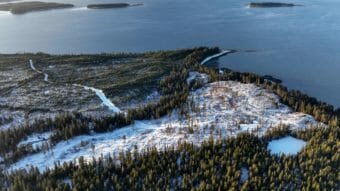
An aerial photo of a snowy, clear-cut area close to the coast.
Clear-cut logging site at Humpback Creek near Yakutat. (Courtesy of Defend Yakutat)

Controversy over a logging project near Yakutat in Southeast Alaska has intensified. The local tribe, an archaeologist and others say a site that’s being logged is home to centuries-old ruins that could provide clues into the history of Southeast Alaska’s Indigenous people.

Yakutat elder Victoria Demmert says her ancestors — for hundreds of years — harvested the abundant salmon that returned to Humpback Creek every summer.

“I don’t know how you could live here, grow up here and not know,” said Demmert, a council member for the Yakutat Tlingit Tribe.

Just this past August, the tribe passed a resolution calling the site sacred and culturally historic. Elders like Demmert and anthropologists say the tribe purchased the site from previous inhabitants hundreds of years ago. Tom Thornton with the University of Alaska Southeast visited the site in August and found “there is evidence of house remains and culturally modified trees and other landscape features.”

So Demmert says she was taken aback when she learned that the local Native village corporation, Yak-tat Kwaan Inc., had begun clear-cutting the forests around Humpback Creek. She says the company never publicly announced that its subsidiary, Yak Timber, planned to log the area.

“We had to find out by seeing what was going on,” Demmert said. “And then seeing some drone footage of it in addition to pictures that were being taken.”

An aerial photo of the clear-cut area annotated to show the locations of boulders and rock walls.
This is an aerial view of the logging near Humpback Creek. The yellow circles indicated boulders found at the site. The black lines represent rock walls. (Courtesy of Defend Yakutat)

In a Dec. 8 letter to Yak-tat Kwaan, the tribe called on the company to stop logging the area. The tribe wants time to investigate the site.

“We know we had a village there,” Demmert said. “And we know there are historical sites there, and we want Yak-Tat Kwaan to stop and let archaeologists get in there before everything’s destroyed.”

Now there’s physical evidence of the history, says Sealaska Heritage Institute. That’s the regional Native nonprofit organization dedicated to preserving the history and culture of Indigenous people in Southeast.

A Yak Timber equipment operator found what could be several house pits and a series of parallel stone walls at the site being logged. That was at the beginning of December.

The institute announced the findings in a joint news release with the Yakutat Tlingit Tribe and Sealaska Corp. on Dec. 15. The groups called on Yak Timber to stop logging the area until it can be investigated.

“There are cultural and spiritual dimensions of it, that’s really important to us,” said Rosita Worl, the institute’s president and a Ph.D. anthropologist. “The rock wall…I’m just so curious about what, what is that? What kind of fishing occurred with that rock wall?”

A close-up photo of the tread from a piece of heavy machinery next to an old, overgrown rock wall.
Stone wall found near Humpback Creek. (Photo courtesy of Defend Yakutat)

Sealaska Heritage is working with archaeologist Aron Crowell with the Smithsonian Institute’s Arctic Studies Center. Crowell believes the Yakutat site could date back 700 years.

In the joint news release, he says “A remarkable set of cultural features related to salmon harvesting appears to be preserved. . . cultural layers at the site could provide a unique record of traditional lifeways and subsistence practices extending back 700 years. Although part of the site has been clearcut, the cultural features do not appear to have been substantially damaged, and their future preservation should be a high priority.”

Even before Humpback Creek, logging was controversial among Yak-tat Kwaan’s shareholders — so much so that Yak Timber announced on Oct. 4 that it would dissolve and sell off its assets.

But later in the fall, Yak Timber reversed course and started logging near Humpback Creek.

“Yak Timber is harvesting. We’ve been harvesting,” said Marvin Adams, CEO of Yak Timber, on December 13, two days before Sealaska Heritage announced their findings. He says the site has never been documented as historic and was approved by the Alaska Division of Forestry after they inspected it in 1975. A 2007 letter (page 12) from Sealaska Corp. discussing historic sites did not identify the area either.

After the findings were announced, Adams said he had yet to be formally notified of Humpback Creek’s cultural significance. He said the company would follow all relevant laws and regulations, but declined to say whether Yak Timber would continue logging the area.

“Obviously, we’re not going to go over some historical site to destroy it,” Adams said. “I think we all respect that. But right now, I have not been able to get any documentation from the tribe or anybody else.”

He points to the work of anthropologist Frederica de Laguna. She researched and wrote extensively about the Yakutat Tlingit Tribe from notes she gathered in the 40s and 50s.

Adams says she never mentioned Humpback Creek as a sacred site.

“If there was actually a historical site and a settlement there, I can assure you that that would have been listed and the specific house and the clan house that was supposed to be there would have been listed,” he said. “But it never was.”

But Demmert sees it differently. Though de Laguna’s work doesn’t go into detail, she says the anthropologist’s notes do mention Humpback Creek as an important salmon-harvesting site. It’s where her people Kwaashk’iḵwáan got their name, which means “people of the Humpback Creek.”

“It’s part of our history, it’s part of who we are,” Demmert said. “And to see it desecrated. . . it just hurts spiritually and physically. It just breaks our heart and brings tears.”

Worl, the Sealaska Heritage president, says the tribal groups are working with Crowell and the state to see how they can investigate the site further.

Alaska marine highway board supports bigger budget for 2024

The Matanuska at the Auke Bay ferry terminal in Juneau, Alaska in February, 2020. (Photo by Rashah McChesney/KTOO)

The statewide advisory board to the Alaska Marine Highway System voted Dec. 2 to spend more in 2024. But labor shortages could hamstring efforts to improve service after years of cost-cutting.

The nearly $160 million approved by the Alaska Marine Highway Operations Board would allow all but one of the state’s nine ferries to sail during the busy summer tourism season. One vessel would be kept idle to fill in during maintenance layups.

The board’s unanimous vote comes ahead of the anticipated release of the governor’s proposed budget. That will be a starting point for lawmakers, who will consider the state’s overall spending plan when the state Legislature convenes next month.

“We’re talking an entire calendar year away before this will even be in effect,” said Rob Carpenter, Deputy Commissioner of the state’s Department of Transportation. He works closely with the ferry board.

The board’s 2024 budget recommendation is more costly than the last five years. Those budgets ranged from roughly $95 million to $142 million.

The operations board was created by the Legislature last year to make recommendations to the marine highway system. The board has talked extensively over the past several months about the need for improvements.

“There are a lot of people, a lot of communities who feel that promises have been made with regard to the Alaska Marine Highway System, that they believe those promises have been broken,” said board member, Wanetta Ayers, at a meeting in September.

Captain Keith Hillard said at the same meeting, “The ferry system is in a very dire, dire straights right now at the moment.”

At the board’s meeting this month, they considered four operating plans for 2024, each with a different price tag and number of ferries. Plan A would have all nine vessels running, Plan D would be a reduction in service. Plan B and C were in between.

Board Chair Shirley Marquardt said she supported Plan B.

“Option B I think is really justifiable in terms of going to the Legislature,” she said.

But board member Paul Johnson questioned whether the system would have enough staff to crew the eight vessels in Plan B. The state’s marine highway system has been suffering from a labor shortage, and in February the state contracted with a job replacement company to help hire new people.

Deputy Commissioner Carpenter was optimistic.

“We’re still aggressively pursuing all the hiring we can,” Carpenter said. “I think we have to budget or plan for [having] a full crew and then adjust as necessary when we get there.”

The board unanimously supported Plan B for the 2024 operating plan. It’s expected to have no service gaps.

The recommendation will be sent as a letter to the DOT Commissioner’s office. It will also be included in the board’s short-range plan.

Governor Mike Dunleavy has vetoed funding for the marine highway system during his tenure: $5 million in 2019$13 million in 2020, and $8.5 million last year.

Former Alaska couple ordered to pay $1.47 million for fraud against Yakutat elder

A woman stands on a rustic porch with fireweed blooming in front of it.
Neva Ogle stands on a porch. She passed away in Nov. 2020 while her elder fraud case was still pending: The State of Alaska vs. James Vernon Sigler and Carla Sue Jones Sigler. (Photo courtesy of Beth Goldstein, Deputy Director/Supervising Attorney, Alaska Office of Public Advocacy, Elder Fraud & Assistance and Public Guardian Units)

A former Alaska couple has been ordered to pay nearly one and a half million dollars for taking money from a Yakutat elder. The couple took hundreds of thousands of dollars and used it to retire early and buy a home in Texas.

Ogle died in 2020 while the case was still pending. Her heirs are expected to get about a $1 million of the judgment.

A decade ago, former Tanana superintendent of schools Carla Sigler and her husband, Vernon James Sigler, approached a friend with a big ask: The couple wanted a quarter of a million dollars to put towards Carla’s retirement.

Their friend, 86-year-old Yakutat elder Neva Ogle, agreed to lend the Siglers the money. They were all living in Yakutat at the time and knew each other well. In a handshake deal, Ogle wrote the couple a check.

The Siglers started repaying Ogle $1,000 a month. A year or so later, Ogle approached them in an attempt to get the money back. But they asked for more. They told Ogle that the quarter million wasn’t enough and that they needed another $50,000. The Siglers later cashed a check for $450,000 that they said in court was a gift.

But Ogle hadn’t written it. The state later presented evidence that it was Carla Sigler who wrote the check even though Ogle signed it.

That’s according to Beth Goldstein, an attorney with the state’s Office of Public Advocacy.

“So when it comes down to it, what we learned throughout this lawsuit was that these individuals, the Siglers … they took 63% of all of the assets that Neva had on hand, not counting her house,” Goldstein said.

Shortly after receiving the second check, the Siglers moved from Yakutat to Bosque County, Texas, where they purchased a five-bedroom house with a swimming pool — all with Ogle’s money.

Carla Sigler was elected Bosque County Treasurer in 2016. She was removed from office this year after a jury found she hadn’t completed the required continuing education for her position, according to the Clifton Record, a newspaper in Bosque County.

Goldstein says the couple had made Ogle many promises.

“They would pay her back when they sold the auto business,” Goldstein said. “They’d pay her back when they sold — they had a house in Fairbanks, they had a house in Yakutat. Neva received no funds from any of the sales of these things.”

When Ogle was 88 — about a year later — she went to the local police in Yakutat, who recorded her. She told officers that the checks were loans that she wanted to get paid back. She wanted her heirs to have something when she was gone.

Goldstein says this police recording was vital to the case.

“The Yakutat Police Department was instrumental in finding this recording,” she said. “And even though none of the officers were currently with the department anymore, they did come back and testify for us. And they were fantastic.”

The police told Ogle to get something in writing. So she went to the couple — who happened to be in Yakutat at the time — and Carla Sigler drafted an agreement, which Ogle signed. That was April of 2014. The agreement had no minimum payments and forgave the debt upon death.

“And it was completely in Carla’s favor, completely contrary to what we heard Neva wanted in the tape,” Goldstein said.

Months later, when the couple moved to Texas, Ogle went to an attorney and filed a lawsuit. She’d been forced to sell her home and move into an assisted living facility after she had spent much of her remaining savings on living expenses.

The State of Alaska got involved when, in 2016, a bank notified them that Ogle was giving money to a scammer. State attorneys filed for a conservatorship to, if nothing else, stop the bleeding.

Shortly afterward, the state found out about her private lawsuit and offered to step in as the plaintiff.

The state filed civil elder fraud charges against the Siglers. A five-day bench trial was held in March and Juneau Superior Court Judge Daniel Schally entered a final judgment against the couple on Nov. 13. They were ordered to pay back Ogle’s $700,000 loan with interest and pay $450,000 in punitive damages, plus attorneys’ fees. All told, the judgment totals $1,473,238.

The couple has never admitted to any wrongdoing, according to court documents.

Goldstein says the case is not uncommon.

“We see cases all the time like this,” she said. “A lot of times it’s family members getting the elder to sign something, a quit claim deed or a power of attorney, or just, you know, loaning money under the parameters where, they’re never going to get paid back. . . ever.”

She says it’s important for seniors and the people who care for them to learn to recognize the signs of fraud.

Here is a video training about identifying elder fraud conducted by Beth Goldstein.

DOT pursues hybrid design for Tustumena replacement

The 300-foot ocean-class ferry Tustumena is nearly six decades old. (Photo by Hope McKenney/KUCB)

The vessel that eventually replaces the aging state ferry Tustumena is likely to be a battery-powered diesel-electric hybrid. That’s as the Alaska Marine Highway System leverages federal infrastructure funding to green up its fleet.

Greg Jennings, special projects liaison with the state transportation department, told the Alaska Marine Highway Operations Board on Friday that the state sees electric propulsion as a big part of the ferry system’s future.

“I would definitely say that there is no way batteries won’t be a part of any future marine transportation environment in the State of Alaska,” Jennings said. “Just because that’s where the industry and the regulations are going. It’s where the funding is going.”

The 300-foot ocean-class ferry Tustumena is nearly six decades old. The plan for its replacement now includes a room for housing batteries with the potential to expand.

Jennings says the decision to install batteries on the vessel opens a lot of doors.

“The beauty of this battery installation is it gives us the flexibility to do a lot of things we couldn’t do before,” he said.

The Tustumena’s two diesel engines currently use about 150 gallons of fuel per hour at cruising speed. Jennings says adding electric power will allow captains to use just one diesel engine at times. He says that’s expected to cut fuel consumption by 1%.

“So if you look year over year, over the lifetime use of the vessel, that’s a major savings to the state,” Jennings said. “One percent may not sound like a lot, but in ship design, you go to immense lengths to get 1% savings, because it’s like every day you operate that vessel, that’s 1% you’re saving fuel.”

This image shows a rendering of the Tustumena replacement vessel. The Alaska Department of Transportation is pursuing an updated design that includes a room for housing batteries for hybrid diesel-electric power. (Image courtesy of Alaska DOT)

State transportation officials estimate that adding batteries to the vessel would add millions to the new ferry’s estimated $200-$250 million price tag. But Jennings says the state expects to lean on federal money to help pay for it — the federal infrastructure law passed last year includes more than $1 billion in ferry funding.

“With the infrastructure funding that’s available to the state, much of that is very much centered around efficiency and modern technologies,” said Jennings. “And it behooves us to try to make use of that, you know, if we cannot, for some reason funding doesn’t come through, it is not a drastic step to remove the battery from the vessel and just say, you know, we don’t have funding, we’re just not going to do that part of it.”

The state is in conversations with the U.S. Coast Guard and American Bureau of Shipping for what kinds of safety measures should be in place for the hybrid ferry.

Jennings says adding battery power to the Tustumena replacement vessel — known as the TRV — will allow the state to learn about the technology and prepare for other projects in the future.

“We’re looking at operating the TRV for the next 50 years, you know, nominally,” Jennings said. “And if we don’t design in some capacity for batterie now, the state’s going to have to pay a much bigger cost in the future to try to fit it into a vessel that wasn’t designed for it. So again, there’s a really big future proofing benefit to this.”

He says adding batteries to the design will not affect the timeline. The new vessel is still scheduled to be ready for service in 2027.

The ferry system is also seeking $46 million in federal grant money for an all-electric ferry to conduct shorter day routes.

Editor’s note: This story originally ran on Oct. 18.

Site notifications
Update notification options
Subscribe to notifications