Angela Denning, CoastAlaska

Angela Denning is CoastAlaska's regional news director, based in Petersburg. CoastAlaska is our partner in Southeast Alaska. KTOO collaborates with partners across the state to cover important news and to share stories with our audiences.
Transboundary Indigenous group declares salmon emergency

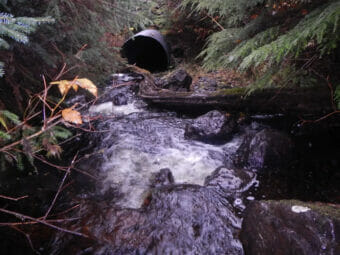
Delegates participate at the 4th Annual Indigenous Leaders Summit in Lummi Nation, Washington last week. (Photo courtesy of SEITC)

Tribes in Southeast Alaska and across the border in Canada have declared an emergency for salmon facing environmental risks. Leaders with the Southeast Alaska Indigenous Transboundary Commission made the announcement at the 4th Annual Indigenous Leaders Summit in Washington last week. The transboundary commission represents 15 Tsimshian, Lingít, and Haida Nations.

They say that Pacific salmon are facing habitat loss and degradation of critical waterways on both sides of the border.

Guy Archibald is the commission’s executive director.

“We’re seeing declining salmon stocks across the board, especially king salmon or chinook,” said Archibald, “and we’ve come to the conclusion that there’s no time to waste.”

At the summit, participants talked about what they experienced at home.

“Our people no longer have salmon running in our streams. Salmon only live in our stories,” said Violet Gatensby, a youth representative from Carcross, Yukon.

Archibald says the commission wants two specific things to come from the salmon emergency declaration. They hope to unify tribes in Alaska and Washington along with First Nations in Canada to strengthen their message. And they want recognition for the traditional territories of Southeast Alaska tribes that run across the border. Archibald says the lands are now in British Columbia and are subject to several large mines – some operating and some that are being proposed.

“Canada has to recognize, you know, those traditional boundaries and give Alaska tribes a real seat at the table on how these mines are developed,” he said.

Archibald gave the example of the Unuk watershed east of Ketchikan, which has several mining projects – like the Brucejack goldmine, the proposed KSM goldmine, and the Eskay Creek Revitalization Project, which is an old gold mine looking to reopen.

Port of Seattle closure could cause cargo delays for Alaska

File photo of Hanjin container ship at the Port of Seattle (Photo by James Brooks/Flickr)
A Hanjin container ship at the Port of Seattle, April 5, 2012. (Creative Commons photo by James Brooks)

The Port of Seattle shut down its cargo operations June 10 due to labor conflicts, and the Port of Alaska says it could affect the state. About 90% of Alaska’s goods arrive by ship or barge, and most of that comes via Seattle.
Jim Jager is a spokesperson for the Port of Alaska in Anchorage.

“Any impact on shipping out of Seattle-Tacoma area is going to have an impact on Alaska, just because we’re getting all of our goods there, or the vast majority,” he said.

Jager says half of the goods barged to Alaska stay in Anchorage, and the other half gets distributed throughout the state — including heading back south to communities in Southeast.

The details of the shutdown are unclear. The Pacific Maritime Association, which represents terminal operators, blames the labor union — the International Longshore and Warehouse Union — for the shutdown. The labor union denies its worker strike is causing the port’s closure.

Jager says the extent of the impact on Alaska won’t be known for a while. But he says it will likely be more of an inconvenience, like minor delays of goods getting onto shelves. He says the bulk of the slowdown is in international cargo, so it probably won’t be a huge hit to Alaska.

“I don’t think it’ll get terrible,” he said. “But you know, it all depends on your line of work. If you’re worried about getting food from the grocery store, yeah, we’ll get most of this stuff. On the other hand, if you’re in a business that relies on something that’s coming from Asia, you know, if you’re saying if you have a production plant that needs some part that’s coming out of Asia — you may have a real problem coming up.

Jager stresses that it’s important for Alaskans to not panic shop as some did buying products like toilet paper during the pandemic. That could only make things worse.

“It took six months to sort of get out of that — that whipsaw action of the supply chain,” Jager said. “Could that happen? You bet it could. Will it happen? Oh, I bet with some goods it does.”

As for the strike itself, Jager says there are different unions in Alaska, and it won’t affect port workers here.

Want to help Alaska biologists log migratory fish? There’s an app for that

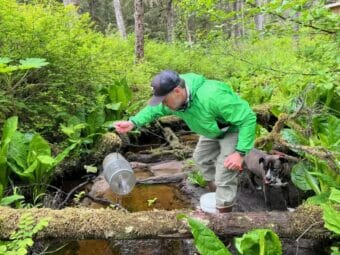
U.S. Forest Service fish biologist, Eric Castro, along with his dog, Redden, checks a minnow trap in a tiny stream in Petersburg’s Sandy Beach Park. (Photo by Angela Denning/CoastAlaska)

A warming climate has scientists wanting to know, more than ever, what’s living in Alaska’s rivers and streams — specifically, what species live in the anadromous freshwater streams where migratory fish return from saltwater to spawn. Biologists and others are hoping that a new phone app will encourage Alaskans to help map these fish habitats.

Alaska has over 46,000 miles of shoreline—more than the rest of the country combined. Sandy Beach in Petersburg is one tiny sliver of it. It’s a popular park with a playground and shelters for picnics. A creek cuts a shallow channel across the sand into Frederick Sound. In late summer, it fills with pink salmon heading in to spawn.

Away from the beach and a few steps into the park’s tree line, there is a tiny tributary of the creek. That’s where I meet Eric Castro, a fish biologist with the U.S. Forest Service.

“This is an uncharted stream as far as the Forest Service has on our records,” Castro said.

Castro is here to use the new Fish Map App to catalog what’s in the water. The app supplies a form that anyone can fill out to nominate fish they find. If approved, the fish will be added to the Alaska Anadromous Waters Catalog. This tiny stream is not recognized in the federal database at all. The state’s catalog lists it, but not all the species living here.

Castro wants to add cutthroat trout to the state’s list because he’s seen them here before. So, he’s set up a few minnow traps.

“I figure we can try this out and see what we get,” he said.

The Alaska Department of Fish and Game has categorized over 21,000 anadromous waterways since the 60s. The listing for Southeast Alaska is nearly 600 pages.

“It’s a massive data set,” said Joe Giefer, who manages the state’s Anadromous Waters Catalog.

Although the catalog includes all major systems in the state, Giefer says there is no way to cover all of the smaller streams. He hopes the phone app will get others to document fish they see in streams while out in the field too.

“There’s a lot of water in Alaska,” Giefer said. “There’s a lot of remote areas.”

Giefer says the catalog data is used by local, state, and federal agencies and provides protections from possible development projects. So the more data that’s added to the catalog, the better.

Minnow traps like Castro’s take permits. But Giefer says documenting adult fish would be very useful too, like those found spawning.

“There’s probably spawning, good spawning habitat all over the place,” Giefer said. “But nobody’s physically there, nobody’s physically [seen] salmon spawning, just because of the remote nature of a lot of these water bodies.”

That’s where local knowledge can help, says Aaron Poe with the Alaska Conservation Foundation. He coordinates the phone app, which is supported by a large partnership of federal, state, tribal, and nonprofit groups. They started testing the app last year and hope to get more users involved.

“Local folks really do know best where the anadromous fish are,” Poe said. “So whether that’s Indigenous knowledge that dates back for millennia, or whether that’s local knowledge from families that grew up in a region or some combination of both, those folks really know where the fish are.”

Poe says there is increased interest in what fish are where, because of climate change.

“Essentially, we’re having some of these anadromous fish, whether they’re salmon or white fish, or other species that are starting to move into other areas of the state,” he said.

The Aleut Community of Saint Paul Island, created the Fish Map App through its Indigenous Sentinels Network, which runs about a dozen apps.

Hannah-Marie Garcia, with the Saint Paul tribe, says they wanted to provide a useful tool to document ecosystem shifts. Saint Paul is 300 miles offshore in the Bering Sea. So, they also wanted to make sure it was usable in remote areas. Garcia says the app doesn’t require Internet.

“If they don’t have Wi Fi or cell signal, it just stays on the device,” said Garcia, “until they then can come to a place — maybe they’re back in town or, you know, they’re back from the fishing ground or the back from wherever they were hiking to go find that stream, when they finally have signal they can then upload to the database, after the fact.”

Back at Sandy Beach Park, Castro pulls a minnow trap from a shaded pool underneath a log. Soon two young girls push through the brush along the bank.

“We’ve been spotted!” Castro said.

The girls ask what we’re doing.

Castro told them we’re doing some minnow trapping and look at this.

He transfers two juvenile fish — a cutthroat trout and a coho salmon — into a bucket to the “oohs” and “ahhs” of the small crowd.

“Cool” they said.

“So these fish right here are living in this water in this little teeny stream, Crazy huh?” Castro said.

“Yeah!”

“Did you know that there were fish in the stream?” I asked them.

“NO!”

Later, Castro uses the phone app to fill out a nomination form including all kinds of information—location, weather, and details about the stream and fish. First, the nomination will be checked by Garcia’s Indigenous Sentinels Network before going to the state for confirmation. That can take months. The state updates its catalog once a year.

Last year — the app’s first year — produced 13 nominations. The app advocates hope to receive thousands more in the future. There is an incentive too. For people who take the time to fill out a nomination for a local stream, they’ll receive $100.

Find out more about the fish-mapping app at the program’s website.

Yak Timber files for bankruptcy after its parent company, the village corporation, is sued for $13M

This Yak Timber logging at Humpback Creek is controversial because the site is culturally and historically significant, according to the Yakutat Tlingit Tribe, Central Council of Tlingit and Haida Indian Tribes of Alaska, and Sealaska Corporation. (Photo/Defend Yakutat)

A timber company owned by Yakutat’s village corporation has filed for bankruptcy this month after a bank sued the corporation over $13 million in outstanding debts. It’s the latest chapter in the story of a contentious logging operation that many of the corporation’s shareholders didn’t support.

Yak Timber filed for bankruptcy on May 11. In a letter to shareholders the next day, the village corporation, Yak-Tat Kwaan, said they filed “only after exhausting all efforts to negotiate a resolution” with the bank.

Yakutat’s tribal government, Yakutat Tlingit Tribe, says the lawsuit is further dividing a town that was already stressed — many residents didn’t agree with the logging operation in the first place. Andrew Gildersleeve is the Tribe’s executive director. He says above all, there is grief.

“The matter itself is almost like a broken piece of glass, with so many edges it’s impossible to pick up without getting cut,” Gildersleeve said. “There’s a shock of what’s happened to tribal lands and disbelief that there could be a claim of the size against an organization that is ultimately run by our friends, family and neighbors.”

Washington bank vs. Yak-Tat Kwaan

The lawsuit, brought by AgWestFarm Credit, alleges that Yak Timber owes the Washington-based bank about $13.3 million in unpaid loans. The suit was filed in U.S. District Court in Seattle on March 31.

“Where did all that money that they borrowed go?” asks shareholder Cindy Bremner. She’s also the former CEO of the corporation and Yakutat’s current mayor. She says shareholders have a lot of questions the corporation won’t answer. It’s straining relationships in the small town of 600.

“We live in a small town — we’re all related,” she said, “and it’s caused quite a divide between those on that board, and then pretty much the rest of the shareholders.”

The suit says the corporation hasn’t made payments since the middle of 2022. The bank is seeking repayment, interest, and attorney’s fees. It lists equipment along with timber, proceeds, and property as collateral.

In a letter to shareholders on April 7, corporation leadership said their board “is united in every possible effort to address the allegations.”

Shari Jensen, the corporation’s CEO said in a written statement that they had no comment for this story. But as recently as October, Jensen told CoastAlaska that paying back the loans wouldn’t be a problem after they sell Yak Timber’s logging equipment.

“Banks don’t lend money to broke companies, they just don’t,” Jensen said. “And, you know, we had a business plan. And they bought into it.”

A large barge is one of the assets the bank AgWestFarm Credit is seeking in its lawsuit against Yak Timber. (Photo/Defend Yakutat)

A controversial project

The Yak-Tat Kwaan corporation was formed in the early 70s after the Alaska Native Claims Settlement Act took effect. The federal law exchanged Indigenous land rights for money, divvying up the remaining land among a few hundred village corporations. Those corporations are charged with making a profit for their shareholders.

The Kwaan created its timber subsidiary in 2018 to harvest 21 million board feet of timber on its land. It logged about three-quarters of that, shipping nearly 4,000 log trucks worth of wood to China.

As Yak Timber pursued different logging projects, opposition grew among shareholders. Some wanted the corporation to seek other resource revenue, such as carbon credits. Eventually, Yak Timber announced last fall that it would sell off its assets.

But the company continued to harvest timber at a place called Humpback Creek, which the local and regional tribal governments say is culturally and historically significant.

They, along with the regional corporation Sealaska, have requested Yak Timber stop logging there.

Shareholders take action in court

The corporation faces a lawsuit from shareholders as well. Some are worried that their land could be lost as collateral for their debt. Amanda Bremner is a cousin to the mayor.

“I am incredibly concerned not just for the risk to existing land, but for what this means for the future of our company and all of our shareholders,” she said.

Yak Timber logging at Humpback Creek. The creek is outside of Yakutat in Southeast Alaska. (Photo by Cindy Bremner)

Amanda Bremner and another shareholder, Jay Stevens, co-chair the Yaakwdáat Latínx’i Coalition that is seeking a change. Their lawsuit, filed on May 9 in Anchorage Superior Court, asks the court step in and force the corporation to hold an election for all nine seats on the board. Yak-Tat Kwaan hasn’t held an election in a couple of years, which led to a state fine.

Amanda Bremner says taking the corporation to court was a difficult decision, but many shareholders share her goals.

“To see our corporation flourish and thrive and be successful and ethical and rooted in Indigenous value and to have business practices reflect that,” she said.

Seattle-based law firm Cairncross and Hempelmann is representing the bank. In an email, they said their client did not want to comment.

In a separate court filing, April 7, the bank seeks to repossess a tug and barge they loaned Yak Timber for $3.3 million in January of 2022. Later, on May 5, they asked the court to ban the corporation from moving the barge, saying it was uninsured. The corporation has disputed this and filed its own motions.

Yak Timber has its own lawsuit playing out. It filed a suit November 18 accusing Bethel Environmental Solutions, an Alaska Native-owned environmental consulting firm, of owing them $443,912 for charter services.

Fishing guides at a Petersburg lodge charged with over 50 violations

Pacific Halibut caught in Cook Inlet in June 2010. (Creative Commons photo by Jlikes2Fish)

Four fishing guides at a Petersburg lodge are being charged by the State of Alaska with over 50 violations. The four men were working for Rocky Point Resort in 2019 and 2020.

All of the charges are misdemeanors involving illegal fishing for halibut. Halibut is strictly regulated with a limited quota for commercial and sports fishermen, and the harvests must be documented.

State and federal officers were involved in the investigations, including undercover officers posing as fishing clients. The officers say they saw 62-year-old Gregory Wasik and 59-year-old Kristopher Thomas break several laws — taking too many customers, too many halibut, using too many fishing lines, throwing out small halibut to keep larger ones, and throwing out halibut that had been gaffed or hooked for bringing the fish onboard. The state also says the guides did not accurately document the halibut their clients caught.

Wasik is being charged with 17 counts for violations in June of 2019.Thomas faces 25 counts for violations in June and August of 2020.

The state is charging 43-year-old Charles King, known as “Nik,” with 10 counts for underreporting halibut caught by his clients in the summer of 2020. John Robert Snyder is being charged with two similar counts for violations in August of 2020. Snyder’s age was not listed in the court documents.

Some of the halibut involved were what’s known as guided angler fish. That’s a halibut quota sold by commercial fishermen to guided sports fishermen through a federal catch-sharing program.

Even though federal investigators were involved, there are no federal charges at this time. NOAA fisheries spokesperson Dominic Andrews said in an email that they are currently investigating and cannot comment.

Rocky Point Resort has been owned by a Petersburg family since 1984 and offers guided and unguided fishing. The person who answered the phone at the resort Monday said she didn’t know about the charges and said no one else was there to comment.

The arraignment for all four guides is set for May 31 at 10 a.m. at the Petersburg Courthouse.

The state’s prosecuting attorney is Ronald Dupuis with the Office of Special Prosecutions in Anchorage. He was unavailable for comment.

Forest Service asks Southeast Alaskans to help make 10-year plan for the Tongass

Rainbow near the Wrangell Narrows. (Photo by Angela Denning/CoastAlaska)

The U.S. Forest Service is asking the public to get involved in creating a 10-year forest management plan for the Tongass National Forest in Southeast Alaska.

The federal agency will be holding in-person workshops, virtual webinars and community gatherings through June.

The project is called the Southeast Alaska Sustainability Strategy, Forest Management — SASS-FM, for short.

Paul Robbins Jr. is a spokesperson for the Forest Service. He talked with CoastAlaska’s Angela Denning about the public engagement effort. He says the federal agency is working from the ground up.

Listen:

Here is a link to the project’s comment box.

Paul Robbins Jr.: In the past, the way the Forest Service worked, right, is we would come out with a 10-plan. And we would be open to public comment. But it would be public comment on a 10-year plan that the Forest Service created. In this case, there is no plan. We’re asking, instead of commenting on a plan we made, that the public help us make the plan. The overall goal is for us to work with our tribes, partners and communities to put together the full range of forest management activities, and complete them in a way that meets the greatest diversity of public needs. That would be the goal of SASS-FM. And we’re excited to get started. And we hope as many people as possible, come out and talk to us and take part in this process.

Angela Denning: What would you ideally like to see with this public engagement process?

Paul Robbins Jr.: Well, we have a couple of different things that we’re trying to get out of it, right. So we want all the organizations that I mentioned to tell us what they want to see from forest management on the Tongass. What are the outcomes that they want to see for themselves and their communities and, and their organizations. And then we also have a separate ask in there of identifying specific projects and locations where we can work collaboratively to get things done. SASS-FM, Southeast Alaska Sustainability Strategy Forest Management, that’s a big term, right? That is all about integration, integrated work, multiple resource activities down to one effort to reach ecological, economic and cultural benefit. So we want them to talk about what the overall outcomes they want to see. We also want to know specifically where and what they want us to do as far as forest management. And we also are taking comments and put on our what we call our assessment tool, which is a list of drafted criteria of what would move a project potentially to the top of our priority list for that 10-year plan.

Angela Denning: Can you give me some examples of projects that might be included in this?

Paul Robbins Jr.: Well, under forest management, you’re talking everything from thinning, which is, you know, harvesting of trees and a stand for the overall health of the ecosystem and the health of the trees that are supposed to be there to watershed restoration, wildlife habitat enhancement, road building, there’s so many factors that go into what we do for forest management on the Tongass because we’re a multiple use forest. On the second ask, we’re actually asking for specific projects. What work do you want us to do? And where? And how can we do it to where we’re getting multiple resource activities done at once, and the most beneficial way possible?

Angela Denning: So you’re taking public input in these kind of live public meetings, but also people can contribute just by themselves online?

Paul Robbins Jr.: You know, the public meetings, like the first 10 minutes or so is going to be us giving a presentation on what this effort is because not everybody, you know, will see the press release or the stories or we’re hearing so we definitely got to break it down. And then the majority of the meeting is just us answering questions and helping them work through this story map tool for submission, where we’re trying to keep it all focused in it’s very easy to use an effective tool to take in all this information.

Angela Denning: Okay, how long do you think this process is going to last? Like, how far out are you scheduling?

Paul Robbins Jr.: Right now, we’re looking to do this all the way through the end of June and could go longer than that because I mentioned the tribal consultations, which are a legal requirement and we’re going keep doing this until all of those are done. But we’re hoping around June 30 is when we can be wrapping up most of this.

Site notifications
Update notification options
Subscribe to notifications